Skip to content

Posts tagged ‘Software-as-a-Service’

Roundup of Big Data Forecasts and Market Estimates, 2012

From the best-known companies in enterprise software to start-ups, everyone is jumping on the big data bandwagon.

The potential of big data to bring insights and intelligence into enterprises is a strong motivator, where managers are constantly looking for the competitive edge to win in their chosen  markets.  With so much potential to provide enterprises with enhanced analytics, insights and intelligence, it is understandable why this area has such high expectations – and hype – associated with it.

Given the potential big data has to reorder an enterprise and make it more competitive and profitable, it’s understandable why there are so many forecasts and market analyses being done today.  The following is a roundup of the latest big data forecasts and market estimates recently published:

  • As of last month, Gartner had received 12,000 searches over the last twelve months for the term “big data” with the pace increasing.
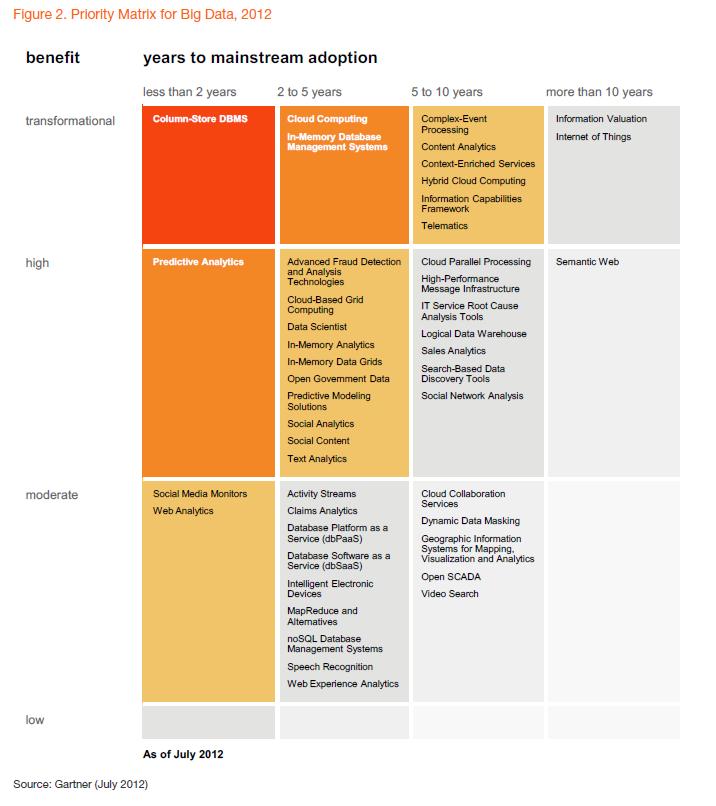
  • In Hype Cycle for Big Data, 2012, Gartner states that Column-Store DBMS, Cloud Computing, In-Memory Database Management Systems will be the three most transformational technologies in the next five years.  Gartner goes on to predict that Complex Event Processing, Content Analytics, Context-Enriched Services, Hybrid Cloud Computing, Information Capabilities Framework and Telematics round out the technologies the research firm considers transformational.  The Hype Cycle for Big Data is shown below:

  • Predictive modeling is gaining momentum with property and casualty (P&C) companies who are using them to support claims analysis, CRM, risk management, pricing and actuarial workflows, quoting, and underwriting. Web-based quoting systems and pricing optimization strategies are benefiting from investments in predictive modeling as well.   The Priority Matrix for Big Data, 2012 is shown below:
  • Social content is the fastest growing category of new content in the enterprise and will eventually attain 20% market penetration.   Gartner defines social content as unstructured data created, edited and published on corporate blogs, communication and collaboration platforms, in addition to external platforms including Facebook, LinkedIn, Twitter, YouTube and a myriad of others.
  • Gartner reports that 45% as sales management teams identify sales analytics as a priority to help them understand sales performance, market conditions and opportunities.
  • Over 80% of Web Analytics solutions are delivered via Software-as-a-Service (SaaS).  Gartner goes on to estimate that over 90% of the total available market for Web Analytics are already using some form of tools and that Google reported 10 million registrations for Google Analytics alone.  Google also reports 200,000 active users of their free Analytics application.  Gartner also states that the majority of the customers for these systems use two or more Web analytics applications, and less than 50% use the advanced functions including data warehousing, advanced reporting and higher-end customer segmentation features.
  • In the report Market Trends: Big Data Opportunities in Vertical Industries, the following heat map by industry shows that from a volume of data perspective, Banking and Securities, Communications, Media and Services, Government, and Manufacturing and Natural Resources have the greatest potential opportunity for Big Data.

  • Big data: The next frontier for innovation, competition, and productivity is available for download from the McKinsey Global Institute for free.  This is 156 page document authored by McKinsey researchers is excellent.  While it was published last year (June, 2011), if you’re following big data, download a copy as much of the research is still relevant.  McKinsey includes extensive analysis of how big data can deliver value in a manufacturing value chains for example, which is shown below:

Gartner Releases Their Hype Cycle for Cloud Computing, 2012

Enterprises are beginning to change their buying behaviors based on the deployment speed, economics and customization that cloud-based technologies provide.  Gartner cautions however that enterprises are far from abandoning their on-premise models and applications entirely for the cloud.

Based on an analysis of the Gartner Hype Cycle for Cloud Computing, 2012, the best results are being attained by enterprises that focus on a very specific strategy and look to cloud-based technologies to accelerate their performance.  Leading with a strategic framework of goals and objectives increases the probability of cloud-based platform success. Those enterprises that look to cloud platforms only for cost reduction miss out on their full potential.

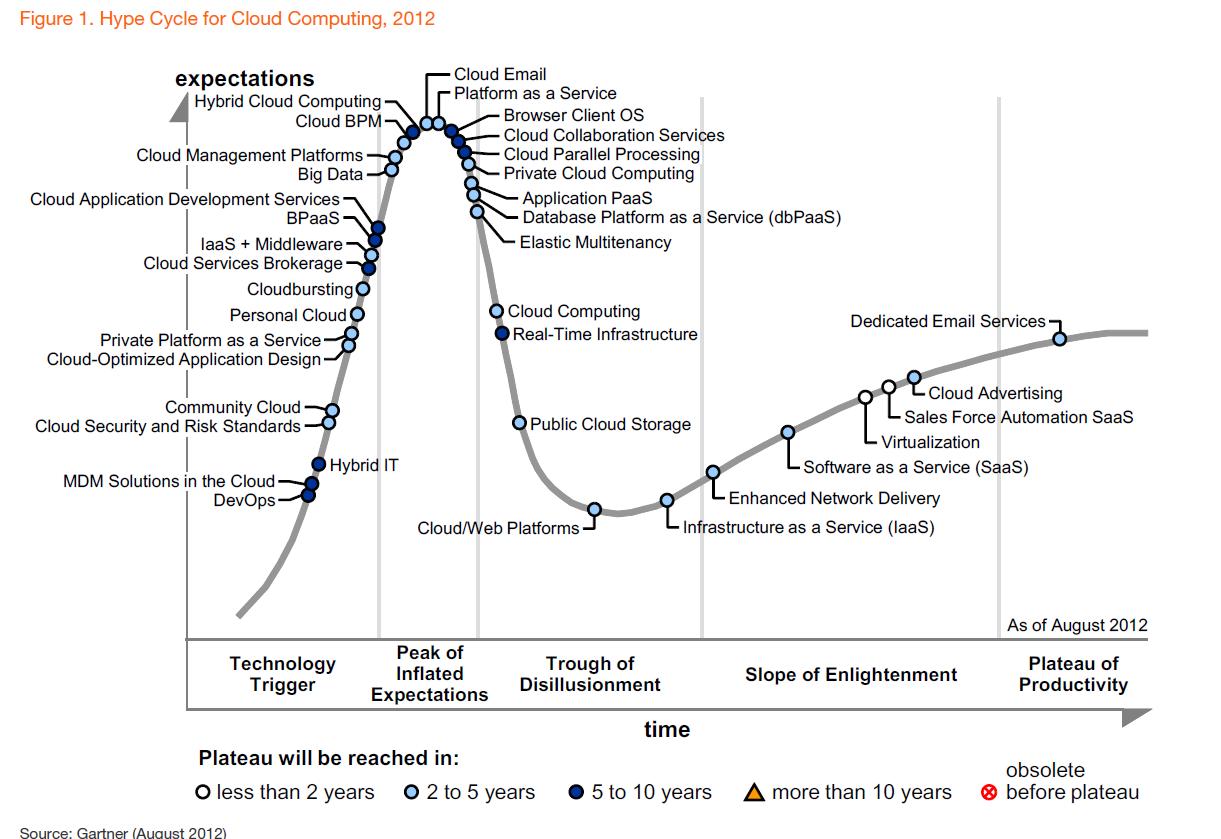
The Hype Cycle for Cloud Computing, 2012 is shown below:

Cloudwashing and Inflated Enterprise Expectations

While the hype surrounding cloud computing may have peaked, cloudwashing continues to cause confusion and inflated expectations with enterprise buyers.  This just slows down sales cycles, when more straightforward selling could lead to more pilots, sales and a potentially larger market. Cloud vendors who have the expertise gained from delivering cloud platforms on time, under budget, with customer references showing results are starting to overtake those that using cloudwashing as part of their selling strategies.

Additional take-aways from the Gartner Hype Cycle for Cloud Computing include the following:

  • Cloud Email is expected to have a 10% adoption rate in enterprises by 2014, down from the 20% Gartner had forecasted in previous Hype Cycles.  This represents modest growth as the adoption rate of this category had been between 5 and 6% in 2011.
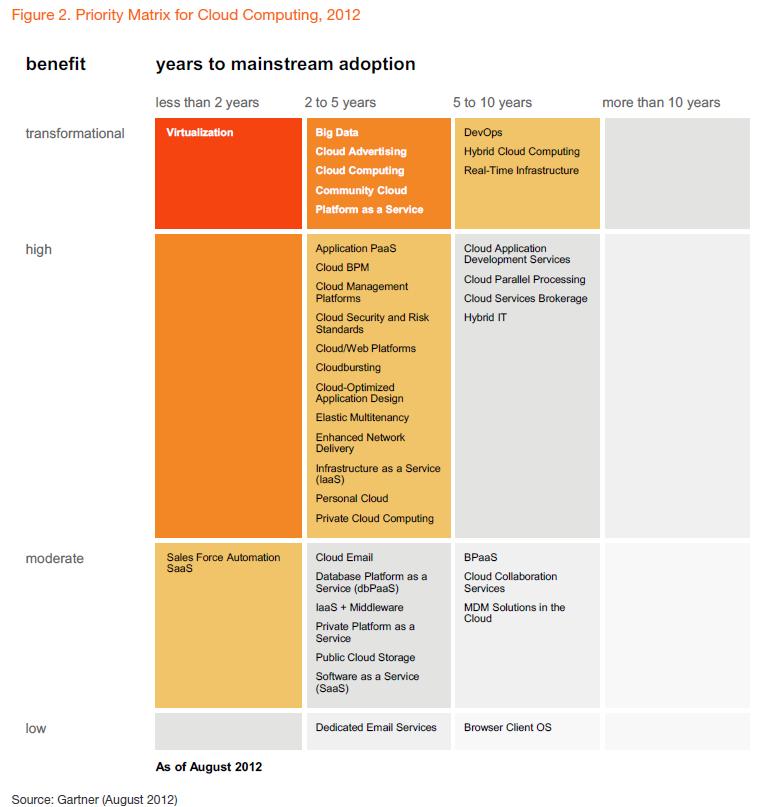
  • Big Data will deliver transformational benefits to enterprises within 2 to 5 years, and by 2015 will enable enterprises adopting this technology to outperform competitors by 20% in every available financial metric.  Gartner defines Big Data as including large volumes processed in streams, in addition to batch.  Integral to Big Data is an extensible services framework that can deploy processing to the data or bring data to the process workflow itself. Gartner also includes more than one asset type of data in their definition, including structured and unstructured content.  The Priority Matrix for Cloud Computing, 2012 is shown below:

  • Master Data Management (MDM) Solutions in the Cloud and Hybrid IT are included in this hype cycle for the first time in 2012.  Gartner reports that MDM Solutions in the Cloud is getting additional interest from Enterprise buyers as part of a continual upward trend of interest in MDM overall.  Dominant vendors in this emerging area include Cognizant, Data Scout, IBM, Informatica, Oracle and Orchestra Networks, are among those with MDM-in-the-cloud solutions.
  • PaaS continues to be one of the most misunderstood aspects of cloud platforms.  The widening gap between enterprise expectations and experiences is most prevalent in this market.  Gartner claims this is attributable to the relatively narrow middleware functions delivered and the consolidation fo vendors and service providers in this market.
  • By 2014 the Personal Cloud will have replaced the personal computer as the center of user’s digital lives.
  • Private Cloud Computing is among the highest interest areas across all cloud computing according to Gartner, with 75% of respondents in Gartner polls saying they plan to pursue a strategy in this area by 2014.  Pilot and production deployments are in process across many different enterprises today, with one of the major goals being the evaluation of virtualization-driven value and benefits.
  • SaaS is rapidly gaining adoption in enterprises, leading Gartner to forecast more than 50% of enterprises will have some form of SaaS-based application strategy by 2015.  Factors driving this adoption are the high priority enterprises are putting on customer relationships, gaining greater insights through analytics, overcoming IT- and capital budget-based limitations, and aligning IT more efficiently to strategic goals.
  • More than 50% of all virtualization workloads are based on the x86 architecture. This is expected to increase to 75% by 2015.  Gartner reports this is a disruptive innovation which is changing the relationship between IT and enterprise where service levels and usage can be tracked.

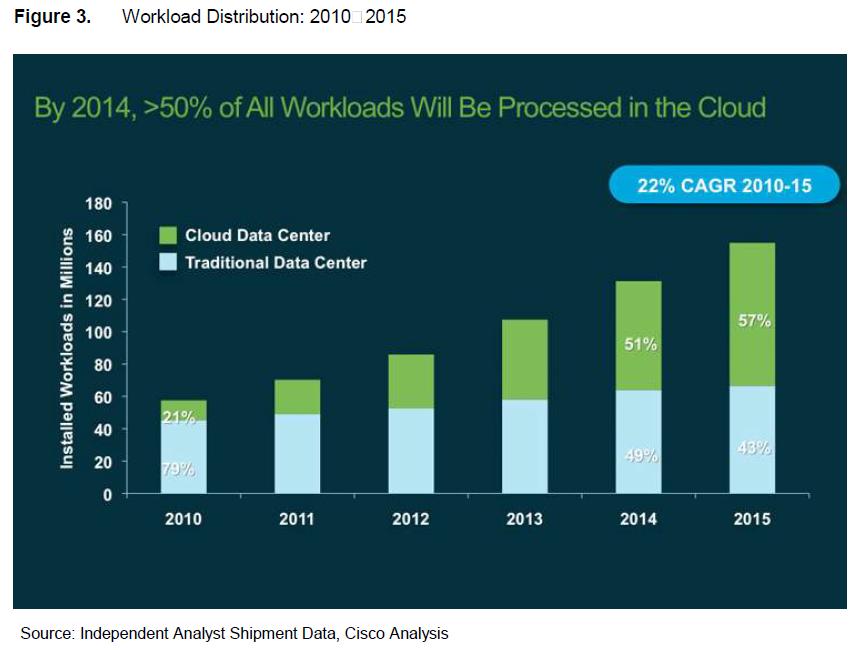
Bottom line: Gartner’s latest Hype Cycle for Cloud Computing  shows that when cloud-based platforms are aligned with well-defined strategic initiatives and line-of-business objectives, they deliver valuable contributions to an enterprise.  It also shows how Infrastructure as a Service (IaaS) and Platform as a Service (PaaS) are the catalysts of long-term market growth.  The following slide from the presentation  High-Tech Tuesday Webinar: Gartner Worldwide IT Spending Forecast, 2Q12 Update: Cloud Is the Silver Lining (free for download) also makes this point.

Gartner Hype Cycle for CRM Sales, 2012: Sales Turns to the Cloud for Quick Relief

Sales VPs for years have been test-driving SaaS-based CRM systems, piloting them with sales teams to see if using them leads to higher sales and greater customer retention.  Marketing VPs and Chief Marketing Officers (CMOs) also continue to pilot SaaS-based web analytics and marketing automation applications.

What’s been missing from these pilots is the ability to bring CRM, marketing automation, sales management and web analytics systems into existing enterprise IT architectures just as fast.  This is changing quickly.  CRM vendors have been quick to respond to the challenge, offering Application Programmer Interfaces (APIs), integration adapters, connectors and from larger vendors, integrated bus architectures.

What the Hype Cycle for CRM Sales, 2012 Means

CRM’s real value is in unifying an entire enterprise based on its ability to sell, serve and retain customers better than before. Gartner shows this is a high priority for its CRM clients by underscoring which technology and application areas of the hype cycle are responding to his market dynamic, and which aren’t.

This Hype Cycle also reflects the urgency I hear from Sales VPs who want to get in control of the complex compensation, quota, territory management, job appraisal and sales coaching responsibilities they have.  While each of these areas is essential, many companies, even those in enterprise software, have ignored these areas, allowing them to stay manually based. Gartner calls this area Sales Performance Management (SPM) and shows it has the highest benefit of all SaaS-based sales management applications in the next two years. Gartner’s analysis captures the time shortage that Sales VPs I know are facing; they have to get to high quota levels while also managing a diverse set of leadership responsibilities as well. The Hype Cycle for CRM Sales, 2012 (G00234919) is shown below:


  • Gartner estimates 35% of all CRM implementations today use SaaS, growing to over 50% by 2020 according to their projections. In 2011, more than $5 billion was invested in sales applications.
  • Cloud adoption varies significantly across CRM software categories with Web analytics achieving 95% adoption, Sales Force Automation achieving just over 50%, and Configure Price Quote (CPQ) achieving 40%.  Cloud-based Sales Performance Management has the highest compound annual growth rate (CAGR) of any CRM category according to inquiry and client calls.
  • Sales, Customer Service, Social CRM and Marketing are the four fastest-growing areas of enterprise Sales applications on SaaS.  Campaign Management is increasingly quickly, up from 19% using SaaS in 2010 to 29% in 2011.
  • Gartner sees significant growth in Configure Price Quote (CPQ), projecting a market of $300M in 2012, up from $240M in 2011.  Gartner is due out with a MarketScope on CPQ shortly, where the 15 major vendors it tracks in this area will be ranked.  40% of existing implementations are on SaaS, and that proportion is increasing relative to licensed versions.  Of the 15 vendors in this market, 12 have announced SaaS-based versions of their applications.
  • There are 3.8M Sales Force Automation SaaS users globally today.
  • By 2017, 25% of companies adopting CRM will have extended their customer service contact centers to include social media including Facebook, Twitter and other emerging online communities.  As of 2012, Gartner is seeing only 1% of companies integrate social media into their companies’ departments and workflows to ensure a consistent customer experience.
  • Price Optimization will experience transformational growth in two to five years. Gartner sees this area as one of the most promising across all CRM Sales as can be seen in the Priority Matrix for CRM Sales 2012 below from the Hype Cycle for CRM Sales, 2012.  The research firm has defined this market as including price analysis, price optimization and price execution.  Gartner estimates this market was $180M to $190M in 2010.  Vendor competing in this market include Accenture, Deloitte, Pros, Vendavo, Vistaar Technologies and Zilliant.

  • Social CRM (SCRM) for Sales is at the Peak of Inflated Expectations, with 90% of spending for these applications being generated from B2C companies.  Gartner expects B2B companies to lead the growth of these applications through 2015, increasing spending from 5% of total SCRM sales in 2011 to 30% by 2015.
  • SaaS-based CRM sales within enterprises are expected to reach $4.48B in 2012, growing to $6.3B in 2015.  The following table from the report Forecast: Software as a Service, Worldwide 2010-2015, 2H11 Update provides a frame of reference for SaaS-based CRM growth overall.

  • Salesforce leads all CRM vendors in market share growth, advancing 2.8% from 2010 to 2011 according to Gartner’s’ global market share analysis shown below. Salesforce attained 26.9% revenue growth from 2010 to 2011 ($1.3B to $1.6B) and 36.7% growth from 2011 to 2012 ($1.6B to $2.27B).  The future momentum of Salesforce is in unifying the enterprise, redefining corporate IT in the context of the customer. Their recent acquisitions show analytics, marketing automation and development platforms are key priorities.  The following table is from the report Market Share Snapshot: CRM Software, 2011 (G00233998).

Bottom line:  Making CRM strategies successful has to start with a common vision and urgency for results.  Both are happening quicker in CRM than ever before, driven by a much clearer understanding of what enterprises need and an impatience for results.

Forecasting Public Cloud Adoption in the Enterprise

The economics of public cloud computing are accelerating the pace of change occurring in enterprise software today.

Many of the scenarios that Clayton Christensen insightfully describes in The Innovator’s Dilemma are playing out right now in many sectors of this industry, shifting the balance of purchasing power to line-of-business leaders away from IT.  True to the cases shown in the book, new entrants are bringing disruptive innovations that are being successfully used to attack the most price-sensitive areas of the market.  Winning customers at the low-end and making their way up-market, new entrants are changing the customer experience, economics and structure of the industry.  Salesforce.com is a prime example of how the insights shared in The Innovator’s Dilemma are alive and well in the CRM market for example.  This is an excellent book to add to your summer reading list.

Defining The Public Cloud

The National Institute of Standards and Technology (NIST) have defined the public cloud in their latest definition of cloud computing in their September, 2011 brief you can download here (The NIST Definition of Cloud Computing). The NIST defines public cloud as “the cloud infrastructure is provisioned for open use by the general public. It may be owned, managed, and operated by a business, academic, or government organization, or some combination of them. It exists on the premises of the cloud provider.”   In addition the NIST defines three models including Software as a Service (SaaS), Platform as a Service (PaaS), and Infrastructure as a Service (IaaS).  Gartner’s definition of public cloud computing is comparable yet includes Business Process as a Service (BPaaS) and Cloud Management and Security.

A quick check of the term public cloud on Google Insights shows the rapid ascent of interest in this area.  A graphic from Google Insights is shown below:

Public Cloud Adoption in the Enterprise 

In the many conversations I’ve had with CIOs and CEOs of manufacturing companies the role of cloud computing comes up often.  There’s a very clear difference in the thinking of CIOs who see their jobs as selectively applying technologies to strategic needs versus those who are focused on compliance and risk aversion.  The former see their enterprises moving to public and hybrid clouds quickly to better integrate with dealers, distributors and suppliers at a strategic level.

The public cloud’s pervasiveness in the enterprise is growing rapidly.  This market dynamic is reflected in the report, Forecast: Public Cloud Services, Worldwide, 2010-2016, 2Q12 Update (ID:G00234814).  Gartner breaks out forecasts into the areas of Cloud Business Process Services/Business Process as a Service (BPaaS), Application Services/Software as a Service (SaaS), Application Infrastructure Services/Platform as a Service (PaaS), System Infrastructure Services/Infrastructure as a Service (IaaS) and Cloud Management and Security Services.  Highlights from the report are presented in the following five areas:

Cloud Business Process Services/Business Process as a Service (BPaaS)

  • Gartner is predicting that BPaaS will grow from $84.1B in 2012 to $144.7B in 2016, generating a global compound annual growth rate of 15%.
  • Of the eight subsegments Gartner is tracking in their BPaaS forecast, Cloud Payments (17.8%) Cloud Advertising (17.1%) and Industry Operations (15.1%) are expected to have the greatest compound annual growth rates (CAGR) in revenues generated by 2016.
  • In terms of revenue generated, Cloud Advertising is projected to grow from  $43.1B in 2011 to $95B in 2016, generating 17.1% CAGR in revenue growth through 2016.
  • Cloud Payments are forecast to grow from $4.7B in 2011  to $10.6B in 2016, generating a CAGR of 17.8% worldwide.
  • E-Commerce Enablement using BPaaS-based platforms is expected to grow from $4.7B in 2011 to $9B in 2016, generating a 13.6% CAGR in revenue globally.

Application Services/Software as a Service (SaaS)

  • SaaS-based applications are expected to grow from $11.8B in 2012 to $26.5B in 2016, generating a CAGR of 17.4% globally.  Gartner tracks ten different categories of SaaS applications in this latest forecast with CRM, ERP, and Web Conferencing, Teaming Platforms, and Social Software Suites being the three largest in terms of global revenue growth.
  • The three fastest-growing SaaS areas include Office Suites (40.7%), Digital Content Creation (32.2%) and Business Intelligence applications (27.1%) having the highest CAGRs from 2011 through 2016.
  • SaaS-based CRM will see the largest global revenue growth of all categories, increasing from $3.9B in 2011 to $7.9B in 2016, achieving a 15.1% CAGR worldwide.
  • Web Conferencing, Teaming Platforms, and Social Software Suites will grow from $2B in 2011 to $3.4B in 2016, generating an 11.2% CAGR.  Gartner is including Enterprise 2.0 applications in this category.
  • SaaS-based ERP is forecasted to grow from $1.9B in 2011 to $4.3B in 2016, achieving a 17.3% CAGR.
  • Supply Chain Management (SCM) is an area that Forrester, Gartner, IDC and others have predicted significant growth in.  Gartner’s latest forecast for SaaS-based SCM is $1.2B spent in 2011 growing to $3.3B in 2016, representing a 21.1% CAGR.

Application Infrastructure Services/Platform as a Service (PaaS)

  • Gartner forecasts the worldwide enterprise market for PaaS platforms will grow from $900M spent in 2011 to $2.9B in 2016, representing a 26.6% CAGR.
  • Growth rates by PaaS subsegment include the following: Application Development (22%), Database Management Systems (48.5%), Business Intelligence Platform (38.9%) and Application Infrastructure and Middleware (26.5%).
  • Application Infrastructure and Middleware is expected to be the largest revenue source in PaaS for the next four years.  Gartner reports this subsegment  generated $649M in 2011, projected to grow to $2.1B in 2016, generating $1.5B in revenue and a 26.5% CAGR.

System Infrastructure Services/Infrastructure as a Service (IaaS)

  • With a projected CAGR of 41.7%, this segment is the fastest growing of the five Gartner included in their public cloud forecast.  From $4.2B in revenue generated in 2011 to $24.4B in 2016, IaaS is expected to grow by just over $20B in the forecast period globally.
  • CAGR by IaaS segment from 2001 to 2016 include Compute (43.2%), Storage (36.6%) and Print (16%).
  • The Compute subsegment is expected to see the greatest revenue growth globally, growing from $3.3B in 2011 to $20.2B in 2016, generating a 43.2% CAGR.

Cloud Management and Security Services

  • Comprised of Security, IT Operations Management and Storage Management, Cloud Management and Security Services generated $2.3B in 2011 with a forecast of $7.9B in 2016, generating a 27.2% CAGR.
  • IT Operations Management (38.2%), Storage Management (30.6%) and Security (23.7%) each have relatively high CAGRs through 2016.

Bottom line:  Of the five areas Gartner includes in their forecast, BPaaS  and its subsegments show trending towards greater support for enterprise-wide transaction and e-commerce management. With 76% of the entire 2012 public cloud forecast being in the BPaaS segment, it is clear Gartner is seeing strong interest on the part of enterprise clients to spend in this area.

The Marketing of Cloud Multitenancy: How Early Adopters Are Killing The Hype

It’s impressive how quickly the teams evaluating CRM cloud-based applications are learning how to deflate the hype surrounding multitenancy.

One gets the impression that hype-hunting has now become a sport in these teams.  In engineering-centric companies it’s a badge of honor to find out just how multitenant a cloud-based application or platform is.  Multitenancy isn’t the only area they are looking at, but given the massive amount of hype surrounding this issue on the part of vendors, it generates more attention because evaluation teams are skeptical.

Teams evaluating CRM applications aren’t satisfied with an easily customized and used graphical interface or series of workflows, they are getting more interested in the architecture itself .  In some cases they’ve been burned by claims of an application being SaaS-based when in fact the architecture is a glorified series of Citrix-like sessions running in the background or worse.  I have seen a healthy amount of skepticism in the evaluations going on right now and recently completed of SaaS applications and entire cloud platforms.  Gartner’s inquiry calls from corporate accounts must be accelerating as their clients look for guidance on how to sort out the multitenancy hype.

CRM, Multitenancy and the Hype Cycle for Cloud Computing

Gartner’s search analytics show that cloud computing and related terms had 29,998 searches in the last twelve months with cloud computing alone generating 10,062 searches.  SaaS and related terms had a search volume of 19,000.  These terms are among the most popular across all Gartner search terms for the last twelve months.  In comparison, CRM had over 42,000 searches in the same period.

It’s in this area of CRM applications where multitenancy has gone into hype overdrive. Looking for differentiators, some CRM vendors are claiming not just multitenancy – but their specific brand of it.  This confuses their prospects, which immediately energizes evaluation teams to do a more thorough job than they have ever done before.  By claiming their own type of multitenancy, CRM vendors are ironically not just slowing down their own sales cycles, they are making the entire industry slow down.  No wonder Gartner places multitenancy along the Peak of Inflated Expectations in the latest Hype Cycle for Cloud Computing which is shown below.

Making Sense of Elasticity and Multitenancy

It’s paradoxical that enterprise software vendors, especially those selling SaaS-based CRM applications,  are attempting to turn multitenancy into a differentiator.  What is needed is a greater focus on usability, flexibility in aligning workflows to specific needs, and better enterprise integration technologies.  Sell the value not the product features.

Given the confusion differentiating on multitenancy is creating and the calls Gartner is getting on this issue, they published Gartner Reference Model for Elasticity and Multitenancy.  It includes what Gartner believes a cloud services provider must implement in terms of a multitenant service in addition to what SaaS-based applications need to provide.  Here are their checklists for each area:

Multitenancy Service Requirements for Cloud Services Providers

  • Isolation of tenant data
  • Isolation of the tenant workspace (memory)
  • Isolation of tenant execution characteristics (performance and availability)
  • Tenant-aware security, monitoring, management, reporting and self-service administration
  • Isolation of tenant customizations and extensions to business logic
  • Continuous, tenant-aware version control
  • Tenant-aware error tracking and recovery
  • Tracking and recording of resources use per tenant
  • The ability to allocate resources to tenants dynamically, as needed and based on policy Horizontal scalability to support real-time addition/removal of tenant resources, tenants or users without interruptions to the running environment

Multitenancy in Cloud Application Services (Software as a Service) Applications

  • Be available 24/7, because of the potential global user base
  • Adopt new versions without disrupting the continuous operations of tenants, and preserve user customizations
  • Scale up or down on demand
  • Allow individual rollback and restore for each tenant
  • Not allow a “noisy neighbor” tenant to affect the performance of other tenants, or increase their costs
  • Be accessible from various locations, devices and software architectures to meet potentially global demand
  • Offer tenant-aware self-service

Gartner also released their Reference Architecture for Multitenancy, which is shown below.  One of the key assumptions of this model is that multitenancy is a mode of operation where multiple, independent and secured instances of applications run in a shared environment.  The model includes the seven different models of multitenancy Gartner has seen in their research.  These seven models, listed across the top of the model beginning with Shared Nothing and progressing to Custom Multitenancy are across the top of the model.

The majority of enterprises I’ve worked with are looking to the Shared Hardware approach in an attempt to create backward compatibility to their legacy applications via Virtual Machines. Another area of interest is the Shared Container approach which relies on a separate logical or physical instance of a DBMS, and often isolates its own business logic.  This is ideal for distributed order management systems and SaaS-based ERP systems for example.  Yet the legacy application support in this type of multitenancy can get expensive fast.

Shared Everything Multitenancy is ideal for quickly on-ramping and off-ramping applications, tenants and individual system users and is what nearly all enterprise vendors claim to do.  In reality only a handful do this well.  This approach to multitenancy is based on the Shared Container approach including support for shared DBMS sessions.  Salesforce.com’s Force.com platform, VMWare WaveMaker and Zoho Creator are all examples of companies who have successfully delivered Shared Everything multitenancy.

With so much to gain by positioning an application or solution suite in the 6th and 7th models, vendors are rushing to define their own versions of Shared Everything and Custom Multitenancy.  The land grab is on in this area of the multitenancy market right now.  IBM, Microsoft and Oracle are all expected to endorse and eventually have many of their cloud-based applications in the Shared Everything model.  Each of these companies and many others will have a multi-model based approach to selling multitenancy as well.

Gartner Reference Model for Elasticity and Multitenancy

Source:  Gartner Reference Model for Elasticity and Multitenancy

Bottom line: Enterprise software vendors can accelerate evaluation cycles and sell more by differentiating on the user experience and value delivered instead of trying to create fear, uncertainty and doubt (FUD) by creating their own definition of multitenancy.

What’s Hot in CRM Applications, 2012

Serving the sales force is a mantra and mindset that resonates through the best companies I’ve ever worked with and for.

That priority alone can help galvanize companies who are adrift in multiple, conflicting agendas, strategies and projects.  Uniting around that goal – serving sales and getting them what they need to excel – can turn around even the most downtrodden companies.  And size doesn’t matter, the intensity of focus and commitment to excel  do.

That’s why the latest report from Gartner’s Ed Thompson, What’s “Hot” in CRM Application 2012, published last Thursday resonates with me.  He’s talking about how sales strategies need to be propelled by rapid advances in mobile technology, social CRM, sales content and collaboration, and clienteling to serve the sales force more thoroughly than ever before.  His assessment of what’s hot in CRM is a great foundation for getting behind the mantra of serving the sales force and engraining it into a corporate culture while getting full value from the latest technologies.

Here are the key take-aways from the report:

  • Software-as-a-Service (SaaS) delivery of CRM applications represented 34% of worldwide CRM application spending in 2011.  More than 50% of all Sales Force Automation (SFA) spending is on the SaaS platform.  Gartner clients who are successfully running SaaS are now looking at how to get value from Platform-as-a-Service (PaaS) in the context of selling strategies.
  • CRM spending grew 13% in 2011, fueled analytical, operational and social CRM growth.  Operational CRM represents 80% of all CRM spending and grew 10% in 2011.
  • Analytical CRM, in which Gartner includes predictive analytics and market segmentation analysis, grew a solid 10% in 2011 and is having a very strong year with inquiry traffic.
  • Social CRM grew 30% in 2011 in revenue terms and is 7% of total CRM spending globally as of 2011.   90% of Social CRM spending is originating in Business-to-Consumer (B2C) organizations with the remaining occurring in B2B.
  • Gartner is projecting that CRM will be one of the top three search terms on Gartner.com throughout calendar 2012 based on the trends and volume of calls they are seeing today.
  • CEOs see CRM as their #1 technology-enabled investment in 2012 according the query calls through April, 2012.
  • CRM is ascending rapidly in the priorities of CIOs in 2012, moving from 18th place to eight place  in the latest Gartner analysis.
  • The following table of Highest CRM Application Priorities, 2012 show what’s trending within Sales, Customer Service, E-Commerce and Marketing inquiries Gartner is receiving from its clients.  Consider these as leading indicators of interest.  Over time these areas will need to solidify for forecasts to be completed.
  • Apple iPads are the great maverick buy of 2012 with thousands being purchased by Sales and Marketing management with the immediate requirement of IT integration to these devices.   IT departments are scrambling on the security issues and lack of polices on BYOD.  In enterprise software, iPads are proving to be highly effective as demo platforms for new SaaS-based applications.  They have become the new sales bag of the 21rst century.
  •  High Tech, Life Sciences and Insurance are the three industries with the greatest levels of iPad adoption as of April 2012.  Gartner is predicting that by the end of 2012, 80% of all sales representatives in the pharmaceutical industry will be using iPads for their daily sales tasks.
  • Social or community customer service is the hottest area of growth for post-sales service with high-tech, media, travel, telecommunications, retail and education-based clients dominating client inquiries.

Roundup of SaaS ERP Forecasts and Market Estimates, 2012

The latest round of SaaS ERP market forecasts are more grounded in the reality of CIO priorities and committed projects in 2012 than ever before.  And this is good news for the many vendors competing in the Financial Management Systems (FMS), Human Capital Management (HCM) and Manufacturing segments of the SaaS ERP market.

Two weeks ago in Houston I interviewed twenty-five different CIOs, IT Directors, CEOs and CTOs as part of a persona research study I am doing.  Their take on SaaS ERP was consistent with what this round-up shows, namely this type of SaaS application is best suited for extending beyond, not replacing, the main ERP systems and platforms.   I concentrated on SaaS ERP adoption in manufacturing and learned the following during my interviews:

  • Usability and speed of deployment are the two most common benefits CIOs mentioned in my survey during Convergence.  The economics of cloud computing is a topic that CFOs love to talk about, especially in the areas of value-based pricing and how that is determined.
  • When asked what kept them up at night, CIOs said it was the thought of a call from their boss (often the CFO) that a cloud system had been compromised or had completely gone down.  Security and reliability are holding back CIOs in manufacturing from adopting SaaS-based ERP systems more pervasively in their companies.
  • CIOs from aerospace and defense companies get the benefits of cloud computing, yet they have much bigger issues to deal with right now, like replacing financials in their existing ERP system and staying in compliance to government requirements.  Earned Value Management is a major focus they have as well.  SaaS-based ERP systems are interesting to them; they however would require a completely enclosed, locked-down implementation due to security requirements.
  • There are vast differences in how CIOs view cloud computing – something that the following forecasts don’t really capture.  For the CIOs who are strategists, cloud computing in general and SaaS ERP specifically is a consideration given the agility and time-to-market, providing customization is held to a minimum.  CIOs who came up through IT have a healthy degree of skepticism and see SaaS ERP as potentially useful for scaling out an operation yet never being the primary financial system.

Here are the latest SaaS ERP forecasts and market estimates:

  • Gartner released their latest SaaS revenue forecast last week predicting revenue will reach $14.5B this year, a 17.9% increase from 2011 of $12.3B, with strong growth predicted through 2015 when the market is expected to be $22.1B. Source: http://www.itjungle.com/tfh/tfh040212-story08.html
  • In the report Market Trends: Cloud Computing and SaaS Adoption in Manufacturing and Natural Resources, Worldwide, 2012 Gartner is predicting  59% of manufacturers will adopt IaaS during the 2011 – 2015 timeframe and 47% will be either piloting or using SaaS-based applications.  Gartner cites the need for greater business and supply chain agility as the factors driving this rapid adoption.  The following figure is from the Gartner report  Market Trends: Cloud Computing and SaaS Adoption in Manufacturing and Natural Resources, Worldwide, 2012.
  • Forrester forecasts SaaS ERP spending staying at 2% of the global ERP market, while Gartner forecasts 7% through 2012.  Gartner is projecting Project and Portfolio Management (29.1%) and Supply Chain Management (22.1%) will see the greatest growth rates through 2015.  Supply Chain Management is expected to reach $2.7B in revenue by 2015.  The Total Software Revenue Forecast for SaaS Delivery Within Enterprise Software is shown in the following table.  Source: Forecast: Software as a Service, Worldwide, 2010-2015, 1H11 Update Published: 22 June 2011 Analyst(s): Sharon A. Mertz, Chad Eschinger, Tom Eid, Chris Pang, Laurie F. Wurster
  • Gartner, IDC and Forrester all predict that Human Capital Management (HCM) will see the broadest adoption of all SaaS-based ERP components through 2015.  Vendors in this category include ADP, Concur, Cornerstone onDemand, HumanConcepts, Infor, Kenexa, Lumesse, Saba, SilkRoad, Sonar6, SuccessFactors, SumTotal Systems, Taleo, Ultimate Software and Workday.  Based on a recent Gartner Spending and Usage of SaaS Survey, 39% of manufacturers are piloting or using SaaS-based financials followed by 37% using Expense Management.The following figure illustrates their forecast, from the report  Market Trends: Cloud Computing and SaaS Adoption in Manufacturing and Natural Resources, Worldwide, 2012
  • Gartner’s IT Market Clock for ERP Platform Technology indicates that multitenant SaaS-based ERP is maturing rapidly, driven by time-to-market and cost advantages. The IT Market Clock is shown below, indicating SaaS ERP-based systems position relative to other ERP platforms now in use.  Vendors including  Epicor Express Editions, Glovia, Kenandy, NetSuite, Plex Systems, and SAP Business ByDesign compete in this segment.Source: IT Market Clock for ERP Platform Technology, 2011 Published: 19 September 2011 Analyst: Jim Shepherd.

Gartner has also compiled a Market Clock Recommendation Summary which is shown in the following table.  Of the CIOs I’ve spoken with during the persona research, the description of Multitenant SaaS is accurate.  No CIO I’ve spoken with is willing to bet their job on a rip-and-replace strategy for SaaS ERP; yet many are willing to extend their existing ERP systems using SaaS implementations to get up and running quickly at lower cost.  The one caveat nearly everyone mentions is little or no customization is necessary for SaaS ERP systems to be even evaluated by their companies.  Slight configuration is expected; however in-depth customization is not.

Bottom line: The persona research completed shows that the SaaS-based ERP growth is being helped by the transition occurring in the CIO ranks today.  More of them are strategists, who are expected to make business strategies happen, over and above just keeping the system dial tone on in their enterprises.

Roundup of Cloud Computing Forecasts and Market Estimates, 2012

The latest round of cloud computing forecasts released by Cisco, Deloitte, IDC, Forrester, Gartner, The 451 Group and others show how rapidly cloud computing’s adoption in enterprises is happening.  The better forecasts quantify just how and where adoption is and isn’t occurring and why.

Overall, this year’s forecasts have taken into account enterprise constraints more realistically  than prior years, yielding a more reasonable set of market estimates.  There still is much hype surrounding cloud computing forecasts as can be seen from some of the huge growth rates and market size estimates.  With the direction of forecasting by vertical market and process area however, constraints are making the market estimates more realistic.

I’ve summarized the links below for your reference:

  • According to IDC, by 2015, about 24% of all new business software purchases will be of service-enabled software with SaaS delivery being 13.1% of worldwide software spending.  IDC further predicts that 14.4% of applications spending will be SaaS-based in the same time period. Source: http://www.idc.com/getdoc.jsp?containerId=232239
  • The cloud computing marketplace will reach $16.7B in revenue by 2013, according to a new report from the 451 Market Monitor, a market-sizing and forecasting service from The 451 Group. Including the large and well-established software-as-a-service (SaaS) category, cloud computing will grow from revenue of $8.7B 2010 to $16.7B in 2013, a compound annual growth rate (CAGR) of 24%. https://451research.com/
  • Forrester forecasts that the global market for cloud computing will grow from $40.7 billion in 2011 to more than $241 billion in 2020. The total size of the public cloud market will grow from $25.5 billion in 2011 to $159.3 billion in 2020. Link to report excerpt is here.
  • Deloitte is predicting cloud-based applications will replace 2.34% of enterprise IT spending in 2014 rising 14.49% in 2020.  The  slide below  is from an excellent presentation by Deloitte titled Cloud Computing Forecast Change downloadable from this link.

  • Gartner predicts Small & Medium Business (SMB) in the insurance industry will have a higher rate of cloud adoption (34%) compared to their enterprise counterparts (27%).  Gartner cites that insurance industry’s opportunity to significant improve core process areas through the use of technology.  The following figure from the report, 2011 SMB Versus Enterprise Software Budget Allocation to Annual Subscriptions indicates the differences in software budget allocation for annual subscriptions by vertical market from the report:

2011 SMB Versus Enterprise Software Budget Allocation to Annual Subscriptions

  • Gartner is predicting that the cloud system infrastructure (cloud IaaS) market to grow by 47.8% through 2015. The research firm advises outsourcers not moving in that direction that consolidation and cannibalization will occur in the 2013 – 2014 timeframe  The providers named most often by respondents were Amazon (34%), SunGard (30%) and Verizon Business (30%). Of the global top 10 IT outsourcing market leaders, only CSC appears on the list. Source: User Survey Analysis: Infrastructure as a Service, the 2011 Uptake  Claudio Da Rold,  Allie Young.

External Service Providers Being Considered for IaaS (or Cloud IaaS)

How Cloud Computing And ERP Mobility Are Reordering Gartner’s Hype Cycle for ERP

A good friend of mine recently became CIO of a financial services firm and was given his first major project last month: make the complete accounting, financial, and loan provider data and applications available 24/7 on any iPad or Android-based tablet from any office, at any time.

The majority of loan provider applications are cloud-based and his company is running NetSuite.  His corporate office is in Asia and cloud-based applications made it possible for the company to launch and operate in California within months.   He’s been given six months to transform this mobile vision into reality.

Another CIO of a major A&D manufacturer I recently visited wants vendors to challenge him more to get greater value from his investments in legacy data and ERP systems. Using ERP to run batch reports alone has nearly caused project schedules to slip, so the focus internally is on real-time system integration of project management and accounting systems.  He’s also been given the task of revamping accounting and financial systems by October, 2012, and they just started late last year.

Gartner’s Hype Cycle for ERP 

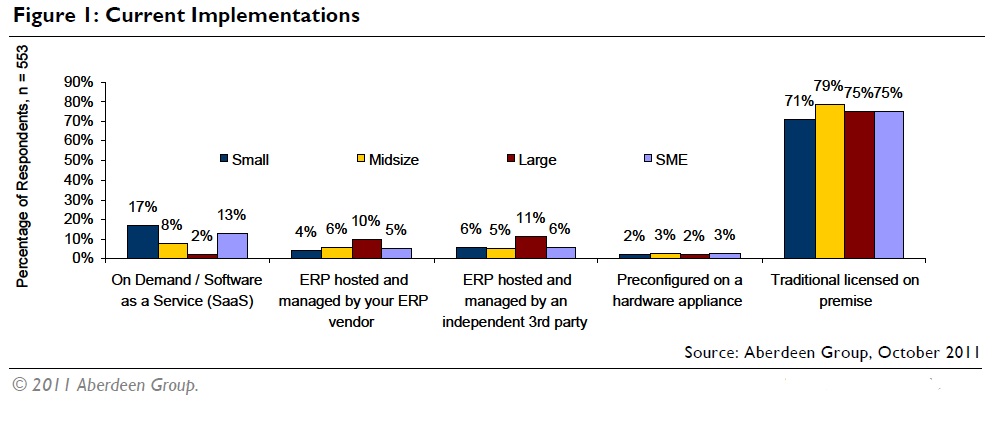
Considering these two extremes in the context of the Gartner Hype Cycle for ERP (shown below) and the recent report SaaS and Cloud ERP Trends, Observations, and Performance 2011  (free for download until January 9, 2012) published by Aberdeen last month several take-aways emerge.

  • CIOs are under increasing pressure in 2012 to enhance, modify even replace existing ERP systems while standardizing technology across the enterprise at the same time.  The most risk-averse way around this is to add applications to single instance ERP backbone systems, with analytics and Business Intelligence (BI) being the among the most in demand.
  • Cloud-based ERP in the Enterprise and Small & Medium Businesses (SMB) are accelerating along the Hype Cycle faster than Gartner indicates.  Enterprises are using Cloud-based ERP systems as part of their two-tier ERP system strategies due to the Total Cost of Ownership (TCO) and time-to-deploy advantages, and the flexibility of tailoring everything from user interfaces to workflows to their specific requirements.  Highly specialized Cloud-based ERP suites including those from Plex Systems are gaining traction due to their expertise in specific industries and the compliance-related challenges inherent within them. In SMBs, the cost and time-to-deploy are two major drivers with concerns over security being the biggest impediment to growth.  Gartner reports that they are seeing Cloud-based ERP adoption fastest in companies with fewer than 200 users overall.
  • Cloud-based ERP systems most often considered in industries that have high variable costs, rapid transaction cycles and tend towards higher Return on Invested Capital (ROIC).  Based on the research SaaS and Cloud ERP Trends, Observations, and Performance 2011 the industries who are the most willing to consider Cloud-based ERP versus on-premise are Financial Services (22% SaaS versus 44% on-premise); Healthcare (42% SaaS versus 58% on-premise); and Professional Services (56% SaaS versus 58% on-premise).
  • Large companies (over $500M in annual revenue) using Cloud-based ERP systems are opting for hosted deployments managed by their ERP vendor (10%) or an independent 3rd party (11%), with just 2% relying on a SaaS platform. Aberdeen defined small organizations as those with annual sales under $50M, midsize organizations having annual sales of $50M – $500M. The following is from SaaS and Cloud ERP Trends, Observations, and Performance 2011:
  • ERP mobility will be a dominant force from the shop floor to each sales call where quotes, orders and contracts deliver real-time order and pricing updates.  How a given manufacturer chooses to sell is even more important than what they sell in many industries. Equipping manufacturing, quality assurance, production scheduling, procurement and sales to have immediate data on what’s going on with orders, customers and suppliers is critical.  For the sales and service teams, real-time data is the fuel they run on.  There’s a chronic time shortage in many, many companies right now, and bringing greater ERP mobility from the shop floor to the sales call will increasingly be seen as a means to lessen the time crunch.  2012 is the year where mobility gets real across the enterprise with solid performance numbers being generated as a result.  For companies with large sales forces and service organizations, integrating to key ERP systems to gain real-time data will quickly lead to increased sales and higher gross margins on service and warranty repairs.
  • Gartner predicts that by 2015 enterprises who are successfully using extreme information management strategies (Big Data) will outperform competitors in their industry sectors by 20% in every available financial metric.  The following is the Priority Matrix for ERP, 2011 showing what Gartner believes to be transformational technologies and strategies in ERP.

Analytics, Cloud Computing Challenge Flat Growth in Forrester’s Tech Market Outlook for 2012

It’s time to strip away the hype surrounding analytics, big data and cloud computing by asking how these technologies contribute  to excellent customer experiences and greater customer engagement.  Those are the real catalysts of market growth and the greatest disruptive forces at work in enterprise software today.

Filtering forecasts of future technology adoption with a customer experience and engagement mindset is essential for separating hype from reality.  Two excellent blog posts were published today that provide useful insights for doing this.  Ray Wang’s Monday’s Musings: 10 Mega Business Trends To Watch For In 2012 provides pragmatic, insightful analysis of the progression going on from transactional to personal fulfillment systems.  Many of the CIOs I’ve met with in the last two months are saying exactly what Ray has written regarding this transition.   Paul Greenberg’s CRM 2012 Forecast – The Era of Customer Engagement – Part I delivers more insight than any of the financial or industry analyst reports I’ve read in the last twelve months on CRM and its intersection to social networks.  He has defined customer engagement so thoroughly I am sure this post will be a classic, referenced for years to come.  Both posts provide an excellent framework to evaluate the upcoming wave of new forecasts due out from research firms at the start of 2012.

Having recently read Forrester’s US Tech Market Outlook For 2012 and applying the concepts Ray Wang and Paul Greenberg discuss, here are several take-aways from that report:

  • Total U.S. ICT market in 2011 was $962B with the majority being generated from software sales ($208B) followed by Telecom Services ($199B) and IT Consulting and Systems Integration Services ($188B).  The following graphic illustrates the purchase of ICT product and services in the U.S. during 2011.  As enterprise software companies are striving to deliver what Ray Wang is calling Experiential Systems, the majority of their core Intellectual Property (IP) was obtained from building Transactional Systems.  Despite this conflict, software development methodologies including Agile give the industry a fighting chance at growth in 2012.
  • Software continues to dominate both in total revenue ($208B) and growth rate, with 8.2% growth projected for 2012.  In addition to analytics and Business Intelligence (BI), Forrester is predicting an increase in ERP, Middleware and SaaS-based application growth.
  • Forrester is most optimistic in their forecasts for analytics, BI, Cloud Computing and Smart Computing.  Cloud Computing forecasts at Forrester are indexed to sales levels of NetSuite, RightNow Technologies (Oracle), Salesforce.com, and Ultimate Software.  Forrester is claiming these four vendors will generate a 23% increase in revenues in calendar Q1, 2012 over Q1, 2011, increasing and staying constant at 24% year-over-year growth from Q2 to Q4, 2012 relative to Q2 to Q4,  2011. Salesforce.com could accomplish this level of growth through acquisitions alone. They’re showing they can integrate newly acquired companies faster than Oracle, who they are challenging for global CRM market leadership in the 2012 – 2013 timeframe.  When customer experience and engagement is taken into account, the forecast seems high.  Salesforce knows how to translate trial users into customers.  The question is can they do this fast enough in 2012 throughout the enterprise and mid-tier accounts to keep up their sales growth on track while reducing churn and increasing profitability.
  • Smart Computing is defined by Forrester as platform technologies including specialized analytics, BI, service-oriented architecture (SOA) infrastructure, virtualization software, rules engines, and awareness-based technologies.  Forrester is very optimistic about this area with a growth rate second only to cloud computing. Its index of the market is based on Informatica, Pegasystems, and Tibco Software.  Forrester is predicting in calendar Q1, 2012 there will be 16% growth over Q1, 2011, followed by consistent 13% growth year-over-year for Q2 to Q4, 2012 relative to 2011.  The following graphic compares growth of both Cloud Computing and Smart Computing.

  • The inflexion point of Smart Computing will happen when analytics, BI and awareness-based technologies including RFID can be used to make customer experiences consistently positive and drive cultural change throughout a business to center on customers’ expectations.  Paul Greenberg refers to this area of customer engagement in his blog post.  I agree with him and see the real value of analytics not for reporting, but for being a barometer of just how customer-centric and focused on delivering exceptional customer experiences a company is becoming.
  • In 2012, financial services, professional services, and manufacturing will be the three industries that dominate software purchases.  Financial services (19%), professional services (15%) and manufacturing (14%) will be the largest buyers of enterprise software.  Forrester believes that ERP replacements, supply chain management (SCM) and product lifecycle management (PLM) will all be proprieties in the coming twelve months.

Bottom line: Critiquing high growth technologies based on their contribution to customer experience, engagement and the creation of Customer Lifetime Value (CLV) is what matter most. Hopefully the new wave of forecasts for 2012 and beyond will take the customer – not just technology and statistical extrapolations – into account.