Skip to content

Posts tagged ‘Software-as-a-Service’

Transactions and Complex Selling: Strong Catalysts of Cloud Computing Growth

Enterprise software vendors need to challenge themselves to deliver significantly more value if the potential for cloud computing is going to be achieved .

Instead of just going for the low-end, easily customized processes within analytics, CRM, supply chain management, ERP, pricing or service, vendors need to take on the more challenging, complex hard-to-solve problems enterprises have.

As I am completing more research on personas, I’m finding what CIOs really look for in SaaS apps.  Flexibility and ease of workflow support, intuitive user interface design without sacrificing functionality, and support for analytics, business intelligence and knowledge management systems integration are all mentioned often.

Nearly all of them also mention that the existing generation SaaS applications on the sell-side, from CRM to order capture and order management aren’t taking on the more challenging areas of their strategies.  The result is the CIOs are still relying on legacy, on-premise apps in areas of their companies that are ready for change to SaaS-based applications.  Cloud platforms are taking on these more complex, challenging problem areas, yet innovation still lags the needs in the market.

Transactions Are The Fuel of Cloud Infrastructure Growth  

CIOs are focusing on how to exceed the expectations of their internal customers at the workflow and interface level while infusing SaaS apps with analytics, business intelligence and knowledge management support.  What’s missing is the killer transaction platform layer and transaction-based applications.  Gartner’s report, A Workforce Without Humans: Three Ways Technology Will Eliminate Skilled Jobs in the U.S. Through 2020 by Kenneth F. Brant by Johan Jacobs has the following graphic which shows CIO’s estimates of migration to cloud-based IT infrastructure and applications which supports this point.

Source: Maverick Research: A Workforce Without Humans: Three Ways Technology Will Eliminate Skilled Jobs in the U.S. Through 2020 by Kenneth F. Brant by Johan Jacobs

Much of the report is based on the results of Gartner’s 2011 survey of U.S. CIOs. Additional insights from the survey include the following:

  • Virtualization and cloud computing are the two top-ranked U.S. CIO technology priorities for 2011.
  • 83% of U.S. CIOs estimated that more than half of their transactions would be conducted on a cloud infrastructure by 2020.
  • 79% of the respondents predicted that more than half of their transactions would be completed on applications leased using the SaaS platform by 2020.

For cloud infrastructure platforms and SaaS applications to deliver that level of transaction volume and support, there needs to be a major shift in how enterprise vendors develop software. Making better use of analytics, business intelligence and knowledge in the enterprise is key. Designing applications that make information and knowledge sharing intuitive is critical.

The following figure from the same report cited earlier shows the relationship of technologies to potential business value.  Many CRM and sell-side vendors tend to focus on being a substitute or just barely delivering increases in human productivity.

Going after the hard work of optimizing pricing strategies, call centers, making multichannel selling strategies profitable and getting the most out of social networks to make the customer experience exceptional will deliver major gains in productivity.  It’s been my experience during the persona interviews that for any SaaS vendor to really excel here they need to get beyond human productivity and make it possible for enterprises to deliver exceptional customer experiences daily.

Creating SaaS applications that take on real complexity earns trust too, which no amount of pure efficiency can compete with.

Source: Maverick Research: A Workforce Without Humans: Three Ways Technology Will Eliminate Skilled Jobs in the U.S. Through 2020 by Kenneth F. Brant by Johan Jacobs

An Example: SaaS in Manufacturing

The following table compares the strategies and systems used in a typical manufacturing company.  Enterprise apps vendors for the most part are focused on make-to-stock and assemble-to-order automation and efficiency (SAP ByDesign for example).

As the continuums move from left to right, the process, systems and strategy challenges exponentially increase.  As a result there are only a few vendors who can manage the more complex engineer-to-order requirements in manufacturing for example. Transactions there are very small in number, yet orders of magnitude more profitable.  This is just an example of many areas in enterprises that need major improvement.

Instead of just focusing on the easy processes and strategies on the left, vendors need to go after the more difficult, complex selling and transaction challenges on the right.  This is why CIOs want SaaS applications that are easy to customize from a user interface and workflow standpoint, while at the same time supporting analytics, BI and knowledge management.  The goal is to slot them into these more challenging areas of their business and transform their company’s intelligence and expertise into profitable growth.

Bottom line: The true catalyst of cloud computing growth isn’t just SaaS economics; it’s how effectively enterprise software vendors address the very difficult transaction, order management and selling challenges their potential customers face all the time. When that happens, the many optimistic forecasts of cloud adoption in the enterprise will take a step closer to being fulfilled.

How Analytics and Business Intelligence Are Accelerating Enterprise Cloud Adoption

During the last few weeks of completing a research project on buyer personas, a key finding of of just how quickly enterprises are switching out legacy reporting apps for SaaS-based analytics and Business Intelligence (BI) is emerging.

I’ve been interviewing sales VPs, sales operations directors, contract managers and CIOs. Of all these groups, the CIOs are providing valuable insight into the transition SaaS is going through in their enterprises.

Throughout this post I’ll correlate the interviewed CIOs’ comments back to a recent report Forrester published titled Understanding The Business Intelligence Growth Opportunity by Holger Kisker, Ph.D.  Dr. Kisker’s findings support many of the insights gained from the research on personas completed to date.

Key Points from Persona Interviews and Forrester Study

  • 80% of enterprises will complement on-premise analytics and BI systems with SaaS-based applications by 2014 according to Forrester.  From the persona study I am working on, the cut-over is going to be much more abrupt.  50% or less of companies will most likely have on-premise applications in place by 2014, as SaaS-based analytics and BI applications provide business users with the information they need when they need it.
  • iPads running analytics and BI apps with lenders’ data in real-time are the new bling in financial services.  One CIO who recently was recruited to a financial services firm told me he quickly picked out the other C-level execs in the room – they all had iPads running analytics apps with live customer data.  One of his first projects: make that happen for the sales teams with a policy app.  Everyone I’ve spoken with on this research study tells me being able to get to their analytics data on an Android or Apple iOS device is critical for their build-out plans.
  • The greatest concerns the CIOs continue to have with SaaS are data integration to legacy systems and lack of security standards.  Despite these concerns one CIO summed it up well and said “We really don’t have a choice, the legacy reporting apps are too high maintenance, don’t integrate to our new workflows well – we need a new reporting platform, so we are piloting a SaaS-based analytics app right now.”
  • The high cost of maintaining legacy reporting applications, integrating them to the latest Microsoft, Oracle or SAP databases, and preserving tribal knowledge are factors pushing CIOs to adopt SaaS-based analytics and BI apps.  One of the CIOs is with a government subcontractor who has Airbus, Boeing, Sikrosky Aircraft as their largest clients explained how dashboards are manually generated in Excel, taking weeks and often being inaccurate.  To comply with contracts they must move to a faster reporting process.  Using SaaS-based analytics in pilots have trimmed the time for creating dashboards from weeks to hours.
  • Cloud integration and security are the skill sets these CIOs are hiring for right now.  A quick analysis from Google Insights shows the rapid ascent of cloud integration as a search term. While Insights doesn’t provide demographics, the persona interviews underscore this trend.
  • Analytics and BI data integration wins are setting the foundation for more complex system migrations in the future.  Bank of America, Citibank and other financial institutions have client-side systems that are outpacing legacy systems’ ability to analyze and make use of the massive amount of inbound data they provide.  Implementing cloud integration projects successfully, in conjunction the successful launch of more scalable SaaS-based analytics and BI applications sets the foundation for migrating even more complex systems.  The Forrester Report Understanding The Business Intelligence Growth Opportunity included the following graphic with further underscores this point.

Bottom line: The lessons learned from migrating analytics and reporting from legacy to SaaS-based analytics and BI applications, combined with the need to have customer and market intelligence on mobile devices, is leading to rapid changes in this market.

SaaS-based Analytics and Business Intelligence Market Update, August 2011

Challenging, uncertain economic times accelerate sales cycles and lead to more closed deals for business intelligence software providers.  Companies get an urgency to reduce costs and risks, relying on the insights gained from these applications.

There’s an interesting dichotomy starting to emerge in how experts and analysts define just how these markets will mature however.  Both agree that economic uncertainty are growth catalysts yet they diverge on adoption rates, roadblocks, and which analytics and BI technology will dominate in the years ahead.

This week I read Balancing Custom And Packaged Apps In Your Application Portfolio Strategy by George Lawrie, Mike Gilpin and Adam Knoll from Forrester and the latest Hype Cycle of Business Intelligence, 2011 by a collection of Gartner authors led by Andreas Bitterer.  I’ve summarized the key points of each below.

Forrester Sees SaaS Applications Overtaking Custom Application Development

Forrester sees SaaS-based applications starting to replace in-house custom application development, gathering momentum through 2013.  Gartner, with their Hype Cycle for Business Intelligence, 2011 just released this week, shows BI platforms having greater near-term benefit than SaaS-based analytics and BI.  Custom application development projects are going to face continued pressure to keep up with business requirements that SaaS applications are proving able to handle more effectively and economically than ever before.

In-house development makes more sense for specific analytics and reporting requirements,  yet will continually be eroded by SaaS-based applications that can meet most requirements at a lower cost.  Forrester has in the past said SaaS-based adoption of analytics applications in general and predictive applications specifically would be very slow due to data integration challenges.  This study points to a potential shift in their mindset, as the data shows SaaS-based analytics beginning to replace custom in-house developed applications.

Here are the key take-aways from the report:

  • Analytics processes are supported 79% of the time with custom application development.  Procure-to-pay (33%) and record-to-report (33%) are the second-most supported.  Multiple responses were allowed in the survey.
  • When asked which process areas they are automating with SaaS, analytics (33%), record-to-report (18%), order-to-cash  (15%), and purchase-to-pay (12%) were the most common responses.  There was a small sample size on the Forrester report and the most startling insight was how quickly respondent companies plan to migrate from custom application development to SaaS-based analytics and BI.
  • Nearly 50% of the respondents to the Forrester survey have between five and 19 SaaS-based applications today with 18% expecting to have 35 or more by 2013.  In addition 63% of respondents expect to deploy between five and 34 SaaS-based applications by 2013, a significant shift in just two years.
  • 36% of survey respondents say their  SaaS applications run completely standalone.  Another 36% mention they use a combination of on-premises Master Data Management (MDM) and process integration tools.  Ironically only 3% are deploying their applications on cloud-based MDM or process integration-based platforms.

Gartner’s Hype Cycle for Business Intelligence, 2011

Unlike the hype cycle for cloud computing, this hype cycle has fewer technology categories (25), a narrative firmly grounded in business process and strategy, and more practical and pragmatic insights versus just theoretical.  At 50 pages it’s  quick read and while there are many excellent points made, I have summarized the key take-aways pertaining to the highest hype points and SaaS adoption below:

  • Mobile Business Intelligence (BI) is the latest entry to the Hype Cycle for Business Intelligence based on the massive hype around analyzing locational and application data.  The hype surrounding the Apple iPad Series, Google Android and other tablet and smartphone platforms has made this one of the most hyped areas of the last year according to the analysis.
  • Consumerization, Decision Support, analysis of non-traditional data and “Big Data” are the areas of the greatest innovation today.  The hype cycle points to search, mobile, visualization and data discovery being the catalyst of Consumerization.  Predictive analytics, which is on the Slope of Enlightenment on this latest hype cycle, is critical to decision support.  The non-traditional and “Big Data” area of innovation is further supported by content, text analytics, in-memory DBMSs and columnar DBMSs.
  • SaaS-based Business Intelligence is at the apex of the Peak of Inflated Expectations yet will continue to have low adoption rates.  Gartner believes that the  lack of trust in third parties managing confidential data, and the inertia and fear many companies have in moving to a new architecture are slowing adoption.  This is in contrast to the survey Forrester released this week showing analytics being one of the most popular SaaS-based applications planned by 2013 in their base of respondents.
  • Gartner sees SaaS-based Business Intelligence of the most value to midsize and smaller organizations who lack IT staff yet have very specific, targeted information needs.  Website analytics, social media monitoring, dashboards, predictive analytics and Excel as a BI front-end all apply.  Both Forrester and Gartner agree on this point and see this type of custom development going away quickly internally.
  • There is a massive amount of hype surrounding in-memory computing, particularly from SAP at its Sapphire conferences .  Gartner believes that SAP’s vision of in-memory computing exceeds  in-memory analytics to include analytical and transactional processing.  As a result, In-Memory Database Management Systems are at the Peak of Inflated Expectations.


Source: Hype Cycle for Business Intelligence, 2011, Published 12 August 2011 | ID:G00216086 By Andreas Bitterer.  Gartner, Inc.

What Both Agree On

Forrester’s survey shows SaaS eventually replacing custom application development while Gartner’s Hype Cycle for Business Intelligence shows the practical, pragmatic technologies including dashboards, predictive analytics combined with the more complex Business Activity Monitoring (BAM), Business Intelligence Platforms, and Data-Mining Workbenches delivering the most value.  Despite these differences, both agree on the following:

  • The overall market for BI, Analytics and Performance Management continues to grow at between 8 to 12% per year depending on the forecast used.  The following forecast is from the report  Market Trends: Business Intelligence, Worldwide, 2011-2014, 7 June 2011 | ID:G00213483 by Dan Sommer and James Richardson.
Source: Market Trends: Business Intelligence, Worldwide, 2011-2014, 7 June 2011 | ID:G00213483 by Dan Sommer and James Richardson
  • 2011 continues to see large, strategic deals for analytics and BI closing more rapidly than they have in the past.
  • SaaS-based analytics and BI continues to gain a greater share of spending in midsize and smaller companies.  Both also agree that the proliferation of smaller SaaS-based analytics and Bi vendors concentrating on a specific niche have successfully displaced in-house custom development of competitive applications.  Trust in the smaller vendor, their track record, customer references and financial viability are what are winning deals for SaaS-based analytics and BI software providers today.
  • The market transition from build to buy is now in full force as budgets become available again.  This is key assumption of both analyses and means that smaller, more niche-oriented SaaS-based analytics and BI vendors stand a chance to get new reference accounts and grow, despite a challenging economy.

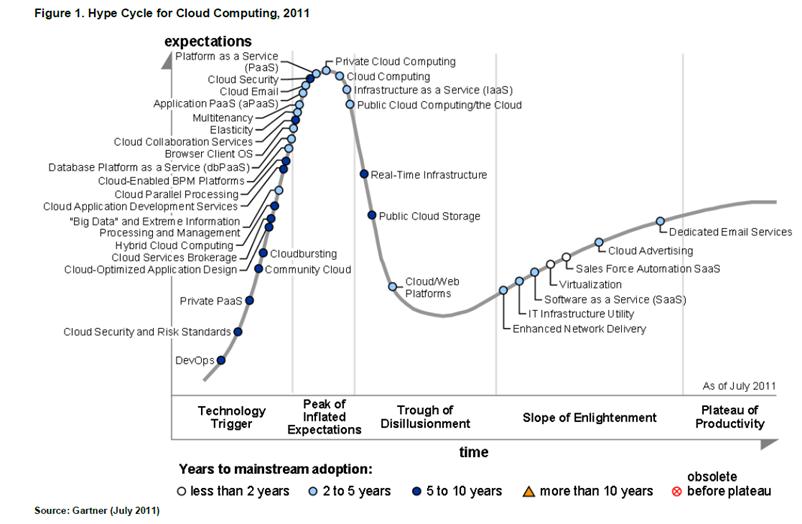
Gartner Releases Their Hype Cycle for Cloud Computing, 2011

Calling the hype around cloud computing “deafening”, Gartner released their annual hype cycle for the 34 different technologies in a 75 page analysis today.  You can find the Hype Cycle at the end of this post and I’ve provided several of the take-aways below:

  • The industry is just beyond the Peak of Inflated Expectations, and headed for the Trough of Disillusionment. The further up the Technology Trigger and Peak of Inflated Expectations curve, the greater the chaotic nature of how technologies are being positioned with widespread confusion throughout markets. The team of analysts who wrote this at Gartner share that conclusion across the many segments of the Hype Cycle.
  • Gartner states that nearly every vendor who briefs them has a cloud computing strategy yet few have shown how their strategies are cloud-centric. Cloudwashing on the part of vendors across all 34 technology areas is accelerating the entire industry into the trough of disillusionment. The report cites the Amazon Web Services outage in April, 2011 as a turning point on the hype cycle for example.
  • Gartner predicts that the most transformational technologies included in the Hype Cycle will be the following: virtualization within two years; Big Data, Cloud Advertising, Cloud Computing, Platform-as-a-Service (PaaS), and Public Cloud computing between two and five years; and Community Cloud, DevOps, Hybrid Cloud Computing and Real-time Infrastructure in five to ten years.
  • There continues to be much confusion with clients relative to hybrid computing.  Gartner’s definition is as follows ”Hybrid cloud computing refers to the combination of external public cloud computing services and internal resources (either a private cloud or traditional infrastructure, operations and applications) in a coordinated fashion to assemble a particular solution”. They provide examples of joint security and management, workload/service placement and runtime optimization, and others to further illustrate the complex nature of hybrid computing.
  • Big Data is also an area of heavy client inquiry activity that Gartner interprets as massive hype in the market. They are predicting that Big Data will reach the apex of the Peak of Inflated Expectations by 2012.  Due to the massive amount of hype surrounding this technology, they predict it will be in the Trough of Disillusionment eventually, as enterprises struggle to get the results they expect.
  • By 2015, those companies who have adopted Big Data and extreme information management (their term for this area) will begin to outperform their unprepared competitors by 20% in every available financial metric. Early use cases of Big Data are delivering measurable results and strong ROI.  The Hype Cycle did not provide any ROI figures however, which would have been interesting to see.
  • PaaS is one of the most highly hyped terms Gartner encounters on client calls, one of the most misunderstood as well, leading to a chaotic market. Gartner does not expect comprehensive PaaS offerings to be part of the mainstream market until 2015.  The point is made that there is much confusion in the market over just what PaaS is and its role in the infrastructure stack.
  • SaaS performs best for relatively simple tasks in IT-constrained organizations. Gartner warns that the initial two years may be low cost for any SaaS-based application, yet could over time be even more expensive than on-premise software.

Bottom line: The greater the hype, the more the analyst inquiries, and the faster a given technology ascends to the Peak of Inflated Expectations. After reading this analysis it becomes clear that vendors who strive to be accurate, precise, real and relevant are winning deals right now and transcending the hype cycle to close sales.  They may not being getting a lot of attention, but they are selling more because enterprises clearly understand their value.

Source: Gartner, Hype Cycle for Cloud Computing, 2011 David Mitchell Smith Publication Date: 27 July 2011 ID Number: G00214915 © 2011

Predicting Cloud Computing Adoption Rates

From conservative, single digit adoption rates to hockey-stick projections of exceptional growth, analyst firms, venture capitalists and government ministries are weighing in on how they see cloud adoption progressing.

While each of the adoption rate predictions vary significantly in terms of their methodologies and results, all rely on the assumption that SaaS applications including CRM will continue to gain momentum.  The user adoption rates vary on how fast the momentum is, yet all share this assumption.  Speed, increased user adoption rates, and the ability to more closely align software to business goals are cited most often as the biggest benefits.

Where the projections vary most is whether enterprises will eventually migrate the majority of their applications to the cloud or not.  Forrester, Gartner and others see a hybrid cloud architecture emerging in the enterprise and forcing the issue of legacy systems migration by 2015.  As would be expected, vendor-driven research sees an “all or nothing” world in the near future.

Sanity Check

Wanting to see how reliable the figures were showing rapid cloud adoption in the enterprise, I did a quick sanity check.  Taking the  distribution of sales by segment for Salesforce.com and their annual revenue growth rate, then normalizing it across all segments, enterprise emerges as their strongest segment by a wide margin in 2015.  It had a 15%+ compound annual growth rate (CAGR) from 2011 – 2015 just taking their current sales by segment distribution of sales and extrapolating forward.  Data points like this and the market factors behind them is why SaaS is often used in these studies as a leading indicator of broader cloud adoption.

Adoption Rate Round-Up

  • Forrester found that SaaS will outgrow all other cloud services, achieving 37% adoption in 2011 growing to 50% by 2012.  In previous studies Forrester has shown that SaaS is a major growth catalyst of ongoing investment in IaaS and PaaS in enterprises. Source: Source:  Forrsights: The Software Market In Transformation, 2011 And Beyond Shifting Buying Preferences Lead To New Software Priorities by Holger Kisker, Ph.D. with Pascal Matzke, Stefan Ried, Ph.D., Miroslaw Lisserman  Link: http://bit.ly/ijJy70  The following table is from the report:

  • Microsoft Global SMB Cloud Adoption Study released in March, 2011 is one of the most comprehensive done this year on this topic. Of the many findings, the study predicts  39 % of SMBs expect to be paying for one or more cloud services within three years).  One of the best studies on cloud adoptions done this year Source: Study Results Document (PDF (22 pages): http://bit.ly/gN8yTx

  • North Bridge Venture Partners, GigaOM PRO and over a dozen research partners completed the study The Future of Cloud Computing 2011.  The study found 13% expressed high level of confidence in cloud computing for enterprise applications, with 40% experimenting and 10% saying they will never use cloud-based platforms as they are too risky. A presentation of the results can be found here:

Source: http://futureofcloudcomputing.drupalgardens.com/2011-future-cloud-computing-survey-results

                                     Microsoft Asia is making this available for download here: http://bit.ly/jWjOj1

  • TechTarget published their analysis of virtualization and cloud computing adoption in the study, State of virtualization and cloud computing: 2011.  Of the many findings, a few of the most significant is how pervasive VMware ESXi 4 and later (vSphere) is throughout enterprises today.  The study also shows that 7% of those interviewed had implemented cloud computing in 2010, growing to 9% in 2011 – quite conservative compared to many of the other adoption rate analyses completed.  You can find the results here: http://searchdatacenter.techtarget.com/feature/State-of-virtualization-and-cloud-computing-2011

Rethinking Cloud ROI from a Customer’s Perspective

Seeing the proliferation of cloud ROI, TCO and cost calculators brings to mind my economics professors who strove with a passion to reduce complex consumer decisions into simple, very powerful formulas.  Like these calculators pervading the market, my economics professors showed a passion for accuracy, precision and measured perfection.

The only trouble is that people, companies and markets defy and will deliberately not conform to an equation, cause-and-effect strategy or series of artificial incentives to get them to change.  If there is one single, loudly reverberating fact in this economy, it is that marketing and selling strategies based on economic theory alone are failing.  The business benefits of cloud computing need to be more integrated into these ROI and TCO calculators to make them relevant.  They need to reflect more of the customers’ needs to be useful.

It’s Time To Bring The Customer and Their Strategies Into The Equation

Of the many white papers, e-books and websites all claiming to translate cloud computing server usage and capacity planning metrics into business benefits, the Open Groups’ white paper published in 2010 delivers useful insights.  The research and analysis was produced by Cloud Business Artifacts (CBA) project of The Open Group Cloud Computing Work Group.  You can find the entire document here.

The following table is from the section on building ROI for Cloud Computing using Key Performance Indicators (KPIs) and Metrics.  While this table is a start, what’s  missing  are more metrics related to the Web customer experience.  There needs to be more measures of whether customer experiences were successful or not by application, and if and how SaaS-based applications contributed to customers’ expectations being exceeded or not.

One of the biggest benefits all ROI and TCO calculators attempt to quantify is speed of cost reduction and time reduction, but what about speed of strategy execution? For many of these online tools, prospects using them would have no idea how their investment will accelerate their goals.  All they see are costs related to the technology.  Not much if any analysis is provided how the technology relates to their strategies being attained more quickly, completely and profitably.

And what about enabling channels to sell more effectively?  Launching products on time, synchronized across online and offline channels and having consistency of messaging, pricing, services – in short the entire user experience– is rarely if ever mentioned.  Ironically the greater the focus on ROI and TCO calculators, the greater the lack of focus on creating a truly exceptional customer experience while attaining complex selling strategies.

It’s time for the industry’s vendors to wake up and realize that they are selling for the most part to nonconformists not robots.  ROI and TCO calculators that don’t reflect what customers really want to accomplish and stay centered on technology alone are missing huge opportunities to sell on value.

Bottom line: The comfort that comes from attempting to take the chaos of a market and crystalize it into an equation is an illusion – the real test of a vendor’s value is being able to navigate customers to their goals using technology when necessary, not as a crutch.

Cloud ROI and TCO Calculators

Amazon Web Services Economics Center  http://aws.amazon.com/economics/

Amazon Web Services Simple Monthly Calculator http://calculator.s3.amazonaws.com/calc5.html

Astadia Cloud Computing ROI Calculator http://www.astadia.com/products-and-services/IT-cloud-transformation/roi/

Azure ROI Calculator (written in Silverlight)  http://azureroi.cloudapp.net/

Commentary: http://social.msdn.microsoft.com/Forums/en/windowsazure/thread/c4155f48-d51f-4c14-b79c-3f8248ac9646

Azure TCO calculator http://www.microsoft.com/windowsazure/offers/

Cloud Business Review – Cloud Migration ROI Calculator http://www.cloudbusinessreview.com/cloud-migration-roi-calculator.html

EMC ROI Analyst (requires opt-in) https://roianalyst.alinean.com/emc/Welcome.do

GetApp Cloud Computing Calculator http://www.getapp.com/cloud-computing-roi-calculator

Google Cloud Calculator http://www.gonegoogle.com/#/company-name

Rackspace Load Balancer Calculator http://www.rackspace.com/cloud/cloud_hosting_products/loadbalancers/pricing/

Salesforce.com Force.com Business Case Calculator (ROI) http://www.salesforce.com/platform/tco/calculator.jsp?d=70130000000EfON&internal=true

Stelligent ROI Calculator http://stelligent-roi.appspot.com/

VMWare ThinApp Calculator http://roitco.vmware.com/ThinApp/

Sources:

Open Group Publishes Guidelines on Cloud Computing ROI http://cloudcomputing.sys-con.com/node/1376952

Private cloud discredited, part 1 http://www.zdnet.com/blog/saas/private-cloud-discredited-part-1/1204?tag=mantle_skin;content

Deciding Which Applications Belong on SaaS

The debate is getting louder by the week about which applications should move to SaaS versus be kept on-premise.  Wanting to it both ways, more and more companies are offering both SaaS and on-premise versions.

A recent report from Forrester, What CEOs Of Small Software Companies Need To Do In 2011 How To Find The Best Opportunities In A High-Growth Market, underscores the debates at enterprise software companies facing this dilemma.

A graphic from the report is shown below and served as the catalyst of the points show here:

  • Decide if your company can afford the revenue and potential profit hit of switching business models.  Vendors selling licensed on-premise systems often have annual maintenance revenue streams that contribute 60% or more of their annual revenues.  This revenue stream  gives companies a cushion to wait out long sales cycles and spend years developing new products.  Enterprise vendors in this position need to set aggressive goals for new sales, development and cultivate a culture of accountability so complacency doesn’t take hold.  With more than 50% of revenues gained often in the first year of the license, this model is very challenging to migrate off of in favor of SaaS.  Conversely, SaaS-based licenses have been known to generate only 20% of contract value the first year.  That’s why many investors tell SaaS start-ups and companies making the transition to get customers to pay multiple years ahead if at all possible.
  • SaaS is ideally suited for highly collaborative, distributed applications that need to match how your customers work.  CRM, Social CRM and its many related segments of the software market, along with enterprise collaboration, knowledge management and communication all fit here.  Reducing churn through greater loyalty to CRM and related applications, in addition to creating vertical market extensions have proven to be great strategies.   SaaS-based ERP, Supply Chain Management (SCM), Warehouse Management and other enterprise applications are gaining traction because the companies offering them are doing the hard work of simplifying very complex processes before moving the to SaaS.

  • Upgrade paths for both licensed and SaaS applications can force your company into being all things to all people.  Customers of  SaaS applications are going to expect incremental updates every three months or more at the least, while licensed customers are content with interim releases every six months and a major release every three to four years.

Bottom line: Migrating to SaaS from licensed applications often leads to sales and profits dropping for two to three years due to the change in maintenance and renewal revenue streams.  Being smart about which applications get moved when and not deviating from the plan can mean the difference between being profitable or not.

Source:   What CEOs Of Small Software Companies Need To Do In 2011 How To Find The Best Opportunities In A High-Growth Market by Andrew Bartels with Christopher Mines, Peter Burris, Sarah Musto. July 7, 2011

Sizing the Public Cloud Services Market

Gartner’s latest forecast of the public cloud services market predicts that by 2015, this worldwide market will be worth $176.8 billion, achieving a five-year compound annual growth rate (CAGR) of 18.9%.

Their latest forecast is based on defining the public cloud services market from revenue generation, not an IT spending perspective.  This is in contrast to the public cloud services forecast IDC also released this week, stating that public IT cloud services spending would reach $72.9B by 2015.  Of the two approaches, the one that is revenue-based delivers a more granular, detailed look at Platform-as-a-Service (PaaS) and Infrastructure-as-a-Service (IaaS) challenges and opportunities for growth (see tables below for details).  The Gartner report, Public Cloud Services, Worldwide and Regions, Industry Sectors, 2010-2015, 2011 Update, was published on June 29, 2011.

Gartner’s decision to base their methodology on revenue generated versus pure IT spending opens up the potential to evaluate entirely new business models based on services growth.  The forecast is based on revenue either directly or indirectly generated from the sales of services and from sales to enterprise or consumers.  Business process services are defined in this forecast as any process that can be delivered as a service over a scalable, elastic and secure connection over the web.  This includes advertising, payroll, printing, e-c0mmerce, in addition to applying applications and systems infrastructure. Presented below are key take-aways and analysis from the reports.

Key Take-Aways

  • By 2015, the total market will be worth $176.8 billion, which represents a five-year compound annual growth rate (CAGR) from 2010 of 18.9%. The largest part of this is revenue derived from advertising that is used to provide IT services ($77.1 billion in 2015), which represents an addition to the total size of the IT market.
  • The transition of software from licensed to service models continues, but it has yet to reach breakthrough proportions (9.6% in 2010, rising to 13.8% in 2015). Traditional outsourcing services also continue to transition to cloud delivery models, involving a high degree of service standardization. Gartner continues to take a conservative view of revenue recognition in terms of SaaS adoption compared to other research firms as is shown in the following table.

  • Application and systems infrastructure are projected to grow the fastest in terms of revenue generation through 2015, with advertising-related revenue being a significant proportion of the total public cloud services market through the forecast period.  The following table breaks out public cloud revenue globally by business process services, applications, application infrastructure and systems infrastructure.
  • The North American market continues to be, by far, the largest regional market representing 60% of the global market currently, but growth in China remains of interesting potential.
  • Financial services organizations in aggregate represent the largest users of public cloud services.
  • Some smaller countries will demonstrate very high growth (more than 25%) in e-commerce cloud services, because of high growth in underlying retail e-commerce. The Census Bureau of the U.S. Department of Commerce estimates that e-commerce sales in the fourth quarter of 2010 accounted for 4.3% of total U.S. retail sales.

Bottom line: Taking a revenue-based approach to defining cloud services shows how critical the application and system infrastructure is to overall market growth.  Gartner predicts the fastest growing revenue generating segment of public clouds will be storage services (89.5%) followed by Compute Services (47.8%) and supply management (39.5%).

Infographic of Cloud Computing Outlook 2011

Today Cloud.com, Zenoss and BitNami released the results of a recent survey to determine the key IT objectives and obstacles to cloud adoption.  The survey respondent base consisted of the development communities from BitNami, CloudStack and Zenoss Core, all open source projects, and included more than 500 IT professionals.  For an analysis of the results see Cloud Computing Survey Finds Scalability and Cost Savings Driving Cloud Adoption on CloudTweaks.com.  The following Infographic is based on the survey results.

Gartner Search Analytics Shows Spike in Platform as a Service (PaaS) Inquiries in 2011

Trends of search terms from user accounts and topics of their inquiries form the catalyst of research agendas in many IT advisory firms.  At Gartner these two factors and others like them are commonly regarded as leading indicators of future IT spending.

Gartner has been delivering short analyses of these subject areas to clients in the form of reports, with the latest being Search Analytics Trends: Platform as a Service published on June 9, 2011.  This report covers user search activity from April, 2009 to March, 2011. For purposes of the report, Platform-as-a-Service (PaaS) is defined as cloud application infrastructure services delivered as a service.  Gartner makes the point that PaaS includes no traditional software license and is expensed on a metered or utility basis.  Presented below is the time series of searches by month from the report.

A few key take-aways emerge from the report, and they are presented below:

  • Cloud Middleware Services including Platform-as-a-Service (PaaS) are still unknown to many Gartner IT user clients.  As a result this area is seen with skepticism by many of their clients.  In studies of PaaS adoption from other analysts at Gartner and Forrester, it is evident that internal software development will make or break the credibility of PaaS initiatives for the long-term.
  • When Gartner IT users search for PaaS on the website and throughout online research, the four most common secondary terms are IaaS and SaaS (7.05%), Magic Quadrant (6.12%) and cloud (5.72%).  Clearly Gartner IT user clients are looking to define their own technology stack in this area and looking for a framework of reference of where PaaS fits into their own IT plans and architectures.  The competitive intensity across the analyst community will most likely go up as a result of the uncertainty many IT buyers have over PaaS.
  • The top three vendors that Gartner IT users search for are Microsoft (18%), Amazon (13%) and Tata (11%).  Additional vendors include IBM (11%), Salesforce.com (11%), SAP (7%), Google and Oracle (4%).

Bottom line: The key to PaaS adoption in larger enterprises, many of which are IT user clients of Gartner, is how successfully Independent Software Vendors (ISVs) clarify their value proposition and how their apps add value to the platform layer.