Skip to content

Posts from the ‘Tech Careers & Workplace’ Category

LinkedIn Best Companies To Work For In 2022 Dominated Again By Tech

LinkedIn

Amazon’s Sunnyvale, CA Campus (source: Istockphoto)

  • Tech leaders are six of LinkedIn’s top ten companies to grow your career in 2022.
  • Amazon is the again highest rated company, followed by Alphabet (2nd), IBM (6th), AT&T (7th), Apple (9th), and Comcast (10th).
  • 19 of the 50 top companies in the U.S. are in the tech industry, including Dell, Intel, Oracle, Salesforce, Cisco, and others.
  • LinkedIn identified four key trends in their analysis, with flexible work is becoming table stakes for recruiting and retaining employees.

These and many other insights are from LinkedIn Top Companies 2022: The 50 best workplaces to grow your career in the U.S., published today. All 50 companies are currently hiring and have over 530,000 jobs open across the U.S, with over 70,000 being remote positions. The LinkedIn analysis of the best companies to grow your career spans 35 global markets, including the U.S., Canada, Mexico, Brazil, Argentina, Colombia, Chile, Ireland, France, Switzerland, Austria, Germany, Israel, Italy, Spain, the U.K., Sweden, Belgium, Denmark, the Netherlands, Portugal, India, Japan, Singapore, Philippines, Malaysia, Indonesia, Australia, New Zealand, UAE, Egypt, Saudi Arabia, South Africa, Nigeria, and Kenya.

LinkedIn’s Top Companies 2022 spotlights the organizations investing in employee success and career development. LinkedIn’s methodology and internal analysis ranked companies based on seven pillars that display career progression: ability to advance, skills growth, company stability, external opportunity, company affinity, gender diversity, and educational background.

The 19 Best Tech Companies To Grow Your Career In 2022

The following are profiles of the top 19 tech companies hiring in the U.S. today with links to available positions accessible via LinkedIn:

Amazon

Amazon is the parent company of Whole Foods Market, Zappos, Twitch, PillPack, and others.

Global headcount: 1,600,000 (with 1,100,000 in the U.S.) | Top U.S. locations: Seattle, San Francisco Bay Area, New York City | Most notable skills: Warehouse Operations, Data Entry, AWS Lambda | Most common job titles: Software Engineer, Fulfillment Associate, Warehouse Associate | Largest job functions: Operations, Engineering, Program and Project Management | What you should know: Even as the country’s second-largest private employer, Amazon continues to compete in recruiting and retaining top talent amid a competitive labor market. The company recently announced that it’s doubling its maximum base salary for corporate and tech workers, and it raised average wages for warehouse workers late last year, increasing pay for more than half a million of its employees. But the e-commerce giant is going beyond compensation, too: investing $1.2 billion over the next three years to expand its education and skills training initiatives. Amazon now pays 100% of college tuition for frontline employees as part of its Career Choice program and covers high school diploma programs, GEDs, and English proficiency certifications.

See jobs at Amazon

Alphabet

Alphabet is the parent company of Google, YouTube, Fitbit, Waymo, Verily, and others.

Global headcount: 156,000 | Top U.S. locations: San Francisco Bay Area, New York City, Seattle | Most notable skills: Video Editing and Production, Google Cloud Platform (GCP), C++ | Most common job titles: Software Engineer, Program Manager, Product Manager | Largest job function: Engineering, Information Technology, Program and Project Management | What you should know: It’s been a big year for Alphabet: The company onboarded nearly 6,500 employees last quarter and saw significant growth across Google’s Cloud service and YouTube (whose revenues are now growing at a faster rate than Netflix). For those interested in flexibility, the tech giant has a robust offering. In addition to adopting a hybrid work model, the company told LinkedIn that Alphabet offers four ‘work from anywhere’ weeks per year, sabbaticals for long-term employees, and ‘no meeting’ days. But Alphabet has also worked to maintain a collaborative culture and support career growth while working remotely. Employees can take advantage of resource groups like Women@Google and its Googler-to-Googler training, which lets its workers get first-hand knowledge across different fields from other employees.

See jobs at Alphabet

IBM

IBM is the parent company of Red Hat, SoftLayer Technologies, Truven Health Analytics, and others.

Global headcount: 250,000 | Top U.S. locations: New York City; Raleigh-Durham, N.C.; San Francisco Bay Area | Most special skills: Kubernetes, Openshift, Hybrid Cloud | Most common job titles: Software Engineer, Project Manager, Data Scientist | Largest job functions: Engineering, Information Technology, Sales | What you should know: The perennial IT giant has re-upped its benefits offerings amid the Great Reshuffle, IBM told LinkedIn. The new initiatives are increased paid time off, more promotion and pay reviews, backup dependent care, virtual tutoring, and ‘compassionate leave’ for parents who experience stillbirth or miscarriage. In addition, as the company moves forward with a hybrid working model that allows employees to decide how often they want to be onsite, IBM has also transformed its onboarding process with “a focus on empathy and engagement” to help remote new hires feel more connected.

See jobs at IBM

AT&T

AT&T is the parent company of DIRECTV, WarnerMedia, Cricket Wireless, and others.

Global full-time headcount: 202,600 | Top U.S. locations: Atlanta, Dallas, New York City | Most notable skills: Design Thinking, Customer Experience, Futurism | Most common job titles: Retail Sales Consultant, Client Solutions Executive, Customer Service Representative | Largest job functions: Sales, Information Technology, Engineering | What you should know: Just three years after the acquisition of Time Warner, AT&T is changing course. The company agreed to a deal last year that will combine WarnerMedia’s assets with Discovery’s to create a new, separate global entertainment giant. Once the spinoff is completed (likely mid-2022), the telecom company will be focused on its core business — expanding access to broadband internet. For its employees, AT&T offers several advancement opportunities. For example, it invests $2 million annually in ‘AT&T University,’ an internal training program to help its workers upskill, and has partnered with groups like Udacity and Coursera to offer advanced online courses.

See jobs at AT&T

Apple

Apple is the parent company of AuthenTec, NeXT Software, Shazam, and others.

Global headcount: 154,000 | Top U.S. locations: San Francisco Bay Area; Austin, Texas; New York City | Most notable skills: Apple Software and Hardware, Technical Learning, iOS | Most common job titles: Software Engineer, Technical Specialist, Mac Genius | Largest job functions: Engineering, Information Technology, Sales | What you should know: Apple is increasing benefits and pay for retail workers to attract and retain employees at its 270 retail stores across the U.S. — including doubling sick days for both full-time and part-time employees and granting more vacation days. Its retail employees are also eligible for paid parental leave and can access discounted emergency childcare. In addition, after being one of the first companies to tell its corporate employees to work remotely in March 2020, Apple is now asking that they return to the office three days a week.

See jobs at Apple

Comcast

Comcast is the parent company of NBCUniversal, Sky, DreamWorks Animation, and others.

Global headcount: 189,000 (with 130,000 in the U.S.) | Top U.S. locations: Philadelphia, New York City, Los Angeles | Most notable skills: Media Production, Cable Modems, Broadcast Television | Most common job titles: Software Engineer, Communications Technician, Salesperson | Largest job functions: Engineering, Sales, Information Technology | What you should know: Comcast prioritizes career growth and development among its employees through various benefits — including mentorship programs, department rotations and tuition assistance for continuing education and skills development. As a part of its commitment to wellbeing, it also pays for 78% of its employees’ health care costs. Want an in? Comcast says the #1 skill it looks for in new hires is authenticity. We believe that by being yourself, you are empowered to do your best work,” the company told LinkedIn.

See jobs at Comcast

Meta

Meta is the parent company of Onavo, WhatsApp, Instagram, and others.

Global headcount: 71,900 | Top U.S. locations: San Francisco Bay Area, Seattle, New York City | Most notable skills: PHP, Program Management, Social Media Marketing | Most common job titles: Software Engineer, Technical Recruiter, Data Scientist | Largest job functions: Engineering, Information Technology, Human Resources

See jobs at Meta

Dell Technologies

Dell Technologies is the parent company of Dell EMC, SecureWorks, and others.

Global headcount: 133,000 | Top U.S. locations: Austin, Texas; Boston; San Francisco Bay Area | Most notable skills: Software as a Service (SaaS), Kubernetes, Salesforce | Most common job titles: Account Executive, Software Engineer, Inside Sales Representative | Largest job functions: Sales, Information Technology, Engineering

See jobs at Dell Technologies

 Accenture

Accenture is the parent company of Karmarama, The Monkeys, Fjord, and others.

Global headcount: 674,000 | Top U.S. locations: Washington D.C., New York City, Chicago | Most notable skills: Amazon Web Services (AWS), Management Consulting, Software Development Life Cycle (SDLC) | Most common job titles: Managing Director, Management Consultant, Business Integration Manager | Largest job functions: Information Technology, Business Development, Engineering

See jobs at Accenture

 Verizon

Verizon is the parent company of GTE Corporation, MCI Communications Corporation, and others.

Global headcount: 119,400 (with 105,800 in the U.S.) | Top U.S. locations: New York City, Dallas, Washington D.C. | Most notable skills: Quotas, Wireless Technologies, Solution Selling | Most common job titles: Solutions Specialist, Customer Service Representative, Business Account Manager | Largest job functions: Sales, Engineering, Information Technology

See jobs at Verizon

 Intel

Intel is the parent company of Mobileye, Data Center Group, and others.

Global headcount: 121,000 (with 55,700 in the U.S.) | Top U.S. locations: Portland, Ore.; Phoenix; San Francisco Bay Area | Most notable skills: JMP, System on a Chip (SoC), Statistical Process Control (SPC) | Most common job titles: Software Engineer, Process Engineer, System-on-Chip Design Engineer | Largest job functions: Engineering, Operations, Information Technology

See jobs at Intel

Oracle

Oracle is the parent company of MICROS Systems, NetSuite, Peoplesoft, BEA Systems, and others.

Global headcount: 133,000 (46,600 in the U.S.) | Top U.S. locations: San Francisco Bay Area, Boston, Denver | Most notable skills: Oracle Cloud, NetSuite, OCI | Most common job titles: Software Engineer, Business Development Consultant, Application Sales Manager | Largest job functions: Engineering, Sales, Information Technology

See jobs at Oracle

 Salesforce

Salesforce is the parent company of Slack, Mulesoft, Buddy Media, Tableau, and others.

Global headcount: 74,300 (41,000 in the U.S.) | Top U.S. locations: San Francisco Bay Area, Seattle, New York City | Most notable skills: Salesforce.com Administration, Salesforce Sales Cloud, Slack | Most common job titles: Account Executive, Software Engineer, Solutions Engineer | Largest job functions: Sales, Engineering, Information Technology

See jobs at Salesforce

Cisco

Cisco is the parent company of Duo Security and others.

Global headcount: 81,800 (38,800 in the U.S.) | Top U.S. locations: San Francisco Bay Area; Raleigh-Durham, N.C.; Dallas | Most notable skills: Software as a Service (SaaS), Kubernetes, Network Engineering | Most common job titles: Software Engineer, Account Manager, Program Manager | Largest job functions: Engineering, Information Technology, Sales

See jobs at Cisco

Cognizant

Global headcount: 330,600 (34,680 in the U.S.) | Top U.S. locations: New York City, Dallas, Chicago | Most notable skills: Amazon Web Services (AWS), Software Development Life Cycle (SDLC), Agile & Waterfall Methodologies | Most common job titles: Project Manager, Software Engineer, Technical Lead | Largest job functions: Engineering, Information Technology, Program and Project Management

See jobs at Cognizant | See people you may know at Cognizant

Siemens

Siemens is the parent company of Mendix and others.

Global headcount: 303,000 (with 40,000 in the U.S.) | Top U.S. locations: New York City, Philadelphia, Atlanta | Most notable skills: Building Automation, HVAC Controls, Electrical Troubleshooting | Most common job titles: Project Manager, Software Engineer, Senior Sales Executive | Largest job functions: Engineering, Sales, Operations

See jobs at Siemens

Juniper Networks

Global headcount: 10,400 (with 4,400 in the U.S.) | Top U.S. locations: San Francisco Bay Area, Boston, Washington D.C. | Most notable skills: Junos, Kubernetes, Border Gateway Protocol (BGP) | Most common job titles: Software Engineer, System Engineer, Technical Support Engineer  | Largest job functions: Engineering, Sales, Information Technology

See jobs at Juniper Networks

Viasat

Viasat is the parent company of RigNet and others.

Global headcount: 5,800 | Top U.S. locations: San Diego, Denver, Atlanta | Most notable skills: RF Test, Amazon Web Services (AWS), Satellite Communications (SATCOM) | Most common job titles: Software Engineer, Program Manager, System Engineer | Largest job functions: Engineering, Information Technology, Operations

See jobs at Viasat

MathWorks

Global headcount: 5,000 (with 3,000 in the U.S.) | Top U.S. locations: Boston, Detroit, Los Angeles | Most notable skills: MATLAB, Simulink, Deep Learning | Most common job titles: Software Engineer, Application Support Engineer, Principal Software Engineer | Largest job function: Engineering, Information Technology, Sales

See jobs at MathWorks


LinkedIn’s Key Trends Of 2022

  • Flexible work is becoming table stakes for recruiting and retaining employees. With job seekers and employees in the driver’s seat and able to ask for the work-life balance they need, flexible work has become required to attract and retain top talent. Most companies on this year’s list offer some form of work-from-anywhere flexibility, with more than 70,000 remote jobs open now across the top 50 companies. Many companies also allow employees to set their schedules and work custom “on” hours through asynchronous work. Some, like Amazon (#1), Raytheon Technologies (#21), and General Motors (#44), are encouraging work-life balance with company-wide days off, while others offer unlimited paid vacation and sabbaticals. In addition, many companies are testing out new flexible offerings – employees at Cisco (#30) have adopted a four-day workweek through the company’s Interim Reduced Workweek program, IBM (#6) has set mandatory “off” hours, Cognizant (#33) offers the option to work a compressed week through its WorkFlex program, Realogy (#40) has a no meetings policy on “Focus Fridays,” Publicis Groupe (#41) allows employees the freedom to work from anywhere they like for up to six weeks per year and PwC (#32) allows employees to step away from work for up to six months while paid through its new Leave of Absence program.
  • Top companies offer stability in an unstable world. While many companies across the U.S. have faced challenges and disruptions over the last year, the Top Companies offer stability and upskilling opportunities that employees can count on – from tuition assistance and PTO for professional development to mentorship programs and job shadowing. Many organizations instituted new programs to retain employees. For example, Deloitte (#11) introduced a new Talent Experience Office focused on employee sentiments and preferences to help inform company choices, EY (#22) offers a Pathway to Purpose virtual program to help employees discover and live their personal purpose and vision, and Kimley-Horn (#31) offers job rotations, so employees learn from different roles and departments. Amazon (#1) is investing $1.2 billion to expand its education and skills training initiatives, Walmart (#5) gives field-based associates access to a no-cost college degree through its Live Better U program, and Verizon (#18) offers an apprenticeship program for those facing employment loss due to automation in technology to prepare them for the jobs of the future. PwC (#32) invested $3 billion in a “New World. New Skills” commitment to equip employees with digital training and awarded a “thank you” bonus of one-week extra pay. Bank of America (#8) provided an additional $1 billion in compensation stock awards to employees globally, and Northrop Grumman (#38) enhanced their annual bonus plan in addition to their ongoing stay interviews.
  • Mental health care is going mainstream across hiring and talent management. To keep employees healthy and happy at work, almost all of this year’s honorees now provide services that address mental health and well-being. Companies like Intel (#23), Salesforce (#28), and Juniper Networks (#46) provide dedicated mental health days, with many – including FedEx (#47) and Blackstone (#43) – offering company-paid mental health benefits. In addition, EY (#22) has expanded its no-cost counseling and mental health coaching sessions to 25 per year for employees and family. Deloitte (#11) provides a $1,000 well-being subsidy in addition to individualized psychological health resources. Unitedhealth Group (#13) provides complimentary access to wellness apps offering coaching, talk therapy, and more.
  • Authenticity, compassion, and curiosity are must-have skills. Most of the Top Companies do not require college degrees and instead look for soft skills that can translate across departments and roles. For example, the #1 skill Comcast (#10) seeks in new hires is authenticity, HCA Healthcare (#37) wants new hires to possess compassion, and Dell Technologies (#14) looks for people who thrive in an environment with a diversity of people and ideas. Accenture (#17), Oracle (#27), and Lockheed Martin (#29) value candidates with curiosity and eagerness to learn and grow. Alphabet (#2) looks for problem-solving skills and a growth mindset.

LinkedIn’s Top 50 Companies In The U.S., 2022

  1. Amazon
  2. Alphabet
  3. Wells Fargo
  4. JPMorgan Chase & Co.
  5. Walmart
  6. IBM
  7. AT&T
  8. Bank of America
  9. Apple
  10. Comcast
  11. Deloitte
  12. Meta
  13. UnitedHealth Group
  14. Dell Technologies
  15. CVS Health
  16. The Walt Disney Company
  17. Accenture
  18. Verizon
  19. GE
  20. Boeing
  21. Raytheon Technologies
  22. EY
  23. Intel
  24. Keller Williams
  25. Kaiser Permanente
  26. Target
  27. Oracle
  28. Salesforce
  29. Lockheed Martin
  30. Cisco
  31. Kimley-Horn
  32. PwC
  33. Cognizant
  34. Citi
  35. Citadel
  36. Johnson & Johnson
  37. HCA Healthcare
  38. Northrop Grumman
  39. Siemens
  40. Realogy
  41. Publicis Groupe
  42. Whiting-Turner
  43. Blackstone
  44. General Motors
  45. Capital One
  46. Juniper Networks
  47. FedEx
  48. Ford Motor Company
  49. Viasat
  50. MathWorks


LinkedIn Best Companies To Work For In 2021 Dominated By Tech

  • Four of LinkedIn’s top ten companies to grow your career in 2021 are tech leaders.
  • Amazon is the highest rated company, followed by Alphabet (2nd), IBM (6th), and Apple (8th).
  • 15 of the 50 top companies in the U.S. are in the tech industry, including Oracle, Salesforce, and SAP.

These and many other insights are from the LinkedIn Top Companies 2021: The 50 best workplaces to grow your career in the U.S. published today. All 50 companies are currently hiring and have over 300,000 jobs available right now. LinkedIn’s analysis of the best companies to grow your career spans 20 countries, including Australia, Brazil, Canada, China, France, Germany, India, Italy, Japan, Malaysia, Mexico, the Netherlands, the Philippines, Saudi Arabia, Singapore, Spain, Qatar, the UAE, and the U.K. 

LinkedIn is relying on a new methodology for the 2021 Top Companies Report. They’re basing the methodology has seven key pillars, each revealing an important element of career progression: the ability to advance, skills growth, company stability, external opportunity, company affinity, gender diversity, and educational background. LinkedIn provides an in-depth description of how they built their methodology here.

The 10 Best Companies To Grow Your Career In 2021

  1. Amazon – According to LinkedIn, Amazon has built an innovative remote-onboarding system, and it has more than 30,000 openings now. The fastest-growing skills in demand at Amazon include User Experience Design (UED), Digital Illustration, and Interaction Design. LinkedIn’s analysis shows the most in-demand jobs are Health And Safety Specialist, Station Operations Manager, Learning Manager.
  1. Alphabet, Inc – Planning to add at least 10,000 jobs in the U.S. alone and investing $7B in data centers and offices across 19 states, Alphabet grew revenue 47% last year, reaching $13B.  According to LinkedIn, the most in-demand jobs are Digital Specialist, Field Sales Specialist, and Business Systems Analyst.
  1. JPMorgan Chase & Co. – JPMorgan now offers 300 accredited skills and education programs to its workers, and the bank has been boosting wages for thousands of customer-facing roles to $16-$20 an hour. The most in-demand jobs include Market Specialist, Software Engineering Specialist, and Mortgage Underwriter.
  1. AT&T – 2020 was a tough year for AT&T, increasing the urgency the company has to grow its wireless and WarnerMedia businesses. Due to the pandemic, the company had to close hundreds of stores. Fortunately, AT&T was able to help the employees affected by the closures to find new jobs. The most in-demand jobs are Service Analyst, Trading Analyst, and Investment Specialist.
  1. Bank of America – Bank of America rose to the challenges of 2020, quickly redeploying almost 30,000 employees to assist in its role facilitating the government-backed Paycheck Protection Program. The most in-demand jobs are Trading Analyst, Investment Specialist, and Financial Management Analyst.
  1. IBM – More than one-third of IBMs revenue now comes from work related to cloud computing. The company’s Red Hat unit is a leading contributor to that growth, prizing skills such as Linux, Java, Python, and agile methodologies. IBM also is a leader in hiring autistic people through its Neurodiversity program. Most in-demand jobs include Back End Developer, Enterprise Account Executive, and Technical Writer.
  1. Deloitte –  Deloitte’s key activities span audit, assurance, tax, risk, and financial advisory work, as well as management consulting. It’s aiming to hire 19,000 people in the year ending May 29. Top recruiting priorities currently include cybersecurity, cloud computing, and analytics specialists.
  1. Apple – LinkedIn finds that Apple is committed to building an inclusive culture. Over half of its new hires in the U.S. represent historically underrepresented groups in tech — and the company claims to have achieved pay equity in every country where it operates—looking for an in? Apple has nearly 3,000 open jobs in the U.S. right now, ranging from its “genius” role at its retail stores to executive assistants and software engineers. 
  1. Walmart –  In February, the retail giant promised further raises to over 400,000 of its people and months later announced it would increase the share of its hourly store employees who work full-time to over 66% (up from 53% five years ago). Meanwhile, Walmart continues to think beyond the store as it ventures deeper into the e-commerce realm. Most in-demand jobs include Operational Specialist, Fulfillment Associate, and Replenishment Manager.
  1. EY – The accounting firm spent $450 million on employee training in 2020. And it is planning to hire over 15,000 people in the next year. With that much talent coming in, EY is focused on bringing in workers with diverse backgrounds, focusing on gender identity, race, and ethnicity, disability, LGBT+, and veterans. The most in-demand jobs include Strategy Director, Business Transformation Consultant, and Information Technology Consulting Manager.

Top 10 Tech Job Skills Predicted To Grow The Fastest In 2021

Top 10 Tech Job Skills Predicted To Grow The Fastest In 2021
  • According to Burning Glass Technologies, the two tech job skills paying the highest salary premiums today and in 2021 are IT Automation ($24,969) and AI & Machine Learning ($14,175).
  • The average salary premiums for the most in-demand tech skills range from $4,204 to nearly $25,000.
  • Startups valued at $1 billion or more are 33% more likely to prioritize one or several top ten tech job skills in their new hire plans versus their legacy Fortune 100-based competitors or colleagues.

These and many other fascinating insights are from Skills of Mass Disruption: Pinpointing the 10 Most Disruptive Skills in Tech, Burning Glass Technologies’ latest research study published earlier this month. Their latest study provides pragmatic, useful insights for tech professionals interested in furthering their careers and earning potential. Burning Glass Technologies is a leading job market analytics provider that delivers job market analytics that empowers employers, workers and educators to make data-driven decisions. 

Using AI To Find The Most Valuable Job Skills

Using artificial intelligence-based technologies they’ve developed, Burning Glass Technologies analyzed over 17,000 unique skills demanded across their database of over one billion historical job listings. The study aggregates then define disruptive skill clusters as those skill groups projected to grow the fastest, are most undersupplied and provide the highest value. For additional details regarding their methodology, please see page 8 of the report.

The research study is noteworthy because it explains how essential acquiring skills is to translating new technologies’ benefits into business value. They’ve also taken their analysis a step further, providing technical professionals with additional insights they need to plan their personal development and careers.

Key takeaways from their analysis include the following:

  • IT Automation expertise can earn technical professionals a $24,969 salary premium, the most lucrative of all tech job skills to have in 2021. Burning Glass Technologies defines IT Automation as the skills related to automating and orchestrating digital processes and workflows. Six of the ten job skills are marketable enough to drive technical professionals’ salaries above $10,000 a year. At an average salary uplift of $8,851, proactive security (cybersecurity) job skills’ market value seems low. Future surveys in 2021 will most likely reflect the impact of the SolarWinds breach on demand for this skill set. The following graphic compares the average salary premium by tech job skill area.
Top 10 Tech Job Skills Predicted To Grow The Fastest In 2021
Skills of Mass Disruption: Pinpointing the 10 Most Disruptive Skills in Tech by Burning Glass Technologies
  • Software Dev. Methodologies (DevOps) expertise is the most marketable going into 2021, with 634,600 open positions available in North America based on Burning Glass Technologies’ analysis. Employers initiated 1,714,483 job postings requesting at least one disruptive skill area between December 2019 and November 2020. With each skill predicted to grow at least 17%, technical professionals have several lucrative options for their personal and professional development plans. The following graphic compares job openings by skill areas for the time frame of the study:
Top 10 Tech Job Skills Predicted To Grow The Fastest In 2021
Skills of Mass Disruption: Pinpointing the 10 Most Disruptive Skills in Tech by Burning Glass Technologies
  • Quantum Computing, Connected Technologies, Fintech and AI & Machine Learning expertise are predicted to be the fastest-growing tech job skills in 2021 and beyond. Demand for technical professionals skilled in building and optimizing quantum computers and their applications will be in high demand for the next five years based on the study’s findings. Connected Technologies refers to skills related to the Internet of Things and connected physical tools and the telecommunications infrastructure needed to enable them. Fintech skills are related to technologies, including blockchain and others, that make financial transactions more efficient and secure. The following graphic compares the top ten tech job skills predicted to grow the fastest in 2021.
Top 10 Tech Job Skills Predicted To Grow The Fastest In 2021
Skills of Mass Disruption: Pinpointing the 10 Most Disruptive Skills in Tech by Burning Glass Technologies
  • AI & Machine Learning, Cloud Technologies, Parallel Computing and Proactive Security (Cybersecurity) are the most distributed across industries, translating into more diverse job opportunities for technical professionals with these skills. Professional Services leads all industries in demand for nine of the ten tech job skills, except Parallel Computing, the most in-demand skill in Manufacturing. Factors contributing to Professional Services leading all industries in demand for technical job skills include the following factors. First, their business models need to continue pivoting fast to stabilize during the pandemic. Second, better risk and compliance controls of remote operations are urgently needed. Third, better visibility into services costs across all systems to ensure financial reporting accuracy is a must-have, according to the CFOs I spoke with regarding the survey results. The following graphic compares demand for tech skills by industry sector.
Top 10 Tech Job Skills Predicted To Grow The Fastest In 2021
Skills of Mass Disruption: Pinpointing the 10 Most Disruptive Skills in Tech by Burning Glass Technologies
  • Demand for AI and Machine Learning skills is growing at a 71% compound annual growth rate through 2025, with 197,810 open positions today. Technical professionals with job skills in this area see salary premiums of $14,175. Top positions include Data Scientist, Software Developer, Network Engineer, Network Architect, Data Engineer and Senior Data Scientist.
Top 10 Tech Job Skills Predicted To Grow The Fastest In 2021
Skills of Mass Disruption: Pinpointing the 10 Most Disruptive Skills in Tech by Burning Glass Technologies
  •  Positions requiring IT Automation job skills are predicted to grow 59% over the next five years and have 282,380 positions open today. Besides being the most lucrative job skillset to have, IT Automation job skills lead to positions including Software Developer, DevOps Engineer, Senior Software Developer, Systems Engineer and Java Developer or Engineer.
Top 10 Tech Job Skills Predicted To Grow The Fastest In 2021
Skills of Mass Disruption: Pinpointing the 10 Most Disruptive Skills in Tech by Burning Glass Technologies

The Best Tech Companies For Remote Jobs In 2021 According To Glassdoor

  • Glassdoor shows 3,937 companies in the middle of a hiring surge during Covid-19, 960 of which are in information technology.
  • Leading software companies going through a hiring surge right now include Aha! Software, Appen, Clevertech, CrowdStrike, Datadog, Dataiku, Fastly, Hashicorp, Leidos, Liveops, Netskope, Proofpoint, Rackspace, Zapier and Zendesk.   
  • Modern Tribe, Dataiku, Zapier, PartnerCentric, Slack, Fuse, ScienceLogic and SAP are the highest rated companies by their employees on Glassdoor who offer remote jobs today.
  • Between Glassdoor, Indeed, LinkedIn and Monster, there are over 16,500 open remote-based software technical professional jobs available today. Companies with open, remote-based solutions include Aha!, Box, Cloudera, DemandBase, Jobot,  Red Hat, NTT Data, Salesforce and many others.   
  • Freshworks currently has 161 openings, the majority of which are remote. Check out their open positions here on Glassdoor.
  • GitLab alone has 79 remote full-time positions open today and is widely considered a leader in creating a productive, positive remote working culture, with 88% of employees saying they would recommend the company to a friend.  

These and many other useful insights are based on comparing the leading tech companies who offer remote, work-from-home job positions by their Glassdoor scores. Leading tech companies are ranked on the percentage of employees who would recommend their company to a friend and the percent of employees who approve of the CEO. The total number of open job positions by company is in the third column of the table. Hiring companies of note include the following:

  • Freshworks’ excellent Glassdoor ratings make them a must-consider in any remote job research, and with 161 open positions, there are many opportunities available. Their Glassdoor ratings are impressive: 95% of their employees approve of their CEO and 90% would recommend the company to a friend. Among the many great remote positions they have open today is a Senior Manager, Analyst Relations, and a Senior Corporate PR Manager. Check out their 161 open positions here on Glassdoor.

PowerToFly has had an impressive growth year and is the go-to remote job search engine for women professionals. The company was launched in 2014 by Milena Berry and Katharine Zaleski to connect Fortune 500 companies, startups and growing companies with women looking to work for businesses that value gender diversity and inclusion. PowerToFly’s number of available remote jobs has soared from 994 earlier this year to over 2,500 open remote positions today. 94% of employees would recommend working at PowerToFly to a friend and 93% approve of their CEOs.  

The best tech companies for remote jobs in 2021 table is shown below. You can download the original Excel data set here. Please click on the image to expand it for easier reading.

  • Angelist has 2,700 enterprise software-related remote positions on their website today with companies including Auth0, Arctic Wolf Networks, Confluent, Couchbase, HackerOne, Slack, MindTickle, MongoDB, Sendoso, Tanium and many others.  
  • FlexJobs has 5,566 remote-based software jobs that include full-time, part-time and freelance positions. Open positions include Senior Software Engineers, DevOps Engineers, Product Managers, Project Managers, Full Stack Developers and more. 
  • Remotive provides a curated list of 192 startups, many of which have open remote-based positions on December 1, 2020.
  • StackOverflow has 815 open remote-based job positions available today, including Canonical (39 open jobs), Octane AI, Shield AI and many others.
  • Torch Capital’s Talent Connect Portal has 980 positions open today, including several from DoubleVerify, Electric, Lexis Nexis, Nexon America, Shopify, Tesla and others.  
  • Working Nomads site currently has 11,216 remote, work-from-home development jobs advertised. There are also 2,021 marketing, 1,922 management, 1,873 system administration, 1,592 design and 1,164 sales remote, work-from-home job postings.  

How An AI Platform Is Matching Employees And Opportunities

How An AI Platform Is Matching Employees And Opportunities

Instead of relying on data-driven signals of past accomplishments, Eightfold.ai is using AI to discover the innate capabilities of people and matching them to new opportunities in their own companies.

Bottom Line: Eightfold.ai’s innovative approach of combining their own AI and virtual hackathons to create and launch new additions to their Project Marketplace rapidly is a model enterprises need to consider emulating.

Eightfold.ai was founded with the mission that there is a right career for everyone in the world. Since its founding in 2016, Eightfold.ai’s Talent Intelligence Platform continues to see rapid global growth, attracting customers across four continents and 25 countries, supporting 15 languages with users in 110 countries. Their Talent Intelligence Platform is built to assist enterprises with Talent Acquisition and Management holistically.

What’s noteworthy about Eightfold.ai’s approach is how they have successfully created a platform that aggregates all available data on people across an enterprise – from applicants to alumni – to create a comprehensive Talent Network. Instead of relying on data-driven signals of past accomplishments, Eightfold.ai is using AI to discover the innate capabilities of people and matching them to new opportunities in their own companies. Eightfold’s AI and machine learning algorithms are continuously learning from enterprise and individual performance to better predict role, performance and career options for employees based on capabilities.

How Eightfold Sets A Quick Pace Innovating Their Marketplace

Recently Eightfold.ai announced Project Marketplace, an AI-based solution for enterprises that align employees seeking new opportunities and companies’ need to reskill and upskill their employees with capabilities that line up well with new business imperatives. Eightfold wanted to provide employees with opportunities to gain new skills through experiential learning, network with their colleagues, join project teams and also attain the satisfaction of helping flatten the unemployment curve outside. Project Marketplace helps employers find hidden talent, improve retention strategies and gain new knowledge of who has specific capabilities and skills. The following is a screen from the Marketplace that provides employees the flexibility of browsing all projects their unique capabilities qualify them for:

How An AI Platform Is Matching Employees And Opportunities

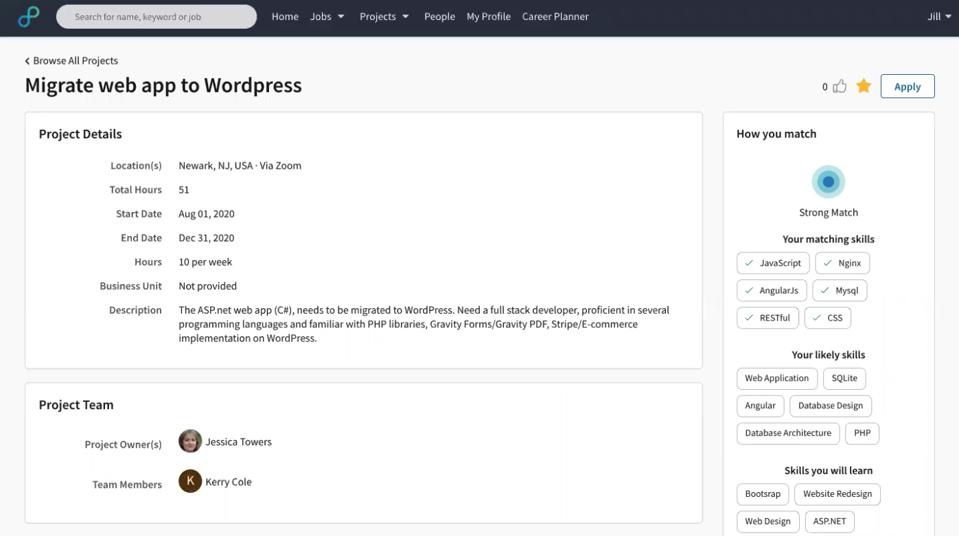
Employees select a project of interest and are immediately shown how strong of a match they are with the open position. Eightfold provides insights into relevant skills that an employee already has, why they are a strong match and the rest of the project team members – often a carrot in itself. Keeping focused on expanding employee’s capabilities, Eightfold also provides guidance of which skills an employee will learn. The following is an example of what an open project positions looks like:

How An AI Platform Is Matching Employees And Opportunities

How An AI Platform Is Matching Employees And Opportunities

Employee applicants can also view all the projects they currently have open from the My Projects view shown below:

How An AI Platform Is Matching Employees And Opportunities

Project Marketplace is the win/win every employee has yearned for as they start to feel less challenged in their current position and start looking for a new one, often outside their companies. I recently spoke with Ashutosh Garg, CEO and Co-Founder and Kamal Ahluwalia, Eightfold’s President, to see how they successfully ran a virtual hackathon across three continents to keep the Marketplace platform fresh with new features and responsive to the market.

How to Run A Virtual Hackathon

Starting with the hackathon, Eightfold relied on its own Talent Intelligence Platform to define the teams across all three continents, based on their employees’ combined mix of capabilities. Ashutosh, Kamal and the senior management team defined three goals of the hackathon:

  1. Solve problems customers are asking about with solutions that are not on the roadmap yet.
  2. Accelerate time to value for customers with new approaches no one has thought of before.
  3. Find new features and unique strengths that further strengthen the company’s mission of finding the right career for everyone in the world.

It’s fascinating to see how AI, cybersecurity and revenue management software companies continue to innovate at a fast pace delivering complex apps with everyone being remote. I asked Ashutosh how he and his management team approached the challenge of having a hackathon spanning three continents deliver results. Here’s what I learned from our discussion and these lessons are directly applicable to any virtual hackathon today:

  1. Define the hackathon’s purpose clearly and link it to the company mission, explaining what’s at stake for customers, employees and the millions of people looking for work today – all served by the Talent Intelligence Platform broadening its base of features.
  2. Realize that what you are building during the hackathon will help set some employees free from stagnating skills allowing them to be more employable with their new capabilities.
  3. The hackathon is a chance to master new skills through experiential learning, further strengthening their capabilities as well. And often learning from some of the experts in the company by joining their teams.
  4. Reward risk-taking and new innovative ideas that initially appear to be edge cases, but can potentially be game changers for customers.

I’ve been interviewing CEOs from startups to established enterprise software companies about how they kept innovation alive during the lockdown. CEOs have mentioned agile development, extensive use of Slack channels and daily virtual stand-ups. Ashutosh Garg is the only one to mention how putting intrinsic motivation into practice, along with these core techniques, binds hackathon teams together fast. Dan Pink’s classic TED Talk, The Puzzle of Motivation, explains intrinsic motivators briefly and it’s clear they have implications on a hackathon succeeding or not.

Measuring Results Of the Hackathon

Within a weekend, Project Marketplace revealed several new rock stars amongst the Eightfold hackathon teams. Instead of doing side projects for people who had time on their hands, this Hackathon was about making Eightfold’s everyday projects better and faster. Their best Engineers and Services team members took a step back, re-looked at the current approaches and competed with each other to find better and innovative ways. And they all voted for the most popular projects and solutions – ultimate reward in gaining the respect of your peers. As well as the most “prolific coder” for those who couldn’t resist working on multiple teams.

Conclusion

Remote work is creating daunting challenges for individuals at home as well as for companies. Business models need to change and innovation cannot take a back seat while most companies have employees working from home for the foreseeable future. Running a hackathon during a global lockdown and making it deliver valuable new insights and features that benefit customers now is achievable as Eightfold’s track record shows. Project marketplace may prove to be a useful ally for employees and companies looking to stay true to their mission and help each other grow – even in a pandemic. This will create better job security, a culture of continuous learning, loyalty and more jobs. AI will change how we look at our work – and this is a great example of inspiring innovation.


Remote Recruiting In A Post COVID-19 World

Remote Recruiting In A Post COVID-19 World

Bottom Line: Virtual career fairs and events, fully-remote recruiting, more personalized career paths, and greater insights into candidate experiences are quickly becoming the new normal in a post-COVID-19 world.

The COVID-19 pandemic is quickly changing how every organization is attracting, recruiting, and retaining employees on their virtual teams, making remote work the new normal. Recruiting systems, Applicant Tracking Systems (ATS), and talent management systems were designed for one-on-one personal interactions, not virtual ones. Legacy Human Resource Management (HRM) systems are already showing signs of not being able to scale and meet the challenges of the brave, new post-COVID-19 world. The majority of legacy systems are built for transaction scale and can’t see candidate potential. Closing the gaps between legacy talent management systems and new virtual event recruiting and AI-based talent management platforms are changing that by putting candidate potential at the center of their architectures.

Closing The Virtual Event Recruiting Gap Needs To Happen First

Many organizations during this time of year prioritize recruiting the best and brightest college seniors they can attract during in-person interviews on campus. That’s no longer an option today. College recruiters are resorting to individual Skype or Zoom sessions with candidates while attempting to keep track of interviews the best they can with Excel, Google Sheets, and e-mail. Recruiters trying to recruit for mid-level and senior positions are under increasing pressure from hiring managers to arrange interviews with the highest quality candidates possible.

Seeing an opportunity to help organizations find, engage, and recruit using online events, Eightfold.ai has created and launched Virtual Event Recruiting. Eightfold.ai is best-known for its Talent Intelligence Platform™, the first AI-powered solution and most effective way for companies to identify promising candidates, reach diversity hiring goals, retain top performers, and engage talent. Eightfold.ai’s recent webinar How To Hold Virtual Recruiting Events is worth checking out if you’re interested in how Virtual Event Recruiting is evolving..

What Does Success Look Like In Virtual Event Recruiting?

The table stakes for any Virtual Event Recruiting solution need include support for students just starting their careers, veterans, return-to-work mothers, and experienced professionals. For a solution to be effective, it also needs to enable companies and job seekers to connect, giving companies greater scale than is possible for physical recruiting events. Ideally, any virtual event recruiting system needs to provide the following:

  • The ability to upload resume books and use AI to find the highest quality matches for open positions in real-time. Machine learning algorithms excel at pattern matching and can save recruiters thousands of hours of drudgery by immediately seeing the highest quality matches for open positions.
  • Provide a planning center that also serves a company’s specific talent community and provide tools to grow it by tailoring events to their specific interests while seeking the best-qualified candidates for open positions. Creating, launching, and tracking recruiting campaigns from the same dashboard that tracks invitations, registrations, and open positions being filled gives recruiters the end-to-end visibility they need to succeed with a virtual event. It’s important to have Assessments included in every virtual event to measure candidates’ experiences and see what’s going well and which areas need to improve. The following is an example of what Eightfold’s planning center looks like:

Remote Recruiting In a Post COVID-19 World

  • Rely on AI to match high-potential candidates with the best possible virtual events to increase opt-in and participation rates. For a virtual event recruiting solution to be effective, high-potential candidates need to be matched with positions they will most excel in. A first step to making this happen is using AI to understand every candidate’s strengths and inviting them to the virtual events that will help them the most in choosing the best position given their potential.

Remote Recruiting In a Post COVID-19 World

  • Guide candidates to the positions that best match their existing capabilities and future potential. Instead of relying on keyword matching from resumes alone, virtual event recruiting applications need to suggest those positions high-potential candidates have the greatest potential to excel at. Using AI to combine all available data on a candidate, so their existing capabilities and future potential are taken into account is key to making more successful hires. Integrating job recommendations with virtual event recruiting is a must-have for any organization looking to add staff in 2020 and beyond.

Remote Recruiting In a Post COVID-19 World

  • After the virtual event, all potential candidates for an open position need to be stacked-ranked so recruiters can prioritize who they contact. By providing personalization at scale to every candidate by providing them recommendations for the positions they are the strongest match for, recruiters will find following-up is easier to accomplish than cold-calling a candidate found on LinkedIn, for example. Stack ranking needs to include members of the existing talent community and organization is cultivating as well. An excellent example of how this could work is shown below:

Remote Recruiting In a Post COVID-19 World

Conclusion

University campuses need to consider partnering with Eightfold.ai to make it easier for their graduating students to find best available careers, perhaps across a much broader range of companies than ever visited any individual campus. And there is no reason this paradigm can’t be applied to other job fairs and recruiting events like Grace Hopper.

Improving event virtual recruiting needs to be the priority recruiters and HR professionals take action on first to stay competitive from a talent management standpoint. Organizations that will win the war for talent in this new remote, distributed workforce era are already looking at how to excel at virtual recruiting. Having a talent intelligence platform that can provide end-to-end visibility and personalization at scale is the future of talent management.


10 Most In-Demand Tech Jobs On Indeed In 2020

10 Most In-Demand Tech Jobs On Indeed In 2020

  • There has been a 73.6% increase in WordPress developer job postings on Indeed through the first three months of 2020.
  •  Demand for tech jobs is more resilient than the national average, with tech job listings down 5.8% from the same time last year compared to a 15.2% drop across all job listings.
  • The top ten most in-demand tech jobs’ open positions grew 30.2% through March 2020.

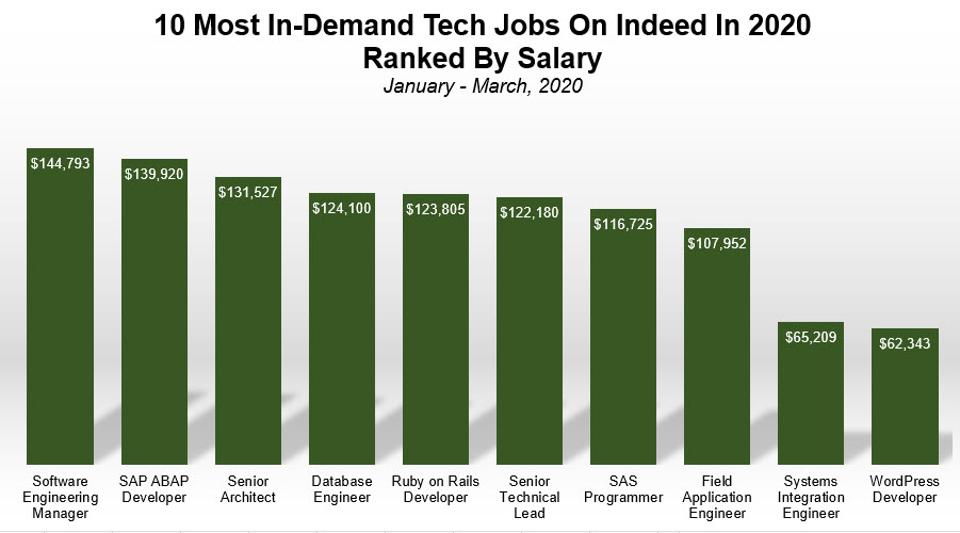
While job postings in the U.S. are 23.6% lower year-to-date compared to 2019, tech hiring is showing signs of being more resilient than average. Indeed’s economists looked at the tech job titles with the highest percentage increase in job postings per million from January 2020 to March 2020. They included average salary along with the % increase in job postings per million on Indeed during the same time period in 2019. Their analysis found the ten most in-demand technical jobs through the end of March have seen on average a 30% increase in job listings. WordPress Developers, Systems Integration Engineers, and SAS Programmers are the most in-demand, according to Indeed’s analysis.

According to Nick Bunker, Economist at Indeed: “Demand for tech workers has slowed considerably. The trend in job postings for software development job titles included in the analysis is down 18.5% from the same time last year, as of April 3. Compare that to the trend in overall postings in the U.S. which is down 23.6% from last year’s trend.” Demand for tech workers appears to be slowing down, but is doing relatively better than the overall labor market. Nick says that “the trend in job postings for software development jobs titles is down 5.8% from the same time last year, as of March 27st. Compare that to the trend in overall postings in the U.S. which is down 15.2% from last year’s trend.”  

The following are key insights from Indeed’s analysis of tech jobs most in-demand so far this year.

  • The average salary of the ten most in-demand tech jobs on Indeed through March 2020 is $113,855. SAP ABAP Developers are earning the highest salaries, with an average annual salary of $139,920. Indeed’s economists say professionals with skills in the area can make, on average, $69.96 per hour. SAP ABAP expertise is among the most lucrative skills to have in an economic downturn, paying $26,065 more than the average income level of the top ten tech jobs combined.

10 Most In-Demand Tech Jobs On Indeed In 2020

  • There has been a 30.25% growth in new job listings across the ten most in-demand jobs through March 2020, countering the downward trend in overall national hiring. The five fastest-growing positions’ job listings are growing at an aggregate 44% growth rate through the first three months of the year. Professionals with skills in WordPress Development, Systems Integration Engineering, SAS Programming, experience being a Senior Technical Lead, and SAP ABAP development have an excellent chance of finding work during this downtime.

10 Most In-Demand Tech Jobs On Indeed In 2020

  • There are just over 29,000 job listings across the ten most in-demand positions today. To get the number of open positions by title, I searched Indeed on each and entered the counts in the table below.

10 Most In-Demand Tech Jobs On Indeed In 2020


The Best Tech Companies For Remote Jobs In 2020 According To Glassdoor

The Best Tech Companies For Remote Jobs In 2020 According To Glassdoor

  • Modern Tribe, CloudBeds, Dataiku, PartnerCentric, GitLab, Hotjar, HubSpot, PowerToFly, Close.io, Fuse, Databricks, eightfold.ai, Fortinet, and SAP are most likely to be recommended by 93% or more of the employees who work for these companies in 2020.
  • Between LinkedIn, Glassdoor, and Indeed there are over 12,000 open remote-based software technical professional jobs available today. Companies with open positions on these sites include Aha!, AutoDesk, Calix, Cardinal Financial,  Chef Software, CoreLogic, Couchbase, Medidata Solutions, OutSystems, Qlik,  RedHat,  Riverbend, Salesforce, ServiceNow, Ultimate Software and many others.
  • Working Nomads has 10,127 open remote-based developer jobs listed, along with over 1,800 in tech marketing, 1,700 in management, and just over 1,000 in tech sales.

These and many other insights are from a comparison of the leading tech companies who offer remote, work-from-home job positions today and their Glassdoor scores. Tech companies with open remote positions are compared on two Glassdoor scores of the (%) of employees who would recommend this company to a friend and (%) of employees who approve of the CEO. Of the many companies include in the comparison, PowerToFly and GitLab stand out as exceptional in their ability to create strong virtual organizations. They’re defining the future of work today.

PowerToFly was launched by Milena Berry and Katharine Zaleski in 2014 to connect Fortune 500 companies and fast-growing startups with women who are looking to work for companies that value gender diversity and inclusion. PowerToFly is building the platform to propel diversity recruiting and hiring. PowerToFly’s job search engine currently has 994 open remote positions. Founders Milena Berry and Katharine Zaleski have created an excellent remote-based culture where 95% of employees would recommend working there to a friend, and 94% approve of them as CEOs.

GitLab has team members located in more than 65 countries around the world and provides a Guide to Remote Work. GitLab has over 100 open remote locations open, and you can find them here. Open positions are in Engineering, Marketing, Sales, Quality, Security, UX, and several other areas. GitLab knows how to excel at creating and growing a remote-based culture, reflected in 97% of employees willing to recommend the company to a friend and their CEO Sid Sijbrandij having a 97% approval rating based on 125 ratings. GitLab is one of several remote-only software companies defining the future of work.

The best tech companies for remote jobs in 2020 table is shown below. You can download the original Excel data set here. If the image below is not viewable in your browser, you can see the image here.

Where To Find Remote Tech Jobs Today

Originally posted on Forbes here. 


Top 10 Most Popular Cybersecurity Certifications In 2019

Top 10 Most Popular Cybersecurity Certifications In 2019

  • IT decision-makers (ITDMs) report that cybersecurity is the hardest area to find qualified talent, followed by cloud computing skills.
  • 56% of ITDMs report that certified personnel closes organizational skills gaps.
  • 48% of ITDMs report that certifications boost productivity.
  • 44% of ITDM report that certifications help meet client requirements.

Knowing which cybersecurity certifications are in the greatest demand is invaluable in planning a career in the field. I asked Global Knowledge, the world’s largest dedicated IT training company, which hosts over 3,000 unique IT courses delivered by over 1,100 subject matter experts for their help in finding out which cybersecurity certifications are the most sought after in North America this year. Their 2019 IT Skills and Salary Report is considered the gold standard of IT skills, certification, and salary data, with many IT professionals relying on it to plan their careers. Human Resource professionals also use the report and consider it an invaluable reference to guide their recruiting efforts. Thank you Global Knowledge for providing custom research of the current state of demand for cybersecurity certifications.

Ranking The Most Sought-After Cybersecurity Certifications

Of the 63% of North American IT professionals planning to or are pursuing a certification in 2019, 23% are pursuing a cybersecurity certification according to the latest Global Knowledge IT Skills and Salary Report. The certifications reflect how quickly unique, specialized areas of knowledge are gaining in popularity. “Traditionally, cybersecurity senior leadership-level certifications have been dominated in popularity by the administrative and Governance, Risk Management, and Compliance accreditations. This continues to be reflected in the latest data with the most popular (ISC)2 and ISACA certification bodies represented well in the list,” said Brad Puckett, Global Knowledge’s global product director for cybersecurity. Brad used the Global Knowledgebase of survey data to produce the ten most sought-after cybersecurity certifications in North America in 2019 shown below:

1.    (ISC)2: CISSP – Certified Information Systems Security Professional

2.   ISACA: CISM – Certified Information Security Manager

3.   EC-Council: CEH – Certified Ethical Hacker

4.   ISACA: CRISC – Certified in Risk and Information Systems Control

5.   (ISC)2: CCSP – Certified Cloud Security Professional

6.   ISACA: CISA – Certified Information Systems Auditor

7.   (ISC)2: CISSP-ISSMP – Information Systems Security Management Professional also please see the ISC’s specifics on this certification here.

8.   (ISC)2: CISSP-ISSAP – Information Systems Security Architecture Professional also please see the ISC’s specifics on this certification here.

9.   ISACA: CGEIT – Certified in the Governance of Enterprise IT

10. EC-Council: CHFI – Computer Hacking Forensic Investigator


AWS Certifications Increase Tech Pay Up To $12K A Year

AWS Certifications Increase Tech Pay Up To $12K A Year

  • AWS and Google certifications are among the most lucrative in North America, paying average salaries of $129,868 and $147,357 respectively.
  • Cross-certifying on AWS is providing a $12K salary bump to IT professionals who already have Citrix and Red Hat/Linux certifications today
  • Globally, four of the five top-paying certifications are in cloud computing.

These and many other insights of which certifications provide the highest salaries by region of the world are from the recently published Global Knowledge 2019 IT Skills and Salary Report. The report is downloadable here (27 pp., PDF, free, opt-in). The methodology is based on 12,271 interviews across non-management IT staffs (29% of interviews), mid-level professionals including managers and team leads (43%), and senior-level and executive roles (28%) across four global regions. For additional details regarding the study’s methodology, please see page 24 of the report.

Key insights from the report include the following:

  • Cross-certifying on AWS is providing a $12K salary bump to IT professionals who already have Citrix and Red Hat/Linux certifications. Citrix certifications pay an average salary of $109,546 and those earning an AWS certification see a $12,339 salary bump on average. Red Hat/Linux certification-based jobs pay an average of $113,165 and are seeing an average salary bump of $12,553.  Cisco-certified IT professionals who gain AWS certification increase their salaries on average from $101,533 to $111,869, gaining a 10.2% increase. The following chart compares the salary bump AWS certifications are providing to IT professionals with seven of the more popular certifications (please click on the graphic to expand for easier reading).

  • AWS and Google certifications are among the most lucrative in North America, paying average salaries of $129,868 and $147,357 while the most popular are cybersecurity, governance, compliance, and policy. 27% of all respondents to Global Knowledge’s survey have at least one certification in this category. Nearly 18% are ITIL certified. In North American, the most popular certification categories beyond cybersecurity are CompTIA, Microsoft, and Cisco. The following table from the report provides an overview of salary by certification category (please click on the graphic to expand for easier reading).

  • AWS Certified Solutions Architect – Associate is the most popular AWS certification today, with 72% of respondents having achieved its requirements. Certified Solutions Architect – Associate leads the top five most commonly held AWS certifications today according to the survey. AWS Certified Developer – Associate (33%), AWS Certified SysOps Administrator – Associate (24%), AWS Certified Solutions Architect – Professional (16%) and AWS Certified Cloud Practitioner round out the top five most common AWS certifications across the 12,271 global respondents to the Global Knowledge survey.