Skip to content

Posts from the ‘SaaS’ Category

Top 10 insights from Forrester’s 2026 Cybersecurity Budget Report

Top 10 Insights from Forrester’s 2026 Cybersecurity Budget Report

“With volatility now the norm, security and risk leaders need practical guidance on managing existing spending and new budgetary necessities,” states Forrester’s 2026 Budget Planning Guide.

The research firm’s planning guide for next year provides security leaders with new insights into how their clients are allocating budgets, which gives a helpful overview of the next 12 months of cybersecurity spending.

Implicit in the guide is the need for new technologies that enable organizations to be more adaptive to threats and take action on them before they become breaches. There’s also a strong focus on getting a head start on new technologies, anticipating the severity of threats new developments in AI, generative AI (genAI), deepfakes, and all other forms of weaponized technologies can pose to an organization.

Software is a solid 40% of cybersecurity spending, exceeding hardware at 15.8%, outsourcing at 15% and surpassing personnel costs at 29% by 11 percentage points. Meanwhile, security leaders face escalating threats, with generative AI attacks executing in milliseconds, a stark contrast to the average Mean Time to Identify (MTTI) of 181 days, according to IBM’s latest Cost of a Data Breach Report.

A fast-changing threatscape is changing spending priorities

Three converging threats are flipping cybersecurity on its head. What once protected organizations is now working against them. Generative AI (gen AI) is enabling attackers to craft 10,000 personalized phishing emails per minute using scraped LinkedIn profiles and corporate communications. NIST’s 2030 quantum deadline threatens retroactive decryption of $425 billion in currently protected data. Deepfake fraud that surged 3,000% in 2024 now bypasses biometric authentication in 97% of attempts, forcing security leaders to reimagine defensive architectures fundamentally.

Top ten insights from Forrester’s 2026 cybersecurity budget benchmarks

1.     Software now claims 40% of cybersecurity budgets, surpassing personnel spend. Forrester’s budget planning guide reports that software now accounts for approximately 40.2% of cybersecurity spending, eclipsing combined hardware and outsourcing budgets. It’s noteworthy that software spending is surpassing personnel costs by 11 percentage points.

Top 10 insights from Forrester’s 2026 Cybersecurity Budget Report
Source: Forrester Budget Planning Guide 2026: Security and Risk

2. Security budgets are accelerating, with 55% of global security and tech leaders forecasting significant increases next year. A robust 15% anticipate their budgets jumping more than 10%, and another 40% project hikes between 5% and 10%. Regional outlooks vary sharply: APAC is most bullish, with 22% expecting double-digit growth, compared to a cautious 9% in North America and just 12% in EMEA. However, nearly half (45%) remain reserved; 30% predict minimal budget bumps of 1%–4% or barely keeping pace with inflation, while another 10% expectSource: Forrester Budget Planning Guide 2026: Security and Risk no change, and 5% foresee cuts.

Top 10 insights from Forrester’s 2026 Cybersecurity Budget Report
Source: Forrester Budget Planning Guide 2026: Security and Risk

3. Cloud security, on-prem tech, and security awareness training are set to lead cybersecurity spending in 2026. Decision-makers are doubling down on cloud security, with 12% boosting budgets in this area by 10% or more, 11% doing the same for new on-premises solutions, and another 10% ramping up security awareness programs. Notably, investments in on-premises security technology appear twice among the top priorities, as 36% plan at least a 5% increase for both new deployments and upgrades to existing infrastructure. The numbers reflect an uneven global adoption of cloud strategies, driven by persistent concerns around cost, security, and data sovereignty. APAC is exceptionally bullish. 78% of companies there plan increased spending on new on-prem security, outpacing EMEA by 10% and North America by 8%.

Top 10 insights from Forrester’s 2026 Cybersecurity Budget Report
Source: Forrester Budget Planning Guide 2026: Security and Risk

4. Forrester recommends that security leaders broaden AI and ML security throughout the enterprise in 2026 as generative AI moves from standalone apps to essential business systems. Productivity suites, CRM platforms, and service tools now embed genAI natively, transforming workflows and widening potential attack surfaces. Enterprises urgently need comprehensive protection across AI models, data, applications, and user identities to counter risks such as model vulnerabilities, data leakage, and prompt jailbreaking. Hyperscalers like Google Cloud and Microsoft are responding quickly, while cybersecurity incumbents, notably Palo Alto Networks with its Protect AI acquisition, actively expand their footprint. Meanwhile, innovative startups, including Knostic and CalypsoAI, both featured at RSA’s Innovation Sandbox, target niche but critical genAI security gaps. Enterprises investing strategically now will securely scale genAI deployments and establish a clear competitive advantage.

5. Standalone SSE spending will sharply decline in 2026 as enterprises shift to unified SASE platforms, streamlining security operations and accelerating Zero Trust initiatives. Initially positioned to fill security gaps left by SD-WAN deployments and the surge in remote work, standalone SSE and isolated ZTNA solutions have now reached their functional limits. Leading companies increasingly adopt integrated platforms like Cato Networks’ cloud-native SASE, which consolidates SD-WAN, ZTNA, SWG, CASB, and firewall capabilities within a single, unified framework. As I’ve noted in VentureBeat, CISOs who pivot to unified SASE platforms benefit from simpler integration, superior AI-driven threat detection, and significant operational efficiencies that isolated solutions cannot deliver. Organizations proactively embracing integrated SASE from providers like Cato Networks will immediately enhance security resilience, improve operational agility, and significantly reduce vendor complexity.

6. Forrester predicts that by 2026, security leaders will seize a critical advantage by accelerating the adoption of post-quantum cryptography (PQC). With NIST’s landmark release of three core PQC standards in August 2024, organizations now have clear guidance to protect their data and applications against emerging quantum threats. Most governments align with NIST timelines, targeting legacy encryption deprecation by 2030, while Australia’s ASD urges adoption of approved PQC algorithms even sooner. Enterprises should immediately focus efforts on securing their most sensitive asymmetric cryptography, covering data at rest, data in transit, and data actively used within applications. Comprehensive cryptographic discovery and inventory tools provide the visibility required to assess readiness. Strategic partnerships with cryptoagility innovators, including Entrust, IBM, Keyfactor, Palo Alto Networks, QuSecure, SandboxAQ, and Thales, enable organizations to define a clear, secure migration path. Organizations acting decisively now will confidently navigate the quantum transition and fortify their competitive edge.

7. Machine identity management will become essential by 2026 as automated identities multiply rapidly across the IT infrastructure. Apps, AI agents, IoT devices, containers, cloud environments, and infrastructure scripts now generate identities faster than humans can manually track or manage. Enterprises urgently require solutions capable of managing these identities throughout their lifecycle, automating key rotations, and enforcing role-based access. Leading vendors, including Akeyless, BeyondTrust, CyberArk, Delinea, HashiCorp, Keyfactor, AppViewX, and emerging startups like Aembit, Astrix, Clutch, Entro, and Oasis Security, offer robust platforms to meet this challenge.

8. There will be a significant reallocation away from standalone interactive application security testing (IAST) in 2026, as operational hurdles continue to limit adoption. Originally designed to blend the runtime accuracy of dynamic application security testing (DAST) with static application security testing’s (SAST) code-level insights, standalone IAST has proven overly complex. Forrester recommends shifting budgets toward integrated IAST and DAST platforms, such as those from Invicti and HCLSoftware, that simplify deployment. Alternatively, APIs, microservices, and containers provide more transparent and consistent returns.

9. Consolidation of endpoint security and SIEM tools will accelerate in 2026. As extended detection and response (XDR) platforms gain momentum, security leaders have a clear opportunity to reduce agent sprawl, improve analyst efficiency, and lower the total cost of ownership. Vendors, including Microsoft, CrowdStrike, and Palo Alto Networks, now embed critical SIEM functions such as detection, correlation, third-party data ingestion (particularly from cloud, identity, and email), and response directly within their XDR offerings. While these integrated solutions currently don’t fully match standalone security analytics platforms, they deliver compelling advantages: simplified deployments, centralized threat context, and measurable operational savings. Organizations consolidating around unified XDR solutions today will streamline security operations and achieve faster, higher-quality threat detection.

10. By 2026, rapidly evolving generative AI will make deepfakes virtually indistinguishable from authentic media, rendering simplistic identity checks obsolete. Enterprises must proactively deploy sophisticated detection platforms using advanced ensemble modeling—spectral analysis, image artifacts, skin tone consistency, lighting anomalies, audio echo patterns, and device reputation, to ensure trusted employee verification and transaction authentication. Vendors such as GetReal Security, Sensity, and Reality Defender already offer real-time risk scoring, transparent reasoning, and integrated case management. Early adopters will safeguard identity security, sustain customer trust, and remain resilient against future deepfake threats.

Gartner’s 13 ways GenAI is improving B2B Sales is the roadmap every business needs

Gartner's 13 ways GenAI is improving B2B Sales is the roadmap every business needs

Generative AI (GenAI) ‘s potential for streamlining the most time-consuming processes in B2B sales is just getting started. As businesses increasingly rely on AI to enhance efficiency, automate routine tasks, and personalize customer engagement, GenAI is set to become a critical differentiator in the race for B2B sales and market leadership.

  • B2B sales organizations using GenAI-embedded sales technologies will reduce the time they spend prospecting and preparing for customer meetings by over 50% within two years.
  • Conversational interfaces based on GenAI will gain momentum and further revolutionize B2B selling. In 2028, they will be the driving force behind up to 60% of B2B sales interactions, up from less than 5% in 2023.
  • Centralized GenAI operations teams are also on the way, championed by Chief Revenue Officers (CROs). These teams will focus on integrating AI-driven strategies into sales and revenue operations. 35% of CROs will have GenAI operations teams online and incorporated into their companies’ strategic planning process by 2025.

The goal: find the most likely wins for GenAI in B2B Sales

Gartner’s recent report, 13 Generative AI Use Cases for B2B Sales, provides an analysis of where GenAI is helping improve B2B sales now and in the future.

“Generative artificial intelligence (GenAI) is reshaping the sales technology landscape, offering innovative solutions in areas such as prospecting, sales analytics, forecasting, and sales enablement. Tools infused with GenAI capabilities are embedded in use cases across the sales function, supporting key priorities such as revenue growth, GTM, cost optimization, and risk mitigation,” write the authors of Gartner’s study.

In defining and ranking the most valuable use cases of GenAI in B2B sales, Gartner examined where the technology is being most effectively applied to improve sales operations, increase seller productivity, and fuel future transformation.

The following multidimensional grid defines the use cases by value and feasibility.

Source: Generative AI Use Cases for B2B Sales, Gartner, Inc.

Gartner evaluated each use case for GenAI in B2B sales by scoring them on two key factors: business value and feasibility. The figure below shows the breakout of value and feasibility factors Gartner has used as a framework to rank the 13 use cases: “While we’ve defined the dimensions of value and feasibility according to our research criteria, companies are encouraged to customize these parameters to align with their own business needs,” the report states.

Source: Gartner, Inc. (2024) Generative AI Use Cases for B2B Sales

Mapping GenAI Use Cases Across Business Functions

Gartner also provides a GenAI use-case pipeline as part of their analysis to graphically explain how the 13 AI-driven strategies or use cases are distributed across business functions, including marketing, sales, and customer success.

The goal is to help organizations identify and take action on the use cases that will deliver the most significant potential impact. Gartner advises that use cases that span multiple stages of the pipeline typically deliver greater overall business value, making them strategic targets for investment. Additionally, the pipeline acts as a guide to identifying the relevant stakeholders within the organization, enabling more focused discussions and alignment on AI implementation priorities.

Source: Gartner, Generative AI Use Cases for B2B Sales.

GenAI is redefining the future of B2B Sales

Within the next three years, GenAI will emerge as one of the main factors that differentiate the most efficient and financially successful B2B sales organizations. With CROs creating operations teams to scale AI improvements across every phase of the sales process and sales teams using AI to automate reporting and manually-intensive tasks, GenAI is supposed to revamp the time-consuming work that gets in the way of selling.

Gartner’s analysis highlights that AI-driven strategies will soon dominate, with significant gains in efficiency and customer engagement. The message is clear: for sales organizations looking to stay ahead, embracing GenAI is not optional—it’s essential. Those who act now will position themselves as leaders in the evolving world of B2B sales, while those who hesitate risk being left behind.


Top ten insights CEOs need to know about GenAI going into 2025

Top ten insights CEOs need to know about GenAI going into 2025

CEOs and C-level executives, including line-of-business leaders managing enterprises, no longer have time for AI hype—they need actionable plans that deliver measurable results.

Every CEO I know has a Gen AI tech trends deck ready for board meetings. They’re all impatient for results.

Gartner’s 2024 Generative AI Planning Survey, published yesterday, reflects how impatient CEOs and their teams are gaining traction with GenAI pilots and AI initiatives. The survey involved 822 business executives from North America, Europe, and Asia/Pacific across eight corporate functions.

Key insights from the GenAI planning survey include the following:

  • 11.3% to 19.7% cost savings are expected from GenAI, with the lowest in finance and highest in marketing and HR, as predicted by CEOs and C-level leaders.

  • 87% of CEOs/C-suite are driving GenAI adoption in areas like sales and finance, pushing top-down initiatives for implementation.

  • Legal departments: 26% rolling out GenAI for contract review in 6 months; already widely used for legal research and analysis.

  • 19.7% cost savings in marketing driven by GenAI, making it the most impacted department for efficiency gains.

  • 28% of leaders cite technical challenges as the top barrier to GenAI implementation, followed by talent acquisition (26%) and costs (24%).

  • 69% of GenAI-advanced companies focus on upskilling staff, while 64% are creating new AI-specific roles to meet talent needs.

Cutting through the hype: What CEOs need to know about GenAI going into next year

Rhetoric into results is the new mantra of the C-suite going into 2025.

That’s especially the case with GenAI.

Board members are worried they’re about to get lapped or, worse, see their companies become gradually irrelevant by competitors who are more focused on making GenAI pay than they are. The greater the acuity and insight of how to turn GenAI into a competitive strength, the greater the speed at which an enterprise executes and gets solid results. Speed isn’t optional anymore, it’s table stakes to compete.

Just as every business needs to keep challenging itself to find new paths to reinvent itself to make AI a competitive strength, the same holds for working professionals. There has never been a better time to double down on new skills and master AI tools, technologies, and knowledge.

The following are ten insights every CEO needs to know about GenAI going into 2025:

  • Over the next 12-18 months, GenAI will boost productivity by 22.6%, outpacing revenue growth at 15.8% and cost savings at 15.2%. While cost efficiency and revenue gains matter, the most immediate and substantial impact will be on operational efficiency. Gartner predicts that enterprises that prioritize GenAI integration will see significant increases in both workflow optimization and financial performance.

Top ten insights CEOs need to know about GenAI going into 2025

Source: Gartner’s 2024 Gartner Generative AI Planning Survey

  • 30% of leaders plan to reduce headcount by 3% to 5% in 2024 due to GenAI-driven automation, with an overall average savings of 4.6%. These reductions will primarily affect roles tied to repetitive or manual tasks as organizations seek to streamline operations. Another 18% anticipate more minor cuts of 1% to 3%, while 14% expect deeper reductions of 8% to 10%, signaling that GenAI’s impact will vary by function. Only 10% foresee no layoffs.

Top ten insights CEOs need to know about GenAI going into 2025

Source: Gartner’s 2024 Gartner Generative AI Planning Survey

  • 87% of sales teams are following CEO or C-suite directives to implement GenAI, demonstrating a top-down strategy that prioritizes AI for revenue growth and a more significant competitive advantage. Supply chain (79%) and finance (74%) also see intense executive pressure, indicating that leadership views AI as critical for optimizing operational efficiency and financial management.

Top ten insights CEOs need to know about GenAI going into 2025

Source: Gartner’s 2024 Gartner Generative AI Planning Survey

  • 84% of organizations prioritize embedding GenAI into existing applications as the top method for enabling their use cases, with 34% making it their first choice. Customizing existing models (74%) and training custom models (65%) follow, while only 59% opt for stand-alone tools. Enterprises are focusing on integrating GenAI within their current systems to drive efficiency and impact rather than relying on isolated or siloed solutions.

Top ten insights CEOs need to know about GenAI going into 2025

Source: Gartner’s 2024 Gartner Generative AI Planning Survey

  • HR leads GenAI budget allocation at 7.1%, followed closely by customer service (7.0%) and finance (6.9%). Across functions, business leaders plan to allocate 5.4% to 7.1% of their 2024 budgets to GenAI initiatives, including spending on technology licensing and employee deployment costs. Gartner observes that this shows a solid commitment to embedding GenAI across departments, with HR and customer service prioritizing it for operational efficiency and innovation.

Top ten insights CEOs need to know about GenAI going into 2025

Source: Gartner’s 2024 Gartner Generative AI Planning Survey

  • 54% of C-level executives prioritize privacy concerns as the top GenAI risk, followed closely by misuse (49%) and job displacement fears (48%). These top concerns highlight the critical need for strong governance and risk management frameworks and plans to ensure ethical, secure AI deployment. CEOs need to step up the pace on this now if they’re going to compete in this dimension of their business in 2025.

Top ten insights CEOs need to know about GenAI going into 2025

Source: Gartner’s 2024 Gartner Generative AI Planning Survey

  • According to 28% of leaders, technical implementation, talent acquisition (26%), and governance issues (25%) are the top three barriers to GenAI adoption. North America struggles more with measuring value (30%), while Europe faces higher cultural resistance (24%). These barriers highlight the need for focused strategies to overcome implementation and talent gaps across regions.

Top ten insights CEOs need to know about GenAI going into 2025
  • 32% of service-centric industries struggle with measuring value from GenAI initiatives, significantly more than asset-centric industries. The top barriers for both include the cost of running AI, technical implementation (32% each), and getting the necessary talent (28%). To excel, enterprises need to address these common challenges and tailor strategies that overcome sector-specific obstacles, including data availability (28% for service-centric industries).

Top ten insights CEOs need to know about GenAI going into 2025

Source: Gartner’s 2024 Gartner Generative AI Planning Survey

  • Customer service leads GenAI adoption with 40% using real-time speech and text translation, followed by marketing (38% with chatbots and digital humans), sales (34% with generative business intelligence), HR (29% for job descriptions and skills data), supply chain (30% for chatbots and code generation), finance (22% for coding assistance), legal/risk (17% for legal research), and procurement (18% for contract lifecycle management).

Top ten insights CEOs need to know about GenAI going into 2025

Source: Gartner’s 2024 Gartner Generative AI Planning Survey

  • 76% of mature AI organizations actively recruit additional headcount for existing roles to meet GenAI talent needs, significantly more than the 52% of less mature organizations. They also prioritize running AI literacy programs (67%) and upskilling staff with GenAI skills (67%) to ensure their workforce remains competitive. Mature organizations are also more likely to create new roles for GenAI (67%) and establish AI centers of excellence (45%), showing their commitment to both talent acquisition and long-term AI capability development.

Top ten insights CEOs need to know about GenAI going into 2025

Source: Gartner’s 2024 Gartner Generative AI Planning Survey

FinancialForce Unleashes Spring ’23 Release, Strengthening Opportunity-to-Renewal

Finding new ways to improve opportunity-to-renewal is core to any services business’s growth.

FinancialForce has long bet its business on the belief that it could streamline opportunity-to-renewal for people- and software-centered businesses better than any other vendor. In delivering their Spring ’23 release, they’re proving how adept they are at delivering new features on a faster release cadence of three major releases a year. Out of its workforce of 1,000 people, FinancialForce has 400 full-time employees in DevOps, engineering, product management, and quality and nearly 100 outside resources in R&D.

FinancialForce’s overarching goal with the Spring ’23 release is to strengthen the customer’s ability to excel at opportunity-to-renewal. The feature refresh for Spring ’23 includes 18 different areas of their platform, with the most, eight, being in Services CPQ. Dan Brown, Chief Product, and Strategy Officer at FinancialForce, says, “Opportunity-to-renewal is core to companies that deliver services. It’s an area that has been dramatically underserved by classic vendors in this space. Most are fairly product-centric, and that tends to hold companies that are service-oriented back.”

Services-as-a-Business is gaining traction

FinancialForce’s Spring ’23 release shows how Services-as-a-Business is closing gaps and improving the opportunity-to-renewal process. Tight labor markets, spiraling costs and prices due to inflation, and blind spots in opportunity-to-renewal cycles continually jeopardize services revenue. As a result, professional services and software companies relying on service revenue risk losing Annual Recurring Revenue (ARR) and seeing reduced Customer Lifetime Value for every account. The Spring ’23 release provides a more granular, 360-degree view across eight core areas of the opportunity-to-renewal process to help services businesses meet new growth challenges.

“Our new Spring ’23 release is designed to give organizations the kind of certainty they need in these very uncertain economic times,” said Scott Brown, President, and Chief Executive Officer at FinancialForce. “Given the pace at which market and business conditions change, services businesses need confidence in their ability to manage estimates, skills and resources, and solve complex problems. This new release gives organizations a complete, customer-centric view of their business to turn continuous disruption into a competitive edge.”

FinancialForce Spring '23 Release

FinancialForce’s Spring ’23 release doubles down in the areas of Service CPQ and Resource Management, which are the areas where the majority of new features have been added in the Spring ’23 release.

Improving Services CPQ process performance protects margins

FinancialForce is prioritizing Services CPQ, first introduced in the Winter ’22 release, to help customers get more in control of their margins and time management. The number and depth of new features in this area and Dan Brown’s insights into how popular Services CPQ has become with enterprise accounts demonstrate that prioritization. FinancialForce’s enterprise accounts are adopting Services CPQ to save time during sales cycles by providing their prospects with the visibility to identify resources available for quoting work, their billable rate, skills, and previous experience.

Dan Brown said that “in (quote) estimation, you now can reach into your PSA (Professional Services Automation) system and identify the resource that you’re going to quote, what’s their billable rate, what’s their skills, what’s their capabilities. A big issue our customers have is that the As Quoted versus the As Delivered are almost always materially very different.”

He continued, emphasizing, “And that’s where you end up with margin erosion, that’s where you end up with revenue leakage for our customers. Now with Services CPQ, the As Quoted and As Delivered features are tightly linked together. And that has driven enormous improvements.”

Scott Brown added, “When I was a customer, this was a big pain point. For me, the capability to connect your pre-sales activities to your post-sale delivery is a real game changer for us.”

Underscoring how vital Services CPQ is to FinancialForce’s opportunity-to-renewal strategy, the Spring ‘23 Customer Overview notes that “with usability improvements in Services CPQ, support for additional pricing and costing scenarios, and streamlined estimate export for correct Statements of Work, services teams will be able to create accurate and competitive proposals faster, leading to higher win rates on projects, with much lower risk profiles.”

FinancialForce Unleashes Spring '23 Release, Strengthening Opportunity-to-RenewalAmong the many enhancements to Services CPQ are usability enhancements to the Estimate Builder, helping to reduce errors in As Quoted and As Delivered Results.

New features to optimize resources and projects

Additional goals of the spring ’23 release are to provide customers with improved workflows for optimizing resources and streamlining project management. Given how every professional services firm and software company today is under pressure to continually find new ways to optimize resources and be more done with less, the timing of Resource Optimizer Enhancements and introducing Resource Manager Work Planner is excellent. FinancialForce allows assigning multiple resources to project enhancements, integrating with MS Outlook and Google Calendar, as well as mass deletion of pass utilization results. FinancialForce also delivers task-based scheduling of held resource requests.

FinancialForce Unleashes Spring '23 Release, Strengthening Opportunity-to-Renewal

The Spring ’23 release is designed to help enterprises optimize resources from small-scale to multi-location projects by adding Resource Work Planner and Enhanced Skills Maintenance that can scale across multiple global locations.

How FinancialForce’s Spring ’23 Release Strengthens Opportunity-to-Renewal

“This new release gives organizations a complete, customer-centric view of their business to turn continuous disruption into a competitive edge,” remarked Scott Brown during a recent briefing. FinancialForce aims to help services businesses more efficiently monetize their time and resources by concentrating their development efforts across opportunity-to-renewal.

The release shows how services companies are looking to real-time financial analytics, including new risk management features, as guardrails to keep their businesses on track to margin and profit goals. The Spring ’23 release shows FinancialForce’s view of the opportunity-to-renewal process and what strengths it can offer customers, from a new Scheduling Risk Dashboard that provides early intervention and project course corrections in real time, to streamlined estimate exports for accurate Statements of Work (SOWs).

The following table uses the opportunity-to-renewal process as a framework to put the new release into context. It compares each phase of the opportunity-to-order process, how FinancialForce defines their role, how the Spring ’23 release strengthens each area, what the people and software-oriented benefits are, along with their leading customer references. You can also download a copy of the Opportunity-to-Renewal Process comparison here.

FinancialForce Spring '23 Release

FinancialForce Services-as-a-Business Is What Their Customers Need To Drive Growth

services, FinancialForce services-as-a-business

Service businesses must keep finding new ways to add value to existing clients while removing barriers that slow growth. Overcoming the challenges of outdated HR planning and human resource management (HRM), contract management, and CRM systems are table stakes for staying competitive.

FinancialForce’s Summer 22 release aims to turn those weaknesses into strengths with one of the most comprehensive releases they’ve had lately. “Organizations continue to be buffeted by market disruptions, from spiraling inflation to new COVID variants and unanticipated supply chain issues,” said Scott Brown, President and Chief Executive Officer of FinancialForce. “Our new Services-as-a-Business approach delivers the automation, intelligence, and innovation that services organizations need to become more agile so they can expertly turn disruption into opportunity.”

Improving Opportunity-to-Renewal Is Key  

FinancialForce’s Summer 2022 release reflects how services businesses need to gain greater visibility and control across to their opportunity-to-renewal process while growing more resilient to spiraling costs, uncertain supply chains, and chronic labor shortages. They need to take on these challenges and keep growing. FinancialForce believes its Business-as-a-Service unified platform can strengthen services’ traditionally weak areas (integrated HR, CRM, & contract management) without giving up on how fast they can react to new opportunities.

CEOs and COOs running several leading professional services firms spoken with recently say that tight labor markets, rising prices, and blind spots in the opportunity-to-renewal cycles are hurting revenue. As a result, they’re seeing a drain in Annual Recurring Revenue (ARR) and Customer Lifetime Value at risk. They also see that the blind spots in Contract Management, Configure, Price & Quote (CPQ), Resource Management, and Financial Planning & Analysis (FPA) across opportunity-to-renewal grow wider the more diverse their client bases become. What’s needed is a 360-degree view of the opportunity-to-renewal process that encompasses every aspect of service operations, from sales to delivery to customer success management, financial management, and planning.

FinancialForce Services-as-a-Business

FinancialForce’s Summer 22 release introduces Business-as-a-Service to bridge the gaps in the opportunity-to-renewal process, improving customer experiences, and driving faster growth by enabling greater real-time collaboration and visibility organization-wide.

Skills Matching & Scheduling Speed Is A Services Killer App

In the Summer 22 Release, FinancialForce strikes at the heart of what challenges services businesses face the most regarding getting staffing right. Skills matching is new in the release, providing Resource Managers with the insights they need to identify skills related to open roles as either Essential or Desirable. The goal is to bring greater accuracy and speed into the assignment process to control for costs, usage rates, and margin impacts while assigning associates to one project versus another.

FinancialForce Services-as-a-Business

Optimizing project schedules and seeing potential scheduling conflicts in real-time helps improve scheduling efficiency by identifying potential project conflicts early and alleviating them by balancing available hours.

A New Streamlined UX Pays Off For Services CPQ 

The Summer 22 release marks the first time FinancialForce ERP Cloud and Professional Services (PS) Cloud run entirely on the Salesforce Lightning Experience (LEX). During the FinancialForce analyst briefing, Heidi Minzner, Vice President, Product Management (ERP Cloud) at FinancialForce, demonstrated how users could create, manage and update line-level data on requisitions and purchase orders in a single view. Additionally, LEX is evident across the entire platform.

Of the many improvements announced in the Summer 22 release, updates to Services CPQ are noteworthy. The updated Services CPQ interface built on LEX has streamlined estimates creation and provides options for defining date-driven rates. Reflecting how services businesses need more role management capabilities, the Summer 22 release can enable role requests from templates and also supports pass-through of needed skills.

FinancialForce Services-as-a-Business

Services’ CPQ improvements are based partly on the platform’s flexibility LEX provides.

William Spice, Senior Director of Product Management says that Services CPQ and Customer Success Cloud are born in LEX, providing FinancialForce with the flexibility of using the latest Salesforce visual UI to deliver greater simplicity of workflows. “Services CPQ shows us extending the footprint across the whole services lifecycle, allowing our customers to build up a range of different estimates for professional services work, widen the selling and opportunity phase, and then seamlessly be able to transition these into a delivery model,” William said.

“Customer Success Cloud is really focused on making it simple and automatic to create playbooks, which are means for anyone across the organization to help ensure that we’re treating our customers with all the respect and impact they would expect from us. And finally, performance to scale sees us continuing to invest and make sure that our applications scale faster than any of our customers can, and focusing on enterprise-level integrations like linking out of the box with JIRA and Concur, for example,” William concluded.

Improving Opportunity-to-Renewal With More Intelligence

Services CPQ’s improvements reflect revenue managers’ need for greater visibility into their sales pipelines and more insights into the propensity to close by client. FinancialForce takes that a step further by providing insights into which factors are most and least affecting opportunity-to-renewal performance.

Current FinancialForce customers have access to dashboards that deliver utilization performance and staffing efficiency and can be configured to provide revenue forecasting. Also announced is a project burn-up dashboard that visualizes work completed and enables teams to be more cost-efficient during project delivery.

Improving Services Revenue With Real-time Visibility And Control

Business-as-a-Service is predicated on the design goal of enabling any business to migrate into providing services profitably. As a result, product-centric companies’ transition to services is commonplace. Nearly every major equipment manufacturer is now selling the value delivered by their machinery as a service.

The many improvements FinancialForce has made in their platform’s Financial Planning & Analysis (FP&A) areas reflect how this area is core to getting service revenue right. Of the many announcements made in this area of their platform, highlights include providing FP&A teams with the option of performing headcount planning at the resource level to better understand how compensation adjustments will impact future budgets. In addition, flexible budget templates for improving headcount planning alignment with company goals and objectives are now included.

Also announced is a new Planning Workspace where FP&A teams can collaborate and analyze budget information and potential scenarios. The value of having the entire platform on LEX is evident in how FP&A managers can immediately use financial data to accelerate planning cycles which also drives more accurate forecasting within the Planning Workspace. Also introduced is a new machine-learning-based component to the ERP product suite. Its Intelligent bank reconciliation solution provides accounting teams the agility to match a single bank statement transaction to multiple accounting transactions. It’s also supporting a more extensive end-to-end intelligent transaction matching that streamlines reconciliation procedures. That’s welcome news for accounting teams that need the time for more intensive tasks and would like to be free from the repetitive nature of reconciliation work.

Conclusion

FinancialForce’s decision to change its cadence from four to three releases a year shows its product strategy is delving further into where the gaps are in the opportunity-to-renewal process. Concentrating on three significant releases gives their DevOps and engineering teams the time they need to develop new features while revamping the entire platform to the Salesforce Lightning Experience (LEX). Leading with usability on Services CPQ and Customer Success Cloud makes sense as services businesses need to excel in each area to grow and retain customers. Additionally, a new UX will help accelerate the ramp-up times of new users. FinancialForce enters a new era with the Summer 22 Release, closing gaps in platform strategy while helping customers do the same.

LinkedIn Best Companies To Work For In 2022 Dominated Again By Tech

LinkedIn

Amazon’s Sunnyvale, CA Campus (source: Istockphoto)

  • Tech leaders are six of LinkedIn’s top ten companies to grow your career in 2022.
  • Amazon is the again highest rated company, followed by Alphabet (2nd), IBM (6th), AT&T (7th), Apple (9th), and Comcast (10th).
  • 19 of the 50 top companies in the U.S. are in the tech industry, including Dell, Intel, Oracle, Salesforce, Cisco, and others.
  • LinkedIn identified four key trends in their analysis, with flexible work is becoming table stakes for recruiting and retaining employees.

These and many other insights are from LinkedIn Top Companies 2022: The 50 best workplaces to grow your career in the U.S., published today. All 50 companies are currently hiring and have over 530,000 jobs open across the U.S, with over 70,000 being remote positions. The LinkedIn analysis of the best companies to grow your career spans 35 global markets, including the U.S., Canada, Mexico, Brazil, Argentina, Colombia, Chile, Ireland, France, Switzerland, Austria, Germany, Israel, Italy, Spain, the U.K., Sweden, Belgium, Denmark, the Netherlands, Portugal, India, Japan, Singapore, Philippines, Malaysia, Indonesia, Australia, New Zealand, UAE, Egypt, Saudi Arabia, South Africa, Nigeria, and Kenya.

LinkedIn’s Top Companies 2022 spotlights the organizations investing in employee success and career development. LinkedIn’s methodology and internal analysis ranked companies based on seven pillars that display career progression: ability to advance, skills growth, company stability, external opportunity, company affinity, gender diversity, and educational background.

The 19 Best Tech Companies To Grow Your Career In 2022

The following are profiles of the top 19 tech companies hiring in the U.S. today with links to available positions accessible via LinkedIn:

Amazon

Amazon is the parent company of Whole Foods Market, Zappos, Twitch, PillPack, and others.

Global headcount: 1,600,000 (with 1,100,000 in the U.S.) | Top U.S. locations: Seattle, San Francisco Bay Area, New York City | Most notable skills: Warehouse Operations, Data Entry, AWS Lambda | Most common job titles: Software Engineer, Fulfillment Associate, Warehouse Associate | Largest job functions: Operations, Engineering, Program and Project Management | What you should know: Even as the country’s second-largest private employer, Amazon continues to compete in recruiting and retaining top talent amid a competitive labor market. The company recently announced that it’s doubling its maximum base salary for corporate and tech workers, and it raised average wages for warehouse workers late last year, increasing pay for more than half a million of its employees. But the e-commerce giant is going beyond compensation, too: investing $1.2 billion over the next three years to expand its education and skills training initiatives. Amazon now pays 100% of college tuition for frontline employees as part of its Career Choice program and covers high school diploma programs, GEDs, and English proficiency certifications.

See jobs at Amazon

Alphabet

Alphabet is the parent company of Google, YouTube, Fitbit, Waymo, Verily, and others.

Global headcount: 156,000 | Top U.S. locations: San Francisco Bay Area, New York City, Seattle | Most notable skills: Video Editing and Production, Google Cloud Platform (GCP), C++ | Most common job titles: Software Engineer, Program Manager, Product Manager | Largest job function: Engineering, Information Technology, Program and Project Management | What you should know: It’s been a big year for Alphabet: The company onboarded nearly 6,500 employees last quarter and saw significant growth across Google’s Cloud service and YouTube (whose revenues are now growing at a faster rate than Netflix). For those interested in flexibility, the tech giant has a robust offering. In addition to adopting a hybrid work model, the company told LinkedIn that Alphabet offers four ‘work from anywhere’ weeks per year, sabbaticals for long-term employees, and ‘no meeting’ days. But Alphabet has also worked to maintain a collaborative culture and support career growth while working remotely. Employees can take advantage of resource groups like Women@Google and its Googler-to-Googler training, which lets its workers get first-hand knowledge across different fields from other employees.

See jobs at Alphabet

IBM

IBM is the parent company of Red Hat, SoftLayer Technologies, Truven Health Analytics, and others.

Global headcount: 250,000 | Top U.S. locations: New York City; Raleigh-Durham, N.C.; San Francisco Bay Area | Most special skills: Kubernetes, Openshift, Hybrid Cloud | Most common job titles: Software Engineer, Project Manager, Data Scientist | Largest job functions: Engineering, Information Technology, Sales | What you should know: The perennial IT giant has re-upped its benefits offerings amid the Great Reshuffle, IBM told LinkedIn. The new initiatives are increased paid time off, more promotion and pay reviews, backup dependent care, virtual tutoring, and ‘compassionate leave’ for parents who experience stillbirth or miscarriage. In addition, as the company moves forward with a hybrid working model that allows employees to decide how often they want to be onsite, IBM has also transformed its onboarding process with “a focus on empathy and engagement” to help remote new hires feel more connected.

See jobs at IBM

AT&T

AT&T is the parent company of DIRECTV, WarnerMedia, Cricket Wireless, and others.

Global full-time headcount: 202,600 | Top U.S. locations: Atlanta, Dallas, New York City | Most notable skills: Design Thinking, Customer Experience, Futurism | Most common job titles: Retail Sales Consultant, Client Solutions Executive, Customer Service Representative | Largest job functions: Sales, Information Technology, Engineering | What you should know: Just three years after the acquisition of Time Warner, AT&T is changing course. The company agreed to a deal last year that will combine WarnerMedia’s assets with Discovery’s to create a new, separate global entertainment giant. Once the spinoff is completed (likely mid-2022), the telecom company will be focused on its core business — expanding access to broadband internet. For its employees, AT&T offers several advancement opportunities. For example, it invests $2 million annually in ‘AT&T University,’ an internal training program to help its workers upskill, and has partnered with groups like Udacity and Coursera to offer advanced online courses.

See jobs at AT&T

Apple

Apple is the parent company of AuthenTec, NeXT Software, Shazam, and others.

Global headcount: 154,000 | Top U.S. locations: San Francisco Bay Area; Austin, Texas; New York City | Most notable skills: Apple Software and Hardware, Technical Learning, iOS | Most common job titles: Software Engineer, Technical Specialist, Mac Genius | Largest job functions: Engineering, Information Technology, Sales | What you should know: Apple is increasing benefits and pay for retail workers to attract and retain employees at its 270 retail stores across the U.S. — including doubling sick days for both full-time and part-time employees and granting more vacation days. Its retail employees are also eligible for paid parental leave and can access discounted emergency childcare. In addition, after being one of the first companies to tell its corporate employees to work remotely in March 2020, Apple is now asking that they return to the office three days a week.

See jobs at Apple

Comcast

Comcast is the parent company of NBCUniversal, Sky, DreamWorks Animation, and others.

Global headcount: 189,000 (with 130,000 in the U.S.) | Top U.S. locations: Philadelphia, New York City, Los Angeles | Most notable skills: Media Production, Cable Modems, Broadcast Television | Most common job titles: Software Engineer, Communications Technician, Salesperson | Largest job functions: Engineering, Sales, Information Technology | What you should know: Comcast prioritizes career growth and development among its employees through various benefits — including mentorship programs, department rotations and tuition assistance for continuing education and skills development. As a part of its commitment to wellbeing, it also pays for 78% of its employees’ health care costs. Want an in? Comcast says the #1 skill it looks for in new hires is authenticity. “We believe that by being yourself, you are empowered to do your best work,” the company told LinkedIn.

See jobs at Comcast

Meta

Meta is the parent company of Onavo, WhatsApp, Instagram, and others.

Global headcount: 71,900 | Top U.S. locations: San Francisco Bay Area, Seattle, New York City | Most notable skills: PHP, Program Management, Social Media Marketing | Most common job titles: Software Engineer, Technical Recruiter, Data Scientist | Largest job functions: Engineering, Information Technology, Human Resources

See jobs at Meta

Dell Technologies

Dell Technologies is the parent company of Dell EMC, SecureWorks, and others.

Global headcount: 133,000 | Top U.S. locations: Austin, Texas; Boston; San Francisco Bay Area | Most notable skills: Software as a Service (SaaS), Kubernetes, Salesforce | Most common job titles: Account Executive, Software Engineer, Inside Sales Representative | Largest job functions: Sales, Information Technology, Engineering

See jobs at Dell Technologies

 Accenture

Accenture is the parent company of Karmarama, The Monkeys, Fjord, and others.

Global headcount: 674,000 | Top U.S. locations: Washington D.C., New York City, Chicago | Most notable skills: Amazon Web Services (AWS), Management Consulting, Software Development Life Cycle (SDLC) | Most common job titles: Managing Director, Management Consultant, Business Integration Manager | Largest job functions: Information Technology, Business Development, Engineering

See jobs at Accenture

 Verizon

Verizon is the parent company of GTE Corporation, MCI Communications Corporation, and others.

Global headcount: 119,400 (with 105,800 in the U.S.) | Top U.S. locations: New York City, Dallas, Washington D.C. | Most notable skills: Quotas, Wireless Technologies, Solution Selling | Most common job titles: Solutions Specialist, Customer Service Representative, Business Account Manager | Largest job functions: Sales, Engineering, Information Technology

See jobs at Verizon

 Intel

Intel is the parent company of Mobileye, Data Center Group, and others.

Global headcount: 121,000 (with 55,700 in the U.S.) | Top U.S. locations: Portland, Ore.; Phoenix; San Francisco Bay Area | Most notable skills: JMP, System on a Chip (SoC), Statistical Process Control (SPC) | Most common job titles: Software Engineer, Process Engineer, System-on-Chip Design Engineer | Largest job functions: Engineering, Operations, Information Technology

See jobs at Intel

Oracle

Oracle is the parent company of MICROS Systems, NetSuite, Peoplesoft, BEA Systems, and others.

Global headcount: 133,000 (46,600 in the U.S.) | Top U.S. locations: San Francisco Bay Area, Boston, Denver | Most notable skills: Oracle Cloud, NetSuite, OCI | Most common job titles: Software Engineer, Business Development Consultant, Application Sales Manager | Largest job functions: Engineering, Sales, Information Technology

See jobs at Oracle

 Salesforce

Salesforce is the parent company of Slack, Mulesoft, Buddy Media, Tableau, and others.

Global headcount: 74,300 (41,000 in the U.S.) | Top U.S. locations: San Francisco Bay Area, Seattle, New York City | Most notable skills: Salesforce.com Administration, Salesforce Sales Cloud, Slack | Most common job titles: Account Executive, Software Engineer, Solutions Engineer | Largest job functions: Sales, Engineering, Information Technology

See jobs at Salesforce

Cisco

Cisco is the parent company of Duo Security and others.

Global headcount: 81,800 (38,800 in the U.S.) | Top U.S. locations: San Francisco Bay Area; Raleigh-Durham, N.C.; Dallas | Most notable skills: Software as a Service (SaaS), Kubernetes, Network Engineering | Most common job titles: Software Engineer, Account Manager, Program Manager | Largest job functions: Engineering, Information Technology, Sales

See jobs at Cisco

Cognizant

Global headcount: 330,600 (34,680 in the U.S.) | Top U.S. locations: New York City, Dallas, Chicago | Most notable skills: Amazon Web Services (AWS), Software Development Life Cycle (SDLC), Agile & Waterfall Methodologies | Most common job titles: Project Manager, Software Engineer, Technical Lead | Largest job functions: Engineering, Information Technology, Program and Project Management

See jobs at Cognizant | See people you may know at Cognizant

Siemens

Siemens is the parent company of Mendix and others.

Global headcount: 303,000 (with 40,000 in the U.S.) | Top U.S. locations: New York City, Philadelphia, Atlanta | Most notable skills: Building Automation, HVAC Controls, Electrical Troubleshooting | Most common job titles: Project Manager, Software Engineer, Senior Sales Executive | Largest job functions: Engineering, Sales, Operations

See jobs at Siemens

Juniper Networks

Global headcount: 10,400 (with 4,400 in the U.S.) | Top U.S. locations: San Francisco Bay Area, Boston, Washington D.C. | Most notable skills: Junos, Kubernetes, Border Gateway Protocol (BGP) | Most common job titles: Software Engineer, System Engineer, Technical Support Engineer  | Largest job functions: Engineering, Sales, Information Technology

See jobs at Juniper Networks

Viasat

Viasat is the parent company of RigNet and others.

Global headcount: 5,800 | Top U.S. locations: San Diego, Denver, Atlanta | Most notable skills: RF Test, Amazon Web Services (AWS), Satellite Communications (SATCOM) | Most common job titles: Software Engineer, Program Manager, System Engineer | Largest job functions: Engineering, Information Technology, Operations

See jobs at Viasat

MathWorks

Global headcount: 5,000 (with 3,000 in the U.S.) | Top U.S. locations: Boston, Detroit, Los Angeles | Most notable skills: MATLAB, Simulink, Deep Learning | Most common job titles: Software Engineer, Application Support Engineer, Principal Software Engineer | Largest job function: Engineering, Information Technology, Sales

See jobs at MathWorks


LinkedIn’s Key Trends Of 2022

  • Flexible work is becoming table stakes for recruiting and retaining employees. With job seekers and employees in the driver’s seat and able to ask for the work-life balance they need, flexible work has become required to attract and retain top talent. Most companies on this year’s list offer some form of work-from-anywhere flexibility, with more than 70,000 remote jobs open now across the top 50 companies. Many companies also allow employees to set their schedules and work custom “on” hours through asynchronous work. Some, like Amazon (#1), Raytheon Technologies (#21), and General Motors (#44), are encouraging work-life balance with company-wide days off, while others offer unlimited paid vacation and sabbaticals. In addition, many companies are testing out new flexible offerings – employees at Cisco (#30) have adopted a four-day workweek through the company’s Interim Reduced Workweek program, IBM (#6) has set mandatory “off” hours, Cognizant (#33) offers the option to work a compressed week through its WorkFlex program, Realogy (#40) has a no meetings policy on “Focus Fridays,” Publicis Groupe (#41) allows employees the freedom to work from anywhere they like for up to six weeks per year and PwC (#32) allows employees to step away from work for up to six months while paid through its new Leave of Absence program.
  • Top companies offer stability in an unstable world. While many companies across the U.S. have faced challenges and disruptions over the last year, the Top Companies offer stability and upskilling opportunities that employees can count on – from tuition assistance and PTO for professional development to mentorship programs and job shadowing. Many organizations instituted new programs to retain employees. For example, Deloitte (#11) introduced a new Talent Experience Office focused on employee sentiments and preferences to help inform company choices, EY (#22) offers a Pathway to Purpose virtual program to help employees discover and live their personal purpose and vision, and Kimley-Horn (#31) offers job rotations, so employees learn from different roles and departments. Amazon (#1) is investing $1.2 billion to expand its education and skills training initiatives, Walmart (#5) gives field-based associates access to a no-cost college degree through its Live Better U program, and Verizon (#18) offers an apprenticeship program for those facing employment loss due to automation in technology to prepare them for the jobs of the future. PwC (#32) invested $3 billion in a “New World. New Skills” commitment to equip employees with digital training and awarded a “thank you” bonus of one-week extra pay. Bank of America (#8) provided an additional $1 billion in compensation stock awards to employees globally, and Northrop Grumman (#38) enhanced their annual bonus plan in addition to their ongoing stay interviews.
  • Mental health care is going mainstream across hiring and talent management. To keep employees healthy and happy at work, almost all of this year’s honorees now provide services that address mental health and well-being. Companies like Intel (#23), Salesforce (#28), and Juniper Networks (#46) provide dedicated mental health days, with many – including FedEx (#47) and Blackstone (#43) – offering company-paid mental health benefits. In addition, EY (#22) has expanded its no-cost counseling and mental health coaching sessions to 25 per year for employees and family. Deloitte (#11) provides a $1,000 well-being subsidy in addition to individualized psychological health resources. Unitedhealth Group (#13) provides complimentary access to wellness apps offering coaching, talk therapy, and more.
  • Authenticity, compassion, and curiosity are must-have skills. Most of the Top Companies do not require college degrees and instead look for soft skills that can translate across departments and roles. For example, the #1 skill Comcast (#10) seeks in new hires is authenticity, HCA Healthcare (#37) wants new hires to possess compassion, and Dell Technologies (#14) looks for people who thrive in an environment with a diversity of people and ideas. Accenture (#17), Oracle (#27), and Lockheed Martin (#29) value candidates with curiosity and eagerness to learn and grow. Alphabet (#2) looks for problem-solving skills and a growth mindset.

LinkedIn’s Top 50 Companies In The U.S., 2022

  1. Amazon
  2. Alphabet
  3. Wells Fargo
  4. JPMorgan Chase & Co.
  5. Walmart
  6. IBM
  7. AT&T
  8. Bank of America
  9. Apple
  10. Comcast
  11. Deloitte
  12. Meta
  13. UnitedHealth Group
  14. Dell Technologies
  15. CVS Health
  16. The Walt Disney Company
  17. Accenture
  18. Verizon
  19. GE
  20. Boeing
  21. Raytheon Technologies
  22. EY
  23. Intel
  24. Keller Williams
  25. Kaiser Permanente
  26. Target
  27. Oracle
  28. Salesforce
  29. Lockheed Martin
  30. Cisco
  31. Kimley-Horn
  32. PwC
  33. Cognizant
  34. Citi
  35. Citadel
  36. Johnson & Johnson
  37. HCA Healthcare
  38. Northrop Grumman
  39. Siemens
  40. Realogy
  41. Publicis Groupe
  42. Whiting-Turner
  43. Blackstone
  44. General Motors
  45. Capital One
  46. Juniper Networks
  47. FedEx
  48. Ford Motor Company
  49. Viasat
  50. MathWorks


How Services CPQ Helps Close Revenue Gaps

How Services CPQ Helps Close Revenue Gaps

Bottom Line: Professional services (PS) organizations need to close the gaps in their CPQ selling strategies to win more deals, capture more revenue and protect margins from ongoing price pressure.

Why Services CPQ Is Too Slow Today

When PS organizations compete in sales cycles, the first competitor to have a complete quote with accurate pricing, schedules, and an engagement plan will often win. However, getting a complete quote out fast is a major challenge for most PS organizations today. Many PS organizations manually create their quotes by taking into account a broad base of factors that include the following: talent profiles of employees and the market value of their skills; utilization rates; direct and indirect engagement costs; typical gross margins by type of engagement; and, competitive pricing. The average PS organization takes six weeks to deliver a quote or proposal. John Ragsdale’s excellent recent article Automating Services Quote-to-Cash: Emergence of CPQ for Services provides useful insights into what needs to change for PS quoting and selling to increase its velocity.

Getting Services CPQ Right Is Hard

Gaps that drain revenue and margin grow wider when PS organizations attempt to use product-centric CPQ platforms to sell services. Too often, PS organizations attempt to wedge their quoting, pricing, and revenue management into a product-based CPQ system – and get mediocre results at best. Earlier in my career, I led a product management team that defined, created, and launched a quoting system for professional services inside a large IT organization. The most valuable lessons learned from that experience include the following:

  • PS bundles only work if they have simple, solid direct cost structures. Adding a synthetic SKU that represents a PS bundle only works for the most simple, automated PS engagements. Think of those PS engagements with long-standing direct cost structures that are simple, clear and easy to implement. Attempting to group PS bundles can easily lead to quoting mistakes that drain margin when a product-centric CPQ system is used for PS.
  • The greater the differences in PS revenue management, the more the need for a new CPQ platform. Many PS organizations are making a mistake by attempting to make product-centric CPQ platforms work for their unique costing, pricing, and selling needs. My team and I learned that the more a PS revenue model is unique and one-of-a-kind, the more it requires a unique CPQ platform.
  • Getting product-based CPQ rules and constraint logic right is hard in PS. Our teams’ biggest challenge in recycling IT’s CPQ app for PS was how difficult it was to get the rules-based engine to work for the wide variety of variables in a common service engagement. Rules created for transaction velocity needed to be reworked for greater variety. PS engagements didn’t follow a common logic structure like a product, making the constraint logic code only somewhat usable.
  • Only launch after CRM and Revenue Management integration is complete. Our team was handed a project that had languished in IT for nearly a year because PS selling teams wouldn’t use it. The problem was that the quoting module ran batch updates to a series of databases to get customer records and fetch the latest price tables off of a mainframe. In addition, CPQ wasn’t connected in real-time to CRM or Revenue Management.

Closing Long-Standing Services CPQ Gaps

The more a Services CPQ app can close the gaps between CRM, PSA, Revenue Management, and CPQ apps and their workflows, the more effective it will be stopping margin and revenue leakage. Having APIs that share data in real-time between CRM, PSA, and Revenue Management within each quote creation session has the potential to save thousands of hours a year. FinancialForce’s recently announced Services CPQ shows how a platform-based integration strategy works. The following graphic shows how revenue potential increases as a Services CPQ’s systems become more integrated.

How Services CPQ Helps Close Revenue Gaps

FinancialForce’s approach to taking on the challenge of providing an enterprise-grade Services CPQ is noteworthy for several reasons, including the following:

  • Real-time visibility and control of Services CPQ Effectiveness. Having Services CPQ, PSA and Revenue Management on the same Salesforce platform provides the visibility and control PS sales managers need to track quoting effectiveness by program, geography, customer segment, and rep. The more real-time the data integration across these systems the greater the potential for revenue growth in existing accounts and winning new ones.
  • Changing professional services quotes in real-time without impacting sales cycles is possible. Due to the integrated design of Services CPQ, one change made anywhere on a quote will replicate through the entire system and change all related factors immediately.
  • Getting in control of professional services engagement dates and utilization rates by associates helps reduce time-to-market and assures better time-to-customer performance. Keeping track of the myriad of factors that influence a services quote using a manually-based process is too slow for how quickly engagements are decided. Instead, having a single, unified data model that can track effectiveness and provide updates on how they impact engagement project plans is needed to excel at selling with Services CPQ. Adopting an agile CPQ strategy that relies on an integration thread to unify all systems is the secret to scaling and selling more with an agile approach to services CPQ.
  • Pricing needs to be one of the core strengths in an integrated Services CPQ platform. Realizing how a customers’ requested changes to a professional services engagement will impact costs and margins gives PS teams with an integrated system a formidable pricing advantage. FinancialForce’s approach to solving the Services CPQ challenge shows the potential to take on this challenge and provide its PS customers with the insights they need to upsell engagements – and not lose margin doing it.
  • A must-have for any Services CPQ platform is support for channel partner collaboration and team quoting. For any Services CPQ to scale up and deliver its full potential value, there needs to be support for customizing partner selling experiences while providing for team selling and quoting. FinancialForce solves this by relying on the Salesforce platform. By closing the gaps between the systems Services CPQ relies on, the channel selling teams and partners gain greater flexibility in defining customized products.

Conclusion

Services CPQ needs to scale out on a platform to achieve its full potential by providing the analytical insights to track engagement lifecycles and customer lifetime value by engagement. FinancialForce has proven they can do this in their Spring 2021 release. Taking on the most challenging aspects of a Services CPQ architecture starts by providing insights and guidance on how best to optimize the mix of associates and their utilization and billing rates, locations of each engagement, margin threshold levels, and the expected duration of each engagement. Additionally, the world’s leading professional services organizations could use an automated Services CPQ solution as many of them don’t rely on enough data, letting revenue leakage happen without knowing it.


Salesforce Sees Surge In $1M+ Deals Powering Record Q1, FY22 Results

Salesforce Sees Surge In $1M+ Deals Powering Record Q1, FY22 Results
  • Salesforce Q1, FY22 revenue was $5.96B, the best quarter in the company’s history. 
  • $1M+ deals hit an all-time high and were up 120% year-over-year.  New $1M+ sales are averaging four or more Clouds, with senior management calling out Service Cloud during the earnings call as gaining strong traction in enterprises. Eight of the top 10 deals included Tableau, and five included MuleSoft.
  • FY22 Revenue guidance raised from $25.9B to $26B, approximately 22% year-over-year growth.
  • Service Cloud Q1, FY22 revenue is $1.5B, growing 20% year-over-year.
  • Tableau sales grew 38% year-over-year, reaching $394M in sales. MuleSoft grew 49% year-over-year, reaching $380M in sales in Q1, FY22.
  • The Slack acquisition is expected to close at the end of Q2, FY22.

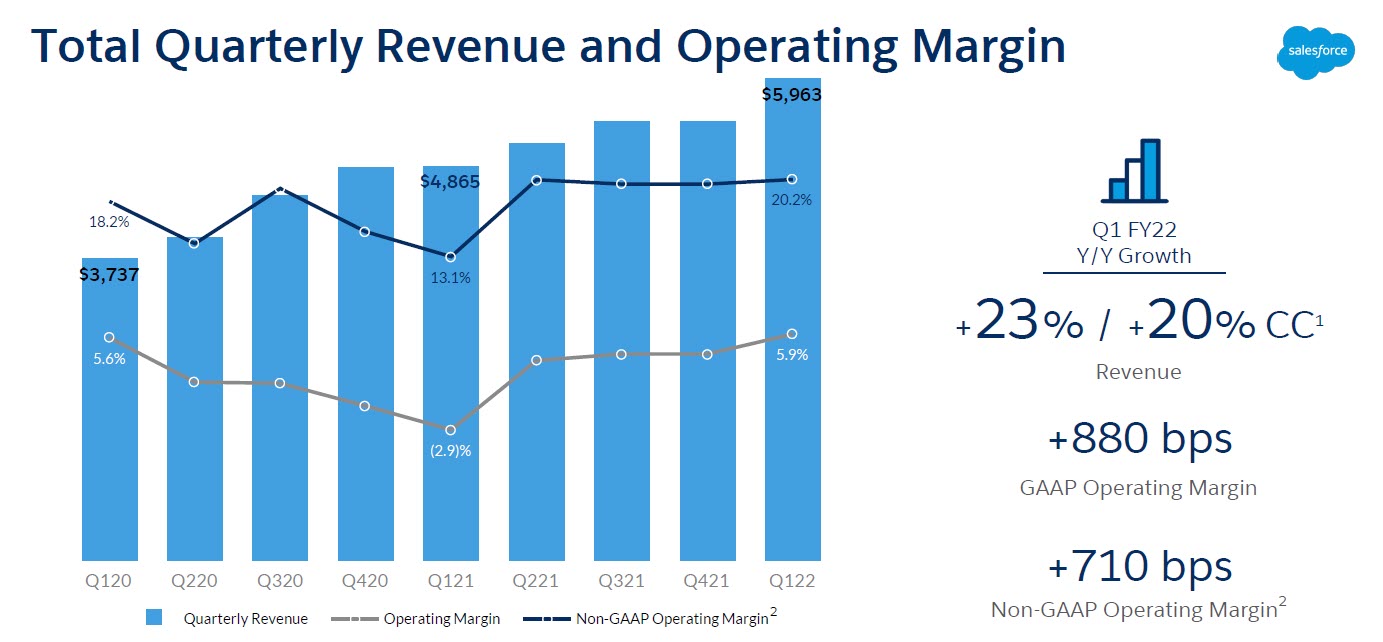
Salesforce’s ability to successfully close new multi-cloud deals and upsell multi-cloud solutions into their sizeable installed base helped deliver the best quarterly results in its history. Service Cloud, Tableau, MuleSoft, and Government sector customer wins also contributed to a strong FY Q1, 2022. The following is the Salesforce Q1, FY22 Financial Summary from their Financial Update Q1 FY22 Presentation.


Salesforce Sees Surge In $1M+ Deals Powering Record Q1, FY22 Results

Key takeaways from their Q1, FY22 results include the following:

  • Q1, FY22 revenue is up 23% year-over-year to $5.96B. Operating margins reached 5.9%, with non-GAAP operating margins reaching 20.2% in Q1. Salesforce successfully capitalizes on its customers’ urgency to transform their businesses while providing them with proven, well-integrated apps and platform strategies to help them build new digital businesses. Salesforce is also well-positioned to increase revenue based on the growing interest in analytics apps, combined with strong demand for mobile and social apps and multi-cloud integration. Combining proven apps and platforms with their ongoing R&D work in machine learning, AI, and predictive intelligence shows Salesforce is well-positioned for long-term growth in an increasingly multi-cloud enterprise world.
Salesforce Sees Surge In $1M+ Deals Powering Record Q1, FY22 Results
  • Successful multi-cloud sales strategies are propelling double-digit growth in the platform side of the business. Five of the ten $1M+ deals Salesforce signed in Q1 included MuleSoft. The Platform business is the fastest-growing segment of Salesforce today, attaining 28% year-over-year growth. Marketing and Commerce are next at 25% year-over-year revenue growth, driven by many Salesforce customers digitally transforming their selling and service strategies online. The latest quarters’ financial results by product area show how well-integrated and revenue-generating the ExactTarget, MuleSoft, and Tableau are turning out to be today.
Salesforce Sees Surge In $1M+ Deals Powering Record Q1, FY22 Results
  • Salesforce will reach $50B in revenue by 2026, supported by their Total Available Market (TAM), reaching $204B by CY2025. During the Q1, FY22 earnings call, Marc Benioff predicted Salesforce would nearly double in size in four years, reaching $50B from $26B, which is the projected FY22 revenue target. During the earnings call, Marc Benioff also said, “but I’ll tell you that it’s awesome to see not just be number one in CRM, but we’re going to be the number one enterprise software applications company in the world passing SAP.”  The seven core product areas Salesforce compete are combining to create a TAM growing at an 11% CAGR between 2021 and 2025. 
Salesforce Sees Surge In $1M+ Deals Powering Record Q1, FY22 Results

The Top 20 Machine Learning Startups To Watch In 2021

.
  • There are a record number of 9,977 machine learning startups and companies in Crunchbase today, an 8.2% increase over the 9,216 startups listed in 2020 and a 14.6% increase over the 8,705 listed in 2019.
  • Artificial Intelligence (A.I.) and machine learning (ML)-related companies received a record $27.6 billion in funding in 2020, according to Crunchbase. 
  • Of those A.I. and machine learning startups receiving funding since January 1, 2020, 62% are seed rounds, 31% early-stage venture rounds and 6.7% late-stage venture capital-funded rounds.
  • A.I. and machine learning startups’ median funding round was $4.4 million and the average was $29.8 million in 2020, according to Crunchbase.

Throughout 2020, venture capital firms continued expanding into new global markets, with London, New York, Tel Aviv, Toronto, Boston, Seattle and Singapore startups receiving increased funding. Out of the 79 most popular A.I. & ML startup locations, 15 are in the San Francisco Bay Area, making that region home to 19% of startups who received funding in the last year. Israel’s Tel Aviv region has 37 startups who received venture funding over the last year, including those launched in Herzliya, a region of the city known for its robust startup and entrepreneurial culture.  

The following graphic compares the top 10 most popular locations for A.I. & ML startups globally based on Crunchbase data as of today:

Top 20 Machine Learning Startups To Watch In 2021

Augury – Augury combines real-time monitoring data from production machinery with AI and machine learning algorithms to determine machine health, asset performance management (APM) and predictive maintenance (PdM) to provide manufacturing companies with new insights into their operations. The digital machine health technology that the company offers can listen to the machine, analyze the data and catch any malfunctions before they arise. This enables customers to adjust their maintenance and manufacturing processes based on actual machine conditions. The platform is in use with HVAC, industrial factories and commercial facilities.

Alation – Alation is credited with pioneering the data catalog market and is well-respected in the financial services community for its use of A.I. to interpret and present data for analysis. Alation has also set a quick pace to evolving its platform to include data search & discovery, data governance, data stewardship, analytics and digital transformation. With its Behavioral Analysis Engine, inbuilt collaboration capabilities and open interfaces, Alation combines machine learning with human insight to successfully tackle data and metadata management challenges. More than 200 enterprises are using Alation’s platform today, including AbbVie, American Family Insurance, Cisco, Exelon, Finnair, Munich Re, New Balance, Pfizer, Scandinavian Airlines and U.S. Foods. Headquartered in Silicon Valley, Alation is backed by leading venture capitalists including Costanoa, Data Collective, Icon, Sapphire and Salesforce Ventures.

Algorithmia – Algorithmia’s expertise is in machine learning operations (MLOps) and helping customers deliver ML models to production with enterprise-grade security and governance. Algorithmia automates ML deployment, provides tooling flexibility, enables collaboration between operations and development and leverages existing SDLC and CI/CD practices. Over 110,000 engineers and data scientists have used Algorithmia’s platform to date, including the United Nations, government intelligence agencies and Fortune 500 companies.

Avora – Avora is noteworthy for its augmented analytics platform, making in-depth data analysis intuitively as easy as performing web searches. The company’s unique technology hides complexity, empowering non-technical users to run and share their reports easily. By eliminating the limitations of existing analytics, reducing data preparation and discovery time by 50-80% and accelerating time to insight, Avora uses ML to streamline business decision-making. Headquartered in London with offices in New York and Romania, Avora helps accelerate decision making and productivity for customers across various industries and markets, including Retail, Financial Services, Advertising, Supply Chain and Media and Entertainment.

Boast.ai – Focused on helping companies in the U.S. and Canada recover their R&D costs from respective federal governments, Boast.ai enables engineers and accountants to gain tax credits using AI-based tools. Some of the tax programs Boast.ai works with include US R&D Tax Credits, Scientific Research and Experimental Development (SR&ED) and Interactive Digital Media Tax Credits (IDMTC). The startup has offices in San Francisco, Vancouver and Calgary.

ClosedLoop.ai – An Austin, Texas-based startup, ClosedLoop.ai has created one of the healthcare industry’s first data science platforms that streamline patient experiences while improving healthcare providers’ profitability.  Their machine learning automation platform and a catalog of pre-built predictive and prescriptive models can be customized and extended based on a healthcare provider’s unique population or client base needs. Examples of their technology applications include predicting admissions/readmissions, predicting total utilization & total risk, reducing out-of-network utilization, avoiding appointment no-shows, predicting chronic disease onset or progression and improving clinical documentation and reimbursement. The Harvard Business School, through its Kraft Precision Medicine Accelerator, recently named ClosedLoop.ai as one of the fastest accelerating companies in its Real World Data Analytics Landscapes report.

Databand – A Tel Aviv-based startup that provides a software platform for agile machine learning development, Databand was founded in 2018 by Evgeny Shulman, Joshua Benamram and Victor Shafran. Data engineering teams are responsible for managing a wide suite of powerful tools but lack the utilities they need to ensure their ops are running properly. Databand fills this gap with a solution that enables teams to gain a global view of their data flows, make sure pipelines complete successfully and monitor resource consumption and costs. Databand fits natively in the modern data stack, plugging seamlessly into tools like Apache Airflow, Spark, Kubernetes and various ML offerings from the major cloud providers.

DataVisor – DataVisor’s approach to using AI for increasing fraud detection accuracy on a platform level is noteworthy. Using proprietary unsupervised machine learning algorithms, DataVisor enables organizations to detect and act on fast-evolving fraud patterns and prevent future attacks before they happen. Combining advanced analytics and an intelligence network of more than 4.2B global user accounts, DataVisor protects against financial and reputational damage across various industries, including financial services, marketplaces, e-commerce and social platforms. They’re one of the more fascinating cybersecurity startups using AI today.

Exceed.ai – What makes Exceed.ai noteworthy is how their AI-powered sales assistant platform automatically communicates the lead’s context and enables sales and marketing teams to scale their lead engagement and qualification efforts accordingly. Exceed.ai follows up with every lead and qualifies them quickly through two-way, automated conversations with prospects using natural language over chat and email. Sales reps are freed from performing error-prone and repetitive tasks, allowing them to focus on revenue-generating activities such as phone calls and demos with potential customers.

Indico – Indico is a Boston-based startup specializing in solving the formidable challenge of how dependent businesses are on unstructured content yet lack the frameworks, systems and tools to manage it effectively. Indico provides an enterprise-ready A.I. platform that organizes unstructured content while streamlining and automating back-office tasks. Indico is noteworthy given its track record of helping organizations automate manual, labor-intensive, document-based workflows.  Its breakthrough in solving these challenges is an approach known as transfer learning, which allows users to train machine learning models with orders of magnitude fewer data than required by traditional rule-based techniques. Indico enables enterprises to deploy A.I. to unstructured content challenges more effectively while eliminating many common barriers to A.I. & ML adoption.

LeadGenius – LeadGenius is noteworthy for its use of AI to provide personalized and actionable B2B lead information that helps its clients attain their global revenue growth goals. LeadGenius’s worldwide team of researchers uses proprietary technologies, including AI and ML-based techniques, to deliver customized lead generation, lead enrichment and data hygiene services in the format, methods and frequency defined by the customer. Their mission is to enable B2B sales and marketing organizations to connect with their prospects via unique and personalized data sets.

Netra – Netra is a Boston-based startup that began as part of MIT CSAIL research and has multiple issued and pending patents on its technology today. Netra is noteworthy for how advanced its video imagery scanning and text metadata interpretation are, ensuring safety and contextual awareness. Netra’s patented A.I. technology analyzes videos in real-time for contextual references to unsafe content, including deepfakes and potential cybersecurity threats. 

Particle –  Particle is an end-to-end IoT platform that combines software including A.I., hardware and connectivity to provide a wide range of organizations, from startups to enterprises, with the framework they need to launch IoT systems and networks successfully.  Particle customers include Jacuzzi, Continental Tires, Watsco, Shifted Energy, Anderson EV, Opti and others. Particle is venture-backed and has offices in San Francisco, Shenzhen, Las Vegas, Minneapolis and Boston. Particle’s developer community includes over 200,000 developers and engineers in more than 170 countries today.

RideVision – RideVision was founded in 2018 by motorcycle enthusiasts Uri Lavi and Lior Cohen. The company is revolutionizing the motorcycle-safety industry by harnessing the strength of artificial intelligence and image-recognition technology, ultimately providing riders with a much broader awareness of their surroundings, preventing collisions and enabling bikers to ride with full confidence that they are safe. RideVision’s latest round was $7 million in November of last year, bringing their total funding to $10 million in addition to a partnership with Continental AG.

Savvie – Savvie is an Oslo-based startup specializing in translating large volumes of data into concrete actions that bakery and café owners can utilize to improve their bottom line every day.  In doing so, we help food businesses make the right decisions to optimize their operations and increase profitability while reducing waste at its source. What’s noteworthy about this startup is how adept they are at fine-tuning ML algorithms to provide their clients with customized recommendations and real-time insights about their food and catering businesses.  Their ML-driven insights are especially valuable given how bakery and café owners are pivoting their business models in response to the pandemic.

SECURITI.ai – One of the most innovative startups in cybersecurity, combining AI and ML to secure sensitive data in multi-cloud and mixed platform environments, SECURITI.ai is a machine learning company to watch in 2021, especially if you are interested in cybersecurity.  Their AI-powered platform and systems enable organizations to discover potential breach risk areas across multi-cloud, SaaS and on-premise environments, protect it and automate all private systems, networks and infrastructure functions.

SkyHive – SkyHive is an artificial intelligence-based SaaS platform that aims to reskill enterprise workforces and communities. It develops and commercializes a methodology, Quantum Labor Analysis, to deliver real-time, skill-level insights into internal workforces and external labor markets, identify future and emerging skills and facilitate individual-and company-level reskilling. SkyHive is industry-agnostic and supporting enterprise and government customers globally with a mission to reduce unemployment and underemployment. Sean Hinton founded the technology company in Vancouver, British Columbia, in 2017.

Stravito – Stravito is an A.I. startup that’s combining machine learning, Natural Language Processing (NLP) and Search to help organizations find and get more value out of the many market research reports, competitive, industry, market share, financial analysis and market projection analyses they have by making them searchable. Thor Olof Philogène and Sarah Lee founded the company in 2017, who identified an opportunity to help companies be more productive, getting greater value from their market research investments. Thor Olof Philogène and Andreas Lee were co-founders of NORM, a research agency where both worked for 15 years serving multinational brands, eventually selling the company to IPSOS. While at NORM, Anders and Andreas were receiving repeated calls from global clients that had bought research from them but could not find it internally and ended up calling them asking for a copy. Today the startup has Carlsberg, Comcast, Colruyt Group, Danone, Electrolux, Pepsi Lipton and others. Stravito has offices in Stockholm (H.Q.), Malmö and Amsterdam.

Verta.ai – Verta is a startup dedicated to solving the complex problems of managing machine learning model versions and providing a platform to launch models into production. Founded by Dr. Manasi Vartak, Ph.D., a graduate of MIT, who led a team of graduate and undergraduate students at MIT CSAIL to build ModelDB, Verta is based on their work define the first open-source system for managing machine learning models. Her dissertation, Infrastructure for model management and model diagnosis, proposes ModelDB, a system to track ML-based workflows’ provenance and performance. In August of this year, Verta received a $10 million Series A round led by Intel Capital and General Catalyst, who also led its $1.7 million seed round. For additional details on Verta.ai, please see How Startup Verta Helps Enterprises Get Machine Learning Right. The Verta MLOps platform launch webinar provides a comprehensive overview of the platform and how it’s been designed to streamline machine learning models into production:

V7 – V7 allows vision-based A.I. systems to learn continuously from training data with minimal human supervision. The London-based startup emerged out of stealth in August 2018 to reveal V7 Darwin, an image labeling platform to create training data for computer vision projects with little or no human involvement necessary. V7 specializes in healthcare, life sciences, manufacturing, autonomous driving, agri-tech, sporting clients like Merck, GE Healthcare and Toyota. V7 Darwin launched at CVPR 2019 in Long Beach, CA. Within its first year, it has semi-automatically annotated over 1,000 image and video segmentation datasets. V7 Neurons is a series of pre-trained image recognition applications for industry use. The following video explains how V7 Darwin works:

The Pandemic Is Teaching Enterprises How To Mind The Cybersecurity Gap

The Pandemic Is Teaching Enterprises How To Mind The Cybersecurity Gap

  • 30% of US and UK remote workers say their organizations don’t require them to use a secure access tool, including VPN, to log into corporate databases and systems, according to Ivanti’s 2021 Secure Consumer Cyber Report.
  • Plus, 25% of remote workers in the US and UK aren’t required to have specific security software running on their devices to access certain applications while working remotely.
  • And one in four US remote workers use their work email and passwords to log in to consumer websites and apps.

Cybersecurity gaps have continued to widen during the pandemic. A noteworthy survey by Ivanti illustrates exactly how remote workers are putting organizations at risk and where enterprise security is falling short, making those cybersecurity gaps challenging for CISOs to close. Ivanti’s 2021 Secure Consumer Cyber Report outlines the challenges that cybersecurity and IT teams have faced when securing remote workers in what’s being described as the “Everywhere Workplace.” Based on interviews with more than 2,000 US and UK respondents working from home in November 2020, the survey shows that authentication and endpoint security needs to improve across all devices that employees use.

IT Organizations Need Help Closing Their Cybersecurity  Gaps

Of the many lessons learned from 2020, among the most valuable are how virtual workforces need self-diagnosing and self-remediating endpoints, while IT organizations need improved unified endpoint management (UEM) as part of a zero-trust strategy. Bad actors continue to target remote workers’ privileged access credentials to gain access and exfiltrate customer, financial and proprietary data, including intellectual property. Ivanti’s survey provides insights into where cybersecurity gaps need attention first:

  • The most challenging threat surface to protect is a person’s identity because it’s exposed across so many threat surfaces, including personal and work devices, consumer websites, and IoT devices in homes. The pandemic is proving identities are the new security perimeter. A person’s cell phone, personal tablet, and laptop is a real-time digital definition of a person’s identity. Nearly half (49%) of US remote workers use personal devices for their jobs, often without two-factor authentication enabled. The graphic below shows how organizations can close this cybersecurity gap by adopting UEM as part of their go-forward initiatives in 2021 and beyond:

The Pandemic Is Teaching Enterprises How To Mind The Cybersecurity Gap

  • Lack of consistent security software and password standards is a big contributor to US and UK organizations’ cybersecurity gaps today. One in four remote workers can access enterprise resources without any security software in place. An even more surprising finding is that 30% of remote workers in the US and UK can access corporate data without a secure access tool or VPN connection. If a remote worker’s identity is compromised, there’s a one in three chance that their organization will be breached, enabling cyberattackers to move laterally through the company’s systems:

The Pandemic Is Teaching Enterprises How To Mind The Cybersecurity Gap

  • Protecting remote workers’ identities & devices at scale requires Zero Trust. Automating as many tasks as possible while providing a continuous and seamless user experience is the surest way to close cybersecurity gaps. Getting rid of passwords and automating two-factor authentication using Zero Sign-On (ZSO), a core part of the Ivanti platform, is proving essential today. Zero Sign-On relies on proven biometrics, including Apple’s Face ID, as a secondary authentication factor to gain access to work email, unified communications and collaboration tools, and corporate-shared databases and resources. CISOs and their teams also need to consider how mobile threat defense can better secure personal devices against phishing, device, network, and malicious app threats. Late last year, MobileIron (now part of Ivanti) received its second mention in two years in the Forrester Wave™: Zero Trust eXtended Ecosystem Platform Providers, Q3 2020. The Forrester Wave graphic is shown below:

The Pandemic Is Teaching Enterprises How To Mind The Cybersecurity Gap

  • In conclusion, enterprise cybersecurity gaps are widening due to a combination of risky consumer behavior and a lack of consistent security for mobile workforces. And these gaps will only increase as employees increasingly work from anywhere, using their personal devices to connect to corporate resources. To secure and enable the future of work, organizations need to start implementing and maturing an end-to-end zero trust security model today by leveraging new technologies and protecting their current security technology investments.