Skip to content

Posts from the ‘Louis Columbus’ blog’ Category

76% Of Enterprises Prioritize AI & Machine Learning In 2021 IT Budgets

  • 43% of enterprises say their AI and Machine Learning (ML) initiatives matter “more than we thought,” with one in four saying AI and ML should have been their top priority sooner.
  • 50% of enterprises plan to spend more on AI and ML this year, with 20% saying they will be significantly increasing their budgets.
  • 56% of all enterprises rank governance, security and auditability issues as their highest-priority concerns today.
  • In just over a third of enterprises surveyed (38%), data scientists spend more than 50% of their time on model deployment.   

Enterprises accelerated their adoption of AI and machine learning in 2020, concentrating on those initiatives that deliver revenue growth and cost reduction. Consistent with many other surveys of enterprises’ AI and machine learning accelerating projects last year, Algorithmia’s third annual survey, 2021 Enterprise Trends in Machine Learning finds enterprises expanding into a wider range of applications starting with process automation and customer experience. Based on interviews with 403 business leaders and practitioners who have insights into their company’s machine learning efforts, the study represents a random sampling of industries across a spectrum of machine learning maturity levels. Algorithmia chose to limit the survey to only those from enterprises with $100M or more in revenue. Please see page 34 of the study for additional details regarding the methodology.   

Key insights from the research include the following:

  • 76% of enterprises prioritize AI and machine learning (ML) over other IT initiatives in 2021. Six in ten (64%) say AI and ML initiatives’ priorities have increased relative to other IT priorities in the last twelve months. Algorithmia’s survey from last summer found that enterprises began doubling down on AI & ML spending last year. The pandemic created a new sense of urgency regarding getting AI and ML projects completed, a key point made by CIOs across the financial services and tech sectors last year during interviews for comparable research studies.
76% Of Enterprises Prioritize AI & Machine Learning In 2021 IT Budgets
Algorithmia’s third annual survey, 2021 Enterprise Trends in Machine Learning
  • 83% of enterprises have increased their budgets for AI and machine learning year-over-year from 2019 to 2020. 20% of enterprises increased their budget by over 50% between 2019 and 2020. According to MMC Ventures’ The State of AI Divergence Study, one in ten enterprises now uses ten or more AI applications with chatbots, process optimization and fraud analysis leading all categories. A recent Salesforce Research report, Enterprise Technology Trends, found that 83% of IT leaders say AI & ML is transforming customer engagement and 69% say it is transforming their business. The following compares year-over-year AI and ML budget changes between FY 2018 – 2019 and FY 2019 – 20.
76% Of Enterprises Prioritize AI & Machine Learning In 2021 IT Budgets
Algorithmia’s third annual survey, 2021 Enterprise Trends in Machine Learning
76% Of Enterprises Prioritize AI & Machine Learning In 2021 IT Budgets
Algorithmia’s third annual survey, 2021 Enterprise Trends in Machine Learning
  • Improving customer experiences to drive greater revenue growth and automating processes to reduce costs are the two most popular use cases or application areas for AI and ML in enterprises today. It’s noteworthy that seven of the top 20 use cases are customer-centric, nearly half of all use cases tracked in Algorithmia’s survey.  46% of enterprises are using AI & ML to combat fraud, which will most likely grow given the growth and severity of breaches, including the SolarWinds cyberattack. Capgemini’s recent study of AI adoption in cybersecurity found network, data and endpoint security are the three leading use cases of AI in cybersecurity today, with each predicted to get more funding in 2021, according to CISOs interviewed for the report.
76% Of Enterprises Prioritize AI & Machine Learning In 2021 IT Budgets
Algorithmia’s third annual survey, 2021 Enterprise Trends in Machine Learning
  • AI and ML business cases that provide greater customer revenue growth, reduced costs and greater financial visibility have the highest priority of being funded inside any enterprise today. The combination of improving customer experiences, automating processes (to reduce costs) and generating financial insights (for greater financial visibility) is the ideal combination for getting a proof of concept started for an AI or ML project. The proliferation of AI and ML use cases shown in the graphic below is attributable to how each contributes to enterprises achieving a tangible, positive ROI by combining them to solve specific business problems.
76% Of Enterprises Prioritize AI & Machine Learning In 2021 IT Budgets
Algorithmia’s third annual survey, 2021 Enterprise Trends in Machine Learning

The Best Tech Companies For Remote Jobs In 2021 According To Glassdoor

  • Glassdoor shows 3,937 companies in the middle of a hiring surge during Covid-19, 960 of which are in information technology.
  • Leading software companies going through a hiring surge right now include Aha! Software, Appen, Clevertech, CrowdStrike, Datadog, Dataiku, Fastly, Hashicorp, Leidos, Liveops, Netskope, Proofpoint, Rackspace, Zapier and Zendesk.   
  • Modern Tribe, Dataiku, Zapier, PartnerCentric, Slack, Fuse, ScienceLogic and SAP are the highest rated companies by their employees on Glassdoor who offer remote jobs today.
  • Between Glassdoor, Indeed, LinkedIn and Monster, there are over 16,500 open remote-based software technical professional jobs available today. Companies with open, remote-based solutions include Aha!, Box, Cloudera, DemandBase, Jobot,  Red Hat, NTT Data, Salesforce and many others.   
  • Freshworks currently has 161 openings, the majority of which are remote. Check out their open positions here on Glassdoor.
  • GitLab alone has 79 remote full-time positions open today and is widely considered a leader in creating a productive, positive remote working culture, with 88% of employees saying they would recommend the company to a friend.  

These and many other useful insights are based on comparing the leading tech companies who offer remote, work-from-home job positions by their Glassdoor scores. Leading tech companies are ranked on the percentage of employees who would recommend their company to a friend and the percent of employees who approve of the CEO. The total number of open job positions by company is in the third column of the table. Hiring companies of note include the following:

PowerToFly has had an impressive growth year and is the go-to remote job search engine for women professionals. The company was launched in 2014 by Milena Berry and Katharine Zaleski to connect Fortune 500 companies, startups and growing companies with women looking to work for businesses that value gender diversity and inclusion. PowerToFly’s number of available remote jobs has soared from 994 earlier this year to over 2,500 open remote positions today. 94% of employees would recommend working at PowerToFly to a friend and 93% approve of their CEOs.  

The best tech companies for remote jobs in 2021 table is shown below. You can download the original Excel data set here. Please click on the image to expand it for easier reading.

  • Angelist has 2,700 enterprise software-related remote positions on their website today with companies including Auth0, Arctic Wolf Networks, Confluent, Couchbase, HackerOne, Slack, MindTickle, MongoDB, Sendoso, Tanium and many others.  
  • FlexJobs has 5,566 remote-based software jobs that include full-time, part-time and freelance positions. Open positions include Senior Software Engineers, DevOps Engineers, Product Managers, Project Managers, Full Stack Developers and more. 
  • Remotive provides a curated list of 192 startups, many of which have open remote-based positions on December 1, 2020.
  • StackOverflow has 815 open remote-based job positions available today, including Canonical (39 open jobs), Octane AI, Shield AI and many others.
  • Torch Capital’s Talent Connect Portal has 980 positions open today, including several from DoubleVerify, Electric, Lexis Nexis, Nexon America, Shopify, Tesla and others.  
  • Working Nomads site currently has 11,216 remote, work-from-home development jobs advertised. There are also 2,021 marketing, 1,922 management, 1,873 system administration, 1,592 design and 1,164 sales remote, work-from-home job postings.  

Software Dominates Deloitte’s 2020 Tech Fast 500 With 71% Of All Companies

  • Software companies continue to deliver the highest growth rates for the 25th straight year, representing 71% of the entire list, the highest-ever percentage in the history of the rankings.
  •  353 of the 500 fastest-growing companies in North America are in the software industry according to Deloitte’s 2020 Tech Fast 500, the most ever in the history of their rankings and a 3% increase over last year.
  • Two of the ten fastest-growing companies over the last three years specialize in cybersecurity, OneTrust and Transmit Security.
  • Notable software companies ranked in Deloitte’s 2020 Tech Fast 500 include Bolt, Illumio, LogicMonitor and Seeq.
  • Biotechnology/pharmaceutical companies are the second most prevalent sector, comprising 14% of all companies, followed by digital content/media/entertainment (5%) and medical devices (4%).  

It’s fascinating to look at the emerging trends in Deloitte’s 2020 North America Technology Fast 500 Rankings as leading predictors of innovation. This year’s report is a quick read and provides a glimpse into the fastest-growing companies between 2016 and 2019. Deloitte chooses Technology Fast 500 awardees based on percentage fiscal year revenue growth from 2016 to 2019. Overall, the 2020 Technology Fast 500 companies achieved revenue growth ranging from 175% to 106,508% over the three-year time frame, with a median growth rate of 450%.

Key insights from the rankings include the following:

  • Five of the top ten winners are software companies, including Branch Metrics, OneTrust, Transmit Security, Drift and CharterUP. It’s noteworthy that cybersecurity is well-represented in the top ten fastest-growing companies between 2016 and 2019. OneTrust and Transmit Security is in the top five fastest-growing companies between 2016 and 2019, accentuating how critical cybersecurity is becoming in all businesses. The following graphic lists the top ten Deloitte 2020 North America Technology Fast 500 winners.
Software Dominates Deloitte's 2020 Tech Fast 500 With 71% Of All Companies
Deloitte’s 2020 North America Technology Fast 500 Rankings
  •  Digital platform and enterprise infrastructure & productivity dominate software companies are dominating software sub-sectors with 56% of all companies. Deloitte’s ranking reflects the increasing urgency all organizations have to launch, scale and excel at new digital selling channels. The pandemic accelerated the urgency faster than the most compelling business case ever could. Having over 50% of all software companies in these categories quantifies the cloud as the platform of choice across enterprises.  
Software Dominates Deloitte's 2020 Tech Fast 500 With 71% Of All Companies
Deloitte’s 2020 North America Technology Fast 500 Rankings
  • Electronic devices/hardware, energy tech and software & SaaS are the three sectors generating the fastest growing businesses over the last three years. Edge computing and the quick pace of innovation in intelligent sensor development and adoption for the Internet of Things (IoT) and Industrial Internet of Things (IIoT) use cases are catalysts driving the 683% growth rate. Sustainability’s bottom-line benefits, including its positive impact on lean manufacturing, help drive to 525% growth rate in energy tech. Software and SaaS median growth rate of 465% shows enterprise software’s evolution is nascent and just getting started.
Software Dominates Deloitte's 2020 Tech Fast 500 With 71% Of All Companies
Deloitte’s 2020 North America Technology Fast 500 Rankings
Software Dominates Deloitte's 2020 Tech Fast 500 With 71% Of All Companies
Deloitte’s 2020 North America Technology Fast 500 Rankings

What Are The Fastest Growing Cybersecurity Skills In 2021?

  • Cybersecurity professionals with cloud security skills can gain a $15,025 salary premium by capitalizing on strong market demand for their skills in 2021.  
  • DevOps and Application Development Security professionals can expect to earn a $12,266 salary premium based on their unique, in-demand skills.
  • 413,687 job postings for Health Information Security professionals were posted between October 2019 to September 2020, leading all skill areas in demand.  

Cybersecurity’s fastest-growing skill areas reflect the high priority organizations place on building secure digital infrastructures that can scale. Application Development Security and Cloud Security are far and away from the fastest-growing skill areas in cybersecurity, with projected 5-year growth of 164% and 115%, respectively. This underscores the shift from retroactive security strategies to proactive security strategies. According to The U.S. Bureau of Labor Statistics’ Information Security Analyst’s Outlook, cybersecurity jobs are among the fastest-growing career areas nationally. The BLS predicts cybersecurity jobs will grow 31% through 2029, over seven times faster than the national average job growth of 4%. 

Burning Glass, a leading labor market analytics firm, has been tracking demand for cybersecurity skills based on its database of more than one billion current and historical job postings. This week they published the results of their analysis of the top 10 cybersecurity skills for 2021. Their report of the 10 cybersecurity skills for 2021 can be downloaded here.

What Are The Fastest Growing Cybersecurity Skills In 2021?

Key takeaways from their analysis include the following:

  • Cloud Security skills are the most lucrative of all, predicted to deliver a $15,008 salary boost in 2021. Demand for specific Cloud Security skills is far outpacing the broader demand for cybersecurity skills in the labor market. Burning Glass predicts the fastest-growing skills over the next five years include Azure Security (+164%), Cloud Security Infrastructure (+144%), Google Cloud Security (+135%), Public Cloud Security (+121%), Cloud Security Architecture (+103%). There are 19,477 positions available for cybersecurity professionals with Cloud Security skills.
What Are The Fastest Growing Cybersecurity Skills In 2021?

Burning Glass Technologies: Protecting the Future: The Fastest-Growing Cybersecurity Skills October 2020

  • The fastest-growing cybersecurity skill is Application Development Security, predicted to see a 164% increase in available positions over five years. Cybersecurity professionals with Application Development Security, DevSecOps, Container Security, Microservices Security, Application Security Code Review are predicted to see an average $12,266 salary boost starting next year given the strong marketability of their skills. Like Cloud Security, market demand for Application Development Security professionals’ skillsets far outpaces average cybersecirty jobs growth over five years.
What Are The Fastest Growing Cybersecurity Skills In 2021?

Burning Glass Technologies: Protecting the Future: The Fastest-Growing Cybersecurity Skills October 2020

  • Knowing where the most cybersecurity job postings are by metro area and state provides job seekers with the insights they need to narrow their job search. Cyberseek partnered with Burning Glass to create an interactive U.S.-based heat map that shows cybersecurity positions by state or metro area. The heat map can be configured to show total job openings, supply of workers, supply/demand ratio,and location quotients. You can access the heat map here.    
What Are The Fastest Growing Cybersecurity Skills In 2021?

Burning Glass Technologies: Protecting the Future: The Fastest-Growing Cybersecurity Skills October 2020


83% Of Enterprises Transformed Their Cybersecurity In 2020

83% Of Enterprises Transformed Their Cybersecurity In 2020

  • 73% of enterprises (over 500 employees) accelerated their cloud migration plans to support the shift to remote working across their organizations due to the pandemic.
  • 81% of enterprises accelerated their IT modernization processes due to the pandemic.
  • 48% of all companies surveyed have accelerated their cloud migration plans, 49% have sped up their IT modernization plans because of Covid-19.
  • 32% of large-scale enterprises, over 500 employees, are implementing more automation using artificial intelligence-based tools this year.

These and many other insights are from a recent survey of IT leaders completed by CensusWide and sponsored by Centrify. The survey’s objectives on understanding how the dynamics of IT investments, operations and spending have shifted over the last six months. The study finds that the larger the enterprise, the more important it is to secure remote access to critical infrastructure to IT admin teams. Remote access and updating privacy policies and notices are two of the highest priorities for mid-size organizations to enterprises today. The methodology is based on interviews with 215 IT leaders located in the U.S.     

Key insights from the survey include the following:

  • The overwhelming majority of enterprises have transformed their cybersecurity approach over the last six months, with 83% of large-scale enterprises leading all organizations. It’s encouraging to see small and medium-sized businesses adjusting and improving their approach to cybersecurity. Reflecting how digitally-driven many small and medium businesses are, cybersecurity adjustments begin in organizations with 10 to 49 employees. 60% adjusted their cloud security postures as a result of distributed workforces. 

83% Of Enterprises Transformed Their Cybersecurity In 2020

  • 48% of all organizations had to accelerate cloud migration due to the pandemic, with larger enterprises leading the way. Enterprises with over 500 employees are the most likely to accelerate cloud migration plans due to the pandemic. 73.5% of enterprises with more than 500 employees accelerated cloud migration plans to support their employees’ remote working arrangements, leading all organization categories. This finding reflects how cloud-first the largest enterprises have become this year. It’s also consistent with many other surveys completed in 2020, reflecting how much the cloud has solidly won the enterprise. 
83% Of Enterprises Transformed Their Cybersecurity In 2020
  • 49% of all organizations and 81% of large-scale enterprises had to accelerate their IT modernization process due to the pandemic. For the largest enterprises, IT modernization equates to digitizing more processes using cloud-native services (59%), maintaining flexibility and security for a partially remote workforce (57%) and revisiting and adjusting their cybersecurity stacks (40%).
83% Of Enterprises Transformed Their Cybersecurity In 2020
  •  51% of enterprises with 500 employees or more are making remote, secure access their highest internal priority. In contrast, 27% of all organizations’ IT leaders say that providing secure, granular access to IT admin teams, outsourced IT and third-party vendors is a leading priority. The larger the enterprise, the more important remote access becomes. The survey also found organizations with 250 – 500 employees are most likely to purchase specific cybersecurity tools and applications to meet compliance requirements. 
83% Of Enterprises Transformed Their Cybersecurity In 2020


Conclusion & Wrap-Up  

IT leaders are quickly using the lessons learned from the pandemic as a crucible to strengthen cloud transformation and IT modernization strategies. One of every three IT leaders interviewed, 34%, say their budgets have increased during the pandemic. In large-scale enterprises with over 500 employees, 59% of IT leaders have seen their budgets increase.

All organizations are also keeping their IT staff in place. 63% saw little to no impact on their teams, indicating that the majority of organizations will have both the budget and resources to maintain or grow their cybersecurity programs. 25% of IT leaders indicated that their company plans to keep their entire workforce 100% remote.

It’s encouraging to see IT leaders getting the support they need to achieve their cloud transformation and IT modernization initiatives going into next year. With every size of organization spending on cybersecurity tools, protecting cloud infrastructures needs to be a priority. Controlling administrative access risk in the cloud and DevOps is an excellent place to start with a comprehensive, modern Privileged Access Management solution. Leaders in this field, including Centrify, whose cloud-native architecture and flexible deployment and management options, deliver deep expertise in securing cloud environments.

How An AI Platform Is Matching Employees And Opportunities

How An AI Platform Is Matching Employees And Opportunities

Instead of relying on data-driven signals of past accomplishments, Eightfold.ai is using AI to discover the innate capabilities of people and matching them to new opportunities in their own companies.

Bottom Line: Eightfold.ai’s innovative approach of combining their own AI and virtual hackathons to create and launch new additions to their Project Marketplace rapidly is a model enterprises need to consider emulating.

Eightfold.ai was founded with the mission that there is a right career for everyone in the world. Since its founding in 2016, Eightfold.ai’s Talent Intelligence Platform continues to see rapid global growth, attracting customers across four continents and 25 countries, supporting 15 languages with users in 110 countries. Their Talent Intelligence Platform is built to assist enterprises with Talent Acquisition and Management holistically.

What’s noteworthy about Eightfold.ai’s approach is how they have successfully created a platform that aggregates all available data on people across an enterprise – from applicants to alumni – to create a comprehensive Talent Network. Instead of relying on data-driven signals of past accomplishments, Eightfold.ai is using AI to discover the innate capabilities of people and matching them to new opportunities in their own companies. Eightfold’s AI and machine learning algorithms are continuously learning from enterprise and individual performance to better predict role, performance and career options for employees based on capabilities.

How Eightfold Sets A Quick Pace Innovating Their Marketplace

Recently Eightfold.ai announced Project Marketplace, an AI-based solution for enterprises that align employees seeking new opportunities and companies’ need to reskill and upskill their employees with capabilities that line up well with new business imperatives. Eightfold wanted to provide employees with opportunities to gain new skills through experiential learning, network with their colleagues, join project teams and also attain the satisfaction of helping flatten the unemployment curve outside. Project Marketplace helps employers find hidden talent, improve retention strategies and gain new knowledge of who has specific capabilities and skills. The following is a screen from the Marketplace that provides employees the flexibility of browsing all projects their unique capabilities qualify them for:

How An AI Platform Is Matching Employees And Opportunities

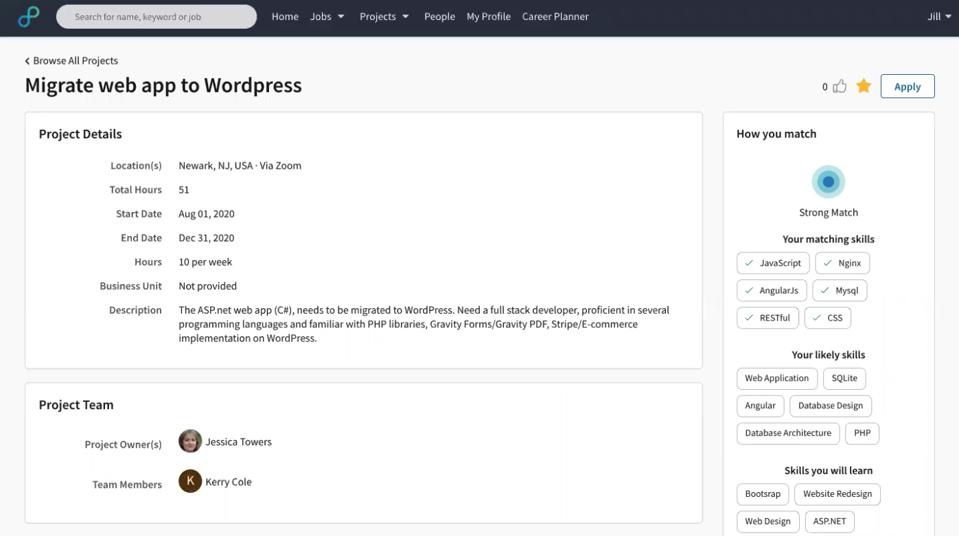
Employees select a project of interest and are immediately shown how strong of a match they are with the open position. Eightfold provides insights into relevant skills that an employee already has, why they are a strong match and the rest of the project team members – often a carrot in itself. Keeping focused on expanding employee’s capabilities, Eightfold also provides guidance of which skills an employee will learn. The following is an example of what an open project positions looks like:

How An AI Platform Is Matching Employees And Opportunities

How An AI Platform Is Matching Employees And Opportunities

Employee applicants can also view all the projects they currently have open from the My Projects view shown below:

How An AI Platform Is Matching Employees And Opportunities

Project Marketplace is the win/win every employee has yearned for as they start to feel less challenged in their current position and start looking for a new one, often outside their companies. I recently spoke with Ashutosh Garg, CEO and Co-Founder and Kamal Ahluwalia, Eightfold’s President, to see how they successfully ran a virtual hackathon across three continents to keep the Marketplace platform fresh with new features and responsive to the market.

How to Run A Virtual Hackathon

Starting with the hackathon, Eightfold relied on its own Talent Intelligence Platform to define the teams across all three continents, based on their employees’ combined mix of capabilities. Ashutosh, Kamal and the senior management team defined three goals of the hackathon:

  1. Solve problems customers are asking about with solutions that are not on the roadmap yet.
  2. Accelerate time to value for customers with new approaches no one has thought of before.
  3. Find new features and unique strengths that further strengthen the company’s mission of finding the right career for everyone in the world.

It’s fascinating to see how AI, cybersecurity and revenue management software companies continue to innovate at a fast pace delivering complex apps with everyone being remote. I asked Ashutosh how he and his management team approached the challenge of having a hackathon spanning three continents deliver results. Here’s what I learned from our discussion and these lessons are directly applicable to any virtual hackathon today:

  1. Define the hackathon’s purpose clearly and link it to the company mission, explaining what’s at stake for customers, employees and the millions of people looking for work today – all served by the Talent Intelligence Platform broadening its base of features.
  2. Realize that what you are building during the hackathon will help set some employees free from stagnating skills allowing them to be more employable with their new capabilities.
  3. The hackathon is a chance to master new skills through experiential learning, further strengthening their capabilities as well. And often learning from some of the experts in the company by joining their teams.
  4. Reward risk-taking and new innovative ideas that initially appear to be edge cases, but can potentially be game changers for customers.

I’ve been interviewing CEOs from startups to established enterprise software companies about how they kept innovation alive during the lockdown. CEOs have mentioned agile development, extensive use of Slack channels and daily virtual stand-ups. Ashutosh Garg is the only one to mention how putting intrinsic motivation into practice, along with these core techniques, binds hackathon teams together fast. Dan Pink’s classic TED Talk, The Puzzle of Motivation, explains intrinsic motivators briefly and it’s clear they have implications on a hackathon succeeding or not.

Measuring Results Of the Hackathon

Within a weekend, Project Marketplace revealed several new rock stars amongst the Eightfold hackathon teams. Instead of doing side projects for people who had time on their hands, this Hackathon was about making Eightfold’s everyday projects better and faster. Their best Engineers and Services team members took a step back, re-looked at the current approaches and competed with each other to find better and innovative ways. And they all voted for the most popular projects and solutions – ultimate reward in gaining the respect of your peers. As well as the most “prolific coder” for those who couldn’t resist working on multiple teams.

Conclusion

Remote work is creating daunting challenges for individuals at home as well as for companies. Business models need to change and innovation cannot take a back seat while most companies have employees working from home for the foreseeable future. Running a hackathon during a global lockdown and making it deliver valuable new insights and features that benefit customers now is achievable as Eightfold’s track record shows. Project marketplace may prove to be a useful ally for employees and companies looking to stay true to their mission and help each other grow – even in a pandemic. This will create better job security, a culture of continuous learning, loyalty and more jobs. AI will change how we look at our work – and this is a great example of inspiring innovation.


What’s New In Gartner’s Hype Cycle For Endpoint Security, 2020

What’s New In Gartner’s Hype Cycle For Endpoint Security, 2020

  • Remote working’s rapid growth is making endpoint security an urgent priority for all organizations today.
  • Cloud-first deployment strategies dominate the innovations on this year’s Hype Cycle for Endpoint Security.
  • Zero Trust Security (ZTNA) is gaining adoption in enterprises who realize identities are the new security perimeter of their business.
  • By 2024, at least 40% of enterprises will have strategies for adopting Secure Access Service Edge (SASE) up from less than 1% at year-end 2018.

These and many other new insights are from Gartner Hype Cycle for Endpoint Security, 2020 published earlier this year and the recent announcement, Gartner Says Bring Your Own PC Security Will Transform Businesses within the Next Five Years. Gartner’s definition of Hype Cycles includes five phases of a technology’s lifecycle and is explained here.  There are 20 technologies on this year’s Hype Cycle for Endpoint Security. The proliferation of endpoint attacks, the rapid surge in remote working, ransomware, fileless and phishing attacks are together, creating new opportunities for vendors to fast-track innovation. Cloud has become the platform of choice for organizations adopting endpoint security today, as evidenced by the Hype Cycle’s many references to cloud-first deployment strategies.  The Gartner Hype Cycle for Endpoint Security, 2020, is shown below:

What’s New In Gartner’s Hype Cycle For Endpoint Security, 2020


Details Of What’s New In Gartner’s Hype Cycle for Endpoint Security, 2020

  • Five technologies are on the Hype Cycle for the first time reflecting remote working’s rapid growth and the growing severity and sophistication of endpoint attacks. Unified Endpoint Security, Extended Detection and Response, Business E-Mail Compromise Protection, BYOPC Security and Secure Access Service Edge (SASE) are the five technologies added this year. Many organizations are grappling with how to equip their remote workforces with systems, devices and smartphones, with many reverting to have employees use their own. Bring your PC (BYOPC) has become so dominant so fast that Gartner replaced BYOD on this year’s Hype Cycle with the new term. Gartner sees BYOPC as one of the most vulnerable threat surfaces every business has today. Employees’ devices accessing valuable data and applications continues to accelerate without safeguards in place across many organizations.
  • Extended detection and response (XDR) are on the Hype Cycle for the first time, reflecting the trend of vendor consolidation across cybersecurity spending today. Gartner defines XDR as a vendor-specific, threat detection and incident response tool that unifies multiple security products into a security operations system. XDR and its potential to reduce the total cost and complexity of cybersecurity infrastructures is a dominant theme throughout this year’s Hype Cycle. XDR vendors are claiming that their integrated portfolios of detection and response applications deliver greater accuracy and prevention than stand-alone systems, driving down Total Cost of Ownership (TCO) and increasing productivity. Key vendors in XDR include Cisco, FireEye, Fortinet, McAfee, Microsoft, Palo Alto Networks, Sophos, Symantec and Trend Micro.
  • Business email compromise (BEC) protection is on the Hype Cycle for the first time this year. Phishing attacks cost businesses $1.8B in 2019, according to the FBI, underscoring the need for better security in the area of business email. Gartner defines business email compromise (BEC) protection as a series of solutions that detect and filter malicious emails that fraudulently impersonate business associates to misdirect funds or data. There have been many instances of business email compromise attacks focused on C-level executives, hoping that a fraudulent directive from them to subordinates leads to thousands of dollars being transferred to outside accounts or being sent in gift cards. Gartner found that fraudulent invoices accounted for 39% of such attacks in 2018, posing an internal risk to organizations and reputation risk.
  • Unified Endpoint Security (UES) is being driven by IT organizations’ demand for having a single security console for all security events. Gartner notes that successful vendors in UES will be those that can demonstrate significant productivity gains from the integration of security and operations and those that can rapidly process large amounts of data to detect previously unknown threats. CIOs and CISOs are looking for a way to integrate UES and Unified Endpoint Management (UEM), so their teams can have a single, comprehensive real-time console of all devices that provides alerts of any security events. The goal is to adjust security policies across all devices. Absolute’s approach to leveraging their unique persistence, resilience and intelligence capabilities are worth watching. Their approach delivers unified endpoint security by relying on their Endpoint Resilience platform that includes a permanent digital tether to every endpoint in the enterprise. By having an undeletable digital thread to every device, Absolute is enabling self-healing, greater visibility and control. Based on conversations with their customers in Education and Healthcare, Absolute’s unique approach gives IT complete visibility into where every device is at all times and what each device configuration looks like in real-time.
  • Unified Endpoint Management (UEM) is expanding rapidly beyond managing PCs and mobile devices to provide greater insights from endpoint analytics and deeper integration Identity and Access Management. Gartner notes interest in UEM remains strong and use-case-driven across their client base. UEM’s many benefits, including streamlining continuous OS updates across multiple mobile platforms, enabling device management regardless of the connection and having an architecture capable of supporting a wide range of devices and operating systems are why enterprises are looking to expand their adoption of UEM. Another major benefit enterprises mention is automating Internet-based patching, policy, configuration management. UEM leaders include MobileIron, whose platform reflects industry leadership with its advanced unified endpoint management (UEM) capabilities. MobileIron provides customers with additional security solutions integrated to their UEM platform, including passwordless multi-factor authentication (Zero Sign-On) and mobile threat defense (MTD). MTD is noteworthy for its success at MobileIron customers who need to validate devices at scale, establish user context, verify network connections, then detect and remediate threats.
  •  Gartner says ten technologies were either removed or replaced in the Hype Cycle because they’ve evolved into features of broader technologies or have developed into tools that address more than security. The ten technologies include protected browsers, DLP for mobile devices, managed detection and response, user and entity behavior analytics, IoT security, content collaboration platforms, mobile identity, user authentication, trusted environments and BYOD being replaced by BYOPC.


Why Digital Transformation Always Needs To Start With Customers First

Why Digital Transformation Always Needs To Start With Customers First

Customers’ expectations, preferences, changing patterns in how and why they purchase need to be the core of any digital transformation effort.

Customers’ expectations, preferences, changing patterns in how and why they purchase need to be the core of any digital transformation effort. With it, digital transformation projects flourish and take on a life of their own. Without it, I’ve seen digital transformation projects become myopic, narrowly focused, substituting internal metric gains for measures that matter most to customers.

Digital Maturity Drives Revenue

Anyone who has worked on a digital transformation project quickly sees how the most digitally mature organizations can turn their investments in transformation into revenue by overwhelming customers with value. Initiatives that put customers first can serve to generate greater confidence among C-level executives and board members, leading to more funding. This is because business cases for customer-centric digital transformation projects are easier to create, more defensible and best of all, point to revenue gains and cost reductions.

Deloitte Insights’ recent survey uncovering the connection between digital maturity and financial performance accurately reflects the true state of customer-centric digital transformation. The article explains how the more digitally mature an organization is, the more achievable gains are in diversity and inclusion, Corporate Social Responsibility (CSR), customer satisfaction, product quality, gross margin and long-term financial performance. Deloitte’s latest study finds a strong correlation between the digital maturity of an enterprise and its net revenue and net profit margin. The following graphic makes clear how valuable pursuing digital maturity is, with customers being at the center of all transformation efforts. This contributes to greater net revenue and net profit margin growth:

A fascinating point regarding Deloitte Insights’ research is the correlation it uncovered between an organization’s digital transformation maturity and the benefits they gain in efficiency, revenue growth, product/service quality, customer satisfaction and employee engagement. They found a hierarchy of pivots successful enterprises make to keep pursuing more agile, adaptive organizational structures combined with business model adaptability, all driven by customer-driven innovation. The most digitally mature organizations can adopt new frameworks that prioritize market responsiveness, customer-centricity and have analytics and data-driven culture with actionable insights embedded in their DNA.

Mastering Data & Removing Roadblocks Are Key To Driving Customer Value

The two highest-payoff areas for accelerating digital maturity and achieving its many benefits are mastering data and creating more intelligent workflows. Deloitte Insights’ research team looked at the seven most effective digital pivots enterprises can make to become more digitally mature. The pivots that paid off the best as measured by revenue, margin, customer satisfaction, product/service quality and employee engagement combined data mastery and improving intelligent workflows. The following graphic shows how 51% of revenue growth can be explained by these two factors alone and 49% of improved customer satisfaction.

Data mastery and intelligent workflows are among the easiest areas to measure and include in a business case for digital transformation projects aimed at delivering a transcendent customer experience. Choosing to excel on the dimension of customer-centric data mastery gives enterprises the insights they need to create their unique omnichannel platforms. Adding in intelligent workflows that give customers the freedom to buy how, where and when they choose across any digital platform is the cornerstone of entirely new digital business models today. Capturing the voice of the customer and combining data mastery and intelligent workflows to gain an accurate, true 360-degree view of customers is invaluable for every aspect of go-to-market strategies.

Achieving Digital Maturity Requires A Framework

Enterprises that have customer centricity and a data-driven mindset are the most likely to succeed with a digital transformation initiative. As the Deloitte Insights study inferred, the most digitally mature organizations are continually adapting to customer and market dynamics. They’re prioritizing market responsiveness, striving to improve customer-centricity and have data-driven cultures with actionable insights as part of their DNA. Enterprises who see new digital business model opportunities and act on them capitalize on these three areas of organizational strength. They’re also able to combine their data mastery and intelligent workflows to identify areas of competitive opportunity to help them excel for their customers.

Consider how cybersecurity is now part of any customer experience, for good and bad. Multi-factor Authentication (MFA) and many other forms of identity verification secure customer transactions, yet they can also cause dissatisfaction. For any digitally mature enterprise, integrating cybersecurity into their existing framework is a challenge. The growth of new frameworks designed to empower greater customer-centricity, agility and actionable insights across every facet of a business is a fascinating area of watch.

One of the more interesting is BMC’s Autonomous Digital Enterprise (ADE) framework, which is shown below. Mapping Deloitte Insights’ top investment priorities for the next 12 months across all digital maturity levels to the ADE framework shows why frameworks like BMC’s are gaining adoption, particularly as organizations look to run and reinvent themselves with new digital business models built around AI/ML capabilities. The following graphic provides insights into how Deloitte’s top investment priorities are integral to BMC’s Autonomous Digital Enterprise Framework and its many contributions to the success of new digital business growth.

Conclusion

Quantifying the impact of having a customer-centric digital transformation strategy has proved elusive until recently. Deloitte Insights’ research shows how digital maturity enables greater gains from customer-centric digital transformation efforts. What’s fascinating about their research is how the progression of digital pivots leads to improved margin, revenue, customer satisfaction, diversity and inclusion and product quality gains. Equally interesting is the growing utility of frameworks like BMC’s, which are designed to enable long-standing enterprises to seamlessly embrace new digital business models, so they can flex and change with the world around them.


Where AIOps Is Delivering Results Today

Where AIOps Is Delivering Results Today

Bottom Line: Capitalizing on AI and machine learning’s inherent strengths to create contextual intelligence in real-time, LogicMonitor’s early warning and failure prevention systems reflect where AIOps is delivering results today.

LogicMonitor’s track record of making solid contributions to their customers’ ability to bring greater accuracy, insight, and precision into monitoring all IT assets is emerging as a de facto industry standard. Recently I was speaking with a startup offering Hosted Managed Services of a variety of manufacturing applications, and the must-have in their services strategy is LogicMonitor LM Intelligence. LogicMonitor’s AIOps platform is powered by LM Intelligence, enabling customers’ businesses to gain early warning into potential trouble spots in IT operations stability and reliability. LogicMonitor does the hard work for you with automated alert thresholds, AI-powered early warning capabilities, customizable escalation chains, workflows, and more.

Engineers who are working at the Hosted Managed Services provider I recently spoke with say LM Intelligence is the best use case of AI and machine learning to provide real-time alerts, contextual insights, discover new patterns in data, and make automation achievable. The following is an example of the LM Intelligence dashboard:

Where AIOps Is Delivering Results Today

How LogicMonitor’s Architecture Supports AIOps

One of the core strengths LogicMonitor continues to build on is integration, which they see as essential to their ability to excel at providing AIOps support for their customers. Their architecture is shown below. By providing real-time integration to public cloud platforms, combined with control over the entire IT infrastructure structure along with over 2,000 integrations from network to cloud, LogicMonitor excels at unifying diverse IT environments into a single, cohesive AIOps-based intelligence system.  The LogicMonitor platform collects cloud data through our cloud collectors. These collectors retrieve metrics such as the cloud provider health and billing information by making API calls to the cloud services. The collector is a Windows Service or background process that is installed in a virtual machine. This collector then pulls metrics from the different devices using a variety of different methods, including SNMP, WMI, perf Mon JMX, APIs, and scripts.

Where AIOps Is Delivering Results Today

Using AIOps To Monitor, Analyze, Automate

LogicMonitor has created an architecture that’s well-suited to support the three dominant dimensions of AIOps, including Monitoring, Analytics (AIOps), and Automating. Their product and services strategies in the past have reflected a strong focus on Monitoring. The logic of prioritizing Monitoring as a product strategy area was to provide the AI and machine learning models with enough data to train on so they could identify anomalies in data patterns faster. Their 2018/2019 major releases in the Monitor area reflect how the unique strength they have of capturing and making use of any IT asset that can deliver a signal is paying off. Key Monitor developers recently include the following:

  • Kubernetes Monitoring
  • Service Insight
  • Topology
  • Remote Sessions
  • Netflow
  • Configuration Monitoring
  • Public Cloud Monitoring
  • Applications Monitoring

LogicMonitor’s core strengths in AIOps are in the Anomaly Detection and Early Warning System areas of their product strategy. Their rapid advances in the Early Warning System development show where AIOps is delivering solid results today. Supporting the Early Warning System, there are Dynamic Thresholds and Root Cause Analysis based on Dependencies as well.

The Automate area of their product strategy shows strong potential for future growth, with the ServiceNow integration having upside potential. Today Alert Chaining and Workflow support integrations to Ansible, Terraform, Slack, Microsoft, Teama, Putter, Terraform, OpsGenie, and others.

Conclusion

LogicMonitor’s platform handles 300B metrics on any given day and up to 10B a month, with over 28K collectors deployed integrated with approximately 1.4M devices being monitored. Putting AI and machine learning to work, interpreting the massive amount of data the platform captures every day to fine-tune their Early Warning and Failure Prevention Systems, is one of the most innovative approaches to AIOps today. Their AIOps Early Warning System is using machine learning Algorithms to fine-tune Root Cause Analysis and Dynamic Thresholds continually. AIOps Log Intelligence is also accessing the data to complete Automatic Log Anomaly Detection, Infrastructure change detection, and Log Volume Reduction to Signal analysis.


5 Ways Machine Learning Can Thwart Phishing Attacks

5 Ways Machine Learning Can Thwart Phishing Attacks

Mobile devices are popular with hackers because they’re designed for quick responses based on minimal contextual information. Verizon’s 2020 Data Breach Investigations Report (DBIR) found that hackers are succeeding with integrated email, SMS and link-based attacks across social media aimed at stealing passwords and privileged access credentials. And with a growing number of breaches originating on mobile devices according to Verizon’s Mobile Security Index 2020, combined with 83% of all social media visits in the United States are on mobile devices according to Merkle’s Digital Marketing Report Q4 2019, applying machine learning to harden mobile threat defense deserves to be on any CISOs’ priority list today.

How Machine Learning Is Helping To Thwart Phishing Attacks

Google’s use of machine learning to thwart the skyrocketing number of phishing attacks occurring during the Covid-19 pandemic provides insights into the scale of these threats. On a typical day, G-Mail blocks 100 million phishing emails. During a typical week in April of this year, Google’s G-Mail Security team saw 18M daily malware and phishing emails related to Covid-19. Google’s machine learning models are evolving to understand and filter phishing threats, successfully blocking more than 99.9% of spam, phishing and malware from reaching G-Mail users. Microsoft thwarts billions of phishing attempts a year on Office365 alone by relying on heuristics, detonation and machine learning strengthened by Microsoft Threat Protection Services.

42% of the U.S. labor force is now working from home, according to a recent study by the Stanford Institute for Economic Policy Research (SIEPR). The majority of those working from home are in professional, technical and managerial roles who rely on multiple mobile devices to get their work done. The proliferating number of threat surfaces all businesses have to contend with today is the perfect use case for thwarting phishing attempts at scale.

What’s needed is a machine learning engine capable of analyzing and interpreting system data in real-time to identify malicious behavior. Using supervised machine learning algorithms that factor in device detection, location, user behavior patterns and more to anticipate and thwart phishing attacks is what’s needed today. It’s a given that any machine learning engine and its supporting platform needs to be cloud-based, capable of scaling to analyze millions of data points. Building the cloud platform on high-performing computing clusters is a must-have, as is the ability to iterative machine learning models on the fly, in milliseconds, to keep learning new patterns of potential phishing breaches. The resulting architecture would be able to learn over time and reside on the device recursively. Protecting every endpoint if it’s connected to WiFi or a network or not is a key design goal that needs to be accomplished as well. MobileIron recently launched one of the most forward-thinking approaches to solving this challenge and its architecture is shown below:

5 Ways Machine Learning Can Thwart Phishing Attacks

Five Ways Machine Learning Can Thwart Phishing Attacks 

The one point of failure machine learning-based anti-phishing apps continue to have is lack of adoption. CIOs and CISOs I’ve spoken with know there is a gap between endpoints secured and the total endpoint population. No one knows for sure how big that gap is because new mobile endpoints get added daily. The best solution to closing the gap is by enabling on-device machine learning protection. The following are five ways machine learning can thwart phishing attacks using an on-device approach:

1.    Have machine learning algorithms resident on every mobile device to detect threats in real-time even when a device is offline.  Creating mobile apps that include supervised machine learning algorithms that can assess a potential phishing risk in less than a second is what’s needed. Angular, Python, Java, native JavaScript and C++ are efficient programming languages to provide detection and remediation, so ongoing visibility into any malicious threat across all Android and iOS mobile devices can be tracked, providing detailed analyses of phishing patterns. The following is an example of how this could be accomplished:

5 Ways Machine Learning Can Thwart Phishing Attacks

2.    Using machine learning to glean new insights out of the massive amount of data and organizations’ entire population of mobile devices creates a must-have.  There are machine learning-based systems capable of scanning across an enterprise of connected endpoints today. What’s needed is an enterprise-level approach to seeing all devices, even those disconnected from the network.

3.    Machine learning algorithms can help strengthen the security on every mobile device, making them suitable as employees’ IDs, alleviating the need for easily-hackable passwords. According to Verizon, stolen passwords cause 81% of data breaches and 86% of security leaders would do away with passwords, if they could, according to a recent IDG Research survey. Hardening endpoint security to the mobile device level needs to be part of any organizations’ Zero Trust Security initiative today. The good news is machine learning algorithms can thwart hacking attempts that get in the way making mobile devise employees’ IDs, streamlining system access to the resources they need to get work done while staying secure.

4.    Keeping enterprise-wide cybersecurity efforts focused takes more than after-the-fact analytics and metrics; what’s needed is look-ahead predictive modeling based machine learning data captured at the device endpoint.  The future of endpoint resiliency and cybersecurity needs to start at the device level. Capturing data at the device level in real-time and using it to train algorithms, combined with phishing URL lookup, and Zero Sign-On (ZSO) and a designed-in Zero Trust approach to security are essential for thwarting the increasingly sophisticated breach attempts happening today.

5.    Cybersecurity strategies and the CISOs leading them will increasingly be evaluated on how well they anticipate and excel at compliance and threat deterrence, making machine learning indispensable to accomplishing these tasks. CISOs and their teams say compliance is another area of unknowns they need greater predictive, quantified insights into. No one wants to do a compliance or security audit manually today as the lack of staff due to stay-at-home orders makes it nearly impossible and no one wants to jeopardize employee’s health to get it done.  CISOs and teams of security architects also need to put as many impediments in front of threat actors as possible to deter them, because the threat actor only has to be successful one time, while the CISO/security architect have to be correct 100% of the time. The answer is to combine real-time endpoint monitoring and machine learning to thwart threat actors while achieving greater compliance.

Conclusion

For machine learning to reach its full potential at blocking phishing attempts today and more advanced threats tomorrow, every device needs to have the ability to know if an email, text or SMS message, instant message, or social media post is a phishing attempt or not. Achieving this at the device level is possible today, as MobileIron’s recently announced cloud-based Mobile Threat Defense architecture illustrates. What’s needed is a further build-out of machine learning-based platforms that can adapt fast to new threats while protecting devices that are sporadically connected to a company’s network.

Machine learning has long been able to provide threat assessment scores as well. What’s needed today is greater insights into how risk scores relate to compliance. Also, there needs to be a greater focus on how machine learning, risk scores, IT infrastructure and the always-growing base of mobile devices can be audited. A key goal that needs to be achieved is having compliance actions and threat notifications performed on the device to shorten the “kill chain” and improve data loss prevention.