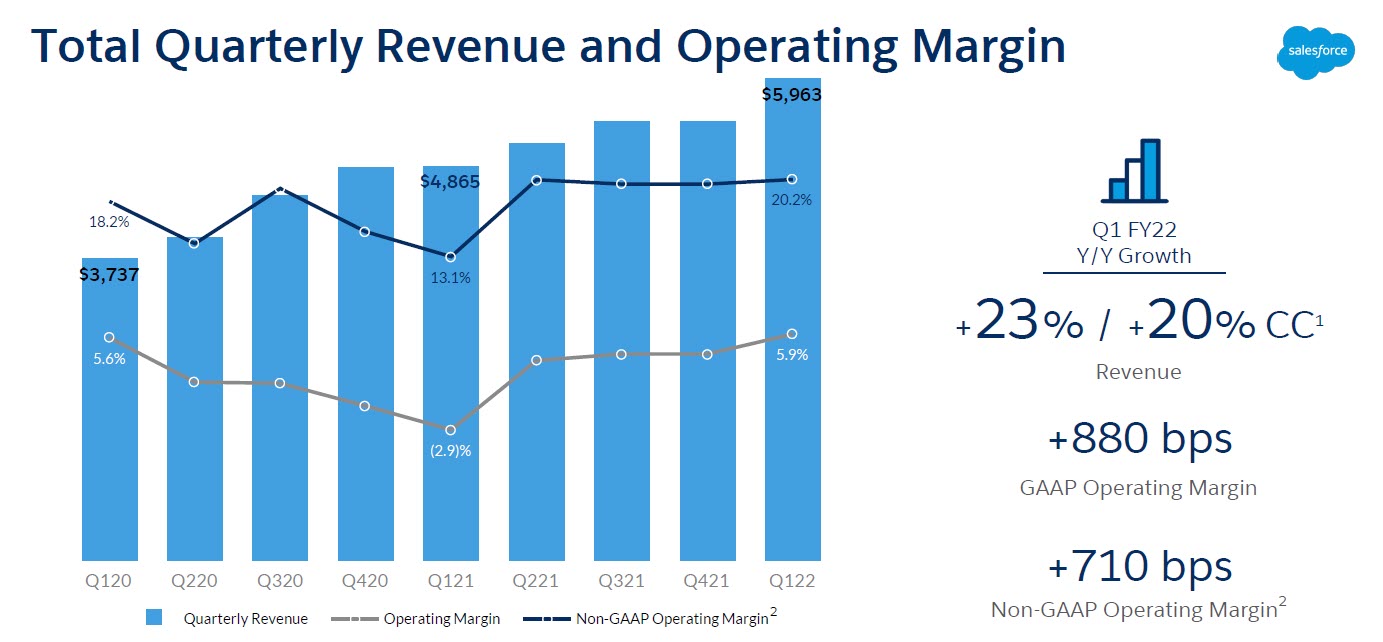
Salesforce Q1, FY22 revenue was $5.96B, the best quarter in the company’s history.
$1M+ deals hit an all-time high and were up 120% year-over-year. New $1M+ sales are averaging four or more Clouds, with senior management calling out Service Cloud during the earnings call as gaining strong traction in enterprises. Eight of the top 10 deals included Tableau, and five included MuleSoft.
FY22 Revenue guidance raised from $25.9B to $26B, approximately 22% year-over-year growth.
Service Cloud Q1, FY22 revenue is $1.5B, growing 20% year-over-year.
Tableau sales grew 38% year-over-year, reaching $394M in sales. MuleSoft grew 49% year-over-year, reaching $380M in sales in Q1, FY22.
The Slack acquisition is expected to close at the end of Q2, FY22.
Key takeaways from their Q1, FY22 results include the following:
Q1, FY22 revenue is up 23% year-over-year to $5.96B. Operating margins reached 5.9%, with non-GAAP operating margins reaching 20.2% in Q1. Salesforce successfully capitalizes on its customers’ urgency to transform their businesses while providing them with proven, well-integrated apps and platform strategies to help them build new digital businesses. Salesforce is also well-positioned to increase revenue based on the growing interest in analytics apps, combined with strong demand for mobile and social apps and multi-cloud integration. Combining proven apps and platforms with their ongoing R&D work in machine learning, AI, and predictive intelligence shows Salesforce is well-positioned for long-term growth in an increasingly multi-cloud enterprise world.
Successful multi-cloud sales strategies are propelling double-digit growth in the platform side of the business. Five of the ten $1M+ deals Salesforce signed in Q1 included MuleSoft. The Platform business is the fastest-growing segment of Salesforce today, attaining 28% year-over-year growth. Marketing and Commerce are next at 25% year-over-year revenue growth, driven by many Salesforce customers digitally transforming their selling and service strategies online. The latest quarters’ financial results by product area show how well-integrated and revenue-generating the ExactTarget, MuleSoft, and Tableau are turning out to be today.
Salesforce will reach $50B in revenue by 2026, supported by their Total Available Market (TAM), reaching $204B by CY2025. During the Q1, FY22 earnings call, Marc Benioff predicted Salesforce would nearly double in size in four years, reaching $50B from $26B, which is the projected FY22 revenue target. During the earnings call, Marc Benioff also said, “but I’ll tell you that it’s awesome to see not just be number one in CRM, but we’re going to be the number one enterprise software applications company in the world passing SAP.” The seven core product areas Salesforce compete are combining to create a TAM growing at an 11% CAGR between 2021 and 2025.
Apple, Alphabet, Amazon, Microsoft, and Tesla are considered the five most innovative companies, according to BCG’s analysis of the 50 most innovative companies of 2021.
Abbott Labs, AstraZeneca, Comcast, Mitsubishi, and Moderna join the top 50 most innovative companies for the first time this year.
The fastest movers include Toyota, who jumped from 41st to 21st; Salesforce, who jumped from 35th to 22nd; and Coca-Cola, who jumped from 48th to 28th.
90% of companies that outperform on innovation outcomes demonstrate clear C-suite ownership of the innovation agenda.
These and many other insights are from the Boston Consulting Group’s (BCG) 15th annual report defining the world’s 50 most innovative companies in 2021. BCG surveyed 1,500 global innovation executives and found a 10% point increase, to 75%, in executives reporting that innovation is a top-three priority at their companies today. That’s the most significant year-over-year increase in the 15 global innovation surveys BCG has conducted since 2005. BCG’s Most Innovative Companies 2021: Overcoming the Innovation Readiness Gap is available for download free here (28 pp., PDF). This years’ report methodology focuses on identifying the factors causing a large innovation readiness gap between the world’s most innovative companies and their peers across industries. Please see page 23 of the study for the methodology.
Key insights from BCGs’ most innovative companies of 2020 include the following:
Creating a new COVID-19 vaccine in less than a year, inventing test kits in weeks to protect public health, and redefining online shopping and safe home delivery reflect the versatility of the world’s most innovative companies in 2021. Pzifer, Moderna, and Merck & Company’s innate ability to innovate gave everyone a decade of their lives back. Delivering a vaccine in a year when the initial projection was a decade reflects the innovative efficiency of these companies. 2021 is the first year Abbott Labs, who invented and scaled the production of COVID-19 test kits, is included in the 50 most innovative companies worldwide. Amazon and Walmart’s logistics and e-commerce expertise helped ensure safe online shopping and fast home delivery was available to millions of people under stay-at-home orders.
Five factors most differentiate the most and least innovative companies. The basis of BCG’s methodology to identify the 50 most innovative companies in 2021 centers on their innovation-to-impact (i2i) framework. The framework is designed to help companies measure the readiness of their innovation programs to operate at a consistently high level of efficiency and effectiveness. The BCG i2i scoring system identified five factors that most differentiate innovative company leaders and laggards. The five factors that best indicate how innovative a company has the potential to be are shown in the following graphic:
Lack of collaboration between sales, marketing & R&D is the major obstacle to innovation. 31% of all companies surveyed see poor collaboration between marketing and R&D as the most significant obstacle to improving the return on their innovation investments. According to BCG, the collaboration between marketing, sales, and R&D is the most challenging in the Pharmaceutical industry, where 42% of respondents say it’s the biggest hurdle to achieving more significant returns on innovation.
Digital transformation of the core business is now a top priority for 75% of CEOs, and 65% of firms are doubling down on their plans for transformation with renewed urgency. BCG identified six success factors that together—and only together—flip the odds of digital transformation success from 30% to 80%. Those six success factors are close integration of digital strategy with the business strategy, commitment from the CEO through middle management, a talent core of digital superstars, business-led and flexible technology and data platforms, agile governance, and effective monitoring of progress toward defined outcomes.
Conclusion
Companies that know how to collaborate quickly between customer and R&D teams have an inside edge on being innovation leaders. The world’s most innovative companies also have senior management teams committed to the long-term success of nascent, unproven programs. There’s greater tolerance for risk, more of a focus on customers first and innovating around their needs, and an intuitive sense of how to close innovation gaps that hold other companies back.
There are a record number of 9,977 machine learning startups and companies in Crunchbase today, an 8.2% increase over the 9,216 startups listed in 2020 and a 14.6% increase over the 8,705 listed in 2019.
Artificial Intelligence (A.I.) and machine learning (ML)-related companies received a record $27.6 billion in funding in 2020, according to Crunchbase.
Of those A.I. and machine learning startups receiving funding since January 1, 2020, 62% are seed rounds, 31% early-stage venture rounds and 6.7% late-stage venture capital-funded rounds.
A.I. and machine learning startups’ median funding round was $4.4 million and the average was $29.8 million in 2020, according to Crunchbase.
Throughout 2020, venture capital firms continued expanding into new global markets, with London, New York, Tel Aviv, Toronto, Boston, Seattle and Singapore startups receiving increased funding. Out of the 79 most popular A.I. & ML startup locations, 15 are in the San Francisco Bay Area, making that region home to 19% of startups who received funding in the last year. Israel’s Tel Aviv region has 37 startups who received venture funding over the last year, including those launched in Herzliya, a region of the city known for its robust startup and entrepreneurial culture.
The following graphic compares the top 10 most popular locations for A.I. & ML startups globally based on Crunchbase data as of today:
Top 20 Machine Learning Startups To Watch In 2021
Augury – Augury combines real-time monitoring data from production machinery with AI and machine learning algorithms to determine machine health, asset performance management (APM) and predictive maintenance (PdM) to provide manufacturing companies with new insights into their operations. The digital machine health technology that the company offers can listen to the machine, analyze the data and catch any malfunctions before they arise. This enables customers to adjust their maintenance and manufacturing processes based on actual machine conditions. The platform is in use with HVAC, industrial factories and commercial facilities.
Alation – Alation is credited with pioneering the data catalog market and is well-respected in the financial services community for its use of A.I. to interpret and present data for analysis. Alation has also set a quick pace to evolving its platform to include data search & discovery, data governance, data stewardship, analytics and digital transformation. With its Behavioral Analysis Engine, inbuilt collaboration capabilities and open interfaces, Alation combines machine learning with human insight to successfully tackle data and metadata management challenges. More than 200 enterprises are using Alation’s platform today, including AbbVie, American Family Insurance, Cisco, Exelon, Finnair, Munich Re, New Balance, Pfizer, Scandinavian Airlines and U.S. Foods. Headquartered in Silicon Valley, Alation is backed by leading venture capitalists including Costanoa, Data Collective, Icon, Sapphire and Salesforce Ventures.
Algorithmia – Algorithmia’s expertise is in machine learning operations (MLOps) and helping customers deliver ML models to production with enterprise-grade security and governance. Algorithmia automates ML deployment, provides tooling flexibility, enables collaboration between operations and development and leverages existing SDLC and CI/CD practices. Over 110,000 engineers and data scientists have used Algorithmia’s platform to date, including the United Nations, government intelligence agencies and Fortune 500 companies.
Avora – Avora is noteworthy for its augmented analytics platform, making in-depth data analysis intuitively as easy as performing web searches. The company’s unique technology hides complexity, empowering non-technical users to run and share their reports easily. By eliminating the limitations of existing analytics, reducing data preparation and discovery time by 50-80% and accelerating time to insight, Avora uses ML to streamline business decision-making. Headquartered in London with offices in New York and Romania, Avora helps accelerate decision making and productivity for customers across various industries and markets, including Retail, Financial Services, Advertising, Supply Chain and Media and Entertainment.
Boast.ai – Focused on helping companies in the U.S. and Canada recover their R&D costs from respective federal governments, Boast.ai enables engineers and accountants to gain tax credits using AI-based tools. Some of the tax programs Boast.ai works with include US R&D Tax Credits, Scientific Research and Experimental Development (SR&ED) and Interactive Digital Media Tax Credits (IDMTC). The startup has offices in San Francisco, Vancouver and Calgary.
ClosedLoop.ai – An Austin, Texas-based startup, ClosedLoop.ai has created one of the healthcare industry’s first data science platforms that streamline patient experiences while improving healthcare providers’ profitability. Their machine learning automation platform and a catalog of pre-built predictive and prescriptive models can be customized and extended based on a healthcare provider’s unique population or client base needs. Examples of their technology applications include predicting admissions/readmissions, predicting total utilization & total risk, reducing out-of-network utilization, avoiding appointment no-shows, predicting chronic disease onset or progression and improving clinical documentation and reimbursement. The Harvard Business School, through its Kraft Precision Medicine Accelerator, recently named ClosedLoop.ai as one of the fastest accelerating companies in its Real World Data Analytics Landscapes report.
Databand – A Tel Aviv-based startup that provides a software platform for agile machine learning development, Databand was founded in 2018 by Evgeny Shulman, Joshua Benamram and Victor Shafran. Data engineering teams are responsible for managing a wide suite of powerful tools but lack the utilities they need to ensure their ops are running properly. Databand fills this gap with a solution that enables teams to gain a global view of their data flows, make sure pipelines complete successfully and monitor resource consumption and costs. Databand fits natively in the modern data stack, plugging seamlessly into tools like Apache Airflow, Spark, Kubernetes and various ML offerings from the major cloud providers.
DataVisor – DataVisor’s approach to using AI for increasing fraud detection accuracy on a platform level is noteworthy. Using proprietary unsupervised machine learning algorithms, DataVisor enables organizations to detect and act on fast-evolving fraud patterns and prevent future attacks before they happen. Combining advanced analytics and an intelligence network of more than 4.2B global user accounts, DataVisor protects against financial and reputational damage across various industries, including financial services, marketplaces, e-commerce and social platforms. They’re one of the more fascinating cybersecurity startups using AI today.
Exceed.ai – What makes Exceed.ai noteworthy is how their AI-powered sales assistant platform automatically communicates the lead’s context and enables sales and marketing teams to scale their lead engagement and qualification efforts accordingly. Exceed.ai follows up with every lead and qualifies them quickly through two-way, automated conversations with prospects using natural language over chat and email. Sales reps are freed from performing error-prone and repetitive tasks, allowing them to focus on revenue-generating activities such as phone calls and demos with potential customers.
Indico – Indico is a Boston-based startup specializing in solving the formidable challenge of how dependent businesses are on unstructured content yet lack the frameworks, systems and tools to manage it effectively. Indico provides an enterprise-ready A.I. platform that organizes unstructured content while streamlining and automating back-office tasks. Indico is noteworthy given its track record of helping organizations automate manual, labor-intensive, document-based workflows. Its breakthrough in solving these challenges is an approach known as transfer learning, which allows users to train machine learning models with orders of magnitude fewer data than required by traditional rule-based techniques. Indico enables enterprises to deploy A.I. to unstructured content challenges more effectively while eliminating many common barriers to A.I. & ML adoption.
LeadGenius – LeadGenius is noteworthy for its use of AI to provide personalized and actionable B2B lead information that helps its clients attain their global revenue growth goals. LeadGenius’s worldwide team of researchers uses proprietary technologies, including AI and ML-based techniques, to deliver customized lead generation, lead enrichment and data hygiene services in the format, methods and frequency defined by the customer. Their mission is to enable B2B sales and marketing organizations to connect with their prospects via unique and personalized data sets.
Netra – Netra is a Boston-based startup that began as part of MIT CSAIL research and has multiple issued and pending patents on its technology today. Netra is noteworthy for how advanced its video imagery scanning and text metadata interpretation are, ensuring safety and contextual awareness. Netra’s patented A.I. technology analyzes videos in real-time for contextual references to unsafe content, including deepfakes and potential cybersecurity threats.
Particle – Particle is an end-to-end IoT platform that combines software including A.I., hardware and connectivity to provide a wide range of organizations, from startups to enterprises, with the framework they need to launch IoT systems and networks successfully. Particle customers include Jacuzzi, Continental Tires, Watsco, Shifted Energy, Anderson EV, Opti and others. Particle is venture-backed and has offices in San Francisco, Shenzhen, Las Vegas, Minneapolis and Boston. Particle’s developer community includes over 200,000 developers and engineers in more than 170 countries today.
RideVision – RideVision was founded in 2018 by motorcycle enthusiasts Uri Lavi and Lior Cohen. The company is revolutionizing the motorcycle-safety industry by harnessing the strength of artificial intelligence and image-recognition technology, ultimately providing riders with a much broader awareness of their surroundings, preventing collisions and enabling bikers to ride with full confidence that they are safe. RideVision’s latest round was $7 million in November of last year, bringing their total funding to $10 million in addition to a partnership with Continental AG.
Savvie – Savvie is an Oslo-based startup specializing in translating large volumes of data into concrete actions that bakery and café owners can utilize to improve their bottom line every day. In doing so, we help food businesses make the right decisions to optimize their operations and increase profitability while reducing waste at its source. What’s noteworthy about this startup is how adept they are at fine-tuning ML algorithms to provide their clients with customized recommendations and real-time insights about their food and catering businesses. Their ML-driven insights are especially valuable given how bakery and café owners are pivoting their business models in response to the pandemic.
SECURITI.ai – One of the most innovative startups in cybersecurity, combining AI and ML to secure sensitive data in multi-cloud and mixed platform environments, SECURITI.ai is a machine learning company to watch in 2021, especially if you are interested in cybersecurity. Their AI-powered platform and systems enable organizations to discover potential breach risk areas across multi-cloud, SaaS and on-premise environments, protect it and automate all private systems, networks and infrastructure functions.
SkyHive – SkyHive is an artificial intelligence-based SaaS platform that aims to reskill enterprise workforces and communities. It develops and commercializes a methodology, Quantum Labor Analysis, to deliver real-time, skill-level insights into internal workforces and external labor markets, identify future and emerging skills and facilitate individual-and company-level reskilling. SkyHive is industry-agnostic and supporting enterprise and government customers globally with a mission to reduce unemployment and underemployment. Sean Hinton founded the technology company in Vancouver, British Columbia, in 2017.
Stravito – Stravito is an A.I. startup that’s combining machine learning, Natural Language Processing (NLP) and Search to help organizations find and get more value out of the many market research reports, competitive, industry, market share, financial analysis and market projection analyses they have by making them searchable. Thor Olof Philogène and Sarah Lee founded the company in 2017, who identified an opportunity to help companies be more productive, getting greater value from their market research investments. Thor Olof Philogène and Andreas Lee were co-founders of NORM, a research agency where both worked for 15 years serving multinational brands, eventually selling the company to IPSOS. While at NORM, Anders and Andreas were receiving repeated calls from global clients that had bought research from them but could not find it internally and ended up calling them asking for a copy. Today the startup has Carlsberg, Comcast, Colruyt Group, Danone, Electrolux, Pepsi Lipton and others. Stravito has offices in Stockholm (H.Q.), Malmö and Amsterdam.
Verta.ai – Verta is a startup dedicated to solving the complex problems of managing machine learning model versions and providing a platform to launch models into production. Founded by Dr. Manasi Vartak, Ph.D., a graduate of MIT, who led a team of graduate and undergraduate students at MIT CSAIL to build ModelDB, Verta is based on their work define the first open-source system for managing machine learning models. Her dissertation, Infrastructure for model management and model diagnosis, proposes ModelDB, a system to track ML-based workflows’ provenance and performance. In August of this year, Verta received a $10 million Series A round led by Intel Capital and General Catalyst, who also led its $1.7 million seed round. For additional details on Verta.ai, please see How Startup Verta Helps Enterprises Get Machine Learning Right. The Verta MLOps platform launch webinar provides a comprehensive overview of the platform and how it’s been designed to streamline machine learning models into production:
V7 – V7 allows vision-based A.I. systems to learn continuously from training data with minimal human supervision. The London-based startup emerged out of stealth in August 2018 to reveal V7 Darwin, an image labeling platform to create training data for computer vision projects with little or no human involvement necessary. V7 specializes in healthcare, life sciences, manufacturing, autonomous driving, agri-tech, sporting clients like Merck, GE Healthcare and Toyota. V7 Darwin launched at CVPR 2019 in Long Beach, CA. Within its first year, it has semi-automatically annotated over 1,000 image and video segmentation datasets. V7 Neurons is a series of pre-trained image recognition applications for industry use. The following video explains how V7 Darwin works:
Bottom Line: CHROs and the HR teams they lead need to commit to keep learning and adopting digital technologies that help improve how they hire, engage and retain talent if they’re going to stay competitive.
Driven by the urgency to keep connected with employees, customers and suppliers, McKinsey’s recent Covid-19 survey finds global organizations are now seven years ahead of schedule on digital transformation initiatives. HR’s role is proving indispensable in enabling the fast pace of digital adoption today. By providing Business Continuity Planning (BCP), HR’s contributions to digital transformation separate the organizations that thrive despite crises versus those left behind, according to McLean & Company’s 2021 HR Trends Report. The graphic below from the report shows how effective HR has been in supporting the rapid changes needed to keep employees communicating and engaged.
The McLean and Company Trends Report also shows that talent management’s major gaps need attention now before they grow wider. These areas include analyzing the employee skills gap (24%), developing employees on new competencies (24%), and training new employees in specific new skills (21%). Improving talent acquisition, retention, diversity and inclusion, and employee experiences by digitally transforming them with greater personalization at scale and visibility is key. CHROs and the HR teams they lead need to close these gaps now.
How To Get Started Digitally Transforming Talent Management
Start with the gaps in talent management you see in your organization. The largest gaps are often in the following four areas: recruiting and talent acquisition; retention of top talent and diverse talent; lack of visibility into employee capabilities; and workforce strategies not aligned to business strategies. Key challenges that need to drive digital transformation in these four areas include the following:
Legacy recruiting and Applicant Tracking Systems prioritize HR’s needs to capture thousands of resumes instead of delivering an excellent candidate experience. Attracting and recruiting the most qualified candidates in a virtual-first world is a daunting task. Organizations who are leaders in digital transformation quickly realized this and relied on automating the applicant experience so much it began to resemble the Amazon 1-Click Ordering experience. McKinsey’s recent Covid survey found that 75% of organizations digitally transforming their operations, including HR, were able to fill tech talent gaps during the crisis:
Source: McKinsey & Company, 2020, How Covid-19 has pushed companies over the technology tipping point—and transformed business forever
Top talent retention is more of a problem than many organizations realize, with top performers receiving between five and ten recruiter calls a month or more. The average tenure of employees at companies has been decreasing for nearly two decades. And a primary driver is not for lack of opportunity, but because employees can’t find a career path internally as easily as they can find a growth opportunity at another company. It’s possible to retain the top talent by guiding employees to what’s next in their careers. Of the many approaches to providing employees a self-service option for personalized coaching guidance at scale, Eightfold’s Talent Intelligence Platform is delivering results at such notable companies as Air Asia, Micron, NetApp, and others. Eightfold found that 47% of top talent leave within two years, but most would happily stay if given the right opportunity. The following video explains how Eightfold helps its customers retain talent:
Employees often lack visibility into new internal opportunities, and both HR and business leaders lack visibility into employees’ unique capabilities. There’s often a 360-degree lack of visibility into new internal career positions from the employee’s side and a lack of awareness on the employer’s side of their employee’s innate capabilities. The lack of visibility from the employer side limits their ability to benchmark talent, create programmatic, scalable, and flexible career development opportunities and ultimately redeploy talent in an agile way that serves business strategies that are evolving rapidly in response to the impacts of the global pandemic.
Workforce strategies that don’t align and support business strategies waste opportunities to improve morale, productivity, and employees’ professional growth. While organizations have invested heavily in valuable infrastructure, including Learning Management Systems (LMS) and other employee experience and development tools, they often lack a unified platform to help deliver the right growth opportunities to the right person at the right time.
Achieving Greater Automation, Visibility And Personalization At Scale
Talent management is core to any digital business and the competitive outcomes each can produce today and in the future. To make greater contributions, Talent Management needs to deliver the following by relying on a unified platform:
Talent Management platforms need to combine ongoing business insights based on operations data, technology management data, and business transformation apps and tools to create new digitally-driven employee experiences quickly.
A key design goal of any Talent Management platform has to be delivering personalized candidate or prospect experiences at scale through every communications channel an organization relies on, both digital and human.
The best Talent Management platforms provide the apps, data, and contextual intelligence to drive task and mission ownership deep into an organization and reinforce accountability. What’s noteworthy about Eightfold’s Talent Intelligence Platform is that it has designed-in empathy and the ability to deliver quick, effective decisions that further reinforce team inclusion. Eightfold’s many customer wins in Talent Management illustrate how combining empathy, inclusion, and accountability in a platform’s design pays off.
As McLean & Company’s 2021 HR Trends Report shows, taking a band-aid approach to solving Talent Management’s many challenges is effective in the short-term. Turning Talent Management into a solid contributor to business strategies for the long-term needs to start at the platform level, however. Eightfold’s approach to combining their Talent Management, Talent Insights and Talent Acquisition modules, all supported by their Talent Intelligence Platform, enables their customers to define their digital transformation goals and strategies and get results.
Conclusion
The Talent Management goal many organizations aspire to today is to digitally transform candidate or prospect experiences so well that people have an immediate affinity for the company they apply to, and the self-service options are so intuitive they rival Amazon’s 1-Click Ordering Experience. Across any industry, digital transformation succeeds when customers’ expectations are exceeded so far that a new category gets created. Uber’s contextual intelligence, rating system, and ability to optimize ride requests is an example. UberEats provides the same real-time visibility into every step of each order, creating greater trust. Domino’s Pizza Tracker app keeps customers informed of every phase of their orders. What’s common across all these examples is personalization at scale, real-time automation across service providers, and real-time visibility. Those same core values need to be at the center of any Talent Management digital transformation effort today.
95% of the content essential for decision making in an organization is unstructured, residing in PDFs and various file formats that defy easy indexing and quick access, according to MIT Media Labs.
80% of typical organizations’ data is unstructured, slowing down work, often leading to less-than-optimal decision-making, according to an Accenture study published earlier this year.
Organizations use 35% of their structured data for insights and decision-making, but only 25% of their unstructured enterprise data, according to an Accenture study on how data is used for decision-making.
60% to 80% of employees can’t find the information they are looking for even when there’s content management or knowledge management system in place, according to IBM’s knowledge management study.
Bottom Line: Stravito is an AI startup that’s combining machine learning, Natural Language Processing (NLP) and Search to help organizations find and get more value out of the many market research reports, competitive, industry, market share, financial analysis and market projection analyses they have by making them searchable.
When It Comes To Finding Market Research Data, Intranets Aren’t Getting It Done
Facing tight deadlines to get a marketing plan together for a new product, channel, or selling strategy, market research and product marketing teams will give up looking for a report they know they’ve bought and re-purchase it. The tighter the deadline and the more important the plan, the more this happens.
When a quick call to the Market Research Analyst who has access privileges to all the market research subscriptions doesn’t have the reports a team needs, they either move on without the data or repurchase the report. Having spent the first years of my career as a Market Research Analyst, I can attest to the accuracy of IBM’s finding that 30% of a typical knowledge workers’ day is spent searching for information and understanding its context and original methodology. All reports our organization had distribution rights to internally went on the Intranet site. There were hundreds of reports available online on an Intranet platform with mediocre search capabilities.
The company was founded by Thor Olof Philogène and Sarah Lee in 2017, who together identified an opportunity to help companies be more productive getting greater value from their market research investments. Thor Olof Philogène and Andreas Lee were co-founders of NORM, a research agency where both worked for 15 years serving multinational brands, eventually selling the company to IPSOS. While at NORM, Anders and Andreas were receiving repeated calls from global clients that had bought research from them but could not find it internally and ended up calling them asking for a copy. Today the startup has Carlsberg, Comcast, Colruyt Group, Danone, Electrolux, Pepsi Lipton and others. Stravito has offices in Stockholm (HQ), Malmö and Amsterdam.
Instead of settling for less-than-optimal market and industry data that partially deliver the insights needed for an exceptional product launch or sales campaign, marketing & senior management teams need to set their sights higher. It’s time to replace legacy Intranet sites and their limited search functions with AI-based search engines that auto-tag content and build taxonomies based on content attributes in real-time. Stravito combines AI, machine learning, NLP and Search on a single platform that can index every major file type an organization uses, creating a taxonomy that streamlines search queries.
Having AI as the foundation of the Stravito platform delivers the following benefits:
AI-powered fast search gives individuals the ability to find and share insights and information quicker than any legacy Intranet technology could. With everyone working from home and self-service being a goal every marketing, business planning and IT department is trying to achieve today, Stravito’s architecture is designed for simple queries and requests anyone can quickly learn to create.
Relying on AI and machine learning to alleviate the need to manually upload and tag hundreds of market research reports and analysis. Stravito’s approach to data categorization using AI also identifies and removes duplicate report copies and can be configured to filter out any reports past a specific date. Search perimeters, auto-tagging and in-PDF search options are all configurable. Stravito will rank PDFs by the percentage of relevant content they have for a specific search term, providing a bar graph designating which pages have the most relevant content.
Stravito’s design team has successfully combined AI, machine learning and advanced user interface design to produce an application comparable to Spotify, Google and Netflix. Developing and launching an enterprise-level search engine designed for usability first is noteworthy. Many enterprise applications still aren’t achieving this design goal despite being mentioned as a first priority by enterprise software vendors. As can be seen from their search results screen, Stravito’s approach is to combine information discovery and collaboration:
Stravito deserves credit for finding new ways to use AI and machine learning to accomplish drag-and-drop integration of any commonly used file format in an organization – and then have it assigned to a taxonomy in seconds. Stravito’s innovative use of AI, machine learning and auto-tagging provides its customers with a simple drag-and-drop interface that supports bulk uploads. The platform has API integration designed with any market research or advisory service with an API library compatible with their platform. Their customer base actively relies on Euromonitor and Mintel today, for example.
Conclusion
Stravito fills the gap legacy Intranet technologies and current generation collaboration platforms are not addressing. That’s the need to provide a more powerful search engine, one capable of continually adapting to new information and documents. Supervised machine learning has proven effective for taking on challenges related to creating and keeping taxonomies current. Stavito’s product strategy of providing personalized recommendations for the content of interest is a natural progression of their platform. For organizations overwhelmed with research data yet can’t seem to get the reports to decision-makers fast enough, the Stravito platform is worth checking out.
AI and Machine Learning are on track to generate between $1.4 Trillion to $2.6 Trillion in value by solving Marketing and Sales problems over the next three years, according to the McKinsey Global Institute.
Marketers’ use of AI soared between 2018 and 2020, jumping from 29% in 2018 to 84% in 2020, according to Salesforce Research’s most recent State of Marketing Study.
AI, Machine Learning, marketing & advertising technologies, voice/chat/digital assistants, and mobile tech & apps are the five technologies that will have the greatest impact on the future of marketing, according to Drift’s 2020 Marketing Leadership Benchmark Report.
Chief Marketing Officers (CMOs) and the marketing teams they lead are expected to excel at creating customer trust, a brand that exudes empathy and data-driven strategies that deliver results. Personalizing channel experiences at scale works when CMOs strike the perfect balance between their jobs’ emotional and logical, data-driven parts. That’s what makes being a CMO today so challenging. They’ve got to have the compassion of a Captain Kirk and the cold, hard logic of a Dr. Spock and know when to use each skill set. CMOs and their teams struggle to keep the emotional and logical parts of their jobs in balance.
Asked how her team keeps them in balance, the CMO of an enterprise software company told me she always leads with empathy, safety and security for customers and results follow. “Throughout the pandemic, our message to our customers is that their health and safety come first and we’ll provide additional services at no charge if they need it.” True to her word, the company offered their latest cybersecurity release update to all customers free in 2020. AI and machine learning tools help her and her team test, learn and excel iteratively to create an empathic brand that delivers results.
The following are ten ways AI and machine learning are improving marketing in 2021:
1. 70% of high-performance marketing teams claim they have a fully defined AI strategy versus 35% of their under-performing peer marketing team counterparts. CMOs who lead high-performance marketing teams place a high value on continually learning and embracing a growth mindset, as evidenced by 56% of them planning to use AI and machine learning over the next year. Choosing to put in the work needed to develop new AI and machine learning skills pays off with improved social marketing performance and greater precision with marketing analytics. Source: State of Marketing, Sixth Edition. Salesforce Research, 2020.
2. 36% of marketers predict AI will have a significant impact on marketing performance this year. 32% of marketers and agency professionals were using AI to create ads, including digital banners, social media posts and digital out-of-home ads, according to a recent study by Advertiser Perceptions. Source: Which Emerging Tech Do Marketers Think Will Most Impact Strategy This Year?, Marketing Charts, January 5, 2021.
3. High-performing marketing teams are averaging seven different uses of AI and machine learning today and just over half (52%) plan on increasing their adoption this year. High-performing marketing teams and the CMOs lead them to invest in AI and machine learning to improve customer segmentation. They’re also focused on personalizing individual channel experiences. The following graphic underscores how quickly high-performing marketing teams learn then adopt advanced AI and machine learning techniques to their competitive advantage. Source: State of Marketing, Sixth Edition. Salesforce Research, 2020.
4. Marketers use AI-based demand sensing to better predict unique buying patterns across geographic regions and alleviate stock-outs and back-orders. Combining all available data sources, including customer sentiment analysis using supervised machine learning algorithms, it’s possible to improve demand sensing and demand forecast accuracy. ML algorithms can correlate location-specific sentiment for a given product or brand and a given product’s regional availability. Having this insight alone can save the retail industry up to $50B a year in obsoleted inventory. Source: AI can help retailers understand the consumer, Phys.org. January 14, 2019.
5. Disney is applying AI modeling techniques, including machine learning algorithms, to fine-tune and optimize its media mix model. Disney’s approach to gaining new insights into its media mix model is to aggregate data from across the organization including partners, prepare the model data and then transform it for use in a model. Next, a variety of models are used to achieve budget and media mix optimization. Then compare scenarios. The result is a series of insights that are presented to senior management. The following dashboard shows the structure of how they analyze AI-based data internally. The data shown is, for example only; this does not reflect Disney’s actual operations. Source: How Disney uses Tableau to visualize its media mix model (https://www.tableau.com/best-marketing-dashboards)
6. 41% of marketers say that AI and machine learning make their greatest contributions to accelerating revenue growth and improving performance. Marketers say that getting more actionable insights from marketing data (40%) and creating personalized consumer experiences at scale (38%) round out the top three uses today. The study also found that most marketers, 77%, have less than a quarter of all marketing tasks intelligently automated and 18% say they haven’t intelligently automated any tasks at all. Marketers need to look to AI and machine learning to automated remote, routine tasks to free up more time to create new campaigns. Source: Drift and Marketing Artificial Intelligence Institute, 2021 State of Marketing AI Report.
7. Starbucks set the ambitious goal of being the world’s most personalized brand by relying on predictive analytics and machine learning to create a real-time personalization experience. The global coffee chain faced several challenges starting with how difficult it was to target individual customers with their existing IT infrastructure. They were also heavily reliant on manual operations across their thousands of stores, which made personalization at scale a formidable challenge to overcome. Starbucks created a real-time personalization engine that integrated with customers’ account information, the mobile app, customer preferences, 3rd party data and contextual data. They achieved a 150% increase in user interaction using predictive analytics and AI, a 3X improvement in per-customer net incremental revenues. The following is a diagram of how DigitalBCG (Boston Consulting Group) was able to assist them. Source: Becoming The World’s Most Personalized Brand, DigitalBCG.
8. Getting personalization-at-scale right starts with a unified Customer Data Platform (CDP) that can use machine learning algorithms to discover new customer data patterns and “learn” over time. For high-achieving marketing organizations, achieving personalization-at-scale is their highest and most urgent priority based on Salesforce Research’s most recent State of Marketing survey. And McKinsey predicts personalization-at-scale can create $1.7 trillion to $3 trillion in new value. For marketers to capture a part of this value, changes to the mar-tech stack (shown below) must be supported by clear accountability and ownership of channel and customer results. Combining a modified mar-tech stack with clear accountability delivers results. Source: McKinsey & Company, A technology blueprint for personalization at scale. May 20, 2019. By Sean Flavin and Jason Heller.
9. Campaign management, mobile app technology and testing/optimization are the leading three plans for a B2C company’s personalization technologies. Just 19% of enterprises have adopted AI and machine learning for B2C personalization today. The Forrester Study commissioned by IBM also found that 55% of enterprises believe the technology limitations inhibit their ability to execute personalization strategies. Source: A Forrester Consulting Thought Leadership Paper, Commissioned by IBM, Personalization Demystified: Enchant Your Customers By Going From Good To Great, February 2020.
10. Successful AI-driven personalization strategies deliver results beyond marketing, delivering strong results enterprise-wide, including lifting sales revenue, Net Promoter Scores and customer retention rates. When personalization-at-scale is done right, enterprises achieve a net 5.63% increase in sales revenue, 10.26% increase in order frequency, uplifts in average order value and an impressive 13.25% improvement in cross-sell/up-sell opportunities. The benefits transcend marketing alone and drive higher customer satisfaction metrics as well. Source: A Forrester Consulting Thought Leadership Paper, Commissioned by IBM, Personalization Demystified: Enchant Your Customers By Going From Good To Great, February 2020.
CMOs and their teams rely on AI and machine learning to iteratively test and improve every aspect of their marketing campaigns and strategies. Striking the perfect balance between empathy and data-driven results takes a new level of data quality which isn’t possible to achieve using Microsoft Excel or personal productivity tools today. The most popular use of AI and machine learning in organizations is delivering personalization at scale across all digital channels. There’s also increasing adoption of predictive analytics based on machine learning to fine-tune propensity models to improve up-sell and cross-sell results.
Bibliography
AI can help retailers understand the consumer, Phys.org. January 14, 2019
Brei, Vinicius. (2020). Machine Learning in Marketing: Overview, Learning Strategies, Applications and Future Developments. Foundations and Trends® in Marketing. 14. 173-236. 10.1561/1700000065.
Conick, H. (2017). The past, present and future of AI in marketing. Marketing News, 51(1), 26-35.
Drift and Marketing Artificial Intelligence Institute, 2021 State of Marketing AI Report.
Huang, M. H., & Rust, R. T. (2021). A strategic framework for artificial intelligence in marketing. Journal of the Academy of Marketing Science, 49(1), 30-50.
Jarek, K., & Mazurek, G. (2019). MARKETING AND ARTIFICIAL INTELLIGENCE. Central European Business Review, 8(2).
Libai, B., Bart, Y., Gensler, S., Hofacker, C. F., Kaplan, A., Kötterheinrich, K., & Kroll, E. B. (2020). Brave new world? On AI and the management of customer relationships. Journal of Interactive Marketing, 51, 44-56.
Ma, L., & Sun, B. (2020). Machine learning and AI in marketing–Connecting computing power to human insights. International Journal of Research in Marketing, 37(3), 481-504.
McKinsey & Company, A technology blueprint for personalization at scale. May 20, 2019
Pedersen, C. L. Empathy‐based marketing. Psychology & Marketing.
Sinha, M., Healey, J., & Sengupta, T. (2020, July). Designing with AI for Digital Marketing. In Adjunct Publication of the 28th ACM Conference on User Modeling, Adaptation and Personalization (pp. 65-70).
State of Marketing, Sixth Edition. Salesforce Research, 2020.
According to Burning Glass Technologies, the two tech job skills paying the highest salary premiums today and in 2021 are IT Automation ($24,969) and AI & Machine Learning ($14,175).
The average salary premiums for the most in-demand tech skills range from $4,204 to nearly $25,000.
Startups valued at $1 billion or more are 33% more likely to prioritize one or several top ten tech job skills in their new hire plans versus their legacy Fortune 100-based competitors or colleagues.
These and many other fascinating insights are from Skills of Mass Disruption: Pinpointing the 10 Most Disruptive Skills in Tech, Burning Glass Technologies’ latest research study published earlier this month. Their latest study provides pragmatic, useful insights for tech professionals interested in furthering their careers and earning potential. Burning Glass Technologies is a leading job market analytics provider that delivers job market analytics that empowers employers, workers and educators to make data-driven decisions.
Using AI To Find The Most Valuable Job Skills
Using artificial intelligence-based technologies they’ve developed, Burning Glass Technologies analyzed over 17,000 unique skills demanded across their database of over one billion historical job listings. The study aggregates then define disruptive skill clusters as those skill groups projected to grow the fastest, are most undersupplied and provide the highest value. For additional details regarding their methodology, please see page 8 of the report.
The research study is noteworthy because it explains how essential acquiring skills is to translating new technologies’ benefits into business value. They’ve also taken their analysis a step further, providing technical professionals with additional insights they need to plan their personal development and careers.
Key takeaways from their analysis include the following:
IT Automation expertise can earn technical professionals a $24,969 salary premium, the most lucrative of all tech job skills to have in 2021. Burning Glass Technologies defines IT Automation as the skills related to automating and orchestrating digital processes and workflows. Six of the ten job skills are marketable enough to drive technical professionals’ salaries above $10,000 a year. At an average salary uplift of $8,851, proactive security (cybersecurity) job skills’ market value seems low. Future surveys in 2021 will most likely reflect the impact of the SolarWinds breach on demand for this skill set. The following graphic compares the average salary premium by tech job skill area.
Skills of Mass Disruption: Pinpointing the 10 Most Disruptive Skills in Tech by Burning Glass Technologies
Software Dev. Methodologies (DevOps) expertise is the most marketable going into 2021, with 634,600 open positions available in North America based on Burning Glass Technologies’ analysis. Employers initiated 1,714,483 job postings requesting at least one disruptive skill area between December 2019 and November 2020. With each skill predicted to grow at least 17%, technical professionals have several lucrative options for their personal and professional development plans. The following graphic compares job openings by skill areas for the time frame of the study:
Skills of Mass Disruption: Pinpointing the 10 Most Disruptive Skills in Tech by Burning Glass Technologies
Quantum Computing, Connected Technologies, Fintech and AI & Machine Learning expertise are predicted to be the fastest-growing tech job skills in 2021 and beyond. Demand for technical professionals skilled in building and optimizing quantum computers and their applications will be in high demand for the next five years based on the study’s findings. Connected Technologies refers to skills related to the Internet of Things and connected physical tools and the telecommunications infrastructure needed to enable them. Fintech skills are related to technologies, including blockchain and others, that make financial transactions more efficient and secure. The following graphic compares the top ten tech job skills predicted to grow the fastest in 2021.
Skills of Mass Disruption: Pinpointing the 10 Most Disruptive Skills in Tech by Burning Glass Technologies
AI & Machine Learning, Cloud Technologies, Parallel Computing and Proactive Security (Cybersecurity) are the most distributed across industries, translating into more diverse job opportunities for technical professionals with these skills. Professional Services leads all industries in demand for nine of the ten tech job skills, except Parallel Computing, the most in-demand skill in Manufacturing. Factors contributing to Professional Services leading all industries in demand for technical job skills include the following factors. First, their business models need to continue pivoting fast to stabilize during the pandemic. Second, better risk and compliance controls of remote operations are urgently needed. Third, better visibility into services costs across all systems to ensure financial reporting accuracy is a must-have, according to the CFOs I spoke with regarding the survey results. The following graphic compares demand for tech skills by industry sector.
Skills of Mass Disruption: Pinpointing the 10 Most Disruptive Skills in Tech by Burning Glass Technologies
Demand for AI and Machine Learning skills is growing at a 71% compound annual growth rate through 2025, with 197,810 open positions today. Technical professionals with job skills in this area see salary premiums of $14,175. Top positions include Data Scientist, Software Developer, Network Engineer, Network Architect, Data Engineer and Senior Data Scientist.
Skills of Mass Disruption: Pinpointing the 10 Most Disruptive Skills in Tech by Burning Glass Technologies
Positions requiring IT Automation job skills are predicted to grow 59% over the next five years and have 282,380 positions open today. Besides being the most lucrative job skillset to have, IT Automation job skills lead to positions including Software Developer, DevOps Engineer, Senior Software Developer, Systems Engineer and Java Developer or Engineer.
Skills of Mass Disruption: Pinpointing the 10 Most Disruptive Skills in Tech by Burning Glass Technologies
According to BDS Analytics, the Covid-19 pandemic drove retail sales up 35% above industry forecasts, accelerated by cannabis businesses being declared “essential” for medical purposes in virtually every U.S. legal market.
Fueled by strong consumer demand, annual legal (medical and adult-use) sales are projected to grow at a compound annual growth rate (CAGR) of 21%, to reach more than $41 billion by 2025 (from $13.2 billion in 2019), according to New Frontier Data.
BDS Analytics predicts that the U.S. Cannabis Industry will generate $20.8 billion in direct spending in 2021 and $39.6 billion in total economic contribution after factoring its indirect economic effects.
Bottom Line: With an average yield per acre of $1.1 million, legal cannabis agriculture dwarfs all other crops in revenue potential while also providing the resources needed to fund AI-based monitoring to improve yields and security.
Cannabis’ value per acre dwarfs all other crops being produced in North America today, prompting every commercial grower to consider how they can improve yields further while securing their crops on a 24/7, virtual basis. Recent studies by the USDA, The Rand Corporation, and the Marijuana Cultivators of Oregon find that at an average price of $1,948 per pound at Colorado prices, an acre of marijuana can yield more than $1.1 million per acre. The studies compared the most widely grown crops in the U.S., including corn, soybeans, oats, and wheat, which all yield less than $1,000 per harvested acre. The following graphic from New Frontier Data illustrates how profitable an acre of marijuana is to cultivate than other crops.
Using AI to Protect & Grow a Cash Crop
AI and machine learning-based techniques based on real-time monitoring data are an integral part of today’s innovation in cannabis farm management. Supervised machine learning algorithms capable of identifying patterns and sequences in imagery from thermal, infrared, and night vision cameras in real-time can help identify diseases affecting plants early. Identifying and alerting farm staff of a breach or break-in by an animal or person is possible using AI-based smart monitoring systems.
The more advanced a smart monitoring system is in its use of machine learning and real-time monitoring integration, the more effective it is in spotting anomalous activity. Over time, the best AI-based remote monitoring and surveillance systems “learn” or begin to identify recurring patterns in data. Cannabis farms rely on AI and machine learning to identify which techniques for improving yield rates by specific fertilizer treatment produce the most flowers and overall yield per acre.
The following are ten ways AI is being used for improving cannabis yields and security:
Monitoring real-time video feeds of remote cannabis fields using machine learning-based surveillance systems can identify a breach by an animal or human then send an alert immediately. Given how valuable a single acre of cannabis is to a farm, knowing in real-time if there’s been an attempted breach or break-in can save thousands of dollars in potential crop damage and theft. Federated cannabis farms with multiple remote locations are starting to use AI and machine learning-based remote monitoring to secure their operations. Machine-learning based video surveillance systems can be programmed or trained over time to identify employees versus unknown people and easily spot animals attempting to break into a field. The following image from Twenty20 Solutions illustrates how machine learning is used for identifying activity at a remote location:
Reducing the dependence on onsite security guards alone and gaining a 24/7, 365-day monitoring view of each grow and farm site. Instead of relying only on onsite security teams to monitor video feeds in real-time, cannabis growers turn to AI and machine learning-based surveillance to isolate the most anomalous or unexpected events given the pattern of previous activity on a site. Reducing the cost and insurance liability of having security teams on site is one of the most significant benefits of relying on a cloud-based remote monitoring system that can interpret and provide alerts based on real-time data.
AI-based surveillance monitoring systems can prepare activity reports in minutes for state and federal auditors, saving farmers and administrative staff thousands of hours a year getting the data together for audit teams. Using machine learning and advanced video analytics, growers and their staff can prepare for state and federal audit reports in minutes instead of the many hours needed in the past.
Helping to keep licensed cannabis growers in compliance by providing a 24/7, 90 day or longer video history of all activities at their farms keeps them in compliance with state regulatory requirements. Included in several states’ requirements are the specific requirements for video footage access, video archiving, access requirements, how cameras are placed, and how quickly video footage can be accessed. State regulatory agencies are initiating audits of licensed cannabis growing facilities in 2021. All states require video footage to be archived, yet 72% of cannabis operators fail to comply with security and surveillance requirements, according to a recent study by the Brightfield Group:
California regulations require that all video recordings from surveillance be saved 90 days or longer.
Washington requires all video recordings to be archived for a minimum of 45 days.
Oregon requires licensed cannabis growers to retain 24/7 video for 90 days with a minimum of 1.3mp per camera at 10fps. The exterior is 5fps.
Cannabis farms often experiment with new fertilizers and plant treatments on a pilot acre to see if they achieve the expected results, and machine learning-based analysis of video stream data helps track results. Agricultural improvements in cannabis farming continue to accelerate as medical and leisure demand continues to grow exponentially. For example, a cannabis grower will often begin planting in the May/June timeframe to achieve a density of up to 4,000 plants per acre. Taking the real-time data stream infrared and thermal cameras of the acre will quickly tell growers how effective their new fertilizer and plan treatments are. Using the data from their monitoring system, the growers will expand the treatment to their entire farm, often over 40 to 50 acres in size.
Monitoring every access point to a facility with video surveillance 24/7 combined with sound recording can prove invaluable in stopping a break-in before it happens. Every entrance to a cannabis farm needs to be considered a primary threat vector if the farm will stay safe. Advanced remote monitoring and surveillance systems can provide video analytics that correlates sound, video, and status of infrared and thermal cameras, which together can help identify potential break-ins. And with real-time alerts, farm staff can take action immediately even if they aren’t onsite.
A few of the largest cannabis growing companies are experimenting with advanced video analytics combining infrared and thermal camera technologies to monitor insects and rodents’ impact on yield rates. Real-time video feeds are being digitally analyzed using advanced video analytics techniques by the largest cannabis farms today to find out how effective pesticides, insect, and rodent deterrents are at protecting their cannabis crops.
When a surveillance system is cloud-based, it is possible to access any farm or cannabis sites’ real-time video feeds, history of alerts, and advanced video analytics from any browser-based device at any time. Remote monitoring systems that are cloud-based often provide much greater flexibility in viewing, analyzing, and sharing monitoring data than their on-premise system counterparts. Any device with a browser can access the platform’s reporting features and know what is going on at a remote farm or cannabis production facility.
AI-based remote monitoring systems can also identify potential safety hazards to workers and reduce workplace injuries and potential liability litigation. Using advanced pattern matching supported by supervised machine learning algorithms, cannabis growers can identify when workers in high-risk roles are at risk of getting hurt while on the job. All cannabis facilities in the U.S. continue to have the requirement of everyone wearing a face shield and masks for the site to stay in compliance with CDC guidelines. Remote monitoring systems can tell immediately which work teams need coaching to remain in compliance.
Define access privileges across a farm facility by the level of access every employee needs to do their job, which is especially useful for new hires. New hires often start in the field and don’t need access to the front offices or the accounting department, for example. One of the most challenging aspects of running a cannabis business is cash management. Using an AI-based surveillance and monitoring system integrated into the local security system and intelligent locks, employees are provided the level of access they need on the first day to be productive.
AI is starting to deliver on its potential and its benefits for businesses are becoming a reality.
47% of artificial intelligence (AI) investments were unchanged since the start of the pandemic and 30% of organizations plan to increase their AI investments, according to a recent Gartner poll.
30% of CEOs own AI initiatives in their organizations and regularly redefine resources, reporting structures and systems to ensure success.
AI projects continue to accelerate this year in healthcare, bioscience, manufacturing, financial services and supply chain sectors despite greater economic & social uncertainty.
Five new technology categories are included in this year’s Hype Cycle for AI, including small data, generative AI, composite AI, responsible AI and things as customers.
These and many other new insights are from the Gartner Hype Cycle for Artificial Intelligence, 2020, published on July 27th of this year and provided in the recent article, 2 Megatrends Dominate the Gartner Hype Cycle for Artificial Intelligence, 2020. Two dominant themes emerge from the combination of 30 diverse AI technologies in this year’s Hype Cycle. The first theme is the democratization or broader adoption of AI across organizations. The greater the democratization of AI, the greater the importance of developers and DevOps to create enterprise-grade applications. The second theme is the industrialization of AI platforms. Reusability, scalability, safety and responsible use of AI and AI governance are the catalysts contributing to the second theme. The Gartner Hype Cycle for Artificial Intelligence, 2020, is shown below:
Smarter with Gartner, 2 Megatrends Dominate the Gartner Hype Cycle for Artificial Intelligence, 2020.
Details Of What’s New In Gartner’s Hype Cycle for Artificial Intelligence, 2020
Chatbots are projected to see over a 100% increase in their adoption rates in the next two to five years and are the leading AI use cases in enterprises today. Gartner revised the bots’ penetration rate from a range of 5% to 20% last year to 20% to 50% this year. Gartner points to chatbot’s successful adoption as the face of AI today and the technology’s contributions to streamlining automated, touchless customer interactions aimed at keeping customers and employees safe. Bot vendors to watch include Amazon Web Services (AWS), Cognigy, Google, IBM, Microsoft, NTT DOCOMO, Oracle, Rasa and Rulai.
GPU Accelerators are the nearest-term technology to mainstream adoption and are predicted to deliver a high level of benefit according to Gartner’s’ Priority Matrix for AI, 2020. Gartner predicts GPU Accelerators will see a 100% improvement in adoption in two to five years, increasing from 5% to 20% adoption last year to 20% to 50% this year. Gartner advises its clients that GPU-accelerated Computing can deliver extreme performance for highly parallel compute-intensive workloads in HPC, DNN training and inferencing. GPU computing is also available as a cloud service. According to the Hype Cycle, it may be economical for applications where utilization is low, but the urgency of completion is high.
AI-based minimum viable products and accelerated AI development cycles are replacing pilot projects due to the pandemic across Gartner’s client base. Before the pandemic, pilot projects’ success or failure was, for the most part, dependent on if a project had an executive sponsor and how much influence they had. Gartner clients are wisely moving to minimum viable product and accelerating AI development to get results quickly in the pandemic. Gartner recommends projects involving Natural Language Processing (NLP), machine learning, chatbots and computer vision to be prioritized above other AI initiatives. They’re also recommending organizations look at insight engines’ potential to deliver value across a business.
Artificial General Intelligence (AGI) lacks commercial viability today and organizations need to focus instead on more narrowly focused AI use cases to get results for their business. Gartner warns there’s a lot of hype surrounding AGI and organizations would be best to ignore vendors’ claims of having commercial-grade products or platforms ready today with this technology. A better AI deployment strategy is to consider the full scope of technologies on the Hype Cycle and choose those delivering proven financial value to the organizations adopting them.
Small Data is now a category in the Hype Cycle for AI for the first time. Gartner defines this technology as a series of techniques that enable organizations to manage production models that are more resilient and adapt to major world events like the pandemic or future disruptions. These techniques are ideal for AI problems where there are no big datasets available.
Generative AI is the second new technology category added to this year’s Hype Cycle for the first time. It’s defined as various machine learning (ML) methods that learn a representation of artifacts from the data and generate brand-new, completely original, realistic artifacts that preserve a likeness to the training data, not repeat it.
Gartner sees potential for Composite AI helping its enterprise clients and has included it as the third new category in this year’s Hype Cycle. Composite AI refers to the combined application of different AI techniques to improve learning efficiency, increase the level of “common sense,” and ultimately to much more efficiently solve a wider range of business problems.
Concentrating on the ethical and social aspects of AI, Gartner recently defined the category Responsible AI as an umbrella term that’s included as the fourth category in the Hype Cycle for AI. Responsible AI is defined as a strategic term that encompasses the many aspects of making the right business and ethical choices when adopting AI that organizations often address independently. These include business and societal value, risk, trust, transparency, fairness, bias mitigation, explainability, accountability, safety, privacy and regulatory compliance.
The exponential gains in accuracy, price/performance, low power consumption and Internet of Things sensors that collect AI model data have to lead to a new category called Things as Customers, as the fifth new category this year. Gartner defines things as Customers as a smart device or machine or that obtains goods or services in exchange for payment. Examples include virtual personal assistants, smart appliances, connected cars and IoT-enabled factory equipment.
Thirteen technologies have either been removed, re-classified, or moved to other Hype Cycles compared to last year. Gartner has chosen to remove VPA-enabled wireless speakers from all Hype Cycles this year. AI developer toolkits are now part of the AI developer and teaching kits category. AI PaaS is now part of AI cloud services. Gartner chose to move AI-related C&SI services, AutoML, Explainable AI (also now part of the Responsible AI category in 2020), graph analytics and Reinforcement Learning to the Hype Cycle for Data Science and Machine Learning, 2020. Conversational User Interfaces, Speech Recognition and Virtual Assistants are now part of the Hype Cycle for Natural Language Technologies, 2020. Gartner has also chosen to move Quantum computing to the Hype Cycle for Compute Infrastructure, 2020. Robotic process automation software is now removed from the Hype Cycle for AI, as Gartner mentions the technology in several other Hype Cycles.
IDC predicts the global market for custom application development services is forecast to grow from $47B in 2018 to more than $61B in 2023, attaining a 5.3% Compound Annual Growth Rate (CAGR) in five years.
40% of DevOps teams will be using application and infrastructure monitoring apps that have integrated artificial intelligence for IT operations (AIOps) platforms by 2023, according to Gartner.
Looking to reduce the delays DevOps teams are challenged with, software development tool providers are accelerating the pace of integrating AI- and Machine Learning technologies into their apps and platforms. Accelerating every phase of the Software Development Lifecycle (SDLC) while increasing software quality is the goal. And the good news is use cases are showing those goals are being accomplished, taking DevOps to a new level of accuracy, quality, and reliability.
What’s particularly fascinating about the ten ways AI is accelerating DevOps is how effective it is proving to be in assisting developers with the difficult, time-consuming tasks that take away from coding. One of the most time-consuming tasks is managing the many iterations and versions of requirements documents. A leader in using AI to streamline every phase of the SDLC and assist with managing requirements is Jira Software from Atlassian, widely considered the industry standard in this area of DevOps.
The following are ten ways AI is accelerating DevOps today:
Improving DevOps productivity by relying on AL and ML to autosuggest code segments or snippets in real-time to accelerate development. DevOps teams interviewed for this article from several leading enterprise software companies competing in CRM, Supply Chain Management, and social media markets say this use case of AI is the most productive and has generated the greatest gains in accuracy. Initial efforts at using AI to autocomplete code were hit or miss, according to a DevOps lead at a leading CRM provider. She credits DevOps’ development tools providers’ use of supervised machine learning algorithms with improving how quickly models learn and respond to code requests. Reflecting what the DevOps teams interviewed for this article prioritized as the most valuable AI development in DevOps, Microsoft’s Visual Studio Intellicode has over 6 million installs as of today.
Streamlining Requirements Management using AI is proving effective at improving the accuracy and quality of requirements documents capturing what users need in the next generation of an app or platform. AI is delivering solid results streamlining every phase of creating, editing, validating, testing, and managing requirements documents. DevOps team members are using AI- and ML-based requirements management platforms to save time so they can get back to coding and creating software products often on tight deadlines. Getting requirements right the first time helps keep an entire project on the critical path of its project plan. Seeing an opportunity to build a business case of keeping projects on schedule, AI-powered software development tools providers are quickly developing and launching new apps in their area. It’s fascinating to watch how quickly Natural Language Processing techniques are being adopted into this area of DevOps tools. Enterprises using AI-based tools have been able to reduce requirements review times by over 50%.
AI is proving effective at bug detection and auto-suggestions for improving code. At Facebook, a bug detection tool predicts defects and suggests remedies that are proving correct 80% of the time with AI tools learning to fix bugs automatically. Semmle CodeQL is considered the leading AI-based DevOps tool in this area. DevOps teams using CodeQL can track down vulnerabilities in code and also find logical variants in their entire codebase. Microsoft uses Semmle for vulnerability hunting. Security researchers in Microsoft’s security response team use Semmle QL to find variants of critical problems, allowing them to identify and respond to serious code problems and prevent incidents.
AI is assisting in prioritizing security testing results and triaging vulnerabilities. Interested in learning more about how ML can find code vulnerability in real-time, I spoke with Maty Siman, CTO Checkmarx, says that “even organizations with the most mature SDLCs often run into issues with prioritizing and triaging vulnerabilities. ML algorithms that focus on developers’ or AppSec teams’ attention on true positives and vulnerable components that pose a threat are key to navigating this challenge.” Maty also says that ML algorithms can be taught to understand that one type of vulnerability vs. another has a higher percentage of being a true positive. With this automated “vetting” process in place, teams can optimize and accelerate their remediation efforts in a much more informed manner.
Improving software quality assurance by auto-generating and auto-running test cases based on the unique attributes of a given code base is another area where AI is saving DevOps teams valuable time. This is invaluable for stress-testing new apps and platforms across a wide variety of use cases. Creating and revising test cases is a unique skill set on any DevOps team, with the developers with this skill often being overwhelmed with test updates. AI-based software development tools are eliminating test coverage overlaps, optimizing existing testing efforts with more predictable testing, and accelerating progress from defect detection to defect prevention. AI-based software development platforms can identify the dependencies across complex and interconnected product modules, improving overall product quality in the process. Improving software quality enhances customer experiences, as well.
AI is proving adept at troubleshooting defects in complex software apps and platforms after they’ve been released and shipped to customers. Enterprise software companies go to great lengths in their software QA processes to eliminate bugs, logic errors, and unreliable segments of code. Retrofitting releases or, worst case, recalling them is costly and impacts customers’ productivity. AI-based QA tools are proving effective at predicting which areas of an enterprise application will fail before being delivered into complex customer environments. AI is proving effective at root cause analysis, and also has proved effective in accelerating a leading CRM providers’ application delivery and a 72% reduction in time-to-restore in customers’ enterprise environments. Another DevOps team says they are using AI to auto-configure their applications’ settings to optimize performance in customer deployments.
ML-based code vulnerability detection can spot anomalies reliably and alert DevOps teams in real-time. Maty Siman, CTO Checkmarx told me that, “assuming that your developers are writing quality, secure code, machine learning can set a baseline of “normal activity” and identify and flag anomalies from that baseline.” He continued, saying that “ultimately, we live in an IT and security landscape that’s evolving every minute of every day, requiring systems and tools that learn and adapt at the same, if not a greater, speed. Organizations and developers can’t do it alone and require solutions that improve the accuracy of threat detection to help them prioritize what matters most.” Spotting anomalies quickly and taking action on them is integral to building a business case for AI software-based QA and DevOps tools.
Advanced DevOps teams are using AI to analyze and find new insights across all development tools, Application Performance Monitoring (APM), Software QA, and release cycle systems. DevOps teams at a leading Supply Chain Management (SCM) enterprise software provider are using AI to analyze why certain projects go so well and deliver excellent code while others get caught in perpetual review and code rewrite cycles. Using supervised machine learning algorithms, they’re able to see patterns and gain insights into their data. Becoming data-driven is quickly becoming part of their DNA, a DevOps lead told me this week on a call.
Improving traceability within each release cycle to find where gaps in DevOps collaboration and data integration workflows can be improved. AI is enabling DevOps teams to stay more coordinated with each other, especially across remote geographic locations. AI-driven insights are helping to see how shared requirements and specifications can reflect localization, unique customer requirements, and specific performance benchmarks.
Creating a more integrated DevOps strategy where AI can deliver the most value depends on frameworks that can keep DevOps customer-centric while improving agility and nurturing an analytics-driven DNA to gain insights into operations. DevOps leaders interviewed for this article say integrating security into development cycles reduces bottlenecks that get in the way of staying on schedule. Several went on to say that frameworks capable of integrating Quality Assurance into the DevOps workflows are key. AI’s use cases taken together reflect the potential to revolutionize DevOps. Executing on this promise, however, requires a framework that empowers enterprise DevOps teams to deliver a transcendent customer experience, automate customer transactions, and provide support for automation everywhere. One of the leaders in this area is BMC’s Autonomous Digital Enterprise framework, which helps businesses harness AI/ML capabilities to run and reinvent in a rapidly transforming world. It’s helping enterprises innovate faster than their competitors by enabling the agility, customer centricity, and actionable insights integral to driving data-driven business outcomes.
Conclusion
Accelerating development cycles while ensuring the highest quality code gets produced is a challenge all DevOps teams face. AI is helping to accelerate every phase of DevOps development cycles by anticipating what developers need before they ask for it. Auto suggesting code segments, improving software quality assurance techniques with automated testing, and streamlining requirements management are core areas where AI is delivering value to DevOps today.