Skip to content

Posts tagged ‘Software-as-a-Service’

2013 ERP Market Share Update: SAP Solidifies Market Leadership

SAP Headquarters, Building 1

SAP Headquarters, Building 1 Source: Wikipedia

During 2012 the Enterprise Resource Planning (ERP) market experienced sluggish growth of just 2.2%, yet Software-as-a-Service (SaaS), financial management and Human Capital Management (HCM) applications showed potential for breakout growth.

Through the challenging times of the previous year however, SAP still retained worldwide market share leadership.  These and other insights were recently published in the recent report, Market Share Analysis: ERP Software Worldwide, 2012 authored by Chris Pang, Yanna Dharmasthira, Chad Eschinger, Koji Motoyoshi and Kenneth F. Brant.

Key Take-Aways

  • Overall market growth of just 2.2% and the top ten vendors owning 64% of the worldwide ERP market is leading Gartner to predict further consolidation of the industry.
  • SAP had just over $6B in total ERP software revenue in 2012, leading the worldwide market with 24.6% market share.  Oracle had $3.12B and Sage, $1.5B in software revenues for 2012.  Oracle’s market share was 12.8%, and Sage, 6.3%. The following graphic shows worldwide ERP market share for 2012.

ERP Market Share 2012 Stats

  • Infor achieved 49.5% revenue growth in 2012, increasing their 2011 sales from $1B in 2011 to $1.5B in 2012.  Their market share increased from 4.2% in 2011 to 6.2% in 2012.
  • Microsoft achieved 4.2% revenue growth  in 2012, increasing revenue from $1B in 2011 to $1.1B in 2012.  The majority of these sales are for the Microsoft Dynamics AX ERP system.
  • The fastest growing ERP vendors  in 2012 include Workday, Cornerstone OnDemand, WorkForce Software, Ventyx and NetSuite.
  • Workday grew 114.7% in 2012, increasing revenue from $88.6M in 2011 to $190.3M in 2012.
  • Cornerstone OnDemand grew 61.5% in 2012, increasing revenue from $58.4M in 2011 to $94.3 in 2012.
  • WorkForce Software grew 39.8% in 2012, increasing revenue from $11.8M in 2011 to $16.5M in 2012.
  • NetSuite grew 34% in 2012, increasing revenue from $139.7M in 2011 to $187.1M in 2012.
  • SaaS-based ERP revenues are projected to grow from 12% worldwide in 2013 to 17% in 2017.  The following graphic from the report Gartner’s Market Trends: SaaS’s Varied Levels of Cannibalization to On-Premises Applications published: 29 October 2012 shows this progression.  You can find a research roundup at the previous post SaaS Adoption Accelerates, Goes Global in the Enterprise, which provides additional insights into which factors are driving SaaS adoption.

SaaS Revenue Market Sizing

Bottom line:  SAP’s continued market dominance depends on how well the company orchestrates it core ERP strategy with the following areas: BusinessObjects 4.0, its highly regarded analytics suite; social application adoption (StreamWorks and SuccessFactors Jam); the many Cloud-based initiatives they have including SuccessFactors and BusinessbyDesign; mobility platform wins;  and major wins with their SAP Sybase DBMS and HANA architectures.

Amazon Web Services Leading Cloud Infrastructure as a Service App Development

IaaS Magic QuadrantEvangelizing development on any cloud computing or enterprise platform is challenging, costly and takes a unique skill set that can educate, persuade, sell and serve developers at the same time.

The companies who excel at this exude technical prowess and as a result earn and keep trust.  For Cloud Infrastructure as a Service (IaaS) platform providers, getting developers, both at partner companies and at enterprise customers to build applications, is a critical catalyst for future growth.

Assessing Cloud Infrastructure as a Service Providers with Inquiry Analytics  

Using the Magic Quadrant for Cloud Infrastructure as a Service, 2012 published October 18, 2012 as the baseline and shown above from Rueven Cohen’s excellent post last year, the five leaders were compared using the Inquiry Analytics Statistics: Topic and Vendor Mind Share for Software, 4Q12 published March 13th of this year.  Analyzing the five leaders in the Magic Quadrant using Inquiry Analytics shows that Amazon Web Services (AWS) was 57.1% of inquiry share worldwide for application development  during the 4th quarter of 2012.

From 4th quarter 2011 to 4th quarter 2012, Amazon Web Services showed just over 10% inquiry gain against the other vendors listed as leaders in the quadrant.  Only five vendors can be compared at once using the Gartner Inquiry Analytics tool so the leaders were included in the comparison first.

cloud IaaS

A second pass through the Inquiry Analytics was done comparing Amazon Web Services to the other vendors in the quadrant.  AWS had 63.6% of inquiries in the application development category during the 4th quarter of 2012 compared to non-leader vendors in the quadrant who were listed in the Inquiry Analytics database.  It was surprising to find that a few of the vendors listed in the Cloud IaaS Magic Quadrant don’t have data available in the Inquiry Analytics Statistics: Topic and Vendor Mind Share for Software, 4Q12 indicating inquiries.  During this pass, Rackspace share of inquiries between the 4th quarter of 2011 to the 4th quarter of 2012 declined just over 5% and Dell declines approximately 2%.

Bottom line: The land grab for developers is accelerating on IaaS and will be a major factor in who establishes a long-term cloud platform for years to come.

10 Ways Cloud Computing Is Revolutionizing Manufacturing

manufacturing floorThe best manufacturers I’ve visited this year all share a common attribute: they are obsessed with making themselves as easy as possible to work with from a supply chain, distribution and services standpoint.  Many are evaluating cloud-based manufacturing applications including Enterprise Resource Planning (ERP) and several have adopted cloud-based applications across their companies.

With so much interest, there is much confusion as well.  I recently spoke with Cindy Jutras, founder and CEO of MintJutras.  Her firm has recently completed a survey of SaaS adoption in manufacturing, distribution and other industries.  She found the following:

  • 49% of respondents in the manufacturing & distribution industries do not understand the difference between single- and multi-tenant SaaS architectures.  Overall 66% of respondents to the survey did not know.
  • SaaS-based applications are 22% of all manufacturing and distribution software installed today, and will grow to 45% within ten years according to MintJutras.
  • The three most important characteristics of a SaaS solution in manufacturing and distribution include giving customers a measure of control over upgrades, consistent support for global operations and allowing for rapid and frequent upgrades.

Cindy Jutras Research May 8 2013

Why Manufacturers Are Looking To Cloud Computing  

Manufacturers are under constant pressure to increase accuracy, make process speed a competitive force, and capitalize on their internal intelligence and knowledge to make every supplier, distributor and service interaction count.  The manufacturers spoken and visited with to gain the following insights are in the high tech, industrial and aerospace and defense industries, where rapid product lifecycles and short time-to-market schedules are commonplace.

Cloud-based strategies give these companies the chance to bring their own innate intelligence and knowledge into every sales situation.  While on-premise systems could also do this, cloud-based systems were quicker to roll out, easier to customize and showed potential to increase adoption rates across resellers.

One manufacturing manager explained how during a new product launch the speed and volume of collaboration was so rapid on between suppliers and distributors that an allocation situation was averted.  That he said, made senior management believers.  These epiphanies are happening daily in manufacturing.

Based on my visits with manufacturers, here are the ten ways they are using cloud computing to revolutionize manufacturing:

  • Capturing and applying company-wide intelligence and knowledge through the use of analytics, business intelligence (BI), and rules engines.  For the many manufacturers who rely on build-to-order, configure-to-order and engineer-to-order strategies as a core part of their business models, using cloud-based platforms to capture knowledge and manage rules is accelerating. A key part of this area is mobility support for analytics, BI and rules engine reporting and analysis.
  • Piloting and then moving quickly to full launch of supplier portals and collaboration platforms, complete with quality management dashboards and workflows.  Among the manufacturers visited, those in high tech are the most advanced in this area, often implementing Vendor Managed Inventory (VMI) and demand management applications that deliver real-time order status and forecasts.
  • Designing in services is now becoming commonplace, making cloud integration expertise critical for manufacturers.  From simplistic services integration on iPhones to the full implementation of voice-activated controls including emergency assistance in the latest luxury cars, adding in services integrated to the cloud is redefining the competitive landscape of industries today.  Revising a product or launching an new product generation with embedded services can mitigate price wars, which is why many manufacturers are pursing this strategy today.
  •  Accelerating new product development and introduction (NPDI) strategies to attain time-to-market objectives. Using cloud-based platforms in high tech manufacturing is growing today as time-to-market constraints are requiring greater collaboration earlier in design cycles.
  • Managing indirect and direct channel sales from a single cloud platform tracking sales results against quota at the individual, group and divisional level is now commonplace across all manufacturers visited.  Dashboards report back the status by each rep and for sales managers, the profitability of each deal.
  • Using cloud-based marketing automation applications to plan, execute and most important, track results of every campaign.  Marketing is under a microscope in many manufacturers today, as marketing automation applications have promised to deliver exceptional results and many manufacturers are still struggling to align their internal content, strategies and ability to execute with the potential these systems promise.
  • Automating customer service, support and common order status inquiries online, integrating these systems to distributed order management, pricing, and content management platforms.  Manufacturing industries are at varying levels of adoption when it comes to automating self-service.  The cost and time advantages in high tech are the highest levels of adoption I’ve seen in visiting manufacturers however.
  • Increasing reliance on two-tier ERP strategies to gain greater efficiencies in material planning, supplier management and reduce logistics costs.  Manufacturers are also using this strategy to gain greater independence from a single ERP vendor dominating their entire operations.  Several manufacturers remarked that their large, monolithic ERP systems could not, without intensive programming and customization, scale down to the smaller operational needs in distributed geographic regions.  Cloud-based ERP systems are getting the attention of manufacturers pursuing two-tier ERP strategies.  AcumaticaCincomMicrosoftNetSuite and Plex Systems are leaders in this area of ERP systems.
  • Reliance on cloud-based Human Resource Management (HRM) systems to unify all manufacturing locations globally.  This often includes combining  multisite talent management, recruiting, payroll and time tracking.  Contract manufacturer Flextronics uses Workday to optimize workforce allocations across their global manufacturing centers for example.

Bottom Line:  Using cloud-based systems to streamline key areas of their business, manufacturers are freeing up more time to invest in new products and selling more.

2013 CRM Market Share Update: 40% Of CRM Systems Sold Are SaaS-Based

CRM-Market-Share-Analysis-Image-2012Last year, four out of every ten CRM systems sold were SaaS-based, and the trend is accelerating.

In the recent Gartner report  Market Share Analysis: Customer Relationship Management Software, Worldwide, 2012 published April 18, 2013 the authors provide insights into why the worldwide CRM market experienced 12% growth in 2012, three times the average of all enterprise software categories.  Gartner cites demand they are seeing from their enterprise clients for CRM systems that can help acquire customers, analyze and act on customer behaviors, and increase all-channel management performance.  Big data inquiries are also increasing in CRM, driven by the interest enterprise clients have in getting more value from social network data and interactions.

Key take-aways from the report include the following:

  • The CRM worldwide market grew from $16B to $18B attaining a 12.5% growth rate from 2011 to 2012.
  • 80% of all CRM software in 2012 was sold in North America and Western Europe.    North America CRM sales grew 16.6% from 2011 to 2012.  The highest growth regions of CRM sales between 2011 to 2012 included Greater China (26.9%) and Latin America (24.3%).
  • Salesforce.com is the world’s leading CRM software vendor with 14% market share in 2012 ($2.5B in sales), surpassing SAP (12.9%, $2.3B in sales), Oracle (11.1%, 2.01B in sales), Microsoft (6.3%, $1.1B in sales), IBM (3.6%, $649M in sales) and all others.  The top ten vendors worldwide generated $10.9B in sales alone in 2012.

Figure-1-Market-Share-CRM

  • Worldwide CRM software spending by subsegment shows Customer Service and Support leading all categories with 36.8% of all spending in 2012 ($6.6B), followed by CRM Sales (26.3%, $4.7B), Marketing (includes marketing automation) (20%, $3.6B) and e-commerce (16.9%, $3B).   The following chart shows the distribution of revenue by category:

CRM-Software-Subsegments

  • 40% of all CRM software sold in 2012 worldwide was SaaS-based.  Gartner states that they are seeing their enterprise clients seek out easier-to-deploy CRM systems compared to on-premise alternatives.  The report states that many enterprises are now replacing their legacy systems with SaaS-based CRM systems as well.  Enterprise clients also report that SaaS-based CRM systems are delivering net-new applications that deliver complementary functionality not possible with legacy and previous-generation CRM platforms.
  • Ten fastest growing CRM vendors as measured in revenue Annual Growth Rate (AGR) in 2012 include Zoho (81.2%), Hybris (78.6%), Teradata (70.4%), Bazaarvoice (56.2%), Marketo (54.3%), Kana (44.2%), Demandware (43.9%), IBM (39.4%), Technology One (37.1%) and Neolane (36%).
  • Communications, media and IT services were the biggest spenders on CRM in 2012 due to their call center requirements.  Manufacturing including Consumer Packaged Goods (CPG) was second, and banking & securities were third.

Making Cloud Computing Pay

Relying on cloud computing strategies to free up dollars and time that can quickly be re-invested in product and service innovation emerged as the highest priority for respondents in a recent Rackspace survey.

While cost reductions were significant, the greatest contributions were seen in investments in innovation (48%), new product & service development (45%), and boosting sale efforts (38%).

Rackspace recently commissioned a study with market research firm Vanson Bourne, who surveyed 1,300 organizations in the UK and the U.S., including 1,000 Small & Medium Enterprises (SME) and 300 enterprises with 1,000 employees or more.  The methodology included coverage of Financial Services, Retail, IT/Technology, Manufacturing, Business and Professional Services, Media, Logistics, and Mobile Telecommunications sectors, with a further small representative group from other sectors.   Rackspace also partners often with the Manchester Business School to complete qualitative research, which they also did on this project.  You can find an executive summary of the study here, Cloud Computing Research.   In February, Joe McKendrick’s post titled Cloud Computing Boosts Next Generation of Startups, Survey Shows covered the findings from this survey from a start-up standpoint.

Key take-aways from the research include the following:

  • In March, Rackspace made a subset of the results available in Microsoft Excel format, titled the Vanson Bourne Cloud Barometer Data – IT Skills.   Thank you Rachel Romoff  and the Rackspace team for responding so quickly to my request for links to the data set and insights into how the study was completed.
  • 62% of respondents state that cloud computing is enabling their organizations to invest more money back into their businesses.  Cloud computing improved profits by an average increase of 22% according to the study.  Marketing benefits most 
    significantly from cloud computing investment, as is shown in the table below. I’ve asked for clarification from Vanson Bourne with regard to sales being rolled up into the marketing figure and will update this post when I get a response.
  • Average cost reduction is 23% due to cloud computing savings on infrastructure, based on the combined results of UK and US-based respondent analysis.
  • 62% of firms have invested funds saved due to cloud computing efficiencies back into their businesses, increasing total investment by an average of 23%.  The following table from the study shows the prioritization of investments being made based on funds saved from cloud computing:
  • 56% of organizations are using open source technology as part of their cloud strategies and 86% say that using open source cloud technology boosts their business’ ability to innovate.
  • 68% say their organizations are increasing their use of open source cloud computing technology due to the lower cost of ownership (58%) and the greater stability and robustness of it as a platform (45%).
  • Manufacturers are saving $774,000 (£506K) per using cloud providers according to the study.  Presented below is a table from the Vanson Bourne study comparing industries.

Bottom line:  Using the cost and time savings from cloud computing to free up up resources for product innovation is giving these companies a long-term competitive advantage in the market.

21 Most Admired Companies Making IT A Competitive Advantage

time-and-IT-competitive-advantage1-300x215All enterprises, regardless of what they produce or the services they deliver, are really information businesses.

The accuracy, speed and precision of IT systems means the difference between winning or losing customers, keeping supply chains profitable, and solidly translating new concepts into revenue-producing products and services.  The world’s best-run services businesses have customer-driven IT as part of their DNA; it is very much who these companies are internally.

In the recently published Garter report CEO and Senior Executive Survey 2013: 21 Top Companies Admired for Competitive IT  completed between October and December, 2012, which was part of the 2013 CEO and Senior Business Executive Survey, C-level respondents were asked to name the companies they most admired in terms of their ability to apply IT-related business capabilities for competitive advantage.   Respondents were also asked to limit their responses only to their own and related industries.

391 respondents participated in the survey with 147 being CEOs, 149, CFOs; 49, COOs; and 46 being board members including Chairman of the board and president.  Geographic distribution included 152 respondents from North America; 124 from Europe; 78 from Asia/Pacific; 20 from Brazil; 12 from South Africa; and 5 from the Middle East with minimum company size being $250M in annual sales or above.

The following is the list of the world’s most admired companies using IT for competitive advantage.

Most Admired Companies Making IT A Competitive Advantage

Accenture
Amazon
Apple
Cleveland Clinic
General Electric
Goldman Sachs
Google
Hospital Corporation of America
IBM
Intermountain Healthcare
JP Morgan Chase
Kaiser Permanente
Mayo Clinic
Microsoft
Nestle
Proctor & Gamble
Progressive Insurance
Schlumberger
Target
Toyota
Wells Fargo

Key Take-Aways

  • Customer-driven IT is the single most admired trait of all 21 companies in the list.  Associated with this attribute is the proven ability of these enterprises to manage complex e-commerce systems & platforms, support multichannel management, in addition to continually show the ability to innovate quickly.
  • Enterprises need to consider how the business successes their investments in  IT are enabling can be used for branding and recruitment.   Providing benchmark performance data and stories of how IT helped create entirely new markets and solve customer problems needs to be used for recruiting.  Many of the 21 companies mentioned are doing this, using success stories as a catalyst for driving recruitment efforts for analytics, cloud computing and systems integration experts.
  • Don’t underestimate the disruptive power of cloud computing and mobility to completely re-order enterprise systems quickly.  Gartner mentions that there are enterprises whose IT organizations would have made the list had they not slowed down.  While not directly stated, Gartner warns IT departments to not become complacent over time.  From personal experience working in IT departments however, it is clear that complacency is a leading career hazard.  It’s imperative for CIOs to keep challenging their organizations to stay intensely focused on new developments, seeking out how they can be used to strengthen business strategies.
  • Four of the top five factors that most impressed respondents about the admired companies are customer-related.  Customer-facing IT (15%); followed by an integrated/standardized/unified IT organization and process framework (13%); exceptional use of CRM (11%); customer-centered innovation (9%);  and product design & offerings (9%) are the most mentioned attributes of the highest-performing companies. Multiple responses were allowed to this area of the survey.  The following graphic provides an analysis of which factors most impressed the C-level executives who were respondents to the survey.

What Impressed Business Leaders Most

Microsoft’s Cloud Computing Strategy and Roadmap Evident at Convergence 2013

cloud-multi-tenancyKirill Tatarinov’s keynote this morning at Microsoft’s Convergence 2013 marks a subtle, yet very significant shift in how this technology leader is marketing itself to partners and the outside world.  They are humanizing their marketing, messaging and products.

Gone is the Spock-like precision of presentations packed with roadmaps, mind-numbing metrics and intricate feature analysis.  The Nick Brophy Band made the keynote complete by delivering excellent sets.

Microsoft is learning that telling a good story trumps terabytes of metrics. They delivered a strong keynote today starting out showing how attendees reached out to the local community and helped Habitat for Humanity.  Kirill then based the majority of his keynote on four customer success stories taken from the Microsoft Customer Excellence Award winners. Chobani, Shock Doctor, Revlon and Weight Watchers shared how they were able to better connect with customers and run more efficient businesses using Microsoft Dynamics.

The only aspect of these award winner’s stories that fell short was how the complexity of back office system integration was glossed over.  No mention of third party or legacy system integration was made, which could have shown how far Microsoft and its partners have progressed on this point, especially with the help of integration partners like Scribe Software.

Microsoft’s Cloud-First Strategy Playing Well With Partners

For Microsoft to succeed with Windows Dynamics and Azure, they are going to need each partner and reseller to believe in the vision of a cloud-first strategy, then translate their unique expertise into sales.  That’s going to be a challenge that Microsoft will have to deal with daily as it looks to further strengthen its partner and reseller base.  The recent Azure outage caused by an expired SSL certificate is on the minds of many partners and resellers here too.  Microsoft is promoting their Windows Azure Service Dashboard heavily here as a result.

Despite that recent outage, Microsoft’s ecosystem on Dynamics is flourishing , as is evidenced by the attendance and participation in this show.  The cloud-first strategy has infused a sense of hope and anticipation in many partners and resellers.  Walking the floor yesterday and today, nearly eight of every ten partners offered up how they are planning on the cloud without being asked about it.

Microsoft 2013 Roadmap Embracing the Cloud, Devices and Services    

Kirill Tatarinov’s keynote underscored how committed Microsoft is to becoming as cloud, devices and services company.  He cited the statistic that there are more devices connected to the Internet today than there are human beings on the planet.

Through several examples he also showed how Microsoft is moving full speed into being a devices and services business.  Microsoft Windows Azure is the foundational component to this strategy.  While Kirill did not specifically say that, it is clear from an architectural standpoint Windows Azure will be the foundational element of their devices and services strategy.  Microsoft is already competing with market leader Amazon Web Services, Google, Rackspace and many others.  For more information on the competitive landscape of this market, please see my previous post, Demystifying Cloud Vendors.

From a roadmap perspective this will also force Microsoft to support many more mobile operating systems and environments than they ever have before.  For their device and services strategy to succeed for example, they will have to support Google Android and Apple iOS device interfaces capable of integrating with SQL Server, at a minimum.

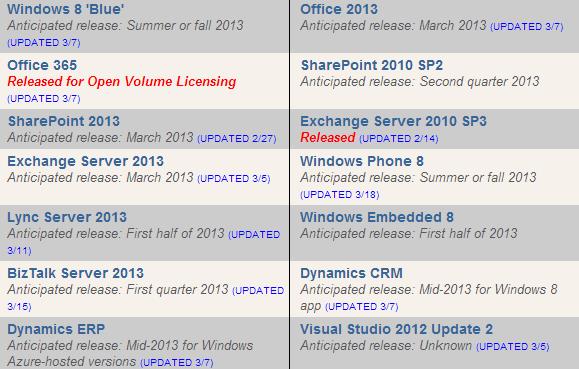
The following table showing recently announced updates to the 2013 Microsoft Product Roadmap first appeared on the Redmond Channel Partner website on march 18th.

Microsoft roadmap analysis

Source: Redmond Channel Partner Magazine  

Microsoft reports that Office365 will go to an accelerated release cycle, further capitalizing on the nature of a cloud-based architecture.  Resellers at this conference like the  Office 365 Open licensing program because it allows them to direct-bill customers for use of the suite, in addition to paying for the bundle of their services. Windows Azure-hosted versions of Dynamics NAV and Dynamics GP will arrive in mid-2013 according to the article as well.

For the cloud, device and services strategy to succeed Microsoft must also succeed in convincing enterprise accounts to migrate their applications to Windows Azure.  This is one of the most critical areas for the future of their cloud strategy in the enterprise, so expect to see customer stories and ongoing messaging on this point.

Bottom line: Microsoft is transitioning to a more humanized approach to marketing while embracing a cloud, device and services strategy. It will be the partner ecosystem that transforms that vision into a profitable reality.

Why Cloud Computing Is Slowly Winning The Trust War

Cloud computing Seeing skeptical CIOs agree to cloud-based pilots of Customer Relationship Management (CRM), Enterprise Resource Planning (ERP) and other applications is evidence of how cloud computing is slowly winning the trust war.

Further evidence can be seen from how skeptical many of these CIOs initially were, and how successful pilots led to their gradual trust.

This trust hasn’t come cheap however.

Every one of these CIOs spoken with, across a range of manufacturing companies, learned that Service Level Agreements (SLAs) aren’t sufficient to manage the areas of security, privacy and confidentiality on their own.  Cloud computing vendors have used SLAs as a means to imply security standards are met; one CIO told me he had an audit done to see if the SLA targets promised were realistic.  They weren’t and he moved on to another vendor.  That is the level of skepticism and lack of trust many CIOs initially have about the cloud today.  Add to that how much Europe doesn’t trust the cloud, and any CIO of a manufacturing or services business that has operations globally has ample reason to be skeptical about cloud computing.  The highly visible failures of Amazon, Apple, Google, Microsoft continues to fuel skepticism and distrust of cloud computing as well.

Despite these factors, cloud computing is slowing winning the trust war.  Here are the key take-aways from my conversations and visits with CIOs and their departments over the last two weeks:

  • Service Level Agreement (SLA) claims of security, privacy and confidentiality often only partially cover the unique needs of a given business – rarely all of them.  CIOs complained that the SLAs they were initially given for cloud pilots by vendors lacked any insight into their core business, how it operated, and how the cloud-based applications could contribute greater insight and intelligence.  Only after several revisions and additions of performance measurements tied to business strategies did these skeptical CIOs let the pilots go on.  Model contracts for defining privacy, for these CIOs, are also losing credibility.  These CIOs forced the issue of a highly specific privacy plan from vendors and got them.
  • For global cloud deployments, CIOs viewed the development a roadmap and plan for how to deal with transborder data flow restrictions and in-country compliance for data confidentiality, security and personal information protection as critical.  One manufacturing CIO is setting up a two-tier ERP system throughout Europe has to first define the global privacy regulations across each nation and province.  Depending on the European nation this could include defining the physical location, contents and specific configuration of every server used.  Germany has among the most intensive data protection rules and requirements, which further require intensive roadmap and plan development to stay in compliance.
  • The most skeptical CIOs run scenario tests of full data and record extractions during pilots.  This is a safeguard in case the relationship with the cloud provider goes badly, and also to make sure they can quickly get their data back and avert vendor lock-in.  As part of this many CIOs want to see proof that data deletion has worked correctly on the provider’s servers.
  • The most trustworthy cloud computing pilots quickly move beyond basic analytics including ROI to deliver expertise and knowledge specific to the clients’ business.  This is the most powerful dynamic of all in the victories cloud computing is having in the trust war.  When a cloud pilot moves beyond showing how it can automate a process – say payroll for example – and starts making contributions to the expertise and knowledge of a company, trust grows quickly.   At that point trust becomes an accelerator for cloud computing and the platform and applications become part of the IT strategy of a business.

Bottom line:  Trust is the greatest accelerator there is in cloud computing’s growing adoption, and that’s earned when cloud applications get beyond simple metrics to delivering insights and useful intelligence on secured platforms.

Thank you Cindy Jutras and Lisa Lincoln for your contributions and insights on this as well.

Additional Reading and References:

Demirkan, H., & Goul, M. (2013). Taking value-networks to the cloud services: Security services, semantics and service level agreements. Information Systems and eBusiness Management, 11(1), 51-91.

Khan, K. M., & Malluhi, Q. (2010). Establishing trust in cloud computing. IT Professional Magazine, 12(5), 20-27.

John C. Roberts, II , Wasim Al-Hamdani, Who can you trust in the cloud?: a review of security issues within cloud computing, Proceedings of the 2011 Information Security Curriculum Development Conference, p.15-19, September 30-October 01, 2011, Kennesaw, Georgia

Rodero-Merino, L., Vaquero, L. M., Caron, E., Muresan, A., & Desprez, F. (2012). Building safe PaaS clouds: A survey on security in multitenant software platforms. Computers & Security, 31(1), 96. Link: http://hal.archives-ouvertes.fr/docs/00/65/73/06/PDF/RR-7838.pdf

Where The Highest Paying Cloud Computing Jobs Are

jobs-are-in-cloud-computing-200x300Using analytics to better understand the cloud computing job market is fascinating.

One of the most advanced companies in this area is Wanted Analytics, who aggregates job postings from over 500 job boards and maintains a database of over 600 million unique job listings.  They specialize in business intelligence for the talent marketplace, providing insights into how one company’s salary range compares to competitors for the same position, also calculating the difficulty to hire a given type of candidate.  They’ve developed a unique Hiring Scale to accomplish this.

I recently had a chance to test-drive their analytics applications.  Using the parameters to analyze all cloud computing jobs that pay $100,000 a year or more for the analysis, I ran several queries.  Key takeaways include the following:

  •  San Jose-Sunnyvale-Santa Clara, CA leads the MSAs with a salary range $118K to $144K and one of the highest Hiring Score index values of 81, meaning it is very difficult for employers to find candidates who are qualified for their open positions. Bridgeport-Stamford-Norwalk, CT is next with a salary range of $117K to $143K and a Hiring Index Score of 75.  The SMA for San Francisco-Oakland-Fremont, CA shows a salary range of $114K to $140K and a relative high Hiring Scale of 88.  Salary range for cloud computing professionals charted by metropolitan  statistical area (MSA) is shown below:

  •  Professional, Scientific and Technical Services (31%), Information Technologies (30%) and Manufacturing (12%) lead the top ten industries hiring cloud computing professionals in positions paying $100K or more. Wanted Analytics uses the NAICS taxonomy to organize this area of their database.

  • A total of 5,299 positions are open today for Computer Software Engineers, Applications and Architects as is shown in the following graphic.  What is surprising is the rapid increase in Marketing Managers (1,076 positions),  Sales Representatives, Wholesale and Manufacturing, Technical and Scientific Products (576 positions) and Sales Engineers (452 positions).   Wanted Analytics uses the Standard Occupational Classification (SOC) taxonomy too organize this area of their database.  The results are shown in the graphic below:

How Cloud Computing Is Redefining the M&A Landscape

Cloud Computing M&AIn 2013, expect to see the pace of mergers and acquisitions for cloud computing, mobile and analytics technologies accelerate as software vendors look to fill gaps in their product and service strategies. This and other key insights of how cloud computing is reshaping the merger and acquisition landscape can be found in the latest Price Waterhouse Coopers (PwC) report published today.

The US Technology M&A insights: Analysis and Trends in US Technology M&A Activity 2013 provides an excellent overview of merger, acquisitions, private equity, divestures, cross-border transactions across the five key industry sectors.  The report, free for download, covers the Internet, IT Services, hardware and networking, software, and semiconductor sectors.

Enterprise Software Players: In Search of Sticky Revenue and Higher Margins

The major catalysts driving cloud deals forward in 2013 are enterprise software companies’ need to redefine their business models and find sources of sticky revenue that can replace for many of them, dwindling maintenance revenue streams.  Knowing that the annuity model of cloud computing works best with multiyear payments required at the beginning of a customer engagement, enterprise software companies are looking to strengthen this area of their product portfolios.  Third, the faster cloud acquisitions can be integrated into their legacy systems, the more upsell can be achieved with their large installed bases of customers.  The greatest challenge many of them face however is selling entirely new cloud applications to entirely new customers they’ve never sold to before.  The potential of these entirely new markets however is going to be a valuation multiplier in 2013 and beyond.

Here are the key take-aways from PwC’s report:

  • Software and Internet deals represented 57% of transactions closed in 2012, a figure that PwC has seen steadily grow over the last two years. Cumulative value for software and Internet deals represented 53% of total 2012 deal value, an increase from 51% in 2011. Software deals represented over a third of 2012 technology deals, generating 35% of deal volume and 36% of deal value for the year   A comparison of both years and technology sectors are shown in the following graphic:

Figure 1 PWC Report

  • PwC takes a cautionary, conservative tone in this report showing how overall IT spending growth finished the year at an anemic 1.2% while technology deal volumes and values dropped by just under 20% from the prior year.
  • The report cites Gartner and Forrester’s optimistic IT spending forecasts for IT growth predicting a recovery in 2013 followed by accelerating growth in 2014 according to Forrester.
  • PwC is seeing SaaS, mobile devices, analytics and Big Data as the drivers of current and future M&A growth and a fundamental shift in deal volumes to software and Internet deals based on these technologies.  The report says the most promising areas of M&A activity in 2013 are mobile application development start-ups who have the intellectual property it would take years for enterprise software companies to create on their own.
  • Analytics will move from being a differentiator to the cost of doing business, a key point made in the PwC analysis.  PwC claims that analytics M&A will accelerate across all enterprise software vendors as they seek to fill gaps in their product and service strategies, and position themselves for growth in specific areas of the emerging industries using Big Data.
  • PwC reports that monthly deal volumes for software remained relatively even throughout 2012, hovering at 8-9 transactions per month and averaging just over 20 per quarter. The average deal value of $433M for 2012 was slightly lower than 2011 levels of $438M but an increase in the number of deals in excess of $500M helped to keep average deal values high. The report also shows how 2012 saw 18 deals (21% of volume) in excess of $500M closed, the majority of which closed in the latter half of the year. Fourteen deals greater than $1B closed in 2012, an increase of 8 deals (133%) over 2011.  The following is a graphic comparing software sector deals by volume and value:
Figure 2 PWC Report

 Bottom line: The land grab is on for intellectual property in the fields of mobile application development, analytics and cloud computing as enterprise software vendors look to fill gaps in their product and service strategies.