Skip to content

Posts tagged ‘SaaS’

Intacct’s CEO Robert Reid On Growing A Successful Cloud Business

Robert-Reid CEO IntacctSelling software to accountants, auditors and Chief Financial Officers (CFOs) takes accuracy, precision and software quality to an entirely new dimension.

Having worked at a start-up selling hosted accounting and finance applications to small and medium businesses, I’ve seen first-hand how demanding these professionals can be.  And rightly so, the system of record they manage keeps their businesses financially strong and growing.  Intacct is one of the companies I’ve tracked for the last few years in this area, and I recently had a chance to speak with their CEO, Robert Reid.

While there are many cloud financial management and accounting companies creating interesting products and winning customers, Intacct is unique.   Rob has infused a passion for customer centricity into the company along with a mindset of continual innovation in their applications’ user experience.  Rob is a longtime veteran of the enterprise software industry, having served previously as CEO of LucidEra and previous to that, group vice president of Siebel CRM On Demand for Oracle Corporation managing the SMB sector.  He also served as president and CEO of on-demand CRM innovator UpShot, where Rob grew the company tenfold before it was acquired by Siebel.  He is also one of the executive founders of Documentum.  You can find his LinkedIn profile here.

I recently had a chance to speak with Rob regarding his perspective on cloud computing in general and regarding Intacct’s business specifically.  Here’s a transcript to my interview with him:

What are the three biggest challenges you see to Intacct’s growth over the long-term and how will you and the management team address them?

Our biggest challenge by far is finding great people.  People who are curious,  people who want to learn and continually grow while also being customer-centric.  We’re looking for great people with these attributes and those who want to do rewarding, challenging work.  That’s a high priority for us today.

Second, we’re looking to add more partners who have expertise in accounting and finance to grow along with us and help customers anticipate what they need to do today and in to the future to deliver value to their organizations .

Third, anticipating the growth of the business and being able to effectively plan for the pace and direction of change is critical to us.

SaaS-based applications have proved themselves very well in small and medium businesses.  How and why are small businesses adopting SaaS-based accounting and finance systems today?  How is this going to change in the future?

We’re seeing usability and excellent customer experience designed into cloud applications being essential for the growth of our business.  In fact we’ve done intensive studies of how our customers can save time and be more productive with greater usability improvements, quickly released into our applications.

Intuitive design of application workflows, in accounting and finance, is another key success factors we’re seeing today.  This is leading to a consumerization of financial management systems.

Accounting and financial professionals are after greater visibility into their financials.  Analytics and modeling from an accounting perspective is also a high priority for our customers today.  The 21rst century CFO needs to have these analytics and modeling tools with real-time data to do their jobs, and we’re very focused on delivering them.

A critical success factor for any SaaS-based accounting system is the ability to integrate with 3rd party systems and also migrate legacy data.  Can you speak to this aspect of your company’s product and service strategy, and what your plans are in this area going forward?

Our architecture includes Open Application Programmer Interfaces (APIs) that simplify the complexity of integrating with homegrown, legacy and 3rd party databases and systems.  Over the last decade we’ve fine-tuned these APIs, publishing them free for our customers.  We’ve learned much from listening to our customers, continually fine-tuning APIs to stay in step with their needs.  Our APIs are making it possible for our systems to have inbound and outbound data from systems throughout our customers’ businesses creating a reliable system of record.

With SaaS it’s possible to accelerate the release cycles to any pace a company chooses.  Right now Intacct is committing to four major releases a year.  Are there plans to accelerate the release cycle and do more?

We’re staying with four major releases a year out of respect for the change management aspects of our customers.  Doing releases more often than that would force our customers to continually be educating their accounting, finance, reporting and services teams of new features.  We do make tens of smaller releases a year to incrementally add features customers ask for.  And our customers can choose to enable these features as they are added to our applications.  We are finding that balance between agile development and quality assurance of configurable features, while striving to make usability and the user experience  paramount.

Much has been said regarding single tenancy and multi-tenancy. Can Intacct customers choose between these options?  Is there a price premium for choosing one over another?

We are exclusively multi-tenant as it makes the most sense for our customers economically.  If a customer chooses a single-tenancy solution it takes a ton of time from an operations team to run it; so it ends up being a bad economic model for the company.  Since the hardware, and resources aren’t being shared, a single tenant system ends up being the most expensive way to go. There is a tremendous amount of cloud washing going on out there, where software companies and providers are trying to put a glow on old technology by calling it single tenancy, when it is really just a hosted version of that old application. It is important to choose a cloud system that was built from day one to be in the cloud and deliver tremendous value.

Do you partner with a cloud provider or own your own hosting center?  Are your long-term plans to own your own data centers? 

Our global hosting partner is Savvis.  We manage the servers and have complete control over our Service Level Agreement (SLA) monitoring and reporting.  We’ve also provided every customer with 24/7 transparency into our applications’ stability and reliability.

What percentage of your sales are from North America relative to Europe and Asia?  How do you see this changing in the next three years? 

The majority of our customers are located in the United States, but have on average five locations around the world..  Our multicurrency, multientitiy, and consolidated roll-up features are heavily used by this group of multinational customers.

Intacct has done well selling to accountants and financial professionals, a community known for valuing accuracy, auditability and precision.  How has Intacct been able to both evangelize cloud computing and cloud-based accounting systems to this pragmatic, at times skeptical market segment?  

We’re selling to the 21rst century CFO really well, stressing the need to have real-time visibility into operations and the ability to define metrics and modeling of current and future financial performance of their business.  As we’re selling them more than a system of record, but a system of engagement.  Our approach is to show how they can accelerate their growth as a business with better insights for all of the knowledge workers into their overall performance.

In 2009 the American Institute of Certified Public Accountants (AICPA), and its subsidiary, CPA2Biz, chose Intacct as the only preferred provider of financial applications to CPA professionals and AIPCA members.  Intacct was given an exclusive five year agreement that was extended for another three taking the agreement to at least 2017.  In addition, the International Federation of Accountants (IFAC) has chosen Intacct as their internal accounting and financial management application as well.  Much has been said about the role of trust in enterprise software in general and cloud-based applications specifically.  The AICPA and IFAC have given us the chance to be the trusted solution to customers as a result.

You’ve often said that Intacct is very focused on getting customers back their time.  How are you designing in greater usability and performance improvements to Intacct’s applications to make this happen?

We have a feature called dimensions, which gives our customers the flexibility to create and track the metrics that are specific to their business.  One of the most compelling cases of the value of dimensions is the example of a airplane leasing company that was able to grow their business 30% faster each year based on the increased insights gained.   Using our dimensions capability, the plane leasing company was able to track plane leasing data, track how many times a given plane had been leased, compare costs of other planes and also track the lifetime value of the planes as well.  One of the most fascinating aspects of this analysis is the finding that over time planes initial values drop and then increases  in value, just like a Ferrari.  Using dimensions gave the company the ability to analyze their data in new ways and, in turn, manage their assets more effectively and profitably than ever before.

The Intacct Accountants Program is one of the more unique in the industry.  Can you discuss how your company was successful in recruiting partners, and what your plans are for 2013 and beyond with this program?

This is one the top three strategic initiatives we continue to invest heavily in.  We’ve been able to build a successful program by concentrating on partners with strong accounting domain expertise, excellent command of billing and profitability analysis, and a broad base of accounting and finance expertise.  Our alliance with the AICPA has also helped in making our Accountants Program a success.

Do you use personas as part of your product development, product management and marketing strategies?  Can you comment on them briefly and how they are impacting your approach to product development and marketing?

We use personas extensively throughout our development, marketing and selling strategies.  Our personas include titles and roles, as well as problems and needs.  We also have a Follow Me To Work Program which is invaluable in fine-tuning the usability of our applications.  Intuit pioneered many of the advances in Follow Me Home research programs to fully understand customers’ needs.  We have much of the original Intuit QuickBooks product management and engineering teams working for us today, focusing on how to continually improve usability and our customers’ experiences with our software.

How Cloud Computing Is Redefining the M&A Landscape

Cloud Computing M&AIn 2013, expect to see the pace of mergers and acquisitions for cloud computing, mobile and analytics technologies accelerate as software vendors look to fill gaps in their product and service strategies. This and other key insights of how cloud computing is reshaping the merger and acquisition landscape can be found in the latest Price Waterhouse Coopers (PwC) report published today.

The US Technology M&A insights: Analysis and Trends in US Technology M&A Activity 2013 provides an excellent overview of merger, acquisitions, private equity, divestures, cross-border transactions across the five key industry sectors.  The report, free for download, covers the Internet, IT Services, hardware and networking, software, and semiconductor sectors.

Enterprise Software Players: In Search of Sticky Revenue and Higher Margins

The major catalysts driving cloud deals forward in 2013 are enterprise software companies’ need to redefine their business models and find sources of sticky revenue that can replace for many of them, dwindling maintenance revenue streams.  Knowing that the annuity model of cloud computing works best with multiyear payments required at the beginning of a customer engagement, enterprise software companies are looking to strengthen this area of their product portfolios.  Third, the faster cloud acquisitions can be integrated into their legacy systems, the more upsell can be achieved with their large installed bases of customers.  The greatest challenge many of them face however is selling entirely new cloud applications to entirely new customers they’ve never sold to before.  The potential of these entirely new markets however is going to be a valuation multiplier in 2013 and beyond.

Here are the key take-aways from PwC’s report:

  • Software and Internet deals represented 57% of transactions closed in 2012, a figure that PwC has seen steadily grow over the last two years. Cumulative value for software and Internet deals represented 53% of total 2012 deal value, an increase from 51% in 2011. Software deals represented over a third of 2012 technology deals, generating 35% of deal volume and 36% of deal value for the year   A comparison of both years and technology sectors are shown in the following graphic:

Figure 1 PWC Report

  • PwC takes a cautionary, conservative tone in this report showing how overall IT spending growth finished the year at an anemic 1.2% while technology deal volumes and values dropped by just under 20% from the prior year.
  • The report cites Gartner and Forrester’s optimistic IT spending forecasts for IT growth predicting a recovery in 2013 followed by accelerating growth in 2014 according to Forrester.
  • PwC is seeing SaaS, mobile devices, analytics and Big Data as the drivers of current and future M&A growth and a fundamental shift in deal volumes to software and Internet deals based on these technologies.  The report says the most promising areas of M&A activity in 2013 are mobile application development start-ups who have the intellectual property it would take years for enterprise software companies to create on their own.
  • Analytics will move from being a differentiator to the cost of doing business, a key point made in the PwC analysis.  PwC claims that analytics M&A will accelerate across all enterprise software vendors as they seek to fill gaps in their product and service strategies, and position themselves for growth in specific areas of the emerging industries using Big Data.
  • PwC reports that monthly deal volumes for software remained relatively even throughout 2012, hovering at 8-9 transactions per month and averaging just over 20 per quarter. The average deal value of $433M for 2012 was slightly lower than 2011 levels of $438M but an increase in the number of deals in excess of $500M helped to keep average deal values high. The report also shows how 2012 saw 18 deals (21% of volume) in excess of $500M closed, the majority of which closed in the latter half of the year. Fourteen deals greater than $1B closed in 2012, an increase of 8 deals (133%) over 2011.  The following is a graphic comparing software sector deals by volume and value:
Figure 2 PWC Report

 Bottom line: The land grab is on for intellectual property in the fields of mobile application development, analytics and cloud computing as enterprise software vendors look to fill gaps in their product and service strategies.

Gartner Predicts Infrastructure Services Will Accelerate Cloud Computing Growth

public cloud computing forecast 2011 - 2016As public cloud computing gains greater adoption across enterprises, there’s an increased level of spending occurring on infrastructure-related services including Infrastructure-as-a-Service(IaaS).  Enterprises are prioritizing how to get cloud platforms integrated with legacy systems to make use of the years of data they have accumulated.  From legacy Enterprise Resource Planning (ERP) to Customer Relationship Management (CRM) systems, integrating legacy systems of record to cloud-based platforms will accelerate through 2016.  I’ve seen this in conversations with resellers and enterprise customers, and this trend is also reflected in Gartner’s latest report on public cloud computing adoption, Forecast Overview: Public Cloud Services, Worldwide, 2011-2016, 4Q12 Update Published: 8 February 2013.  Below are the key take-aways from the report:

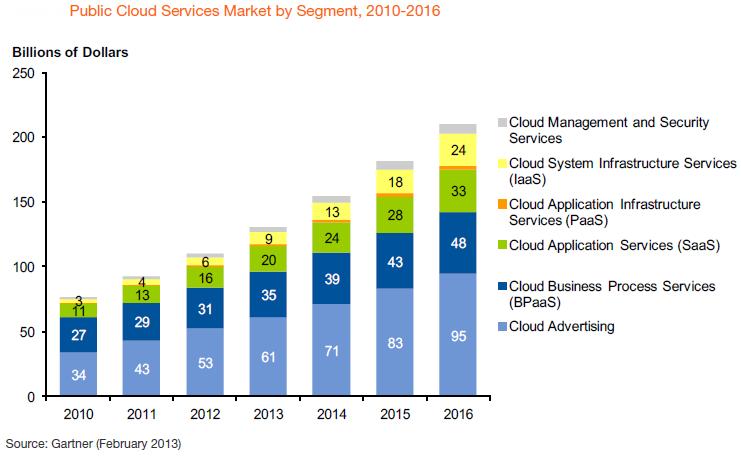
  • Global spending on public cloud services is expected to grow 18.6% in 2012 to $110.3B, achieving a CAGR of 17.7% from 2011 through 2016. The total market is expected to grow from $76.9B in 2010 to $210B in 2016. The following is an analysis of the public cloud services market size and annual growth rates:

Figure 1 Cloud Computing Growth

  • Gartner predicts that Infrastructure-as-a-Service (IaaS) will achieve a compound annual growth rate (CAGR) of 41.3% through 2016, the fastest growing area of public cloud computing the research firm tracks.  The following graphic provides insights into relative market size by each public cloud services market segment:

Figure2

  • Platform-as-a-Service (PaaS) will achieve a 27.7% CAGR through 2016, with Cloud Management and Security Services attaining 26.7% in the same forecast period.  Software-as-a-Service’s CAGR through 2016 is projected to be 19.5%.  The following graphic illustrates the differences in CAGR in the forecast period of 2011 – 2016:

Figure 3

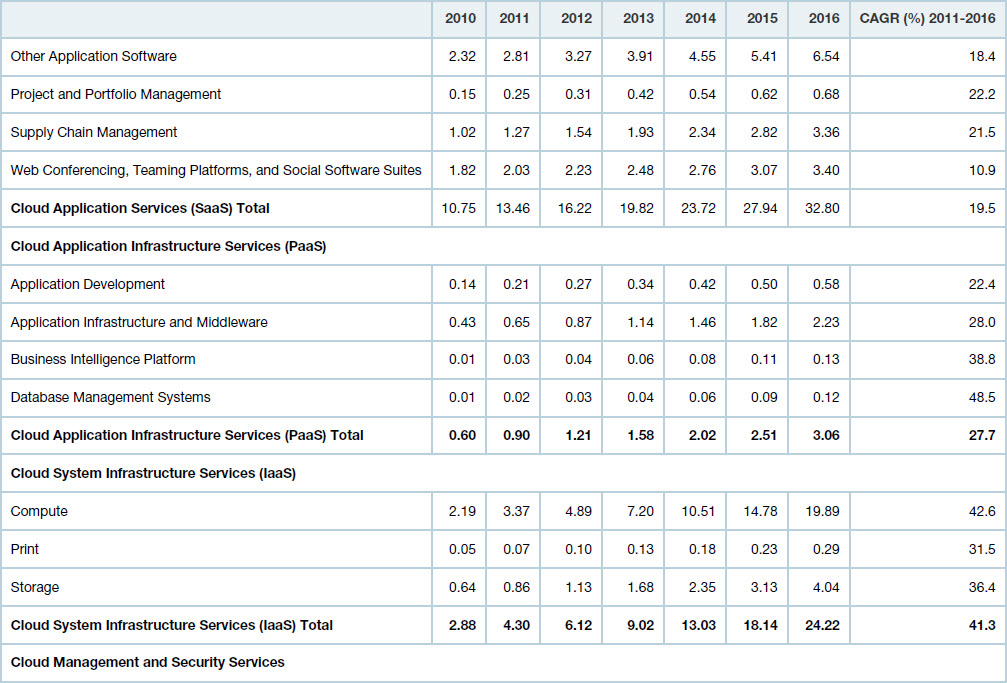
  • Gartner is projecting the SaaS market will grow at a steady CAGR of 19.5% through 2016, having increased the forecast slightly (.4%) since its latest published report.  Global SaaS spending is projected to grow from $13.5B in 2011 to $32.8B in 2016.
  • CRM will continue to be the largest global market within SaaS, forecast to grow beyond $5B in 2012 to $9B in 2016, achieving a 16.3% CAGR through 2016.   The highest growth segments of the SaaS market continue to be office suites (49.1%), followed by digital content creation (34.0%).  The following graphic rank orders CAGRs across all public cloud services segments from the forecast period:

Figure 4

  • 59% of all new spending on cloud computing services originates from North American enterprises, a trend projected to accelerate through 2016.  Western Europe is projected to be 24% of all spending.  A graphic comparing total spending by geography and corresponding growth rates is provided below:

Figure 5

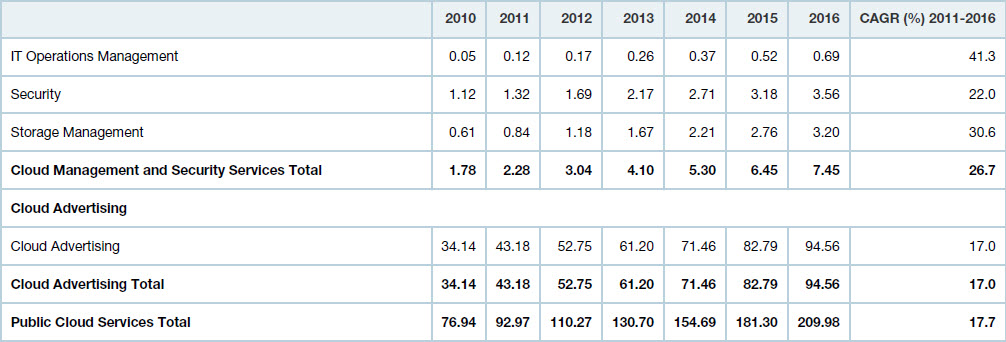
  • The following tables provide insights into each category of public cloud computing spending throughout the forecast period.  Please click on the tables to expand them for easier reading.

Table 1

Table 2

Table 3

Source:  Forecast Overview: Public Cloud Services, Worldwide, 2011-2016, 4Q12 Update Published: 8 February 2013.

Roundup of Cloud Computing & Enterprise Software Market Estimates and Forecasts, 2013

157989221When the CEO of a rust-belt manufacturer speaks of cloud computing as critical to his company’s business strategies for competing globally, it’s clear a fundamental shift is underway.

Nearly every manufacturing company I’ve spoken with in the last ninety days has a mobility roadmap and is also challenged to integrate existing ERP, pricing and fulfillment systems into next-generation selling platforms.

One of the most driven CEOs I’ve met in manufacturing implemented a cloud-based channel management, pricing, quoting and CRM system to manage direct sales and a large distributor network across several countries.  Manufacturers are bringing an entirely new level of pragmatism to cloud computing, quickly deflating its hype by pushing for results on the shop floor.

There’s also been an entirely new series of enterprise software and cloud computing forecasts and market estimates published.  I’ve summarized the key take-aways below:

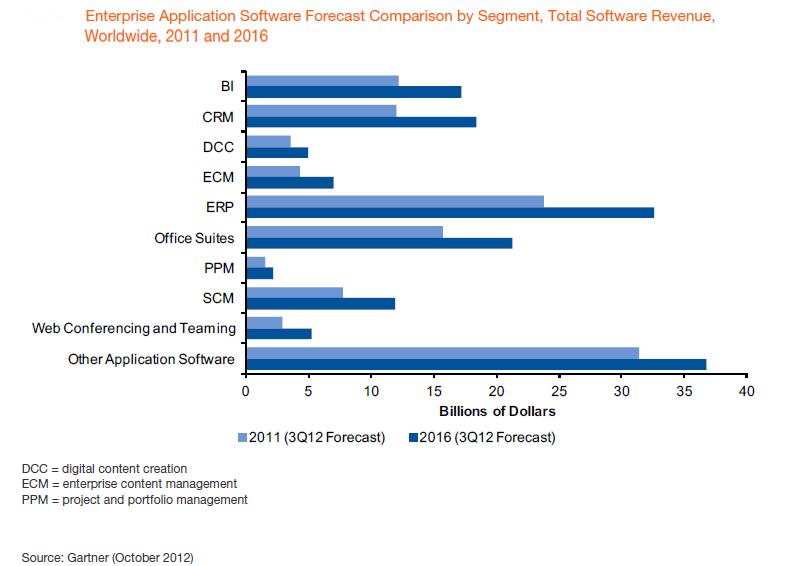
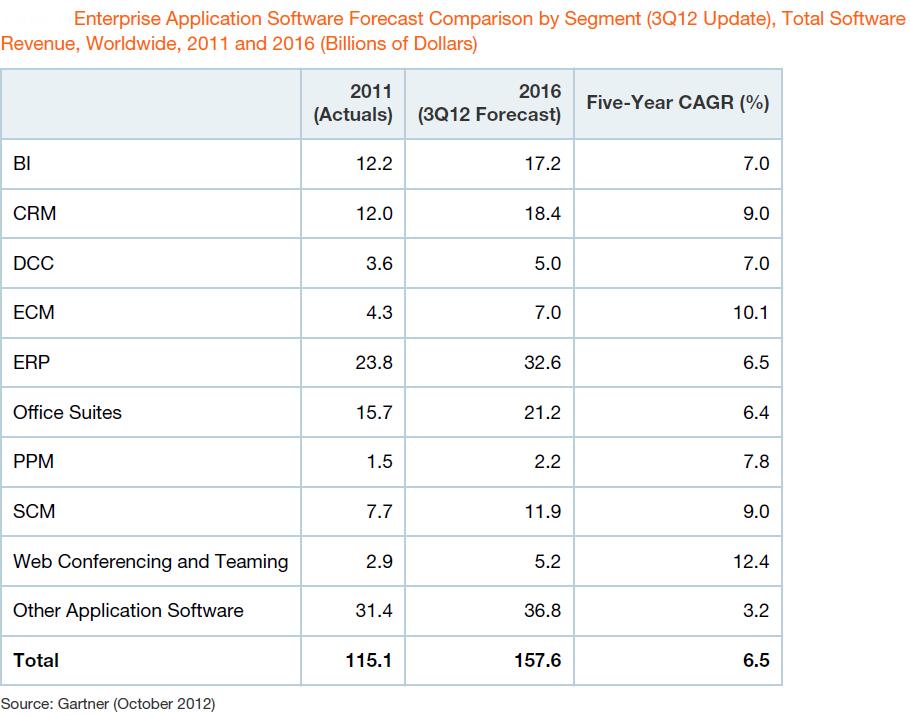
  • Enterprise sales of ERP systems will grow to $32.9B in 2016, attaining a 6.7% CAGR in the forecast period of 2011 to 2016.   CRM is projected to be an $18.6B global market by 2016, attaining a CAGR of 9.1% from 2011 to 2016.   The fastest growing category of enterprise software will be Web Conferencing and Team, growing at a 12.4% CAGR through the forecast period.  The following graphic compares 2011 actual sales and the latest forecast for 2016 by enterprise software product category.  Source:  Gartner’s Forecast Analysis: Enterprise Application Software, Worldwide, 2011-2016, 4Q12 Update Published: 31 January 2013

Figure 1 enteprise spending

Figure 2

figure 3 cloud computing

 public cloud forecast

Forrester Wave

  • IDC is predicting Cloud Services and enablement spending will hit $60 billion, growing at 26% through the year and that over 80% of new apps will be distributed and deployed on cloud platforms.  Their predictions also are saying that 2.5% of legacy packaged enterprise apps will start migrating to clouds.  Source: Top 10 Predictions, IDC Predictions 2012: Competing for 2020 by Frank Gens. You can download a copy of the IDC Predictions here: http://cdn.idc.com/research/Predictions12/Main/downloads/IDCTOP10Predictions2012.pdf

How Cloud Computing Is Accelerating Context-Aware Coupons, Offers and Promotions

Retailers and marketers often face the challenge of getting coupons, offers and promotions delivered at the perfect time and in the right context to their customers.

The rapid advances in cyber foragingcontextual computing and cloud computing platforms are succeeding at revolutionizing this aspect of the retail shopping experience.  Context-aware advertising platforms and strategies can also provide precise audience and segment-based messaging directly to customers while they are in the store or retail outlet.

What makes context-aware advertising so unique and well adapted to the cloud is the real-time data integration and contextual intelligence they use for tailoring and transmitting offers to customers.  When a customer opts in to retailer’s contextually-based advertising system, they are periodically sent alerts, coupons, and offers on products of interest once they are in or near the store.  Real-time offer engines chose which alerts, coupons or offers to send, when, and in which context.  Cloud-based analytics and predictive modeling applications will be used for further fine-tuning of alerts, coupons and offers as well.  The ROI of each campaign, even to a very specific audience, will be measurable.  Companies investing in cloud-based contextual advertising systems include Apple, Google, Greystripe, Jumptap, Microsoft, Millennial Media, Velti and Yahoo.

Exploring the Framework of Me Marketing and Context-Aware Offers

A few years ago, a student in one of my MBA courses in international marketing did their dissertation on cyber foraging and contextual mobile applications’ potential use for streamlining business travel throughout Europe.  As a network engineer for Cisco at the time, he viewed the world very systemically; instead of getting frustrated with long waits he would dissect the problem and look at the challenges from a system-centric view.  The result was a great dissertation on cyber foraging and the potential use of Near Field Communications (NFC) and Radio Frequency Identification (RFID) as sensors to define contextual location and make business travel easier.  One of the greatest benefits of teaching, even part-time, is the opportunity to learn so much from students.

I’ve been following this area since, and when Gartner published Me Marketing: Get Ready for the Promise of Real-Time, Context-Aware Offers in Consumer Goods this month I immediately read it.  Gartner is defining Me Marketing as real-time, context-aware offers in grocery stores. Given the abundance of data on transactions that occur in grocery stores, Gartner is predicting this will be the most popular and fastest-growing area of context-aware offers.  The formula for Me Marketing is shown below:

The four steps of the Me Marketing formula are briefly described as follows:

Me marketing framework for contextual coupons


  • Consumer Insight and Permission – The first step of the framework and the most difficult from a change management standpoint, this requires customers to opt in to receiving alerts, coupons, offers and promotions.  The best retailers also have invested heavily in security and authentication technologies here too.
  • Delivery Mechanism and In-the-Moment Context – The real-time offer engine is used to determining which coupons, offers and promotions are best suited for a specific customer based on their shopping patterns, preferences and locations.
  • Select Best Offer – Next, the real-time offer engine next defines a very specific product or service offer based on location, previous purchase history, social media analysis, predictive and behavioral analysis, and previous learned patterns of purchasing.
  • Redemption – The purchase of the item offered.  Initial pilots have shown that less frequent yet highly relevant, targeted offers have a higher redemption rate.  It is encouraging to see that early tests of these systems show that spamming customers leads to immediate opt-outs and in some cases shopping competitors.

A Short Overview of Contextual Advertising and the Cloud

Cloud-based systems and applications are necessary for retailers to gain the full value that contextual advertising can provide.  This includes the social context, with specific focus on aggregation and analysis of Social CRM, CRM, and social media content, in addition to behavioral analytics and sentiment analysis.  It also includes the previous browsing, purchasing, returns and prices paid by product for each customer.  Cloud-based integration architectures are necessary for making contextual advertising a reality in several hundred or even thousands of retail stores at the same time.

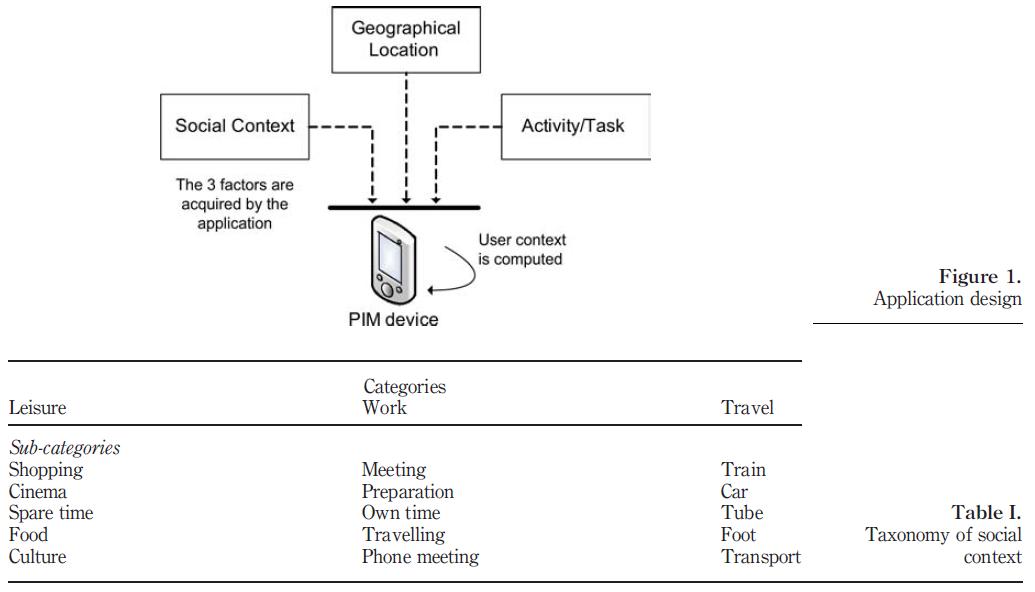
Geographical data and analysis is also essential.  RFID has often been included in cyber foraging and contextual advertising pilots, in addition to NFC.  As Global Positioning System (GPS) chip sets have dropped in price and become more accurate, companies including Google, Microsoft and Yahoo are basing their contextual advertising platforms on them.  Finally the activity or task also needs to have a contextual definition.

Combining all three of these elements gives the context of the customer in the retail store.  The figure below is from Three-Dimensional Context-Aware Tailoring of Information.  This study also took into account how personas are used by companies building cloud-based contextual advertising systems.  The taxonomies shown in the figure are used for building personas of customers.

context aware technology

There are many pilot projects and enterprise-wide system tests going on right now in the area of cloud-based contextual advertising.  One of the more interesting is an application suite created entirely on Google App Engine, Android, and Cloud Services.  The pilot is explained in the study Exploring Solutions for Mobile Companionship: A Design Research Approach to Context-Aware Management.  The following figure shows a diagram of the suite.  This pilot uses Cloud to Device Messaging (C2DM) which is part of the Android API to link the Google App Engine server and Android client.  Google will most likely add more depth of support for C2DM as it plays a critical role in contextual system development.

context aware Google Ad Platform

Benefits of a Cloud-based Contextual Advertising Platform

For the customer, cloud-based advertising systems over time will learn their preferences and eventually impact the demand planning and forecasting systems of retailers.  This translates into the customer-centric benefits of products being out of stock less.  In addition, customers will receive more relevant offers.  The entire shopping experience will be more pleasant with expectations being met more often.

For the retailer, better management of product categories and more effective gross margin growth will be possible. Having real-time analytics of each coupon, offer and promotion will also give them immediate insights into which of their selling strategies are working or not.

For the manufacturer, the opportunity to finally understand how customers respond at the store level to promotions, programs including the results of co-op funds investment and pricing strategies will be known.  The manufacturers who partner with retailers using these systems will also have the chance at attaining greater product differentiation as their coupons, offers and promotions will only go to the most relevant customers.

References:

Me Marketing: Get Ready for the Promise of Real-Time, Context-Aware Offers in Consumer Goods Published: 24 December 2012 Analyst(s): Don Scheibenreif, Dale Hagemeyer

Tor-Morten Grønli, Ghinea, G., & Bygstad, B. (2013). Exploring Solutions for Mobile Companionship: A Design Research Approach to Context-Aware Management. International Journal of Information Management, 33(1), 227. http://www.sciencedirect.com/science/article/pii/S0268401212001259

Tor-Morten Grønli, & Ghinea, G. (2010). Three-Dimensional Context-Aware Tailoring of Information. Online Information Review, 34(6), 892-906. http://www.emeraldinsight.com/journals.htm?articleid=1896452

Cloud Computing and Enterprise Software Forecast Update, 2012

The latest round of cloud computing and enterprise software forecasts reflect the growing influence of analytics, legacy systems integration, mobility and security on IT buyer’s decisions.

Bain & Company and Gartner have moved beyond aggregate forecasts, and are beginning to forecast by cloud and SaaS adoption stage.  SAP is using the Bain adoption model in their vertical market presentations today.

Despite the predictions of the demise of enterprise software, forecasts and sales cycles I’ve been involved with indicate market growth.  Mobility and cloud computing are the catalysts of rejuvenation in many enterprise application areas, and are accelerating sales cycles.  Presented in this roundup are market sizes, forecasts and compound annual growth rates (CAGRS) for ten enterprise software segments.

Key take-aways from the latest cloud computing and enterprise software forecasts are provided below:

  • Public and private cloud computing will be strong catalysts of server growth through 2015.  IDC reports that $5.2B in worldwide server revenue was generated in 2011 or 885,000 units sold.  IDC is forecasting a $9.4B global market by 2015, resulting in 1.8 million servers sold. Source:  IDC Worldwide Enterprise Server Cloud Computing 2011–2015 http://www.idc.com/getdoc.jsp?containerId=228916 
  • 11% of companies are transformational, early adopters of cloud computing, attaining 44% adoption (as defined by % of MIPS) in 2010, growing to 49% in 2013.  This same segment will reduce their reliance on traditional, on-premise software from 34% to 30% in the same period according to Bain & Company’s cloud computing survey results shown below.  SAP is using this adopter-based model in their vertical market presentations, an example of which is shown here.

  • The global Platform-as-a-Service (PaaS) market is growing from $900M in 2011 to $2.9B in 2016, achieving a 26.6% CAGR.  At this projected rate, PaaS will generate an average of $360M a year in revenue between 2011 and 2016.  Gartner projects that the largest segments will be Application Platform Services (aPaaS) which generated 35% of total PaaS spending in 2011, followed by cloud application lifecycle services (12.5).    Source: Market Trends: Platform as a Service, Worldwide, 2012-2016, 2H12 Update Published: 5 October 2012 ID:G00239236.

  • The three most popular net-new SaaS solutions deployed are CRM (49%), Enterprise Content Management (ECM) (37%) and Digital Content Creation (35%).  The three most-replaced on-premise applications are Supply Chain Management (SCM) (35%), Web Conferencing, teaming platforms and social software suites (34%) and Project & Portfolio Management (PPM (33%). The following graphic shows the full distribution of responses. Source: User Survey Analysis: Using Cloud Services for Mission-Critical Applications Published: 28 September 2012

SaaS Adoption Accelerates, Goes Global in the Enterprise

In working with manufacturers and financial services firms over the last year, one point is becoming very clear: SaaS is gaining trust as a solid alternative for global deployments across the enterprise.  And this trend has been accelerating in the last six months.  One case in point is a 4,000 seat SaaS CRM deployment going live in Australia, Europe, and the U.S. by December of this year.

What’s noteworthy about this shift is that just eighteen months ago an Australian-based manufacturer was only considering SaaS for on-premises enhancement of their CRM system.  What changed?  The European and U.S. distribution and sales offices were on nearly 40 different CRM, quoting, proposal and pricing systems.  It was nearly impossible to track global opportunities.

Meanwhile business was booming in Australia and there were up-sell and cross-sell opportunities being missed in the U.S. and European-based headquarters of their prospects. The manufacturer  chose to move to a global SaaS CRM solution quickly.  Uniting all three divisions with a global sales strategy forced the consolidation of 40 different quoting, pricing and CRM systems in the U.S. alone.  What they lost in complexity they are looking to pick up in global customer sales.

Measuring Where SaaS Is Cannibalizing On-Premise Enterprise Applications

Gartner’s Market Trends: SaaS’s Varied Levels of Cannibalization to On-Premises Applications published: 29 October 2012 breaks out the percent of SaaS revenue for ten different enterprise application categories.  The greener the color the greater the adoption.  As was seen with the Australian manufacturer, CRM continues dominate this trend of SaaS cannibalizing on-premise enterprise applications.

Additional take-aways from this report include the following:

  • Perceived lower Total Cost of Ownership (TCO) continues to be the dominant reason enterprises are considering SaaS adoption, with 50% of respondents in 2012 mentioning this as the primary factor in their decision.
  • CRM is leading all other enterprise application areas in net new deployments according to the Gartner study, with the majority of on-premise replacements being in North America and Europe.
  • 95% of Web analytics functions are delivered via the SaaS model  whereas only 40% of sales use cloud today according to the findings of this study.
  • SaaS-based ERP will continued to be a small percentage of the total market, attaining 10% cannibalization by 2012.  Forrester has consistently said this is 13%, growing to 16% by 2015.
  • Office suites and digital content creation (DCC) will attain compound annual growth rates (CAGR) of 40.7% and a 32.2% respectively from 2011 through 2016. Gartner is making the assumption consumers and small businesses will continue be the major forces for Web-based office suites through 2013.
  • The four reasons why companies don’t choose SaaS include uncertainty if it is the right deployment option (36%), satisfaction with existing on-premise applications (30%), no further requirements (33%) and locked into their current solution with expensive contractual requirements (14%).

Bottom Line: Enterprises and their need to compete with greater accuracy and speed are driving the cannibalization of on-premise applications faster than many anticipated; enterprise software vendors need to step up and get in front of this if they are going to retain their greatest sources of revenue.

Source:  Market Trends: SaaS’s Varied Levels of Cannibalization to On-Premises Applications Published: 29 October 2012 written by Chad Eschinger, Joanne M. Correia, Yanna Dharmasthira, Tom Eid, Chris Pang, Dan Sommer, Hai Hong Swinehart and Laurie F. Wurster

What’s Hot in CRM Applications, 2012

Serving the sales force is a mantra and mindset that resonates through the best companies I’ve ever worked with and for.

That priority alone can help galvanize companies who are adrift in multiple, conflicting agendas, strategies and projects.  Uniting around that goal – serving sales and getting them what they need to excel – can turn around even the most downtrodden companies.  And size doesn’t matter, the intensity of focus and commitment to excel  do.

That’s why the latest report from Gartner’s Ed Thompson, What’s “Hot” in CRM Application 2012, published last Thursday resonates with me.  He’s talking about how sales strategies need to be propelled by rapid advances in mobile technology, social CRM, sales content and collaboration, and clienteling to serve the sales force more thoroughly than ever before.  His assessment of what’s hot in CRM is a great foundation for getting behind the mantra of serving the sales force and engraining it into a corporate culture while getting full value from the latest technologies.

Here are the key take-aways from the report:

  • CRM spending grew 13% in 2011, fueled analytical, operational and social CRM growth.  Operational CRM represents 80% of all CRM spending and grew 10% in 2011.
  • Analytical CRM, in which Gartner includes predictive analytics and market segmentation analysis, grew a solid 10% in 2011 and is having a very strong year with inquiry traffic.
  • Social CRM grew 30% in 2011 in revenue terms and is 7% of total CRM spending globally as of 2011.   90% of Social CRM spending is originating in Business-to-Consumer (B2C) organizations with the remaining occurring in B2B.
  • CEOs see CRM as their #1 technology-enabled investment in 2012 according the query calls through April, 2012.
  • CRM is ascending rapidly in the priorities of CIOs in 2012, moving from 18th place to eight place  in the latest Gartner analysis.
  • The following table of Highest CRM Application Priorities, 2012 show what’s trending within Sales, Customer Service, E-Commerce and Marketing inquiries Gartner is receiving from its clients.  Consider these as leading indicators of interest.  Over time these areas will need to solidify for forecasts to be completed.
  • Apple iPads are the great maverick buy of 2012 with thousands being purchased by Sales and Marketing management with the immediate requirement of IT integration to these devices.   IT departments are scrambling on the security issues and lack of polices on BYOD.  In enterprise software, iPads are proving to be highly effective as demo platforms for new SaaS-based applications.  They have become the new sales bag of the 21rst century.
  •  High Tech, Life Sciences and Insurance are the three industries with the greatest levels of iPad adoption as of April 2012.  Gartner is predicting that by the end of 2012, 80% of all sales representatives in the pharmaceutical industry will be using iPads for their daily sales tasks.
  • Social or community customer service is the hottest area of growth for post-sales service with high-tech, media, travel, telecommunications, retail and education-based clients dominating client inquiries.

Roundup of SaaS ERP Forecasts and Market Estimates, 2012

The latest round of SaaS ERP market forecasts are more grounded in the reality of CIO priorities and committed projects in 2012 than ever before.  And this is good news for the many vendors competing in the Financial Management Systems (FMS), Human Capital Management (HCM) and Manufacturing segments of the SaaS ERP market.

Two weeks ago in Houston I interviewed twenty-five different CIOs, IT Directors, CEOs and CTOs as part of a persona research study I am doing.  Their take on SaaS ERP was consistent with what this round-up shows, namely this type of SaaS application is best suited for extending beyond, not replacing, the main ERP systems and platforms.   I concentrated on SaaS ERP adoption in manufacturing and learned the following during my interviews:

  • Usability and speed of deployment are the two most common benefits CIOs mentioned in my survey during Convergence.  The economics of cloud computing is a topic that CFOs love to talk about, especially in the areas of value-based pricing and how that is determined.
  • When asked what kept them up at night, CIOs said it was the thought of a call from their boss (often the CFO) that a cloud system had been compromised or had completely gone down.  Security and reliability are holding back CIOs in manufacturing from adopting SaaS-based ERP systems more pervasively in their companies.
  • CIOs from aerospace and defense companies get the benefits of cloud computing, yet they have much bigger issues to deal with right now, like replacing financials in their existing ERP system and staying in compliance to government requirements.  Earned Value Management is a major focus they have as well.  SaaS-based ERP systems are interesting to them; they however would require a completely enclosed, locked-down implementation due to security requirements.
  • There are vast differences in how CIOs view cloud computing – something that the following forecasts don’t really capture.  For the CIOs who are strategists, cloud computing in general and SaaS ERP specifically is a consideration given the agility and time-to-market, providing customization is held to a minimum.  CIOs who came up through IT have a healthy degree of skepticism and see SaaS ERP as potentially useful for scaling out an operation yet never being the primary financial system.

Here are the latest SaaS ERP forecasts and market estimates:

  • Gartner released their latest SaaS revenue forecast last week predicting revenue will reach $14.5B this year, a 17.9% increase from 2011 of $12.3B, with strong growth predicted through 2015 when the market is expected to be $22.1B. Source: http://www.itjungle.com/tfh/tfh040212-story08.html
  • In the report Market Trends: Cloud Computing and SaaS Adoption in Manufacturing and Natural Resources, Worldwide, 2012 Gartner is predicting  59% of manufacturers will adopt IaaS during the 2011 – 2015 timeframe and 47% will be either piloting or using SaaS-based applications.  Gartner cites the need for greater business and supply chain agility as the factors driving this rapid adoption.  The following figure is from the Gartner report  Market Trends: Cloud Computing and SaaS Adoption in Manufacturing and Natural Resources, Worldwide, 2012.
  • Forrester forecasts SaaS ERP spending staying at 2% of the global ERP market, while Gartner forecasts 7% through 2012.  Gartner is projecting Project and Portfolio Management (29.1%) and Supply Chain Management (22.1%) will see the greatest growth rates through 2015.  Supply Chain Management is expected to reach $2.7B in revenue by 2015.  The Total Software Revenue Forecast for SaaS Delivery Within Enterprise Software is shown in the following table.  Source: Forecast: Software as a Service, Worldwide, 2010-2015, 1H11 Update Published: 22 June 2011 Analyst(s): Sharon A. Mertz, Chad Eschinger, Tom Eid, Chris Pang, Laurie F. Wurster
  • Gartner, IDC and Forrester all predict that Human Capital Management (HCM) will see the broadest adoption of all SaaS-based ERP components through 2015.  Vendors in this category include ADP, Concur, Cornerstone onDemand, HumanConcepts, Infor, Kenexa, Lumesse, Saba, SilkRoad, Sonar6, SuccessFactors, SumTotal Systems, Taleo, Ultimate Software and Workday.  Based on a recent Gartner Spending and Usage of SaaS Survey, 39% of manufacturers are piloting or using SaaS-based financials followed by 37% using Expense Management.The following figure illustrates their forecast, from the report  Market Trends: Cloud Computing and SaaS Adoption in Manufacturing and Natural Resources, Worldwide, 2012
  • Gartner’s IT Market Clock for ERP Platform Technology indicates that multitenant SaaS-based ERP is maturing rapidly, driven by time-to-market and cost advantages. The IT Market Clock is shown below, indicating SaaS ERP-based systems position relative to other ERP platforms now in use.  Vendors including  Epicor Express Editions, Glovia, Kenandy, NetSuite, Plex Systems, and SAP Business ByDesign compete in this segment.Source: IT Market Clock for ERP Platform Technology, 2011 Published: 19 September 2011 Analyst: Jim Shepherd.

Gartner has also compiled a Market Clock Recommendation Summary which is shown in the following table.  Of the CIOs I’ve spoken with during the persona research, the description of Multitenant SaaS is accurate.  No CIO I’ve spoken with is willing to bet their job on a rip-and-replace strategy for SaaS ERP; yet many are willing to extend their existing ERP systems using SaaS implementations to get up and running quickly at lower cost.  The one caveat nearly everyone mentions is little or no customization is necessary for SaaS ERP systems to be even evaluated by their companies.  Slight configuration is expected; however in-depth customization is not.

Bottom line: The persona research completed shows that the SaaS-based ERP growth is being helped by the transition occurring in the CIO ranks today.  More of them are strategists, who are expected to make business strategies happen, over and above just keeping the system dial tone on in their enterprises.

How Cloud Computing And ERP Mobility Are Reordering Gartner’s Hype Cycle for ERP

A good friend of mine recently became CIO of a financial services firm and was given his first major project last month: make the complete accounting, financial, and loan provider data and applications available 24/7 on any iPad or Android-based tablet from any office, at any time.

The majority of loan provider applications are cloud-based and his company is running NetSuite.  His corporate office is in Asia and cloud-based applications made it possible for the company to launch and operate in California within months.   He’s been given six months to transform this mobile vision into reality.

Another CIO of a major A&D manufacturer I recently visited wants vendors to challenge him more to get greater value from his investments in legacy data and ERP systems. Using ERP to run batch reports alone has nearly caused project schedules to slip, so the focus internally is on real-time system integration of project management and accounting systems.  He’s also been given the task of revamping accounting and financial systems by October, 2012, and they just started late last year.

Gartner’s Hype Cycle for ERP 

Considering these two extremes in the context of the Gartner Hype Cycle for ERP (shown below) and the recent report SaaS and Cloud ERP Trends, Observations, and Performance 2011  (free for download until January 9, 2012) published by Aberdeen last month several take-aways emerge.

  • CIOs are under increasing pressure in 2012 to enhance, modify even replace existing ERP systems while standardizing technology across the enterprise at the same time.  The most risk-averse way around this is to add applications to single instance ERP backbone systems, with analytics and Business Intelligence (BI) being the among the most in demand.
  • Cloud-based ERP in the Enterprise and Small & Medium Businesses (SMB) are accelerating along the Hype Cycle faster than Gartner indicates.  Enterprises are using Cloud-based ERP systems as part of their two-tier ERP system strategies due to the Total Cost of Ownership (TCO) and time-to-deploy advantages, and the flexibility of tailoring everything from user interfaces to workflows to their specific requirements.  Highly specialized Cloud-based ERP suites including those from Plex Systems are gaining traction due to their expertise in specific industries and the compliance-related challenges inherent within them. In SMBs, the cost and time-to-deploy are two major drivers with concerns over security being the biggest impediment to growth.  Gartner reports that they are seeing Cloud-based ERP adoption fastest in companies with fewer than 200 users overall.
  • Cloud-based ERP systems most often considered in industries that have high variable costs, rapid transaction cycles and tend towards higher Return on Invested Capital (ROIC).  Based on the research SaaS and Cloud ERP Trends, Observations, and Performance 2011 the industries who are the most willing to consider Cloud-based ERP versus on-premise are Financial Services (22% SaaS versus 44% on-premise); Healthcare (42% SaaS versus 58% on-premise); and Professional Services (56% SaaS versus 58% on-premise).
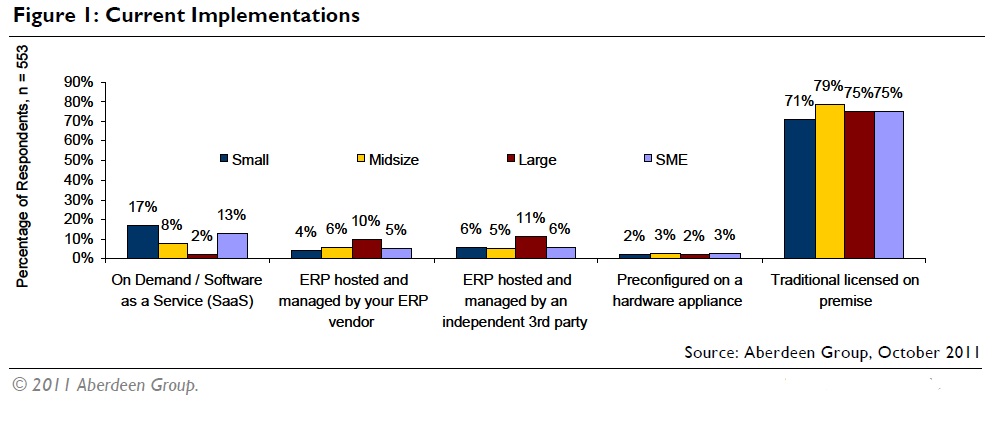
  • Large companies (over $500M in annual revenue) using Cloud-based ERP systems are opting for hosted deployments managed by their ERP vendor (10%) or an independent 3rd party (11%), with just 2% relying on a SaaS platform. Aberdeen defined small organizations as those with annual sales under $50M, midsize organizations having annual sales of $50M – $500M. The following is from SaaS and Cloud ERP Trends, Observations, and Performance 2011:
  • ERP mobility will be a dominant force from the shop floor to each sales call where quotes, orders and contracts deliver real-time order and pricing updates.  How a given manufacturer chooses to sell is even more important than what they sell in many industries. Equipping manufacturing, quality assurance, production scheduling, procurement and sales to have immediate data on what’s going on with orders, customers and suppliers is critical.  For the sales and service teams, real-time data is the fuel they run on.  There’s a chronic time shortage in many, many companies right now, and bringing greater ERP mobility from the shop floor to the sales call will increasingly be seen as a means to lessen the time crunch.  2012 is the year where mobility gets real across the enterprise with solid performance numbers being generated as a result.  For companies with large sales forces and service organizations, integrating to key ERP systems to gain real-time data will quickly lead to increased sales and higher gross margins on service and warranty repairs.
  • Gartner predicts that by 2015 enterprises who are successfully using extreme information management strategies (Big Data) will outperform competitors in their industry sectors by 20% in every available financial metric.  The following is the Priority Matrix for ERP, 2011 showing what Gartner believes to be transformational technologies and strategies in ERP.