Skip to content

Posts tagged ‘SaaS ERP’

Cloud Computing Dominates Deloitte’s 2015 Global Venture Capital Confidence Survey

  • globeCloud computing is the strongest technology investment sector for the third year in a row.
  • Biopharmaceuticals and robotics are the two sectors that have gained the greatest venture capital confidence from 2014 to 2015.
  • U.S. technology hubs (Silicon Valley/San Francisco, New York, Boston, Los Angeles & Chicago), Israel and Canada dominate while confidence continues to fall in Brazil and other emerging markets.

These and other insights are from Deloitte’s 2015 Global Venture Capital Confidence Survey.  You can download a copy here (PDF, no opt-in, 70 pp.).  Deloitte has also produced and made available infographics of the key findings here (PDF, no opt-in, 4 pp.). Deloitte & Touche LLP and the National Venture Capital Association (NVCA) collaborated on the eleventh annual survey, which was conducted in May & June of this year. The study assesses investor confidence in the global venture capital environment, market factors shaping industries and investments on specific geographies and industry sectors.    Please see page 4 of the study for a description of the methodology.

Key take-aways include the following:

  • Global venture capital investors are most confident in cloud computing (4.18). Investors were asked to rate their confidence level in each sector. Confidence levels were measured on a scale of 1 to 5, with 5 representing the most confidence. Basis points indicate year-over-year changes. Mobile (4.05), Internet of Things (3.95) and enterprise software (3.82) are the top four sectors venture capitalists are the most confident in today. Biopharmaceuticals are experiencing the greatest increase in venture capital confidence today.  Please the the graphic below for additional details.

Graphic of venture capital confidence by sector, led by cloud computing at 4.18 and mobile at 4.05

  • The United States (4.17), Israel (3.90) and Canada (3.60) dominate venture capital investors’ confidence while emerging markets including Brazil continues to fall. U.S. technology hubs including Silicon Valley/San Francisco, New York, Boston, Los Angeles and Chicago continue to retain and reinforce global venture capital investor confidence.  The following graphic illustrates global venture capital investor’s confidence by nation.

Graphic of venture capital investor confidence by country, led by the United States at 4.17 and Israel at 3.90

  • Silicon Valley/San Francisco (4.28), New York (3.86) and Boston (3.77) are the top three U.S. metros global venture capital investors have the greatest confidence in.  Los Angeles (3.43) and Chicago (3.22) are the fourth and fifth most trusted U.S. metros that venture capitalists have confidence in.  $15.2B was invested by global venture capital investors in Silicon Valley/San Francisco according to the Deloitte study.  The following graphic compares venture capitalist confidence levels and venture capital investment dollars received in 2015 through Q2.

Chart of venture capital confidence and 2015 investment by U.S. region, led by Silicon Valley at 4.28 and

  •  Immigration reform (61%) and patent demand reform (36%) are the top two  initiatives U.S.-based venture capitalists want addressed by policy leaders.  For non-U.S. venture capitalists, tax incentives/credits (50%), infrastructure and job creation (both 41%) are the top two initiatives they would like to see public policy leaders take on in their home country.

Chart of the public policy initiatives venture capitalists most want leaders in their home country to take on

  • Cloud computing continues across all sectors as the area global venture capital investors have the greatest confidence in.  Confidence in biopharmaceuticals grew the fastest of any sector measured by the survey between 2014 and 2015, and this is the first year Deloitte is tracking investor confidence in the Internet of Things (IoT).  A sector comparison is provided below.

Chart of venture capital confidence by sector, with cloud computing on top at 4.18 and biopharmaceuticals up the most from 2014

2013 ERP Market Share Update: SAP Solidifies Market Leadership

SAP Headquarters, Building 1

SAP Headquarters, Building 1 Source: Wikipedia

During 2012 the Enterprise Resource Planning (ERP) market experienced sluggish growth of just 2.2%, yet Software-as-a-Service (SaaS), financial management and Human Capital Management (HCM) applications showed potential for breakout growth.

Through the challenging times of the previous year however, SAP still retained worldwide market share leadership.  These and other insights were recently published in the recent report, Market Share Analysis: ERP Software Worldwide, 2012 authored by Chris Pang, Yanna Dharmasthira, Chad Eschinger, Koji Motoyoshi and Kenneth F. Brant.

Key Take-Aways

  • Overall market growth of just 2.2% and the top ten vendors owning 64% of the worldwide ERP market is leading Gartner to predict further consolidation of the industry.
  • SAP had just over $6B in total ERP software revenue in 2012, leading the worldwide market with 24.6% market share.  Oracle had $3.12B and Sage, $1.5B in software revenues for 2012.  Oracle’s market share was 12.8%, and Sage, 6.3%. The following graphic shows worldwide ERP market share for 2012.

ERP Market Share 2012 Stats

  • Infor achieved 49.5% revenue growth in 2012, increasing their 2011 sales from $1B in 2011 to $1.5B in 2012.  Their market share increased from 4.2% in 2011 to 6.2% in 2012.
  • Microsoft achieved 4.2% revenue growth  in 2012, increasing revenue from $1B in 2011 to $1.1B in 2012.  The majority of these sales are for the Microsoft Dynamics AX ERP system.
  • The fastest growing ERP vendors  in 2012 include Workday, Cornerstone OnDemand, WorkForce Software, Ventyx and NetSuite.
  • Workday grew 114.7% in 2012, increasing revenue from $88.6M in 2011 to $190.3M in 2012.
  • Cornerstone OnDemand grew 61.5% in 2012, increasing revenue from $58.4M in 2011 to $94.3 in 2012.
  • WorkForce Software grew 39.8% in 2012, increasing revenue from $11.8M in 2011 to $16.5M in 2012.
  • NetSuite grew 34% in 2012, increasing revenue from $139.7M in 2011 to $187.1M in 2012.
  • SaaS-based ERP revenues are projected to grow from 12% worldwide in 2013 to 17% in 2017.  The following graphic from the report Gartner’s Market Trends: SaaS’s Varied Levels of Cannibalization to On-Premises Applications published: 29 October 2012 shows this progression.  You can find a research roundup at the previous post SaaS Adoption Accelerates, Goes Global in the Enterprise, which provides additional insights into which factors are driving SaaS adoption.

SaaS Revenue Market Sizing

Bottom line:  SAP’s continued market dominance depends on how well the company orchestrates it core ERP strategy with the following areas: BusinessObjects 4.0, its highly regarded analytics suite; social application adoption (StreamWorks and SuccessFactors Jam); the many Cloud-based initiatives they have including SuccessFactors and BusinessbyDesign; mobility platform wins;  and major wins with their SAP Sybase DBMS and HANA architectures.

How Cloud Computing Is Redefining the M&A Landscape

Cloud Computing M&AIn 2013, expect to see the pace of mergers and acquisitions for cloud computing, mobile and analytics technologies accelerate as software vendors look to fill gaps in their product and service strategies. This and other key insights of how cloud computing is reshaping the merger and acquisition landscape can be found in the latest Price Waterhouse Coopers (PwC) report published today.

The US Technology M&A insights: Analysis and Trends in US Technology M&A Activity 2013 provides an excellent overview of merger, acquisitions, private equity, divestures, cross-border transactions across the five key industry sectors.  The report, free for download, covers the Internet, IT Services, hardware and networking, software, and semiconductor sectors.

Enterprise Software Players: In Search of Sticky Revenue and Higher Margins

The major catalysts driving cloud deals forward in 2013 are enterprise software companies’ need to redefine their business models and find sources of sticky revenue that can replace for many of them, dwindling maintenance revenue streams.  Knowing that the annuity model of cloud computing works best with multiyear payments required at the beginning of a customer engagement, enterprise software companies are looking to strengthen this area of their product portfolios.  Third, the faster cloud acquisitions can be integrated into their legacy systems, the more upsell can be achieved with their large installed bases of customers.  The greatest challenge many of them face however is selling entirely new cloud applications to entirely new customers they’ve never sold to before.  The potential of these entirely new markets however is going to be a valuation multiplier in 2013 and beyond.

Here are the key take-aways from PwC’s report:

  • Software and Internet deals represented 57% of transactions closed in 2012, a figure that PwC has seen steadily grow over the last two years. Cumulative value for software and Internet deals represented 53% of total 2012 deal value, an increase from 51% in 2011. Software deals represented over a third of 2012 technology deals, generating 35% of deal volume and 36% of deal value for the year   A comparison of both years and technology sectors are shown in the following graphic:

Figure 1 PWC Report

  • PwC takes a cautionary, conservative tone in this report showing how overall IT spending growth finished the year at an anemic 1.2% while technology deal volumes and values dropped by just under 20% from the prior year.
  • The report cites Gartner and Forrester’s optimistic IT spending forecasts for IT growth predicting a recovery in 2013 followed by accelerating growth in 2014 according to Forrester.
  • PwC is seeing SaaS, mobile devices, analytics and Big Data as the drivers of current and future M&A growth and a fundamental shift in deal volumes to software and Internet deals based on these technologies.  The report says the most promising areas of M&A activity in 2013 are mobile application development start-ups who have the intellectual property it would take years for enterprise software companies to create on their own.
  • Analytics will move from being a differentiator to the cost of doing business, a key point made in the PwC analysis.  PwC claims that analytics M&A will accelerate across all enterprise software vendors as they seek to fill gaps in their product and service strategies, and position themselves for growth in specific areas of the emerging industries using Big Data.
  • PwC reports that monthly deal volumes for software remained relatively even throughout 2012, hovering at 8-9 transactions per month and averaging just over 20 per quarter. The average deal value of $433M for 2012 was slightly lower than 2011 levels of $438M but an increase in the number of deals in excess of $500M helped to keep average deal values high. The report also shows how 2012 saw 18 deals (21% of volume) in excess of $500M closed, the majority of which closed in the latter half of the year. Fourteen deals greater than $1B closed in 2012, an increase of 8 deals (133%) over 2011.  The following is a graphic comparing software sector deals by volume and value:
Figure 2 PWC Report

 Bottom line: The land grab is on for intellectual property in the fields of mobile application development, analytics and cloud computing as enterprise software vendors look to fill gaps in their product and service strategies.

Gartner Predicts Infrastructure Services Will Accelerate Cloud Computing Growth

public cloud computing forecast 2011 - 2016As public cloud computing gains greater adoption across enterprises, there’s an increased level of spending occurring on infrastructure-related services including Infrastructure-as-a-Service(IaaS).  Enterprises are prioritizing how to get cloud platforms integrated with legacy systems to make use of the years of data they have accumulated.  From legacy Enterprise Resource Planning (ERP) to Customer Relationship Management (CRM) systems, integrating legacy systems of record to cloud-based platforms will accelerate through 2016.  I’ve seen this in conversations with resellers and enterprise customers, and this trend is also reflected in Gartner’s latest report on public cloud computing adoption, Forecast Overview: Public Cloud Services, Worldwide, 2011-2016, 4Q12 Update Published: 8 February 2013.  Below are the key take-aways from the report:

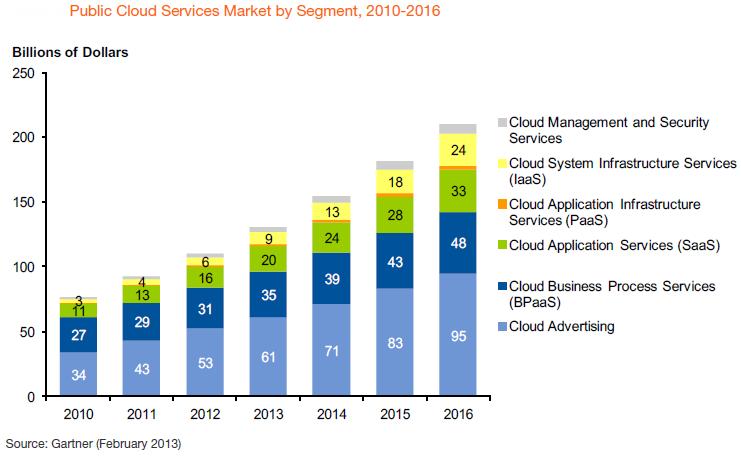
  • Global spending on public cloud services is expected to grow 18.6% in 2012 to $110.3B, achieving a CAGR of 17.7% from 2011 through 2016. The total market is expected to grow from $76.9B in 2010 to $210B in 2016. The following is an analysis of the public cloud services market size and annual growth rates:

Figure 1 Cloud Computing Growth

  • Gartner predicts that Infrastructure-as-a-Service (IaaS) will achieve a compound annual growth rate (CAGR) of 41.3% through 2016, the fastest growing area of public cloud computing the research firm tracks.  The following graphic provides insights into relative market size by each public cloud services market segment:

Figure2

  • Platform-as-a-Service (PaaS) will achieve a 27.7% CAGR through 2016, with Cloud Management and Security Services attaining 26.7% in the same forecast period.  Software-as-a-Service’s CAGR through 2016 is projected to be 19.5%.  The following graphic illustrates the differences in CAGR in the forecast period of 2011 – 2016:

Figure 3

  • Gartner is projecting the SaaS market will grow at a steady CAGR of 19.5% through 2016, having increased the forecast slightly (.4%) since its latest published report.  Global SaaS spending is projected to grow from $13.5B in 2011 to $32.8B in 2016.
  • CRM will continue to be the largest global market within SaaS, forecast to grow beyond $5B in 2012 to $9B in 2016, achieving a 16.3% CAGR through 2016.   The highest growth segments of the SaaS market continue to be office suites (49.1%), followed by digital content creation (34.0%).  The following graphic rank orders CAGRs across all public cloud services segments from the forecast period:

Figure 4

  • 59% of all new spending on cloud computing services originates from North American enterprises, a trend projected to accelerate through 2016.  Western Europe is projected to be 24% of all spending.  A graphic comparing total spending by geography and corresponding growth rates is provided below:

Figure 5

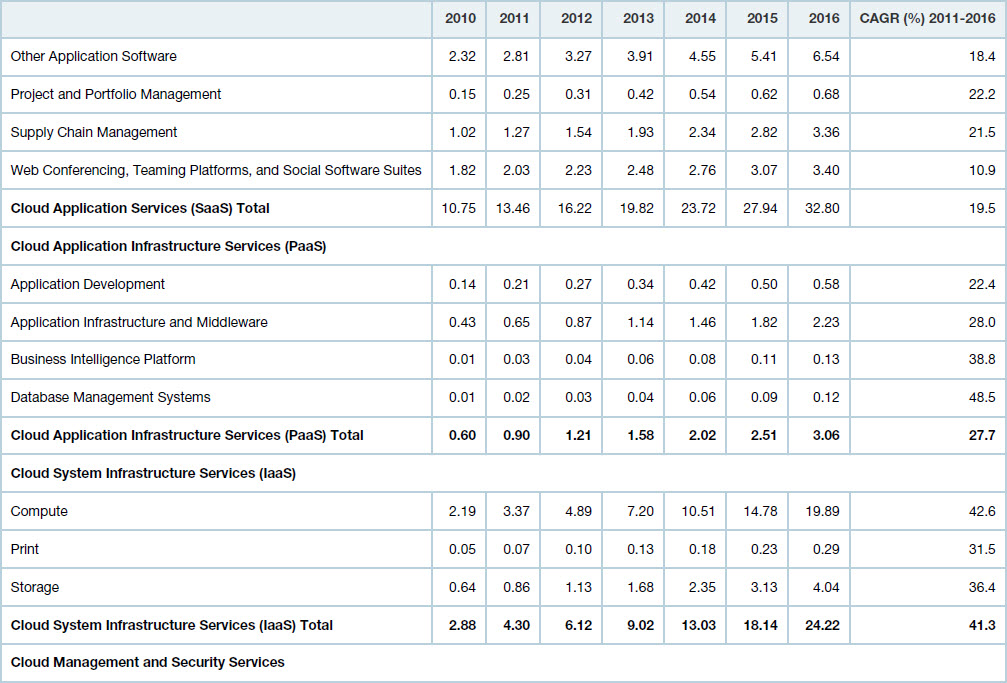
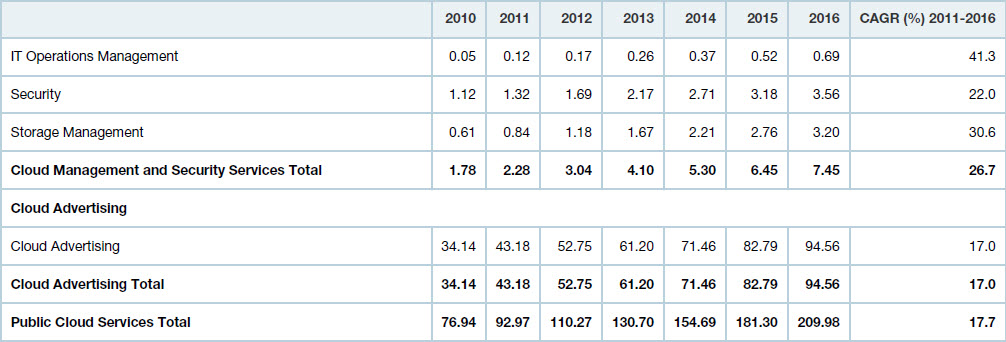
  • The following tables provide insights into each category of public cloud computing spending throughout the forecast period.  Please click on the tables to expand them for easier reading.

Table 1

Table 2

Table 3

Source:  Forecast Overview: Public Cloud Services, Worldwide, 2011-2016, 4Q12 Update Published: 8 February 2013.

Plex Systems’ CEO Jason Blessing on the Future of ERP and Software-as-a-Service (SaaS)

Jason Blessing med HS
Last week Plex Systems, a leading provider of SaaS-based Enterprise Resource Planning (ERP) systems announced enterprise software veteran Jason Blessing has joined their company as CEO.   He is responsible for the strategic direction and growth of the company, and has a proven track record in many facets of enterprise software, from new application development to professional services.  His extensive experience includes previous executive positions at Oracle, Taleo, PeopleSoft and Price Waterhouse.  You can find his LinkedIn profile here.

Plex Systems’ success delivering ERP entirely on the SaaS platform to manufacturers have many industry analysts, experts and pundits saying their unique business model is prescient of the future of enterprise software.  Originally designed for an automotive parts manufacturer, Plex Online is being adopted by aerospace and defense, food and beverage, high tech and electronics, industrial machinery, and precision metal manufacturers.  You can find an overview of Plex Systems here.

I recently had a chance to speak with Jason and get his views on the future of ERP, SaaS in manufacturing and the enterprise, and what he sees as the greatest challenges and opportunities for Plex Systems.

Here’s a transcript of my interview with Jason Blessing, the new CEO of Plex Systems:

What are the three biggest challenges you see to Plex Systems’ growth over the long-term and how will you and the management team address them?

Our greatest challenge is awareness of who Plex Systems is and the value we are delivering to our manufacturing customers today. We’re already putting together programs that will highlight the very meaningful customer base we have and what they are able to accomplish using Plex Online.  Second, we’re going to continue making significant product investments.  Our owners are growth-minded and we’re looking to create a beachheads in additional areas to compliment our heritage in auto manufacturing.  Third, we’re going to expand our sales and marketing investments to provide better coverage domestically and in Europe and Asia. We’re also on a mission to lead the resurgence of manufacturing in America by giving small and mid-sized companies the systems they need to be formidable global competitors. 

SaaS-based applications have proved themselves in the enterprise.  How and why are manufacturers adopting SaaS-based ERP systems today?  How is this going to change in the future?

Credit has to go to Taleo and Salesforce for proving SaaS can succeed at the departmental level in the enterprise.  We’re finding that the combination of financials and Manufacturing Execution Systems (MES) delivered in the cloud is very well-suited for small and medium manufacturers.  These manufacturers often don’t have a large Information Technologies (IT) staff and want to offload these systems so they can stay focused on their core business.  In this sense we free up these smaller manufacturers to get back to work running their businesses without having to hassle with large, complex and costly ERP deployments. 

Will SaaS-based ERP systems cannibalize monolithic ERP systems or coexist and compliment them?  Or are you seeing a mix of both cannibalization and coexistence?  For Plex Systems, what’s the best direction?

We do see customer that adopt parts of our solution, quality for example, to test the cloud model before going wall to wall Plex.   Another approach we see is customers who have global operations bring foreign factories online quicker than they had in the past as a result of SaaS.  The end result will be the cannibalization of monolithic ERP systems by those that are SaaS-based.

One of the implicit factors in this area of cannibalization is the typical release cadence of a SaaS provider.  Most large cloud providers have, on average, 3 releases a year.  Here at Plex Systems we’re on a continuous release cadence.  When a customer asks for a feature enhancement or entirely new set of functions, we strive to be very responsive with our release cycles and deliver what is needed.  

Plex Systems has done well in several key manufacturing industries including automotive, A&D, electronics, food and beverage, and medical devices.  Do you see Plex Systems moving into additional industries, and if so, which ones?  Pharmaceutical and biotech for example.

We’re going to be fairly disciplined in our approach within the verticals we’re already selling into.  We’re seeing increasing interest in moving core shop floor applications to the cloud for example, and we’re going to expand out our coverage in our core vertical markets as a result.      

With the majority of sales in the United States, does Plex Systems have plans for Europe and Asia?  What’s your perspective of those markets for SaaS-based ERP system sales? 

We’re growing at an approximately compound annual growth rate of 30%+ per year, the majority of that growth coming from North America today.  We’re also seeing strong interest from EMEA, South America and Asia.  What’s driving our foreign market demand is the need manufacturers have for quickly getting production centers up and running on financials, MES and Supply Chain Management Systems (SCM).  We also run our own data centers and have hot standby and back facilities supporting our worldwide customer base.

Two-tier ERP delivers significant business value and is growing in adoption. How will Plex Systems capitalize on this trend and what are the implications for the application development priorities?

Were delivering two-tier ERP implementations today and one of the largest heavy equipment manufacturers in the world uses Plex Online to run their shop floor operations at several manufacturing centers.  Their main ERP system is an SAP R/3 instance, and we integrate to that and help this manufacturer be more efficient at the individual plant and shop floor level.   

Plex_ColorLast year Plex Systems announced IntelliPlex, SmartPlex, in addition to several other significant new services and partnerships.  Of these, IntelliPlex has the potential to deliver analytics and business intelligence to manufacturers who may have never had these metrics available before.  How do you see analytics in manufacturing improving this year, and how will this augment Plex Online’s analytics strategy going forward?

Much of our success as a provider of SaaS-based ERP systems is due to the breadth of applications that span from the shop floor to the top floor. We’re seeing analytics resonate really well with the people who write us the checks, the top floor executives and their teams responsible for the getting the highest performance from manufacturing operations.  We’re going to augment our analytics this year, supporting mobile devices.  We’ve also been doing data mining of production data across the worldwide Plex Systems customer base and see the potential to create an index of manufacturing performance. We’re going to look at how this data will be able to help our customers predict economic conditions in their specific manufacturing industries. 

There are a myriad of studies out on the impact of mobile technologies on manufacturing.  Last year, Plex Systems introduced SmartPlex Mobile, which gives ERP users access to data on iOS and Android devices.  Can you discuss the challenges of mobile adoption in manufacturing and how Plex Systems will address them?

Often mobile technologies installed and used on the factory floor are proprietary to the systems and workflows for that specific factory.  They are fine-tuned to the specific workflows on the factory floor, and the proprietary nature of their electronics only work with the systems they are designed for and Plex Online supports many of these devices.  Material handling, RFID and other logistics projects are based on these kinds of technologies.

We’ve also found that senior management teams want to get as close to real-time data as possible on each phase of manufacturing operations.  SmartPlex Mobile is designed to give senior management teams visibility into operations on Android and iOS devices, and continues to gain interest from existing and new customers alike.

Many manufacturers are dealing with “brain drain” or the retiring and churn of their long-time manufacturing, process control, and quality management professionals.  How do you see Plex Systems helping these manufacturers to retain that tacit knowledge in their organizations over their long-term?

We talk quite often about this with our prospects, customers and internally in our development meetings.  Prospects are especially interested in how to solve this problem as tribal knowledge is often the most difficult to capture and re-use.  It’s common to find manufacturers with a myriad of Microsoft Access databases, legacy systems and data locked on spreadsheets. Our architecture is based on a Master Data Management (MDM) model with gives manufacturers a single source or version of the truth.  Using our experience implementing these systems in small and medium-sized manufacturers, we’ve found methods and techniques for managing corporate-wide data effectively.

Visualization in manufacturing including the extensive use of 2D and 3D CAD drawings is also accelerating.   What are your thoughts on the future of visualization in manufacturing, and more specifically, which key process areas do you see Plex Systems addressing with its visualization strategy?

This area is critically important for the shop floor as it can drive higher levels of production quality quickly. We’re going to continue to invest in this area, and our Actify partnership gives us a strong foundation to build on in this area.  The partnership with Actify allows us to embed engineering drawings directly in Plex, allowing shop floor workers to look up specifications on the fly to ensure high levels of quality.  The drawings are highly valuable because they are contextualized in Plex (e.g., tied to the product in question) and don’t require any expensive CAD equipment or training to view.

Plex Systems has also built a strong foundation of partners including system integrators and resellers.  Do you anticipate Plex Systems will increasingly rely on resellers or stay with primarily a direct sales strategy?  

It’s very important to high fidelity relationships with customers when you’re selling SaaS-based enterprise software so the direct model is important to us.   That said, partners are also very important to us because of the value they can bring to customers and the added reach they can provide us.  So, we’ve been successful in creating a partner program, which has a rigorous certification process that ensures those we partner with have strong domain expertise to serve our shared customers.  Partners can quickly become a force multiplier for us, and we’re working towards that goal by keeping direct sales in balance.   

Disclaimer: This interview was done independent of Plex Systems. I have not and have never been a paid consultant of the company.  I approached them to do this interview based on insights gained from WordPress analytics showing readers’ interest in ERP, SaaS and enterprise software.