Skip to content

Posts tagged ‘Cloud computing forecasts’

Predicting Enterprise Cloud Computing Growth

69% of enterprises who have separate budgets for cloud computing are predicting spending increases this year and into 2014.

This is one of several key take-aways from a research study published today by TheInfoPro, a service of 451 Research.  TheInfoPro Wave 5 Cloud Computing Study is based on research completed in the first six months of 2013, and relies on live interviews with IT management and primary decision-makers in midsize and large enterprises in Europe and North America. You can view details of TheInfoPro Cloud Computing Overview Program and methodology here.

Additional key take-aways from the study include the following:

  • The worldwide cloud computing market will grow at a 36% compound annual growth rate (CAGR) through 2016, reaching a market size of $19.5B by 2016.
  • 38% of enterprises surveyed break out cloud computing budgets, while 60% include cloud-related spending as part of their enterprise-wide IT budgets.  TheInfoPro asserts that cloud computing’s benefits of greater business orchestration and reduced time-to-market have led to a change in budgeting approaches.
  • The median enterprise cloud computing budget is $675,000 and the mean enterprise cloud computing budget is $8,234,438.  The study found the largest enterprise cloud computing budget at $125M.  The following graphic provides a distribution of cloud computing budgets by range.

cloud-computing-budget

  • Internal Private Cloud (35%), Cloud Provider Assessments/Strategy Planning (33%), Infrastructure-as-a-Service (IaaS) (31%) and Software-as-a-Service (30%) are the top four cloud computing-related projects enterprises are working on right now.  Cloud Provider Assessments/Strategy Planning have seen the largest increase, attributable to more enterprises looking to better support strategic plans with more agile, efficient IT organizations.

top-challenges-graphic2

deciphering-the-cloud-journey

cloud-related-pain-points

451 Research: Platform-as-a-Service (PaaS) Fastest Growing Area Of Cloud Computing

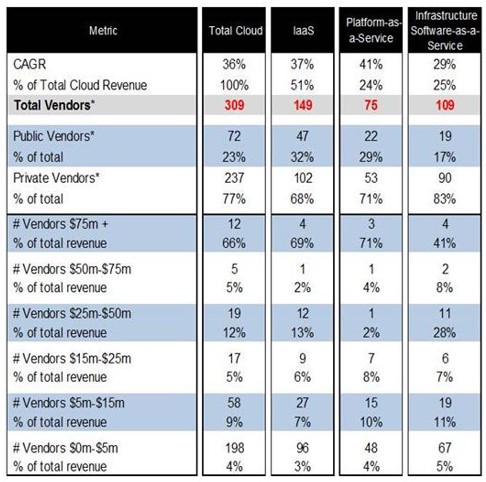
public-cloud-computing-forecast-2011-2016The majority of cloud computing revenue in 2012 was generated from vendors with sales over $75M (66%) and who are privately held (77%), with Platform-as-a-Service (PaaS) projected to attain a 41% compound annual growth rate (CAGR) through 2016.

Market Monitor, a service of 451 Research, is also predicting 36% CAGR in cloud computing, growing from $5.7B in 2012 to $20B by the end of 2016 in their Cloud-as-a-Service overview report. Other research firms including Gartner have much higher forecasts for cloud computing in general and IaaS, PaaS and SaaS specifically.

Market Monitor relies on a bottoms-up forecasting methodology that includes revenue analysis and forecasts from 309 cloud-services providers and technology vendors across 14 sectors. Their taxonomy defining Cloud as a Service is shown in the following graphic:

taxonomy cloud as a service

Here are the key take-aways from the report:

forecast breakout

distribution table

Citrix Sees Strong Cloud Sales Growth, Snaps Up Reuven Cohen As Chief Cloud Advocate

saas-200x300Citrix (NASDAQ: CTXS) continues to successfully launch and manage products in the areas of cloud, desktop, mobile and networking, reporting net revenue of $730M for their latest quarter (Q2, 2013), up 19% from Q2, 2012.  Product license revenue is up 21% from Q2, 2012 to $227M for the latest quarter as well.  In the interest of full disclosure, I have never held a position in Citrix stock and do not today, and they have never been a client.

The following table is from their 2Q13 Financial Results presentation:

Managing Multiple Businesses And Making It Look Easy

Citrix continues to be a fascinating company to watch as it successfully competes across a broad range of businesses.  Cloud management, mobility and desktop management platforms, online collaboration, networking and security, and server virtualization are all revenue-generating businesses in the company today.

And while the majority of acquisitions in enterprise software struggle to deliver revenue or even fail, Citrix has been able to bolster is collaboration, enterprise mobility and telecom and networking businesses with solid additions.  Acquiring Zenprise in December, 2012 to bolster its mobile device management (MDM) strategy has led to increased sales, as has the acquisition of Podio in April of last year to augment its Online Services Division (OSD).  In June of last year Citrix also acquired ByteMobile, which gives the company entry into the telecom/carrier market.

At Citrix Synergy 2013 held May 22 – 24 of this year in Anaheim, California the company hosted the Citrix Financial Analyst Track.  You can download the presentation from this track here.  This presentation shows how challenging it can be to manage a business with multiple revenue streams across a broad base of technologies.  The following slide taken from the Citrix Financial Analyst Track illustrates just how quickly Citrix is growing and how mobile & desktop, SaaS and networking & cloud are contributing to their growth.

The addressable market opportunity for Citrix given the breadth of their product strategies is reflected in this slide, also from the Citrix Financial Analyst track:

Why Citrix Snapped Up Reuven Cohen

With so much growth potential in their cloud-based businesses, Citrix needed a seasoned veteran from the cloud computing industry who had both developed and managed new cloud platforms, products and services to the stack level.

They chose Reuven Cohen as their first-ever Chief Cloud Advocate based on his entrepreneurial expertise in Infrastructure-as-a-Service (IaaS) including being the founder and CEO of Enomaly which was sold to Virtustream in 2012. He is also actively involved in the National Institute of Standards Technology (NIST) cloud definition, and is a GSA Cloud IaaS BPA awardee, presented Great Britain’s G-Cloud initiative to the Parliament, and is an active delegate in the Sino-EU America Cooperation Workgroup.

He is responsible for leading Citrix’s cloud advocacy efforts with a specific focus on increasing the volume, reach and influence of Citrix’s extensive portfolio of cloud solutions used by more than 260,000 customers and 100 million end users across the globe.  He’ll also be responsible for increasing the adoption of several Open Source initiatives at Citrix as well.   Here are a few of the current Citrix open source projects now underway:

Apache CloudStack, an open source software designed to deploy and manage large networks of virtual machines, as a highly available, highly scalable Infrastructure as a Service (IaaS) cloud computing platform.

OpenDaylight, a community-led, open, industry-supported framework, for accelerating adoption, fostering new innovation, reducing risk and creating a more transparent approach to Software-Defined Networking.

The Xen Project, the home for various virtualization technologies powering the world’s largest clouds in production and is the foundation of many commercial products.

XenServer, an open source project and community managed by Citrix. The project develops open source software for securely running multiple operating systems and applications on a single device, enabling hardware consolidation and automation to reduce costs and simplify IT management of servers and applications.

Congratulations to Reuven on being named Chief Cloud Advocate at Citrix, I am sure he’ll accomplish much in his new role.

IDG Cloud Computing Survey: Security, Integration Challenge Growth

cloud computing survey 2IDG Enterprise recently published Cloud Computing: Key Trends and Future Effects Report, showing how enterprises continue to struggle with security, integration and governance while finding immediate value in collaboration and customer relationship management (CRM) applications.

IDG’s methodology is based on interviews with 1,358 respondents, stratified across CIO, Computerworld, CSO, InfoWorld, ITworld, and Network World websites, in addition to respondents contacted via email, and LinkedIn forums.  58% of respondents are from executive IT roles; 17% from Mid-level IT; 14% from IT professionals; 8% from middle-level business management and 3% non-manager roles were represented in the study.  High tech industries are the dominant industry represented with 18% of respondents, followed by financial services, government and manufacturing (each accounting for 10% of respondents).  Education (9%) and telecommunications & utilities (6%) are the other industries represented.

Key take-aways from the survey include the following:

  • 49% of executive-level management see cloud computing as transformational to their business strategies.  40% are currently having their IT staff investigate the potential of cloud computing contributing to their businesses, 5% don’t see cloud as an option and 6% aren’t sure.
  • Amazon (32%), Microsoft (23%) and Google (20%) are most often considered thought leaders in the field of cloud computing by respondents to the IDG survey.
  • Enabling business continuity (43%), greater flexibility to react to changing market conditions (40%), speed of deployment (39%) and improving customer support or services (38%) are the top four drivers of investment in cloud computing technology according to the survey.  The following graphic provides an analysis of each driver by level of relative importance.   This image is from Cloud Computing: Key Trends and Future Effects Report.

  • Accelerating business value by providing access to critical business data and applications (56%); serving as a catalyst of IT innovation (56%); enabling greater employee collaboration (54%); and enabling greater levels of IT agility (54%) are the top four benefits enterprises are gaining from cloud-based applications.  The following graphic provides an analysis of how cloud computing technology is impacting each of the areas shown in respondent’s enterprises. This image is from Cloud Computing: Key Trends and Future Effects Report.

  • Financial Services and high tech companies are projected to have the largest cloud computing budgets based on the survey.  Enterprises are expected to invest an average of $1.5M in cloud-based services during the 2013 – 2014 timeframe.  IDG projects that large companies will spend $2.8M relative to small and medium-sized businesses investing $486K on average.
  • Chief Financial Officers (CFOs) (35%) are the hardest to convince regarding the value of cloud computing, followed by the board of directors or equivalent (24%), the CEO (24%), and the Chief Operating Officer (COO) (16%) third. Chief Marketing Officers (CMO) are the easiest to convince, with just 6% of respondents mentioning this group of executives being a challenge to convince regarding the value of cloud computing.
  • The percentage of organizational IT budgets allocated to SaaS increased from 8% in 2012 to 13% in 2013 according to the last two IDG Enterprise Cloud Computing surveys.  Infrastructure-as-a-Service (IaaS) increased to 10% of overall IT budgets, up from 7% in 2012.  In aggregate, 44% of IT budgets are spent on cloud computing today, increasing to 51% by 2015 in the base of enterprises interviewed for the study.

  • 59% of enterprises are still identifying which IT operations are the best candidates for cloud hosting.  33% have identified all IT operations that they are comfortable having hosted in the cloud, given the current security of cloud infrastructure and application design.
  • The three most important factors in selecting a SaaS application provider include the ability to configure and customize the cloud application to meet specific business needs (40%), consistent cloud application performance and availability (38%) and security certification and practices of the SaaS provider (34%).
  • 61% of enterprises have at least one application that is cloud-based in their organizations today.  This increased from 57% in 2012.  24% of enterprises are planning to implement cloud applications in the next 12 months and 15% are planning to between 1 to three years from now.
  • In enterprises with less than 1,000 employees, CEOs (52%) are the most influential role in cloud purchasing, followed by the CIO (39%) and IT/networking staff (33%).  In enterprises over 1,000 employees, the CIO (60%), followed by the IT/networking management (47%) and CTO or IT network architect (45%) are the three most influential roles in the cloud purchasing process.
  • 42% of cloud-based projects are eventually brought back in-house, with security concerns (65%), technical/oversight problems (64%), and the need for standardization (on one platform) (48%) being the top three reasons why.
  • The top three challenges to implementing a successful cloud strategy in enterprise vary significantly between IT and line-of-business (LOB).  For IT, concerns regarding security (66%), integration stability and reliability (47%) and ability of cloud computing solutions to meet enterprise/industry standards (35%) challenge adoption.    The following table compares the perceptions of IT and line-of-business leaders.  This image is from Cloud Computing: Key Trends and Future Effects Report.

Roundup Of Small & Medium Business Cloud Computing Forecasts And Market Estimates, 2013

Small & Medium Business cloud computing What sets apart the fastest-growing small businesses is their an innate strength at turning data and information into results.

It’s becoming easy to spot a smaller business who is going to break out and grow quickly.  They often have these qualities:  they highly value knowledge, expertise and speed over seniority or cronyism; they have successfully managed a geographically distributed supply chain, production and service operations early in their history; and long before they reach $20M in sales they have learned how to balance domestic and international customer demands.  In short, they learned fast how to compete and win business globally.

Over the last several months research firms and enterprise software vendors have released studies on cloud computing adoption in small & medium businesses (SMBs).

The following are the key take-aways from these studies:

  • 61% of SMBs who responded to a recent survey are using cloud-based solutions today, with an additional 5% planning to add cloud services in the next six months.  69% of SMBs with fewer than 20 employees and 55% of SMBs with 250 to 999 employees are using cloud-based applications today. North American SMBs are more likely to use cloud-based applications co these services than EMEA (64% compared to 56%). Source: State of SMB IT 1H 2013 Semi-Annual Report On Small And Midsize Business Technology Plans & Purchase Intent (Opt-in required): http://www.spiceworks.com/marketing/state-of-smb-it/ The following is a graphic from the report:

figure 1 smb cloud adoption

  • SMB spending on cloud solutions will grow by almost 20% over the next five years, with 3 in 10 midsize firms adopting public cloud solutions.  IBM is offering a free download of the IDC report, Cloud Computing in the Midmarket: Assessing the Options in 2013 (no opt-in required): http://idcdocserv.com/995  IDC’s graphical definition of how their Primary Market and Secondary Market IT Product Taxonomy maps to the NIST Taxonomy is shown below:

figure 2 smb cloud adoption

  • Cisco predicts the U.S. SMB commercial-services market addressable by service providers will grow to more than $200B by 2015. Also included is an analysis of how fundamental differences in business segments drive IT behavior, as the following table illustrates. Source: What Do SMBs Want from Commercial-Services Providers? Insights from Cisco’s U.S. Research on SMB Services Delivery  Link:http://www.cisco.com/web/about/ac79/docs/sp/SMB-Cloud-Survey.pdf. Please click on the image to expand it for easier reading.

figure 3 smb cloud adoption

  • Hosting and cloud services provider Parallels projects that the worldwide SMB SaaS applications market was $14.5B in 2012 today and will grow to $33.8B by 2015, attaining a 32% Compound Annual Growth Rate (CAGR).  Please see the following illustration of a breakdown by region over the forecast period.  Source: Profit from the Cloud 2013 Global Parallels Global SMB Cloud Insights  Opt-in required, Link:  http://www.parallels.com/fileadmin/parallels/documents/smb-reports/2013/2013_SMB_Brochure_Global_web.pdf.  Please click on the image to expand it for easier reading.

figure 4 smb cloud adoption

figure 5 smb cloud adoption

  • SMEs overwhelmingly prefer to buy or acquire  these critical systems (43%) rather than lease or pay for use (23%) in an SAP-sponsored survey by Oxford Economics.  The study found that the tools most commonly used by SMEs are business management software (48%), mobile (46%), and analytics (44%). Cloud computing adoption is expected to jump from 35% to 47% in three years. An infographic summarizing the results is below. You can get the survey results here: http://cdn.news-sap.com/wp-content/blogs.dir/1/files/SAP-SME-analysis-presentation.pdf . Please click on the image to expand it for easier reading.

figure 1a smb cloud adoption

Best- And Worst-Performing Cloud Computing Stocks In The First Half Of 2013

Cloud computing stocks continue to show wide variation in performance throughout the first half of this year.

Ten of the twenty companies in the Cloud Computing Stock Index delivered returns to shareholders with NetSuite leading with a 37.30% share gain, delivering $13,730 on $10,000 invested on January 2, 2013.

To more fully define the stock performance of these companies, I’ve added Earnings Per Share (EPS), Price/Earnings Ratio, Year-To-Date (YTD) Total Gains or Loss, Annualized Gain or Loss, and Total Dollar Value of $10,000 invested on January 2, 2013.  You can download the latest version of the Cloud Computing Stock Index here.  The filter applied to these companies is that 50% or more of their revenues are generated from cloud-based applications, infrastructure and services.  Additional details of the index are provided at the end of this post.


Best Performing

Name

Symbol

(1/2/13 – 7/5/13)Total Gain or Loss

Annualized Gain or Loss

Total Dollar Value of $10K invested in this stock on Jan. 2, 2013 as of July 5th:

NetSuite Inc

N

37.30%

87.55%

$13,730.00

Keynote Systems, Inc.

KEYN

36.18%

84.53%

$13,618.00

CA, Inc.

CA

26.67%

59.83%

$12,667.00

Workday Inc

WDAY

23.81%

52.77%

$12,381.00

Cisco Systems, Inc.

CSCO

22.60%

49.82%

$12,260.00

Symantec Corporation

SYMC

18.84%

40.84%

$11,884.00

Amazon.com, Inc.

AMZN

11.10%

23.23%

$11,110.00


Worst Performing

Name

Symbol

(1/2/13 – 7/5/13)Total Gain or Loss

Annualized Gain or Loss

Total Dollar Value of $10K invested in this stock on Jan. 2, 2013 as of July 5th:

Rackspace Hosting, Inc.

RAX

-46.78%

-71.39%

$5,322.00

Fusion-IO, Inc.

FIO

-41.21%

-65.13%

$5,879.00

F5 Networks, Inc.

FFIV

-31.57%

-52.88%

$6,843.00

VMware, Inc.

VMW

-29.94%

-50.63%

$7,006.00

Riverbed Technology…

RVBD

-24.91%

-43.34%

$7,509.00

Red Hat, Inc.

RHT

-11.47%

-21.46%

$8,853.00

Key Take-Aways:

  • NetSuite leads the index with a 37.3% gain in their stock price, and $10K invested in their stock on January 2nd of this year would be worth $13,730 as of July 5thCloud-based Enterprise Resource Planning (ERP) systems acceptance is accelerating, evidenced by the success NetSuite is having with their two-tier ERP strategy and recent announcement they are moving into manufacturing.  Their recent alliance with Oracle also shows upside potential.   A cloud-based ERP provider leading the index is good news for Acumatica and Plex Systems especially, the leader in cloud-based ERP systems for manufacturing and one of the most enthusiastic customer bases in enterprise software.  Both of these companies are privately held or they would have been included in the index.
  • The 20 companies that comprise the Cloud Computing Stock Index attained a 29.6% return from July 10, 2012 to July 5, 2013.  The Dow Jones Industrial Average (DJIA) gained 18.83%;  Microsoft, 14.02%; Oracle, 7.17%; and SAP, 27.51%.  The following chart compares the performance of each. Please click on the index to expand it for easier viewing.

  • Widespread adoption of Amazon Web Services, success using the Kindle series of tablets as customer acquisition tools for digital content, market leadership of the online retail landscape, and successful pilots of the AmazonFresh online grocery business in Los Angeles and Seattle are all fueling Amazon’s stock performance this year.

Specifics on the Cloud Computing Stock Index

I used The Cloud Times 100 as the basis of the index, and included the 20 following companies, all of which are publically traded.  The latest edition of the Cloud Computing Stock Index is shown here.  Please click on the index to expand it for easier viewing.

 Note: I do not hold equity positions or work for any of the companies mentioned in this blog post or included in the Cloud Computing Stock Index.  

CIOs On Cloud Computing Adoption: Conquer Complexity And Help Us Grow

CIONTT Europe recently completed a study that found 56% of CIOs and Senior IT leaders see complexity of their own Information and Communications Technology (ICT) systems as the biggest barrier to their organization’s enterprise-wide adoption of the cloud.  The survey contends that cloud adoption continues to be tactical in nature as a result of the inordinate complexity of existing and legacy ICT platforms.

Completed in April and May of this year in the United Kingdom, the study Growing Pains In The Cloud, 300 CIOs Express Their Views About Barriers To Cloud Adoption (opt in required) was completed by Vanson Bourne and included 300 interviews of CIOs and Senior IT leaders from public and private organizations with 250+ employees.

While the study was completed in the UK, the findings are applicable to enterprises globally looking to use cloud computing to better align business and IT strategies.  59% of CIOs and IT Leaders surveyed say that enabling alignment of business and IT strategies using cloud infrastructure is their number one priority.

Key take-aways from the study include:

  • 53% said that launching new services and applications more quickly is a key request they receive from business units. In the transport and logistics sector four fifths (80%) of CIOs confirmed launching new services and applications is their most important business focus.
  • 60% of IT leaders are concerned that cloud providers don’t  appreciate how complex legacy ICT systems are, and fear migration to the cloud could fail.  A common concern of respondents is how vendors tend to oversimplify their cloud solutions despite the inordinate complexity of ICT legacy platforms and systems.
  • 46% of the IT leaders polled agree that cloud is a great enabler of ‘bring your own device’ and flexible working, through enabling remote access to data and applications.  The challenge is making cloud infrastructure work seamlessly with legacy platforms and applications.
  • 68% have had cloud-based systems in place for two years or less.  The following graphic shows the distribution of cloud adoption by industry included in the study.
  • 77% of CIOs and Senior IT leaders report cloud-based infrastructure is in use today in their enterprises.  87% of CIOs in media and retail, and 84% of CIOs from telecommunications and ICT companies have already implemented a cloud-based infrastructure as well.  The following graphic illustrates the use of cloud as part of respondent’s ICT infrastructures.
  • 28% of the CIOs surveyed stated their legacy systems were too expensive (or valuable) to abandon altogether.  The implication is that CIOs and Senior IT leaders expect cloud platforms to eventually handle the complexity of their core business systems while also meeting compliance requirements internal and external to their organizations.
  • The four industries with the highest concentration of legacy ICT systems include Financial Services (30%), Media & Retail (31%), Transport and Logistics (31%) and Public Sector (30%).  CIOs in these industries show the highest resistance to cloud adoption in the study.  6% of CIOs said they have no plans to adopt cloud computing.

Bottom line:  CIOs are looking for cloud solution providers that recognize just how uniquely complex their businesses are and can address legacy system integration challenges head-on.  With 59% saying they have responsibility for aligning business and IT strategies, greater cloud adoption at the enterprise level is inevitable.

What’s Hot In CRM 2013: Strong Interest In Mobile For Streamlining Sales And Service

Whats Hot in CRM 2013 imageGartner published the report What’s Hot in CRM Applications in 2013, by Ed Thompson on June 20, 2013.  The report covers areas of interest by clients in the four areas of marketing, sales, customer service and e-commerce.

The report states that “the 2013 What’s Hot list was compiled after examining Gartner inquiry volumes by topic. It was then supplemented by asking all Gartner CRM analysts to offer their opinions on what has been generating the most interest during all the client inquiries they have taken since the end of 2012 and in the beginning of 2013.”

Big data, cloud, social, mobile and the Internet of Things are the five catalysts that are driving inquiries in the hottest areas of interest.  Gartner’s Ed Thompson, author of the report, states that “this is where our clients’ interests lie, although not their current CRM spending.”  Technologies highlighted in red are the hottest in terms of interest, shown in the following table Highest CRM Application Priorities for 2013.

What This Says About the Future of CRM

Mobility is just one part of delivering an excellent customer experience.

  • It is surprising that Gartner clients aren’t looking to create a more unified strategy to customer experience across all channels at all times. As the report states, “The refreshing of an aging agent desktop with a new, more intelligent and unifying user interface has shot to the top of the heat charts once more.” The findings of this Gartner analysis make the highly promoted claims of usability by many CRM vendors look overly hyped.  I think usability is the fastest path to greater system adoption of any CRM system, and that has to include mobile.  It is surprising that a related technology in this area didn’t rise farther in the rankings.
  • Second, mobile sales on smartphones and tablets dominate, followed immediately by Social – Internal Collaboration and Social – Integration with Social Data. What is fascinating about this group of four top items in Sales is the indication that the behavior of how sales teams work individually and together is changing fast. Collaboration is a strong catalyst for Return on Investment (ROI) from social technologies and the sequence of these priorities in Sales underscores that.
  • Third, the vision of the mobile-enabled support representative able to be autonomous yet fully supported to solve customer problems is rapidly approaching.  Of all patterns emerging from this data, this is one shows the greatest profit potential.  Service Lifecycle Management (SLM) and the many forms of service management all have very significant profitability associated with them for manufacturers.  The quicker this area of mobility moves, the faster SLM and Maintenance, Repair and Overhaul (MRO) strategies will grow – giving manufacturers and service providers the ability to mine their installed bases for more profits.
  • Fourth, predictive analytics and big data are reordering how marketing strategies are designed, implemented and managed.  Given the increasing complexity of marketing automation systems and the strategies they support, predictive analytics and big data are starting to dominate the conversations I’ve personally had with Chief Marketing Officers (CMOs) and many demand generation professionals.  I expect the predictive analytics aspects of marketing, combined with big data, to accelerate quickly over the next year.
  • Fifth, the rapid adoption of mobile-based platforms including the Apple iPad in the Configure, Price, Quote (CPQ) continues throughout the professional services, discrete and process manufacturing companies I often visit.  One manufacturer I often work with on their CPQ strategies has the ability today to present a completed 3D model of the proposed product, embed it in a quote and e-mail it to the prospect all from an iPad.  The future of CPQ is going to be dominated by mobility and enterprise support for key order management, pricing and product configuration options.
 Gartner does not endorse any vendor, product or service depicted in its research publications, and does not advise technology users to select only those vendors with the highest ratings. Gartner research publications consist of the opinions of Gartner’s research organization and should not be construed as statements of fact. Gartner disclaims all warranties, expressed or implied, with respect to this research, including any warranties of merchantability or fitness for a particular purpose.

North Bridge Venture Partners Future Of Cloud Computing Survey: SaaS Still The Dominant Cloud Platform

6-19-2013-4-19-15-AM-300x223North Bridge Venture Partners and GigaOM Research released the results of their third annual Future Of Cloud Computing Survey today, providing a glimpse into cloud computing adoption trends, inhibitors and drivers of long-term growth.

This year’s survey included 855 respondents selected across business users, IT decision makers and cloud platform and application vendors.  North Bridge and GigaOM Research report that a third of respondents are C-level executives in their organizations.

You can view a copy of the report results here from SlideShare.

The following are key take-aways from the report:

  • Cloud adoption continued to rise in 2013, with 75%  of those surveyed reporting the use of some sort of cloud platform – up from 67% last year. That growth is consistent with forecasts from GigaOM Research, which expects the total worldwide addressable market for cloud computing to reach $158.8B by 2014, an increase of 126.5% from 2011.  The survey also shows significant growth is yet to come in SaaS adoption for business systems and IT management.

.

  • 63% of those surveyed report Software-as-a-Service (SaaS) is in use in their companies, growing 15% over 2012.  45% are using Infrastructure-as-a-Service (IaaS) today, attaining a growth of 29% from last year.  Platform-as-a-Service (PaaS) is expected to grow the fastest over the next five years, with 72% of respondents saying they expect to use PaaS in their organizations.

  • 52% of organizations are using cloud-based applications to advance business priorities, compared with 36% that use applications that advance IT initiatives.
  • CRM, marketing (including marketing automation) social business & collaboration and file sharing cloud-based applications are in use by more than 50% of all organizations in the sample.
  • North Bridge Venture Partners reports that cloud investments by venture capitalists totaled $1.6B in 2010, increasing to $2.4B in 2011.  Investments in 2012 dropped to $1.8B and through May, 2013, venture-based investments in cloud computing application and services providers totaled $281M.  Subscription fee-based business models dominate with 77% of cloud vendors relying on this strategy.
  • Gaining greater business agility (54.5%), scalability (54.3%) and cost (48%) are the three main drivers of cloud adoption today according to the survey results.  Mobility was mentioned by 25% of respondents as a major driver for adopting cloud applications and platforms, behind cost.
  • Security concerns (46%), vendor lock-in (35%), interoperability (27%), concerns over reliability (22.3%) and complexity (21%) are the top inhibitors to cloud adoption.  Regulatory compliance (30%) and privacy (26%) are he next most frequently mentioned inhibitors to cloud computing adoption according to the survey.
  • 39% expect to increase training, and 17% expect to hire outside resources as a result of increased cloud adoption.
  • Amazon (14.3%), Microsoft (10.96%) and Google (7.88%) are the three most used cloud platforms by the organizations who responded to the survey.

Five Ways CIOs Can Prepare For The Cloud: Lessons Learned From ServiceNow

ServiceNow2ServiceNow (NYSE:NOW) is a global leader in providing cloud-based services used by enterprises to streamline and automate their IT operations.  They’re known for their expertise in IT Service Management (ITSM), speed of development cycles, and commitment to open source including MongoDB and NoSQL.  ServiceNow also has one of the most enthusiastic, rapidly growing and loyal customer bases in enterprise software.  Matt Schvimmer, VP Product Management at ServiceNow, credits the goal of attaining 100% customer referenceability combined with intensive focus on user experience design as contributing factors to their rapid growth, in addition to continuous feedback cycles they use for capturing and acting on customer feedback.

Update from ServiceNow’s Financial Analyst Day and Knowledge13 

On May 13th they held their Financial Analyst Day at the Aria Resort & Casino in Las Vegas, the same location they hosted Knowledge13, their annual user conference held May 12th through the 16th.  You can download a set of the slides presented at the Financial Analyst Day here, and view videos and presentations from Knowledge 13 here.   ServiceNow executives are calling the next phase of their growth ERP for IT. Both in the Financial Analyst Day presentation and the presentation given by President and CEO Frank Slootman at the Pacific Crest Emerging Technology Summit on February, 13th, this concept is shown.  Below is a slide from the February 13th presentation given at the Summit.  You can download the slide deck from the Pacific Crest Emerging Technology Summit here.

ERP for IT

Five Ways CIOs Can Prepare For The Cloud

HS_Arne_Josefsberg (1)I had the opportunity to catch up with Arne Josefsberg, CTO of ServiceNow during Knowledge13.  He shared insights into how ServiceNow’s core customer base, predominantly CIOs and their IT Departments, are driving greater business value into their organizations using the Service Automation Platform.  Arne mentioned that ServiceNow sees IT Operations Management (ITOM) and Platform-as-a-Service (PaaS) as critical to their growth, in addition to enabling those without programming expertise (ServiceNow calls them Citizen Developers) with intuitive, easily used application development tools.

He also shared lessons learned and five ways CIOs can prepare for the cloud, which are listed below:

  • Adopt Cloud Architectures With An Open Mind And See Them As Business Value Accelerators.  Arne advises CIOs who are considering cloud-based initiatives to concentrate on capturing and communicating business value first, including time-to-market, cost and time savings advantages.  Getting beyond a purely cost-cutting mindset is critical for IT to become a strategic partner with business units.  He says that he’s seeing CIOs gain a greater voice in strategic planning initiatives by clearly defining the business value of cloud-based development while pursuing rapid application development.
  • Taking a leadership position in application development leads to gaining greater influence and involvement in strategic plans and initiatives.  This point galvanizes the entire ServiceNow executive team, they all speak of enabling the Citizen Developer to create new applications on their platform without writing a single line of code.  ServiceNow and their customer base have bonded on this issue of rapid application development.  And watching Fred Luddy, Chief Product Officer of ServiceNow move quickly through application development and deployment scenarios during his keynote showed how deeply engrained this value is in the company’s DNA.
  • CIOs need to realize that their resource and human resource management needs in five years will shift to business transformation away from IT alone.  There is a shortage of IT analysts and professionals who are adept at being business strategists, capable of leading transformational application development.  IT analysts and experts need to be trusted partners with business units, continually moving IT-related barriers out of the way while streamlining new application development.  Arne cited how General Electric is excelling on this dimension, consolidating 17 incident management systems into a single ServiceNow application.  All that was possible because the IT teams at GE are an essential part of business unit operations.
  • CIOs need to move beyond managing IT using cost and efficiency alone and think in terms of opportunity-to-cost instead. Arne’s point is that the most respected and counted-upon CIOs he knows today are either making or have made this transition.  They have moved beyond an IT legacy mentality of managing just to cost or efficiency.  Instead, the CIOs emerging as strategists and core members of the executive team are aligning IT as a core part of their company’s ability to compete.
  • Use cloud architectures and rapid application development to make IT more strategic in scope now.  The companies winning awards at Knowledge13 for their applications showed a common thread of anticipating and acting on the strategic needs of their business quickly, often delivering completed applications ahead of schedule and under budget.

Bottom line: Making IT strategic begins by moving away from the constraints of managing to cost and efficiency metrics alone.  Cloud-based platforms and rapid application development technologies are assisting CIOs and their staffs to be more strategic, less tactical, more responsive and focused on line-of-business needs and requirements first.

Disclosure: ServiceNow paid for travel to Knowledge13.  I’ve never held equity positions in ServiceNow, and they are not a client.