Skip to content

Posts from the ‘SaaS’ Category

How To Digitally Transform Talent Management For The Better

How To Digitally Transform Talent Management For The Better

Bottom Line:  CHROs and the HR teams they lead need to commit to keep learning and adopting digital technologies that help improve how they hire, engage and retain talent if they’re going to stay competitive.

Driven by the urgency to keep connected with employees, customers and suppliers, McKinsey’s recent Covid-19 survey finds global organizations are now seven years ahead of schedule on digital transformation initiatives. HR’s role is proving indispensable in enabling the fast pace of digital adoption today. By providing Business Continuity Planning (BCP), HR’s contributions to digital transformation separate the organizations that thrive despite crises versus those left behind, according to McLean & Company’s 2021 HR Trends Report. The graphic below from the report shows how effective HR has been in supporting the rapid changes needed to keep employees communicating and engaged.

The McLean and Company Trends Report also shows that talent management’s major gaps need attention now before they grow wider. These areas include analyzing the employee skills gap (24%), developing employees on new competencies (24%), and training new employees in specific new skills (21%). Improving talent acquisition, retention, diversity and inclusion, and employee experiences by digitally transforming them with greater personalization at scale and visibility is key.  CHROs and the HR teams they lead need to close these gaps now.

How To Digitally Transform Talent Management For The Better


How To Get Started Digitally Transforming Talent Management

Start with the gaps in talent management you see in your organization. The largest gaps are often in the following four areas: recruiting and talent acquisition; retention of top talent and diverse talent; lack of visibility into employee capabilities; and workforce strategies not aligned to business strategies. Key challenges that need to drive digital transformation in these four areas include the following:

  • Legacy recruiting and Applicant Tracking Systems prioritize HR’s needs to capture thousands of resumes instead of delivering an excellent candidate experience. Attracting and recruiting the most qualified candidates in a virtual-first world is a daunting task. Organizations who are leaders in digital transformation quickly realized this and relied on automating the applicant experience so much it began to resemble the Amazon 1-Click Ordering experience. McKinsey’s recent Covid survey found that 75% of organizations digitally transforming their operations, including HR, were able to fill tech talent gaps during the crisis:
How To Digitally Transform Talent Management For The Better

Source: McKinsey & Company, 2020, How Covid-19 has pushed companies over the technology tipping point—and transformed business forever


  • Top talent retention is more of a problem than many organizations realize, with top performers receiving between five and ten recruiter calls a month or more. The average tenure of employees at companies has been decreasing for nearly two decades. And a primary driver is not for lack of opportunity, but because employees can’t find a career path internally as easily as they can find a growth opportunity at another company. It’s possible to retain the top talent by guiding employees to what’s next in their careers. Of the many approaches to providing employees a self-service option for personalized coaching guidance at scale, Eightfold’s Talent Intelligence Platform is delivering results at such notable companies as Air Asia, Micron, NetApp, and others. Eightfold found that 47% of top talent leave within two years, but most would happily stay if given the right opportunity. The following video explains how Eightfold helps its customers retain talent:


  • Employees often lack visibility into new internal opportunities, and both HR and business leaders lack visibility into employees’ unique capabilities. There’s often a 360-degree lack of visibility into new internal career positions from the employee’s side and a lack of awareness on the employer’s side of their employee’s innate capabilities. The lack of visibility from the employer side limits their ability to benchmark talent, create programmatic, scalable, and flexible career development opportunities and ultimately redeploy talent in an agile way that serves business strategies that are evolving rapidly in response to the impacts of the global pandemic.
  • Workforce strategies that don’t align and support business strategies waste opportunities to improve morale, productivity, and employees’ professional growth. While organizations have invested heavily in valuable infrastructure, including Learning Management Systems (LMS) and other employee experience and development tools, they often lack a unified platform to help deliver the right growth opportunities to the right person at the right time.

Achieving Greater Automation, Visibility And Personalization At Scale

Talent management is core to any digital business and the competitive outcomes each can produce today and in the future. To make greater contributions, Talent Management needs to deliver the following by relying on a unified platform:

  • Talent Management platforms need to combine ongoing business insights based on operations data, technology management data, and business transformation apps and tools to create new digitally-driven employee experiences quickly.
  • A key design goal of any Talent Management platform has to be delivering personalized candidate or prospect experiences at scale through every communications channel an organization relies on, both digital and human.
  • The best Talent Management platforms provide the apps, data, and contextual intelligence to drive task and mission ownership deep into an organization and reinforce accountability. What’s noteworthy about Eightfold’s Talent Intelligence Platform is that it has designed-in empathy and the ability to deliver quick, effective decisions that further reinforce team inclusion. Eightfold’s many customer wins in Talent Management illustrate how combining empathy, inclusion, and accountability in a platform’s design pays off.

As McLean & Company’s 2021 HR Trends Report shows, taking a band-aid approach to solving Talent Management’s many challenges is effective in the short-term. Turning Talent Management into a solid contributor to business strategies for the long-term needs to start at the platform level, however. Eightfold’s approach to combining their Talent Management, Talent Insights and Talent Acquisition modules, all supported by their Talent Intelligence Platform, enables their customers to define their digital transformation goals and strategies and get results.

Source: McKinsey & Company, 2020, How Covid-19 has pushed companies over the technology tipping point—and transformed business forever

Conclusion

The Talent Management goal many organizations aspire to today is to digitally transform candidate or prospect experiences so well that people have an immediate affinity for the company they apply to, and the self-service options are so intuitive they rival Amazon’s 1-Click Ordering Experience. Across any industry, digital transformation succeeds when customers’ expectations are exceeded so far that a new category gets created. Uber’s contextual intelligence, rating system, and ability to optimize ride requests is an example. UberEats provides the same real-time visibility into every step of each order, creating greater trust. Domino’s Pizza Tracker app keeps customers informed of every phase of their orders. What’s common across all these examples is personalization at scale, real-time automation across service providers, and real-time visibility. Those same core values need to be at the center of any Talent Management digital transformation effort today.

How LogicMonitor Buying Airbrake Unleashes DevOps To Do What They Do Best

Bottom Line:  LogicMonitor knows first-hand how much pressure DevOps teams are under to produce high-quality code in record time during the pandemic. Acquiring Airbrake proves they get it: DevOps has a high need for speed right now.

LogicMonitor Aims To Solve Today’s DevOps Paradox

The pandemic is forcing every business to make DevOps a core part of their DNA faster than any of them expected. The competitive strengths many banked on in a pre-pandemic world aren’t as relevant as having a steady pipeline of new apps, platforms, and digital channels are. It’s creating a paradox for DevOps: on the one hand, they’re expected to deliver perfect code, and on the other, it needs to be delivered in record time. Pre-pandemic, a typical DevOps team in a $500M+ enterprise has over 200 concurrent projects in progress, with over 70% dedicated to safeguarding and improving customer experiences according to IDC. Today, there are up to 2X more projects, and up to 80% are focused on cybersecurity.

No organization is perfect at DevOps today. Everyone is at various stages of maturity and growth. The pandemic puts a lot of pressure on DevOps teams to get their code right quickly and into a released app in record time. LogicMonitor must see it in their customer base every day. The trade-offs DevOps teams have to make for speed versus quality – and even security – when pushing out a release are real and often tend to overlook diagnostics. That’s why the Airbrake acquisition makes so much sense today. LogicMonitor bought Airbrake to help DevOps teams do what they do best.

The often-quoted Boston Consulting Group (BCG) article, Going All In With DevOps, illustrates the typical pressure DevOps is under to perform, including catching bugs early, solving them, and getting code into test and deployment. According to Airbrake, 73% of their DevOps customers are pushing code multiple times per week – and many said they were deploying code “multiple times per day.”  What makes Airbrake a perfect fit for LogicMonitor is how their developer-centric application error and performance monitoring service provides detailed diagnostics beyond the first layer of a bug or problem. In the context of the BCG graphic below, LogicMonitor buying Airbrake gives DevOps teams the diagnostics they need to move faster through error detection and into the test, deploy and release phases.

How LogicMonitor Buying Airbrake Unleashes DevOps To Do What They Do Best

Competing In Real-Time Is DevOps’ New Reality

  • 46% of DevOps teams are expected to build and deploy software faster now than before the pandemic, according to a recent survey by Checkmarx.
  • 36% of DevOps team members are struggling to keep up with increased dev speeds and demands, according to Checkmarx’s survey.
  • 55% of DevOps team members have taken on more security responsibility during the pandemic, according to Checkmark’s survey.

DevOps teams are struggling to keep up with their workloads today. LogicMonitor believes that by automating more monitoring processes and providing deeper contextual data and insight, DevOps teams can improve their response times and quality.

Automation pays off with more efficient continuous integration and deployment (CI/CD) cycles across DevOps teams, speeding up time-to-market and improving software quality in the process. Buying Airbrake extends LogicMonitor into developer environments and enables their shared customers to gain visibility into CI/CD workflows while reducing risk and ensuring every code release meets customer expectations. The following graphic illustrates how the CI/CD pipelines support DevOps. The more efficient continuous integration, testing, delivery, and operations, the more code releases DevOps can deliver at a higher quality, on time, and to customers’ expectations.

How LogicMonitor Buying Airbrake Unleashes DevOps To Do What They Do Best

Source: Deloitte, DevOps Point of View, An Enterprise Architecture perspective, Amsterdam, 2020

Conclusion

The best aspect of LogicMonitor acquiring Airbrake is how practical, pragmatic, and immediately useful their vision of providing unified observability is in supporting DevOps teams under pressure to perform today. Airbrake is LogicMonitor’s second acquisition in just over a year, having also acquired Stockholm-based log analytics company Unomaly in January 2020. LogicMonitor’s Airbrake page provides additional information.

How FinancialForce Is Using AI To Fight Revenue Leakage

How FinancialForce Is Using AI To Fight Revenue Leakage

Bottom Line: Using AI to measure and predict revenue, costs, and margin across all Professional Services (PS) channels leads to greater accuracy in predicting payment risks, project overruns, and service forecasts, reducing revenue leakage in the process.

Professional Services’ Revenue Challenges Are Complex

Turning time into revenue and profits is one of the greatest challenges of running a Professional Services (PS) business. What makes it such a challenge is incomplete time tracking data and how quickly revenue leaks spring up, drain margins, and continue unnoticed for months. Examples of revenue leaks across a customers’ life cycles include the following:

  • Billing errors are caused by the booking and contract process not being in sync with each other leading to valuable time being wasted.
  • When products are bundled with services, there’s often confusion over recognizing each revenue source, when, and by which PS metric.
  • Inconsistent, inaccurate project cost estimates and actual activity lead to inaccurate forecasting, delaying the project close and the potential for bad debt write-offs and high Days Sales Outstanding (DSO).
  • Revenue leakage gains momentum and drains margins when the following happens:
    • Un-forecasted delays and timescale creep
    • Reduced utilization rates across each key resource required for the project to be completed
    • Invoice and billing errors that result in invoice disputes that turn into high DSOs & write-offs
    • Incorrect pricing versus the costs of sales & service often leads to customer churn.
    • Revenue leakage gains momentum as each of these factors further drains margin

Adding up all these examples and many more can easily add up to 20-30% of actual lost solution and services margin. In many ways, it’s like death by a thousand small cuts. The following graphic provides examples across the customer lifecycle:

How FinancialForce Is Using AI To Fight Revenue Leakage

Why Professional Services Are Especially Vulnerable To Revenue Leakage 

Selling projects and the promise of their outcomes in the future create a unique series of challenges for PS organizations when it comes to controlling revenue leakage. It often starts with inaccurately scoping a project too aggressively to win the deal, only to determine the complexity of tasks originally budgeted for will take 10 – 30% longer or more. Disconnects on project scope are unfortunately too common, turning small revenue leaks into major ones and the potential of long Days Sales Outstanding (DSO) on invoices. When revenue leaks get ingrained in a project’s structure, they continue to cascade into each subsequent phase, growing and costing more than expected.

The SPI 2021 Professional Services Maturity™ Benchmark Service published by Services Performance Insight, LLC in February of this year provides insights into the hidden costs and prevalence of revenue leakage. The following table illustrates how organizations with high levels of revenue leakage also perform badly against other key metrics, including client referencability. The more revenue leakage an organization experiences, the more billable utilization drops, on-time project deliveries become worse, and executive real-time visibility becomes poorer.

How FinancialForce Is Using AI To Fight Revenue Leakage

How FinancialForce Is Using AI To Fight Revenue Leakage

It’s noteworthy that FinancialForce is now on its 12th consecutive product release that includes Salesforce Einstein, and many customers, including Five9, are using AI to manage revenue leakage across their PS business. Throughout the pandemic, the FinancialForce DevOps, product management, and software quality teams have been a machine, creating rich new releases on schedule and with improved AI functionality based on Einstein. The 12th release includes prebuilt data models, lenses, dashboards, and reports.

Andy Campbell, Solution Evangelist at FinancialForce, says that “FinancialForce customers have access to best practices to minimize revenue leakage by scoping and selling the right product and services mix to allocating the optimal range and amount of services personnel and finally billing, collecting and recognizing the right amount of revenue for services provided.” Andy continued, saying that recent dashboards have been built for resource managers to automate demand and capacity planning and service revenue forecasting and assist financial analysts in managing deferred revenue and revenue leakage.

By successfully integrating Einstein into their ERP system for PS organizations, FinancialForce helps clients find new ways to reduce revenue leakage and preserve margin. Relying on AI-based insights for each phase of a PS engagement delivered a 20% increase in Customer Lifetime Value according to a FinancialForce customer. And by combining FinancialForce and Salesforce, customers see an increased bid:win ratio of 10% or more. The following graphic illustrates how combining the capabilities of Einstein’s AI platform with FinancialForce delivers results.

How FinancialForce Is Using AI To Fight Revenue Leakage

Conclusion

FinancialForce’s model building in Einstein is based on ten years of structured and unstructured data, aggregated and anonymized, then used for in-tuning AI models. FinancialForce says these models are used as starting points or templates for AI-based products and workflows, including predict to pay.  Salesforce has also done the same for its Sales Cloud Analytics and Service Cloud Analytics. In both cases, Salesforce and FinancialForce customers benefit from best practices and recommendations based on decades of data, which should be particularly interesting considering the “black swan” nature of 2020 data for most of their customers.

What Are The Fastest Growing Cybersecurity Skills In 2021?

  • Cybersecurity professionals with cloud security skills can gain a $15,025 salary premium by capitalizing on strong market demand for their skills in 2021.  
  • DevOps and Application Development Security professionals can expect to earn a $12,266 salary premium based on their unique, in-demand skills.
  • 413,687 job postings for Health Information Security professionals were posted between October 2019 to September 2020, leading all skill areas in demand.  

Cybersecurity’s fastest-growing skill areas reflect the high priority organizations place on building secure digital infrastructures that can scale. Application Development Security and Cloud Security are far and away from the fastest-growing skill areas in cybersecurity, with projected 5-year growth of 164% and 115%, respectively. This underscores the shift from retroactive security strategies to proactive security strategies. According to The U.S. Bureau of Labor Statistics’ Information Security Analyst’s Outlook, cybersecurity jobs are among the fastest-growing career areas nationally. The BLS predicts cybersecurity jobs will grow 31% through 2029, over seven times faster than the national average job growth of 4%. 

Burning Glass, a leading labor market analytics firm, has been tracking demand for cybersecurity skills based on its database of more than one billion current and historical job postings. This week they published the results of their analysis of the top 10 cybersecurity skills for 2021. Their report of the 10 cybersecurity skills for 2021 can be downloaded here.

What Are The Fastest Growing Cybersecurity Skills In 2021?

Key takeaways from their analysis include the following:

  • Cloud Security skills are the most lucrative of all, predicted to deliver a $15,008 salary boost in 2021. Demand for specific Cloud Security skills is far outpacing the broader demand for cybersecurity skills in the labor market. Burning Glass predicts the fastest-growing skills over the next five years include Azure Security (+164%), Cloud Security Infrastructure (+144%), Google Cloud Security (+135%), Public Cloud Security (+121%), Cloud Security Architecture (+103%). There are 19,477 positions available for cybersecurity professionals with Cloud Security skills.
What Are The Fastest Growing Cybersecurity Skills In 2021?

Burning Glass Technologies: Protecting the Future: The Fastest-Growing Cybersecurity Skills October 2020

  • The fastest-growing cybersecurity skill is Application Development Security, predicted to see a 164% increase in available positions over five years. Cybersecurity professionals with Application Development Security, DevSecOps, Container Security, Microservices Security, Application Security Code Review are predicted to see an average $12,266 salary boost starting next year given the strong marketability of their skills. Like Cloud Security, market demand for Application Development Security professionals’ skillsets far outpaces average cybersecirty jobs growth over five years.
What Are The Fastest Growing Cybersecurity Skills In 2021?

Burning Glass Technologies: Protecting the Future: The Fastest-Growing Cybersecurity Skills October 2020

  • Knowing where the most cybersecurity job postings are by metro area and state provides job seekers with the insights they need to narrow their job search. Cyberseek partnered with Burning Glass to create an interactive U.S.-based heat map that shows cybersecurity positions by state or metro area. The heat map can be configured to show total job openings, supply of workers, supply/demand ratio,and location quotients. You can access the heat map here.    
What Are The Fastest Growing Cybersecurity Skills In 2021?

Burning Glass Technologies: Protecting the Future: The Fastest-Growing Cybersecurity Skills October 2020


83% Of Enterprises Transformed Their Cybersecurity In 2020

83% Of Enterprises Transformed Their Cybersecurity In 2020

  • 73% of enterprises (over 500 employees) accelerated their cloud migration plans to support the shift to remote working across their organizations due to the pandemic.
  • 81% of enterprises accelerated their IT modernization processes due to the pandemic.
  • 48% of all companies surveyed have accelerated their cloud migration plans, 49% have sped up their IT modernization plans because of Covid-19.
  • 32% of large-scale enterprises, over 500 employees, are implementing more automation using artificial intelligence-based tools this year.

These and many other insights are from a recent survey of IT leaders completed by CensusWide and sponsored by Centrify. The survey’s objectives on understanding how the dynamics of IT investments, operations and spending have shifted over the last six months. The study finds that the larger the enterprise, the more important it is to secure remote access to critical infrastructure to IT admin teams. Remote access and updating privacy policies and notices are two of the highest priorities for mid-size organizations to enterprises today. The methodology is based on interviews with 215 IT leaders located in the U.S.     

Key insights from the survey include the following:

  • The overwhelming majority of enterprises have transformed their cybersecurity approach over the last six months, with 83% of large-scale enterprises leading all organizations. It’s encouraging to see small and medium-sized businesses adjusting and improving their approach to cybersecurity. Reflecting how digitally-driven many small and medium businesses are, cybersecurity adjustments begin in organizations with 10 to 49 employees. 60% adjusted their cloud security postures as a result of distributed workforces. 

83% Of Enterprises Transformed Their Cybersecurity In 2020

  • 48% of all organizations had to accelerate cloud migration due to the pandemic, with larger enterprises leading the way. Enterprises with over 500 employees are the most likely to accelerate cloud migration plans due to the pandemic. 73.5% of enterprises with more than 500 employees accelerated cloud migration plans to support their employees’ remote working arrangements, leading all organization categories. This finding reflects how cloud-first the largest enterprises have become this year. It’s also consistent with many other surveys completed in 2020, reflecting how much the cloud has solidly won the enterprise. 
83% Of Enterprises Transformed Their Cybersecurity In 2020
  • 49% of all organizations and 81% of large-scale enterprises had to accelerate their IT modernization process due to the pandemic. For the largest enterprises, IT modernization equates to digitizing more processes using cloud-native services (59%), maintaining flexibility and security for a partially remote workforce (57%) and revisiting and adjusting their cybersecurity stacks (40%).
83% Of Enterprises Transformed Their Cybersecurity In 2020
  •  51% of enterprises with 500 employees or more are making remote, secure access their highest internal priority. In contrast, 27% of all organizations’ IT leaders say that providing secure, granular access to IT admin teams, outsourced IT and third-party vendors is a leading priority. The larger the enterprise, the more important remote access becomes. The survey also found organizations with 250 – 500 employees are most likely to purchase specific cybersecurity tools and applications to meet compliance requirements. 
83% Of Enterprises Transformed Their Cybersecurity In 2020


Conclusion & Wrap-Up  

IT leaders are quickly using the lessons learned from the pandemic as a crucible to strengthen cloud transformation and IT modernization strategies. One of every three IT leaders interviewed, 34%, say their budgets have increased during the pandemic. In large-scale enterprises with over 500 employees, 59% of IT leaders have seen their budgets increase.

All organizations are also keeping their IT staff in place. 63% saw little to no impact on their teams, indicating that the majority of organizations will have both the budget and resources to maintain or grow their cybersecurity programs. 25% of IT leaders indicated that their company plans to keep their entire workforce 100% remote.

It’s encouraging to see IT leaders getting the support they need to achieve their cloud transformation and IT modernization initiatives going into next year. With every size of organization spending on cybersecurity tools, protecting cloud infrastructures needs to be a priority. Controlling administrative access risk in the cloud and DevOps is an excellent place to start with a comprehensive, modern Privileged Access Management solution. Leaders in this field, including Centrify, whose cloud-native architecture and flexible deployment and management options, deliver deep expertise in securing cloud environments.

How An AI Platform Is Matching Employees And Opportunities

How An AI Platform Is Matching Employees And Opportunities

Instead of relying on data-driven signals of past accomplishments, Eightfold.ai is using AI to discover the innate capabilities of people and matching them to new opportunities in their own companies.

Bottom Line: Eightfold.ai’s innovative approach of combining their own AI and virtual hackathons to create and launch new additions to their Project Marketplace rapidly is a model enterprises need to consider emulating.

Eightfold.ai was founded with the mission that there is a right career for everyone in the world. Since its founding in 2016, Eightfold.ai’s Talent Intelligence Platform continues to see rapid global growth, attracting customers across four continents and 25 countries, supporting 15 languages with users in 110 countries. Their Talent Intelligence Platform is built to assist enterprises with Talent Acquisition and Management holistically.

What’s noteworthy about Eightfold.ai’s approach is how they have successfully created a platform that aggregates all available data on people across an enterprise – from applicants to alumni – to create a comprehensive Talent Network. Instead of relying on data-driven signals of past accomplishments, Eightfold.ai is using AI to discover the innate capabilities of people and matching them to new opportunities in their own companies. Eightfold’s AI and machine learning algorithms are continuously learning from enterprise and individual performance to better predict role, performance and career options for employees based on capabilities.

How Eightfold Sets A Quick Pace Innovating Their Marketplace

Recently Eightfold.ai announced Project Marketplace, an AI-based solution for enterprises that align employees seeking new opportunities and companies’ need to reskill and upskill their employees with capabilities that line up well with new business imperatives. Eightfold wanted to provide employees with opportunities to gain new skills through experiential learning, network with their colleagues, join project teams and also attain the satisfaction of helping flatten the unemployment curve outside. Project Marketplace helps employers find hidden talent, improve retention strategies and gain new knowledge of who has specific capabilities and skills. The following is a screen from the Marketplace that provides employees the flexibility of browsing all projects their unique capabilities qualify them for:

How An AI Platform Is Matching Employees And Opportunities

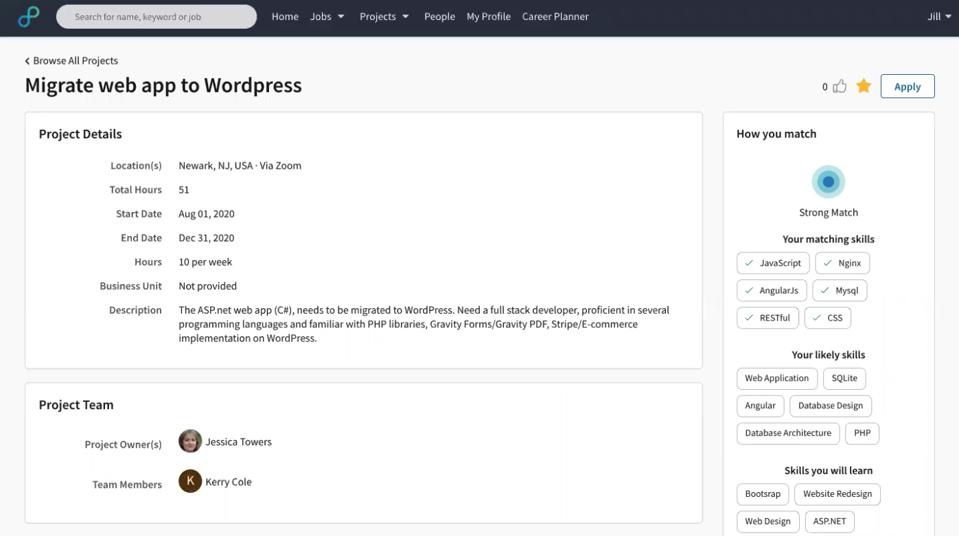
Employees select a project of interest and are immediately shown how strong of a match they are with the open position. Eightfold provides insights into relevant skills that an employee already has, why they are a strong match and the rest of the project team members – often a carrot in itself. Keeping focused on expanding employee’s capabilities, Eightfold also provides guidance of which skills an employee will learn. The following is an example of what an open project positions looks like:

How An AI Platform Is Matching Employees And Opportunities

How An AI Platform Is Matching Employees And Opportunities

Employee applicants can also view all the projects they currently have open from the My Projects view shown below:

How An AI Platform Is Matching Employees And Opportunities

Project Marketplace is the win/win every employee has yearned for as they start to feel less challenged in their current position and start looking for a new one, often outside their companies. I recently spoke with Ashutosh Garg, CEO and Co-Founder and Kamal Ahluwalia, Eightfold’s President, to see how they successfully ran a virtual hackathon across three continents to keep the Marketplace platform fresh with new features and responsive to the market.

How to Run A Virtual Hackathon

Starting with the hackathon, Eightfold relied on its own Talent Intelligence Platform to define the teams across all three continents, based on their employees’ combined mix of capabilities. Ashutosh, Kamal and the senior management team defined three goals of the hackathon:

  1. Solve problems customers are asking about with solutions that are not on the roadmap yet.
  2. Accelerate time to value for customers with new approaches no one has thought of before.
  3. Find new features and unique strengths that further strengthen the company’s mission of finding the right career for everyone in the world.

It’s fascinating to see how AI, cybersecurity and revenue management software companies continue to innovate at a fast pace delivering complex apps with everyone being remote. I asked Ashutosh how he and his management team approached the challenge of having a hackathon spanning three continents deliver results. Here’s what I learned from our discussion and these lessons are directly applicable to any virtual hackathon today:

  1. Define the hackathon’s purpose clearly and link it to the company mission, explaining what’s at stake for customers, employees and the millions of people looking for work today – all served by the Talent Intelligence Platform broadening its base of features.
  2. Realize that what you are building during the hackathon will help set some employees free from stagnating skills allowing them to be more employable with their new capabilities.
  3. The hackathon is a chance to master new skills through experiential learning, further strengthening their capabilities as well. And often learning from some of the experts in the company by joining their teams.
  4. Reward risk-taking and new innovative ideas that initially appear to be edge cases, but can potentially be game changers for customers.

I’ve been interviewing CEOs from startups to established enterprise software companies about how they kept innovation alive during the lockdown. CEOs have mentioned agile development, extensive use of Slack channels and daily virtual stand-ups. Ashutosh Garg is the only one to mention how putting intrinsic motivation into practice, along with these core techniques, binds hackathon teams together fast. Dan Pink’s classic TED Talk, The Puzzle of Motivation, explains intrinsic motivators briefly and it’s clear they have implications on a hackathon succeeding or not.

Measuring Results Of the Hackathon

Within a weekend, Project Marketplace revealed several new rock stars amongst the Eightfold hackathon teams. Instead of doing side projects for people who had time on their hands, this Hackathon was about making Eightfold’s everyday projects better and faster. Their best Engineers and Services team members took a step back, re-looked at the current approaches and competed with each other to find better and innovative ways. And they all voted for the most popular projects and solutions – ultimate reward in gaining the respect of your peers. As well as the most “prolific coder” for those who couldn’t resist working on multiple teams.

Conclusion

Remote work is creating daunting challenges for individuals at home as well as for companies. Business models need to change and innovation cannot take a back seat while most companies have employees working from home for the foreseeable future. Running a hackathon during a global lockdown and making it deliver valuable new insights and features that benefit customers now is achievable as Eightfold’s track record shows. Project marketplace may prove to be a useful ally for employees and companies looking to stay true to their mission and help each other grow – even in a pandemic. This will create better job security, a culture of continuous learning, loyalty and more jobs. AI will change how we look at our work – and this is a great example of inspiring innovation.


Why Digital Transformation Always Needs To Start With Customers First

Why Digital Transformation Always Needs To Start With Customers First

Customers’ expectations, preferences, changing patterns in how and why they purchase need to be the core of any digital transformation effort.

Customers’ expectations, preferences, changing patterns in how and why they purchase need to be the core of any digital transformation effort. With it, digital transformation projects flourish and take on a life of their own. Without it, I’ve seen digital transformation projects become myopic, narrowly focused, substituting internal metric gains for measures that matter most to customers.

Digital Maturity Drives Revenue

Anyone who has worked on a digital transformation project quickly sees how the most digitally mature organizations can turn their investments in transformation into revenue by overwhelming customers with value. Initiatives that put customers first can serve to generate greater confidence among C-level executives and board members, leading to more funding. This is because business cases for customer-centric digital transformation projects are easier to create, more defensible and best of all, point to revenue gains and cost reductions.

Deloitte Insights’ recent survey uncovering the connection between digital maturity and financial performance accurately reflects the true state of customer-centric digital transformation. The article explains how the more digitally mature an organization is, the more achievable gains are in diversity and inclusion, Corporate Social Responsibility (CSR), customer satisfaction, product quality, gross margin and long-term financial performance. Deloitte’s latest study finds a strong correlation between the digital maturity of an enterprise and its net revenue and net profit margin. The following graphic makes clear how valuable pursuing digital maturity is, with customers being at the center of all transformation efforts. This contributes to greater net revenue and net profit margin growth:

A fascinating point regarding Deloitte Insights’ research is the correlation it uncovered between an organization’s digital transformation maturity and the benefits they gain in efficiency, revenue growth, product/service quality, customer satisfaction and employee engagement. They found a hierarchy of pivots successful enterprises make to keep pursuing more agile, adaptive organizational structures combined with business model adaptability, all driven by customer-driven innovation. The most digitally mature organizations can adopt new frameworks that prioritize market responsiveness, customer-centricity and have analytics and data-driven culture with actionable insights embedded in their DNA.

Mastering Data & Removing Roadblocks Are Key To Driving Customer Value

The two highest-payoff areas for accelerating digital maturity and achieving its many benefits are mastering data and creating more intelligent workflows. Deloitte Insights’ research team looked at the seven most effective digital pivots enterprises can make to become more digitally mature. The pivots that paid off the best as measured by revenue, margin, customer satisfaction, product/service quality and employee engagement combined data mastery and improving intelligent workflows. The following graphic shows how 51% of revenue growth can be explained by these two factors alone and 49% of improved customer satisfaction.

Data mastery and intelligent workflows are among the easiest areas to measure and include in a business case for digital transformation projects aimed at delivering a transcendent customer experience. Choosing to excel on the dimension of customer-centric data mastery gives enterprises the insights they need to create their unique omnichannel platforms. Adding in intelligent workflows that give customers the freedom to buy how, where and when they choose across any digital platform is the cornerstone of entirely new digital business models today. Capturing the voice of the customer and combining data mastery and intelligent workflows to gain an accurate, true 360-degree view of customers is invaluable for every aspect of go-to-market strategies.

Achieving Digital Maturity Requires A Framework

Enterprises that have customer centricity and a data-driven mindset are the most likely to succeed with a digital transformation initiative. As the Deloitte Insights study inferred, the most digitally mature organizations are continually adapting to customer and market dynamics. They’re prioritizing market responsiveness, striving to improve customer-centricity and have data-driven cultures with actionable insights as part of their DNA. Enterprises who see new digital business model opportunities and act on them capitalize on these three areas of organizational strength. They’re also able to combine their data mastery and intelligent workflows to identify areas of competitive opportunity to help them excel for their customers.

Consider how cybersecurity is now part of any customer experience, for good and bad. Multi-factor Authentication (MFA) and many other forms of identity verification secure customer transactions, yet they can also cause dissatisfaction. For any digitally mature enterprise, integrating cybersecurity into their existing framework is a challenge. The growth of new frameworks designed to empower greater customer-centricity, agility and actionable insights across every facet of a business is a fascinating area of watch.

One of the more interesting is BMC’s Autonomous Digital Enterprise (ADE) framework, which is shown below. Mapping Deloitte Insights’ top investment priorities for the next 12 months across all digital maturity levels to the ADE framework shows why frameworks like BMC’s are gaining adoption, particularly as organizations look to run and reinvent themselves with new digital business models built around AI/ML capabilities. The following graphic provides insights into how Deloitte’s top investment priorities are integral to BMC’s Autonomous Digital Enterprise Framework and its many contributions to the success of new digital business growth.

Conclusion

Quantifying the impact of having a customer-centric digital transformation strategy has proved elusive until recently. Deloitte Insights’ research shows how digital maturity enables greater gains from customer-centric digital transformation efforts. What’s fascinating about their research is how the progression of digital pivots leads to improved margin, revenue, customer satisfaction, diversity and inclusion and product quality gains. Equally interesting is the growing utility of frameworks like BMC’s, which are designed to enable long-standing enterprises to seamlessly embrace new digital business models, so they can flex and change with the world around them.


Where AIOps Is Delivering Results Today

Where AIOps Is Delivering Results Today

Bottom Line: Capitalizing on AI and machine learning’s inherent strengths to create contextual intelligence in real-time, LogicMonitor’s early warning and failure prevention systems reflect where AIOps is delivering results today.

LogicMonitor’s track record of making solid contributions to their customers’ ability to bring greater accuracy, insight, and precision into monitoring all IT assets is emerging as a de facto industry standard. Recently I was speaking with a startup offering Hosted Managed Services of a variety of manufacturing applications, and the must-have in their services strategy is LogicMonitor LM Intelligence. LogicMonitor’s AIOps platform is powered by LM Intelligence, enabling customers’ businesses to gain early warning into potential trouble spots in IT operations stability and reliability. LogicMonitor does the hard work for you with automated alert thresholds, AI-powered early warning capabilities, customizable escalation chains, workflows, and more.

Engineers who are working at the Hosted Managed Services provider I recently spoke with say LM Intelligence is the best use case of AI and machine learning to provide real-time alerts, contextual insights, discover new patterns in data, and make automation achievable. The following is an example of the LM Intelligence dashboard:

Where AIOps Is Delivering Results Today

How LogicMonitor’s Architecture Supports AIOps

One of the core strengths LogicMonitor continues to build on is integration, which they see as essential to their ability to excel at providing AIOps support for their customers. Their architecture is shown below. By providing real-time integration to public cloud platforms, combined with control over the entire IT infrastructure structure along with over 2,000 integrations from network to cloud, LogicMonitor excels at unifying diverse IT environments into a single, cohesive AIOps-based intelligence system.  The LogicMonitor platform collects cloud data through our cloud collectors. These collectors retrieve metrics such as the cloud provider health and billing information by making API calls to the cloud services. The collector is a Windows Service or background process that is installed in a virtual machine. This collector then pulls metrics from the different devices using a variety of different methods, including SNMP, WMI, perf Mon JMX, APIs, and scripts.

Where AIOps Is Delivering Results Today

Using AIOps To Monitor, Analyze, Automate

LogicMonitor has created an architecture that’s well-suited to support the three dominant dimensions of AIOps, including Monitoring, Analytics (AIOps), and Automating. Their product and services strategies in the past have reflected a strong focus on Monitoring. The logic of prioritizing Monitoring as a product strategy area was to provide the AI and machine learning models with enough data to train on so they could identify anomalies in data patterns faster. Their 2018/2019 major releases in the Monitor area reflect how the unique strength they have of capturing and making use of any IT asset that can deliver a signal is paying off. Key Monitor developers recently include the following:

  • Kubernetes Monitoring
  • Service Insight
  • Topology
  • Remote Sessions
  • Netflow
  • Configuration Monitoring
  • Public Cloud Monitoring
  • Applications Monitoring

LogicMonitor’s core strengths in AIOps are in the Anomaly Detection and Early Warning System areas of their product strategy. Their rapid advances in the Early Warning System development show where AIOps is delivering solid results today. Supporting the Early Warning System, there are Dynamic Thresholds and Root Cause Analysis based on Dependencies as well.

The Automate area of their product strategy shows strong potential for future growth, with the ServiceNow integration having upside potential. Today Alert Chaining and Workflow support integrations to Ansible, Terraform, Slack, Microsoft, Teama, Putter, Terraform, OpsGenie, and others.

Conclusion

LogicMonitor’s platform handles 300B metrics on any given day and up to 10B a month, with over 28K collectors deployed integrated with approximately 1.4M devices being monitored. Putting AI and machine learning to work, interpreting the massive amount of data the platform captures every day to fine-tune their Early Warning and Failure Prevention Systems, is one of the most innovative approaches to AIOps today. Their AIOps Early Warning System is using machine learning Algorithms to fine-tune Root Cause Analysis and Dynamic Thresholds continually. AIOps Log Intelligence is also accessing the data to complete Automatic Log Anomaly Detection, Infrastructure change detection, and Log Volume Reduction to Signal analysis.


Answers To Today’s Toughest Endpoint Security Questions In The Enterprise

Answers To Today's Toughest Endpoint Security Questions In The Enterprise

  • Enterprises who are increasing the average number of endpoint security agents from 9.8 last year to 10.2 today aren’t achieving the endpoint resilience they need because more software agents create more conflicts, leaving each endpoint exposed to a potential breach.
  • 1 in 3 enterprise devices is being used with a non-compliant VPN, further increasing the risk of a breach.
  • 60% of breaches can be linked to a vulnerability where a patch was available, but not applied. Windows 10 devices in enterprises are, on average, 95 days behind on patches.

CIOs, CISOs and cybersecurity teams say autonomous endpoint security is the most challenging area they need to strengthen in their cybersecurity strategy today. Software agents degrade faster than expected and conflict with each other, leaving endpoints exposed. Absolute’s 2020 State of Endpoint Resilience Report quantifies the current state of autonomous endpoint security, the scope of challenges CISOs face today and how elusive endpoint resiliency is to achieve with software agents. It’s an insightful read if you’re interested in autonomous endpoint security.

Endpoint Security Leads CISOs’ Priorities In 2020

With their entire companies working remotely, CIOs and CISOs I’ve spoken with say autonomous endpoint security is now among their top three priorities today. Cutting through the endpoint software clutter and turning autonomous endpoint security into a strength is the goal. CISOs are getting frustrated with spending millions of dollars among themselves only to find out their endpoints are unprotected due to software conflicts and degradation.  Interested in learning more, I spoke with Steven Spadaccini, Vice President, Sales Engineering at Absolute Software and one of the most knowledgeable autonomous endpoint cybersecurity experts I’ve ever met. Our conversation delved into numerous cybersecurity challenges enterprise CIOs and CISOs are facing today. My interview with him is below:

The Seven Toughest Questions the C-Suite Is Asking About Endpoint Security

Louis: Thank you for your time today. I have seven questions from CIOs, CISOs and their teams regarding endpoint security. Let’s get started with their first one. What happens if an endpoint is compromised, how do you recover, encrypt, or delete its data?

Steven:  It’s a challenge using software agents, both security and/or management, to do this as each agents’ tools and features often conflict with each other, making a comprised endpoints’ condition worse while making it virtually impossible to recover, encrypt, delete and replace data. The most proven approach working for enterprises today is to pursue an endpoint resilience strategy. At the center of this strategy is creating a root of trust in the hardware and re-establishes communication and control of a device through an unbreakable digital tether. I’m defining Endpoint Resilience as an autonomous endpoint security strategy that ensures connectivity, visibility and control are achieved and maintained no matter what is happening at the OS or application level. Taking this approach empowers devices to recover automatically from any state to a secure operational state without user intervention. Trust is at the center of every endpoint discussion today as CIOs, CISOs and their teams want the assurance every endpoint will be able to heal itself and keep functioning

Louis: Do endpoint software security solutions fail when you lose access to the endpoint, or is the device still protected at the local level?

Steven: When they’re only protected by software agents, they fail all the time. What’s important for CISOs to think about today is how they can lead their organizations to excel at automated endpoint hygiene. It’s about achieving a stronger endpoint security posture in the face of growing threats. Losing access to an endpoint doesn’t have to end badly; you can still have options to protect every device. It’s time for enterprises to start taking a more resilient-driven mindset and strategy to protecting every endpoint – focus on eliminating dark endpoints. One of the most proven ways to do that is to have endpoint security embedded to the BIOS level every day. That way, each device is still protected to the local level. Using geolocation, it’s possible to “see” a device when it comes online and promptly brick it if it’s been lost or stolen.

Louis: How can our cybersecurity team ensure compliance that all cybersecurity software is active and running on all endpoints?

Steven: Compliance is an area where having an undeletable tether pays off in a big way. Knowing what’s going on from a software configuration and endpoint security agent standpoint – basically the entire software build of a given endpoint – is the most proven way I’ve seen CISOs keep their inventory of devices in compliance. What CISOs and their teams need is the ability to see endpoints in near real-time and predict which ones are most likely to fail at compliance. Using a cloud-based or SaaS console to track compliance down to the BIOS level removes all uncertainty of compliance. Enterprises doing this today stay in compliance with HIPAA, GDPR, PCI, SOX and other compliance requirements at scale. It’s important also to consider how security automation and orchestration kicks on to instantly resolve violations by revising security controls and configurations, restoring anti-malware, or even freezing the device or isolating it from data access. Persistent visibility and control give organizations what they need to be audit-ready at every moment.

Having that level of visibility makes it easy to brick a device. Cybersecurity teams using Absolute’s Persistence platform can lead to humorous results for IT teams, who call the bricking option a “fun button as they watch hackers continually try to reload new images and right after they’re done, re-brick the device again. One CIO told the story of how their laptops had been given to a service provider who was supposed to destroy them to stay in compliance with the Health Insurance Portability and Accountability Act (HIPAA) and one had been resold on the black market, ending up in a 3rd world nation. As the hacker attempted to rebuild the machine, the security team watched as each new image was loaded at which time they would promptly brick the machine. After 19 tries, the hacker gave up and called the image rebuild “brick me.”

Louis: With everyone working remote today, how can we know, with confidence where a given endpoint device is at a moments’ notice?

Steven: That’s another use case where having an undeletable tether pays off in two powerful ways: enabling autonomous endpoint security and real-time asset management. You can know with 100% confidence where a given endpoint device is in real-time so long as the device is connected to a permanent digital tether . Even if the device isn’t reachable by your own corporate network it’s possible to locate it using the technologies and techniques mentioned earlier. CIOs sleep better at night knowing every device is accounted for and if one gets lost or stolen, their teams can brick it in seconds.

Louis: How can our IT and cybersecurity teams know all cybersecurity applications are active and protecting the endpoint?

Steven: By taking a more aggressive approach to endpoint hygiene, it’s possible to know every application, system configuration and attributes of user data on the device. It’s important not to grow complacent and assume the gold image IT uses to configure every new or recycled laptop is accurate. One CIO was adamant they had nine software agents on every endpoint, but Absolute’s Resilience platform found 16, saving the enterprise from potential security gaps. The gold image is an enterprise IT team was using had inadvertently captured only a subset of the total number of software endpoints active on their networks. Absolute’s Resilience offering and Persistence technology enabled the CIO to discover gaps in endpoint security the team didn’t know existed before.

Louis: How can we restrict the geolocations of every endpoint?

Steven: This is an area that’s innovating quickly in response to the needs enterprises have to track and manage assets across countries and regions. IP tracking alone isn’t as effective as the newer techniques, including GPS tracking, Wi-Fi triangulation, with both integrated into the Google Maps API. Enterprises whose business relies on Personal Identifiable Information (PII) is especially interested in and adopting these technologies today. Apria Healthcare is currently using geofencing for endpoint security and asset management. They have laptops in use today across Indonesia, the Philippines and India. Given the confidential nature of the data on those devices and compliance with local government data protection laws, each laptop needs to stay in the country they’re assigned to. Geofencing gives Apria the power to freeze any device that gets outside of its region within seconds, averting costly fines and potential breaches.

Louis: How can our IT team immediately validate an endpoint for vulnerabilities in software and hardware?

Steven: The quickest way is to design in audit-ready compliance as a core part of any endpoint resilience initiative. Endpoint resilience to the BIOS level makes it possible to audit devices and find vulnerabilities in real-time, enabling self-healing of mission-critical security applications regardless of complexity. The goal of immediately validating endpoints for current security posture needs to be a core part of any automated endpoint hygiene strategy. It’s possible to do this across platforms while being OS-agnostic yet still accessible to over 500M endpoint devices, deployed across Microsoft Windows, macOS via a Mac Agent and Chrome platforms.

Conclusion

Knowing if their autonomous endpoint security and enterprise-wide cybersecurity strategies are working or not is what keeps CIOs up the most at night. One CISO confided to me that 70% of the attempted breaches to his organization are happening in areas he and his team already knew were vulnerable to attack. Bad actors are getting very good at finding the weakest links of an enterprises’ cyber defenses fast. They’re able to look at the configuration of endpoints, see which software agents are installed, research known conflicts and exploit them to gain access to corporate networks. All this is happening 24/7 to enterprises today. Needing greater resilient, persistent connections to every device, CISOs are looking at how they can achieve greater resilience on every endpoint. Capitalizing on an undeletable tether to track the location of the device, ensure the device and the apps on that device have self-healing capabilities and gain valuable asset management data  – these are a few of the many benefits they’re after.

How Barclays Is Preventing Fraud With AI

How Barclays Is Preventing Fraud With AI

Bottom Line: Barclays’ and Kount’s co-developed new product, Barclays Transact reflects the future of how companies will innovate together to apply AI-based fraud prevention to the many payment challenges merchants face today.

Merchant payment providers have seen the severity, scope, and speed of fraud attacks increase exponentially this year. Account takeovers, card-not-present fraud, SMS spoofing, and phishing are just a few of the many techniques cybercriminals are using to defraud merchants out of millions of dollars. One in three merchants, 32%, prioritize payment providers’ fraud and security strengths over customer support and trust according to a recent YouGov survey.  But it doesn’t have to be a choice between security and a frictionless transaction.

Frustrated by the limitations of existing fraud prevention systems, many payment providers are working as fast as they can to pilot AI- and machine-learning-based applications and platforms. Barclays Payment Solutions’ decision to work with AI-based solution Kount is what the future of AI-based fraud prevention for payment providers looks like.

How AI Helps Thwart Fraud And Increase Sales at Barclays   

Barclays Payment Services handles 40% of all merchant payments in the UK. They’ve been protecting merchants and their customers’ data for over 50 years, and their fraud and security teams have won industry awards. For Barclays, excelling at merchant and payment security is the only option.

In order to offer an AI-based suite of tools to help merchants make their online transactions both simpler and safer, Barclays chose to partner with Kount. Their model of innovating together enables Barclays to strengthen their merchant payment business with AI-based fraud prevention and gain access to Kount’s Identity Trust Global Network, the largest network of trust and fraud-related signals. Kount gains knowledge into how they can fine-tune their AI and machine learning technologies to excel at payment services. Best of all, Barclays’ merchant customers will be able to sell more by streamlining the payment experience for their customers. The following is an overview of the Barclays Transact suite for merchants.

Barclays and Kount defined objectives for Barclay Transact: protect against increasingly sophisticated eCommerce fraud attempts, improve their merchants’ customer experiences during purchases, prepare for UK-mandated Strong Customer Authentication (SCA) by allowing businesses to take advantage of Transaction Risk Analysis (TRA) exemptions, optimize payment acceptance workflows and capitalize on Kount’s Identity Trust Global Network.

Adding urgency to the co-creation of Barclays Transact are UK regulatory requirements. To help provide clarity and support to merchants and the market from the impact of Covid-19 the Financial Conduct Authority (FCA) have agreed to delay the enforcement of a Strong Customer Authentication (SCA) until 14 September 2021 in the UK. The European Economic Area (EEA) deadline remains 31 December, 2020. Kount’s AI- and machine learning algorithms designed into Barclay Transact, tested at beta sites and fine-tuned for the first release, are effective in meeting UK government mandates.

How AI Is Turning Trust Into A Sales Accelerator At Barclays

The Barclays Payment Solutions and Kount teams believe that the more ambitious the goals for Barclays Transact to deliver value to merchants, the stronger the suite will be. Here are examples of goals businesses can achieve with this partnership:

  1. Achieve as few false positives as possible by making real-time updates to machine learning algorithms and fine-tuning merchant responses.
  2. Reduce the number of manual reviews for fraud analysts consistently by applying AI and machine learning to provide early warning of anomalies.
  3. Minimize the number of chargebacks to merchant partners.
  4. Reduce the friction and challenges merchants experience with legacy fraud prevention systems by streamlining the purchasing experience.
  5. Enable compliance to UK-mandated regulatory requirements while streamlining merchants and their customers’ buying experiences.

Barclays Transact analyzes every transaction in real-time using Kount’s AI-based fraud analysis technology, scoring each on a spectrum of low to high risk. Each Barclays merchant’s gateway then uses this score to identify the transactions which qualify for TRA exemptions. This results in a more frictionless payment and checkout experience for customers, resulting in lower levels of shopping cart abandonment and increased sales. Higher-risk transactions requiring further inspection will still go through two-factor authentication, or be immediately declined, per the regulation and customer risk appetite. The following is an example of the workflow Barclays and Kount were able to accomplish by innovating together:

Conclusion 

Improving buying experiences and keeping them more secure on a trusted platform is an ambitious design goal for any suite of online tools. Barclays and Kount’s successful development and launch of a co-developed product is prescient and points the way forward for payment providers who need AI expertise to battle fraud now. A bonus is how the partnership is going to enrich the Kount Identity Trust Global Network, the largest network of trust and risk signals, which is comprised of 32 billion annual interactions from more than 6,500 customers across 75+ industries. “We are excited to be partnering with Kount, because they share our goal of collaborative innovation, and a drive to deliver best-in-class shopper experiences. Thanks to Kount’s award-winning fraud detection software, the new module will not only help customers to fight fraud and prevent unwanted chargebacks, but it will also help them to maximize sales, improve customer experience, and better prepare for the introduction of SCA,” David Jeffrey, Director of Product, Barclaycard Payments said.