Skip to content

Posts from the ‘Gartner’ Category

Cloud Computing and Enterprise Software Forecast Update, 2012

The latest round of cloud computing and enterprise software forecasts reflect the growing influence of analytics, legacy systems integration, mobility and security on IT buyer’s decisions.

Bain & Company and Gartner have moved beyond aggregate forecasts, and are beginning to forecast by cloud and SaaS adoption stage.  SAP is using the Bain adoption model in their vertical market presentations today.

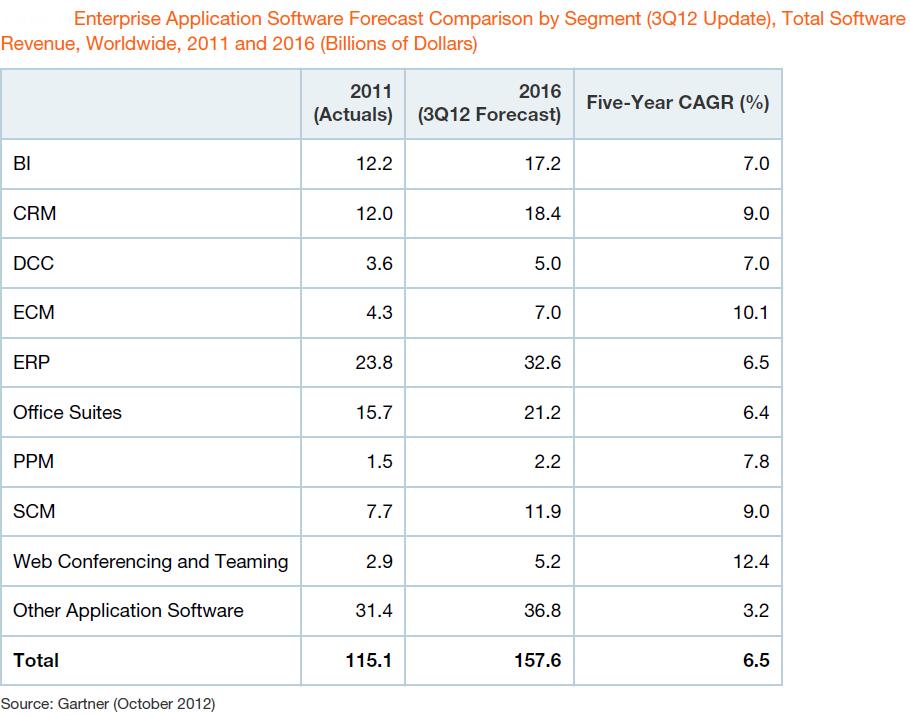
Despite the predictions of the demise of enterprise software, forecasts and sales cycles I’ve been involved with indicate market growth.  Mobility and cloud computing are the catalysts of rejuvenation in many enterprise application areas, and are accelerating sales cycles.  Presented in this roundup are market sizes, forecasts and compound annual growth rates (CAGRS) for ten enterprise software segments.

Key take-aways from the latest cloud computing and enterprise software forecasts are provided below:

  • Public and private cloud computing will be strong catalysts of server growth through 2015.  IDC reports that $5.2B in worldwide server revenue was generated in 2011 or 885,000 units sold.  IDC is forecasting a $9.4B global market by 2015, resulting in 1.8 million servers sold. Source:  IDC Worldwide Enterprise Server Cloud Computing 2011–2015 http://www.idc.com/getdoc.jsp?containerId=228916 
  • 11% of companies are transformational, early adopters of cloud computing, attaining 44% adoption (as defined by % of MIPS) in 2010, growing to 49% in 2013.  This same segment will reduce their reliance on traditional, on-premise software from 34% to 30% in the same period according to Bain & Company’s cloud computing survey results shown below.  SAP is using this adopter-based model in their vertical market presentations, an example of which is shown here.

  • The global Platform-as-a-Service (PaaS) market is growing from $900M in 2011 to $2.9B in 2016, achieving a 26.6% CAGR.  At this projected rate, PaaS will generate an average of $360M a year in revenue between 2011 and 2016.  Gartner projects that the largest segments will be Application Platform Services (aPaaS) which generated 35% of total PaaS spending in 2011, followed by cloud application lifecycle services (12.5).    Source: Market Trends: Platform as a Service, Worldwide, 2012-2016, 2H12 Update Published: 5 October 2012 ID:G00239236.

  • The three most popular net-new SaaS solutions deployed are CRM (49%), Enterprise Content Management (ECM) (37%) and Digital Content Creation (35%).  The three most-replaced on-premise applications are Supply Chain Management (SCM) (35%), Web Conferencing, teaming platforms and social software suites (34%) and Project & Portfolio Management (PPM (33%). The following graphic shows the full distribution of responses. Source: User Survey Analysis: Using Cloud Services for Mission-Critical Applications Published: 28 September 2012

SaaS Adoption Accelerates, Goes Global in the Enterprise

In working with manufacturers and financial services firms over the last year, one point is becoming very clear: SaaS is gaining trust as a solid alternative for global deployments across the enterprise.  And this trend has been accelerating in the last six months.  One case in point is a 4,000 seat SaaS CRM deployment going live in Australia, Europe, and the U.S. by December of this year.

What’s noteworthy about this shift is that just eighteen months ago an Australian-based manufacturer was only considering SaaS for on-premises enhancement of their CRM system.  What changed?  The European and U.S. distribution and sales offices were on nearly 40 different CRM, quoting, proposal and pricing systems.  It was nearly impossible to track global opportunities.

Meanwhile business was booming in Australia and there were up-sell and cross-sell opportunities being missed in the U.S. and European-based headquarters of their prospects. The manufacturer  chose to move to a global SaaS CRM solution quickly.  Uniting all three divisions with a global sales strategy forced the consolidation of 40 different quoting, pricing and CRM systems in the U.S. alone.  What they lost in complexity they are looking to pick up in global customer sales.

Measuring Where SaaS Is Cannibalizing On-Premise Enterprise Applications

Gartner’s Market Trends: SaaS’s Varied Levels of Cannibalization to On-Premises Applications published: 29 October 2012 breaks out the percent of SaaS revenue for ten different enterprise application categories.  The greener the color the greater the adoption.  As was seen with the Australian manufacturer, CRM continues dominate this trend of SaaS cannibalizing on-premise enterprise applications.

Additional take-aways from this report include the following:

  • Perceived lower Total Cost of Ownership (TCO) continues to be the dominant reason enterprises are considering SaaS adoption, with 50% of respondents in 2012 mentioning this as the primary factor in their decision.
  • CRM is leading all other enterprise application areas in net new deployments according to the Gartner study, with the majority of on-premise replacements being in North America and Europe.
  • 95% of Web analytics functions are delivered via the SaaS model  whereas only 40% of sales use cloud today according to the findings of this study.
  • SaaS-based ERP will continued to be a small percentage of the total market, attaining 10% cannibalization by 2012.  Forrester has consistently said this is 13%, growing to 16% by 2015.
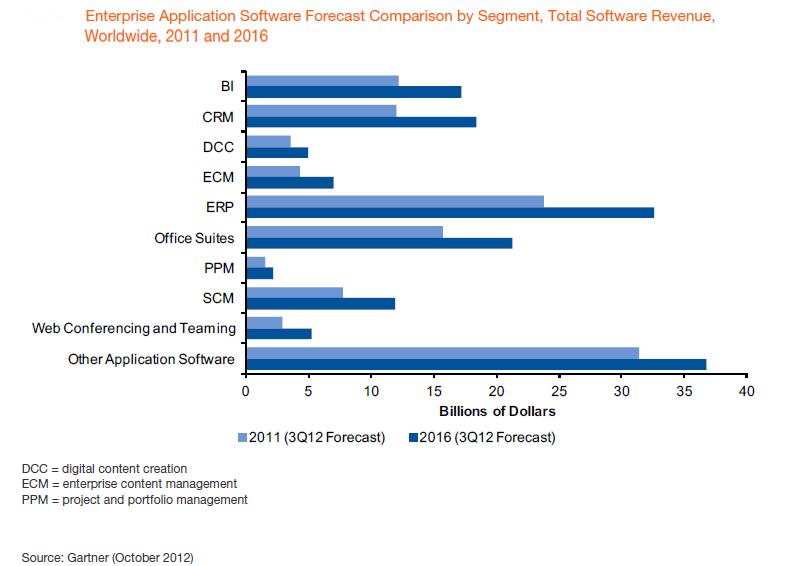
  • Office suites and digital content creation (DCC) will attain compound annual growth rates (CAGR) of 40.7% and a 32.2% respectively from 2011 through 2016. Gartner is making the assumption consumers and small businesses will continue be the major forces for Web-based office suites through 2013.
  • The four reasons why companies don’t choose SaaS include uncertainty if it is the right deployment option (36%), satisfaction with existing on-premise applications (30%), no further requirements (33%) and locked into their current solution with expensive contractual requirements (14%).

Bottom Line: Enterprises and their need to compete with greater accuracy and speed are driving the cannibalization of on-premise applications faster than many anticipated; enterprise software vendors need to step up and get in front of this if they are going to retain their greatest sources of revenue.

Source:  Market Trends: SaaS’s Varied Levels of Cannibalization to On-Premises Applications Published: 29 October 2012 written by Chad Eschinger, Joanne M. Correia, Yanna Dharmasthira, Tom Eid, Chris Pang, Dan Sommer, Hai Hong Swinehart and Laurie F. Wurster

Using Search Analytics To See Into Gartner’s $232B Big Data Forecast

By combining search analytics and the latest Gartner forecast on big data published last week, it’s possible to get a glimpse into this areas’ highest growth industry sectors.  Big data is consistently a leading search term on Gartner.com, which is the basis of the twelve months of data used for the analysis.

In addition, data from Gartner’s latest report, Big Data Drives Rapid Changes in Infrastructure and $232 Billion in IT Spending Through 2016 by Mark A. Beyer, John-David Lovelock, Dan Sommer, and Merv Adrian is also used.  These authors have done a great job of explaining how big data is rapidly emerging as a market force, not just a single market unto itself.  This distinction pervades their analysis and the following table showing Total IT Spending Driven by Big Data reflects the composite market approach.  Use cases from enterprise software spending, storage management, IT services, social media and search forecasts are the basis of the Enterprise Software Spending for Specified Sub-Markets Forecast.  Social Media Analytics are the basis of the Social Media Revenue Worldwide forecast.

Additional Take-Aways

  • Enterprise software spending for specified sub-markets will attain a 16.65% compound annual growth rate (CAGR) in revenue from 2011 to 2016.
  • Attaining a 96.77% CAGR from 2011 through 2016, Social Media Revenue Is one of the primary use case catalysts of this latest forecast.
  • Big Data IT Services Spending will attain a 10.20% CAGR from 2011 to 2016.
  • $29B will be spent on big data throughout 2012 by IT departments.  Of this figure, $5.5B will be for software sales and the balance for IT services.
  • Gartner is projecting a 45% per year average growth rate for social media, social network analysis and content analysis from 2011 to 2016.
  • Gartner projects a 20 times ratio of IT Services to Software in the short term, dropping as this market matures and more expertise is available.
  • Organizations are already replacing early implementations of big data solutions – and Gartner is projecting this will continue through 2020.
  • By 2016 spending on Application Infrastructure and Middleware becomes one of the most dominant for big data in Enterprise Software-Specified Sub Markets.

  • $232B is projected to be sold in total across all categories in the forecast from 2011 to 2016. From $24.4B in 2011 to $43.7B in 2016, this presents a 12.42% CAGR in total market growth.

Search Analytics and Big Data

Big data is continually one of the top terms search on Gartner.com, and over the last twelve months, this trend has accelerated.  The following time series graph shows the weekly number of inquiries Gartner clients have made, with the red line being the logarithmic trend.

Banking (25%), Services (15%) and Manufacturing (15%) are the three most active industries in making inquiries about big data to Gartner over the last twelve months.  The majority of these are large organizations (63%) located in North America (59%) and Europe (19%).

What unifies all of these industries from a big data standpoint is how critical the stability of their customer relationships are to their business models.  Banks have become famous for bad service and according to the American Customer Satisfaction Index (ACSI) have shown anemic growth in customer satisfaction in the latest period measured, 2010 to 2011.  The potential for using big data to becoming more attuned to customer expectations and deliver more effective customer experiences in this and all services industries shows great upside.

Bottom line: Companies struggling with flat or dropping rankings on the ACSI need to consider big data strategies based on structured and unstructured customer data.  In adopting this strategy the potential exists to drastically improve customer satisfaction, loyalty, and ultimately profits.

Why CIOs Are Quickly Prioritizing Analytics, Cloud and Mobile

Customers are quickly reinventing how they choose to learn about new products, keep current on existing ones, and stay loyal to those brands they most value.  The best-run companies are all over this, orchestrating their IT strategies to be as responsive as possible.

The luxury of long technology evaluation cycles, introspective analysis of systems, and long deployment timeframes are giving way to rapid deployments and systems designed for accuracy and speed.

CIOs need to be just as strong at strategic planning and execution as they are at technology.  Many are quickly prioritizing analytics, cloud and mobile strategies to stay in step with their rapidly changing customer bases.  This is especially true for those companies with less than $1B in sales, as analytics, cloud computing and mobility can be combined to compete very effectively against their much bigger rivals.

What’s Driving CIOs – A Look At Technology Priorities

Gartner’s annual survey of CIOs includes 2,300 respondents located in 44 countries, competing in all major industries.  As of the last annual survey, the three-highest rated priorities for investment from 2012 to 2015 included Analytics and Business Intelligence (BI), Mobile Technologies and Cloud Computing.

Source: From the Gartner Report Market Insight: Technology Opens Up Opportunities in SMB Vertical Markets September 6, 2012 by Christine Arcaris, Jeffrey Roster


How Industries Prioritize Analytics, Cloud and Mobile  

When  these priorities are analyzed across eight key industries, patterns emerge showing how the  communications, media and services (CMS) and manufacturing industries have the highest immediate growth potential for mobility (Next 2 years).  In Big Data/BI, Financial Services is projected to be the fastest-developing industry and in Cloud computing, CMS and Government.

In analyzing this and related data, a profile of early adopter enterprises emerges.  These are companies who are based on knowledge-intensive business models, have created and excel at running virtual organization structures, rely on mobility to connect with and build relationships with customers, and have deep analytics expertise.  In short, their business models take the best of what mobility, Big Data/BI and cloud computing have to offer and align it to their strategic plans and programs.  The following figure, Vertical Industry Growth by Technology Over the Next Five Years, shows the prioritization and relative growth by industry.

Source: From the Gartner Report Market Insight: Technology Opens Up Opportunities in SMB Vertical Markets September 6, 2012 by Christine Arcaris, Jeffrey Roster

How Mobility Could Emerge As the Trojan Horse of Enterprise Software

Bring Your Own Device (BYOD), the rapid ascent of enterprise application stores, and the high expectations customers have of continual mobile app usability and performance improvements are just three of many factors driving mobility growth.

Just as significant is the success many mid-tier companies are having in competing with their larger, more globally known rivals using mobile-based Customer Relationship Management (CRM), warranty management, service and spare parts procurement strategies.  What smaller competitors lack in breadth they are more than making up for in speed and responsiveness.   Gartner’s IT Market Clock for Enterprise Mobility, 2012 captures how mobility is changing the nature of competition.

Source: IT Market Clock for Enterprise Mobility, 2012 Published: 10 September 2012 Analyst(s): Monica Basso


Bottom Line – By excelling at the orchestration of analytics, cloud and mobile, enterprises can differentiate where it matters most – by delivering an excellent customer experience.  Mobility can emerge as an enterprise Trojan Horse because it unleashes accuracy, precision and speed into customer-facing processes that larger, complacent competitors may have overlooked.

Roundup of Big Data Forecasts and Market Estimates, 2012

From the best-known companies in enterprise software to start-ups, everyone is jumping on the big data bandwagon.

The potential of big data to bring insights and intelligence into enterprises is a strong motivator, where managers are constantly looking for the competitive edge to win in their chosen  markets.  With so much potential to provide enterprises with enhanced analytics, insights and intelligence, it is understandable why this area has such high expectations – and hype – associated with it.

Given the potential big data has to reorder an enterprise and make it more competitive and profitable, it’s understandable why there are so many forecasts and market analyses being done today.  The following is a roundup of the latest big data forecasts and market estimates recently published:

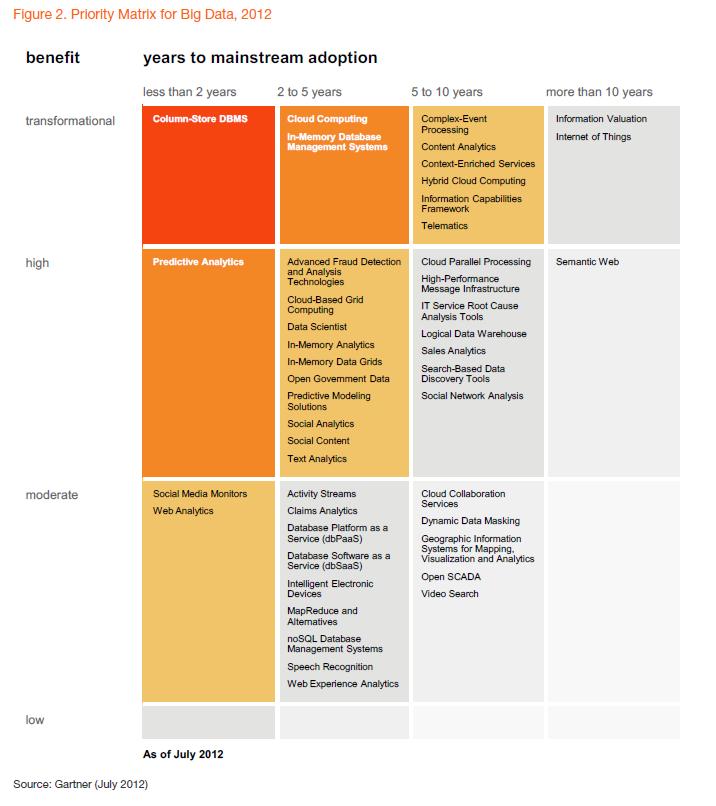
  • In Hype Cycle for Big Data, 2012, Gartner states that Column-Store DBMS, Cloud Computing, In-Memory Database Management Systems will be the three most transformational technologies in the next five years.  Gartner goes on to predict that Complex Event Processing, Content Analytics, Context-Enriched Services, Hybrid Cloud Computing, Information Capabilities Framework and Telematics round out the technologies the research firm considers transformational.  The Hype Cycle for Big Data is shown below:

  • Predictive modeling is gaining momentum with property and casualty (P&C) companies who are using them to support claims analysis, CRM, risk management, pricing and actuarial workflows, quoting, and underwriting. Web-based quoting systems and pricing optimization strategies are benefiting from investments in predictive modeling as well.   The Priority Matrix for Big Data, 2012 is shown below:

  • Social content is the fastest growing category of new content in the enterprise and will eventually attain 20% market penetration.   Gartner defines social content as unstructured data created, edited and published on corporate blogs, communication and collaboration platforms, in addition to external platforms including Facebook, LinkedIn, Twitter, YouTube and a myriad of others.
  • Gartner reports that 45% as sales management teams identify sales analytics as a priority to help them understand sales performance, market conditions and opportunities.
  • Over 80% of Web Analytics solutions are delivered via Software-as-a-Service (SaaS).  Gartner goes on to estimate that over 90% of the total available market for Web Analytics are already using some form of tools and that Google reported 10 million registrations for Google Analytics alone.  Google also reports 200,000 active users of their free Analytics application.  Gartner also states that the majority of the customers for these systems use two or more Web analytics applications, and less than 50% use the advanced functions including data warehousing, advanced reporting and higher-end customer segmentation features.
  • In the report Market Trends: Big Data Opportunities in Vertical Industries, the following heat map by industry shows that from a volume of data perspective, Banking and Securities, Communications, Media and Services, Government, and Manufacturing and Natural Resources have the greatest potential opportunity for Big Data.

The Marketing of Cloud Multitenancy: How Early Adopters Are Killing The Hype

It’s impressive how quickly the teams evaluating CRM cloud-based applications are learning how to deflate the hype surrounding multitenancy.

One gets the impression that hype-hunting has now become a sport in these teams.  In engineering-centric companies it’s a badge of honor to find out just how multitenant a cloud-based application or platform is.  Multitenancy isn’t the only area they are looking at, but given the massive amount of hype surrounding this issue on the part of vendors, it generates more attention because evaluation teams are skeptical.

Teams evaluating CRM applications aren’t satisfied with an easily customized and used graphical interface or series of workflows, they are getting more interested in the architecture itself .  In some cases they’ve been burned by claims of an application being SaaS-based when in fact the architecture is a glorified series of Citrix-like sessions running in the background or worse.  I have seen a healthy amount of skepticism in the evaluations going on right now and recently completed of SaaS applications and entire cloud platforms.  Gartner’s inquiry calls from corporate accounts must be accelerating as their clients look for guidance on how to sort out the multitenancy hype.

CRM, Multitenancy and the Hype Cycle for Cloud Computing

Gartner’s search analytics show that cloud computing and related terms had 29,998 searches in the last twelve months with cloud computing alone generating 10,062 searches.  SaaS and related terms had a search volume of 19,000.  These terms are among the most popular across all Gartner search terms for the last twelve months.  In comparison, CRM had over 42,000 searches in the same period.

It’s in this area of CRM applications where multitenancy has gone into hype overdrive. Looking for differentiators, some CRM vendors are claiming not just multitenancy – but their specific brand of it.  This confuses their prospects, which immediately energizes evaluation teams to do a more thorough job than they have ever done before.  By claiming their own type of multitenancy, CRM vendors are ironically not just slowing down their own sales cycles, they are making the entire industry slow down.  No wonder Gartner places multitenancy along the Peak of Inflated Expectations in the latest Hype Cycle for Cloud Computing which is shown below.

Making Sense of Elasticity and Multitenancy

It’s paradoxical that enterprise software vendors, especially those selling SaaS-based CRM applications,  are attempting to turn multitenancy into a differentiator.  What is needed is a greater focus on usability, flexibility in aligning workflows to specific needs, and better enterprise integration technologies.  Sell the value not the product features.

Given the confusion differentiating on multitenancy is creating and the calls Gartner is getting on this issue, they published Gartner Reference Model for Elasticity and Multitenancy.  It includes what Gartner believes a cloud services provider must implement in terms of a multitenant service in addition to what SaaS-based applications need to provide.  Here are their checklists for each area:

Multitenancy Service Requirements for Cloud Services Providers

  • Isolation of tenant data
  • Isolation of the tenant workspace (memory)
  • Isolation of tenant execution characteristics (performance and availability)
  • Tenant-aware security, monitoring, management, reporting and self-service administration
  • Isolation of tenant customizations and extensions to business logic
  • Continuous, tenant-aware version control
  • Tenant-aware error tracking and recovery
  • Tracking and recording of resources use per tenant
  • The ability to allocate resources to tenants dynamically, as needed and based on policy Horizontal scalability to support real-time addition/removal of tenant resources, tenants or users without interruptions to the running environment

Multitenancy in Cloud Application Services (Software as a Service) Applications

  • Be available 24/7, because of the potential global user base
  • Adopt new versions without disrupting the continuous operations of tenants, and preserve user customizations
  • Scale up or down on demand
  • Allow individual rollback and restore for each tenant
  • Not allow a “noisy neighbor” tenant to affect the performance of other tenants, or increase their costs
  • Be accessible from various locations, devices and software architectures to meet potentially global demand
  • Offer tenant-aware self-service

Gartner also released their Reference Architecture for Multitenancy, which is shown below.  One of the key assumptions of this model is that multitenancy is a mode of operation where multiple, independent and secured instances of applications run in a shared environment.  The model includes the seven different models of multitenancy Gartner has seen in their research.  These seven models, listed across the top of the model beginning with Shared Nothing and progressing to Custom Multitenancy are across the top of the model.

The majority of enterprises I’ve worked with are looking to the Shared Hardware approach in an attempt to create backward compatibility to their legacy applications via Virtual Machines. Another area of interest is the Shared Container approach which relies on a separate logical or physical instance of a DBMS, and often isolates its own business logic.  This is ideal for distributed order management systems and SaaS-based ERP systems for example.  Yet the legacy application support in this type of multitenancy can get expensive fast.

Shared Everything Multitenancy is ideal for quickly on-ramping and off-ramping applications, tenants and individual system users and is what nearly all enterprise vendors claim to do.  In reality only a handful do this well.  This approach to multitenancy is based on the Shared Container approach including support for shared DBMS sessions.  Salesforce.com’s Force.com platform, VMWare WaveMaker and Zoho Creator are all examples of companies who have successfully delivered Shared Everything multitenancy.

With so much to gain by positioning an application or solution suite in the 6th and 7th models, vendors are rushing to define their own versions of Shared Everything and Custom Multitenancy.  The land grab is on in this area of the multitenancy market right now.  IBM, Microsoft and Oracle are all expected to endorse and eventually have many of their cloud-based applications in the Shared Everything model.  Each of these companies and many others will have a multi-model based approach to selling multitenancy as well.

Gartner Reference Model for Elasticity and Multitenancy

Source:  Gartner Reference Model for Elasticity and Multitenancy

Bottom line: Enterprise software vendors can accelerate evaluation cycles and sell more by differentiating on the user experience and value delivered instead of trying to create fear, uncertainty and doubt (FUD) by creating their own definition of multitenancy.

Gartner Releases Hype Cycle for Networking and Communications, 2011

It is ironic that a framework meant to define the relative level of hype associated with new technologies adds in seven new ones, an increase of 20% within just a year.

Are all those technologies really significant enough to be included in a framework whose purpose is to cut through hype?   With less than 1% adoption throughout enterprises for over 50% of these technologies, it may be time for a more rigorous screening process.

After reading this Hype Cycle several dominant themes emerge. They include modernization of IT infrastructure to support greater scalability and security, consolidation of IT hardware investments, recognition of hybrid clouds being a central part of networking strategies, and location-based technologies having the potential to re-define logistics, supply chain and customer service strategies.  That’s a lot of ground to cover in a single Hype Cycle, and to be fair, Gartner says this is an aggregated view of the market.  Yet there is still the issue of technologies being included that have not shown any real value to enterprises yet.

Presented below is the Hype Cycle for Networking and Communications, 2011 and key take-aways.

Source:  2011 Gartner, Inc.  Hype Cycle for Networking and Communications, 2011 David A. Willis, Publication Date: 24 August 2011 ID Number: G00216400

Key Take-Aways:

  • Gartner is predicting the technologies that will experience the fastest growth include Virtual I/O, Gigabit Ethernet, Long-Distance Live Virtual Machine Migration, Energy Efficient Ethernet,  Context Delivery Architecture, and Video Telepresence.
  • Hosted Virtual Desktops, OpenFlow (technology also known of as software-defined networking (SDN), Transcoderless and Software-Based Videoconferencing Infrastructures, Mobile Enterprise Applications via SaaS, 802.11ad (Wi-Fi at multi-Gigabit speeds) , 802.16-2009 (consolidates dated WiMAX standards) and Mobile Satellite Services are the latest technologies Gartner has added to this Hype Cycle.  Of these, Mobile Enterprise Applications with SaaS have the most significant potential effect on Total Cost of Ownership (TCO) on CRM and customer-facing enterprise applications.  None of these have greater than 1% adoption in the enterprise today however.
  • Gartner is projecting over 1B smartphones and media tablets will be sold globally by 2015.  This explosive growth is forcing enterprises to react much faster than they initially expected to mobile security, mobile device management, and application support is an essential services.  A recent survey completed by Gartner indicates that CIOs fully expect to support up to three mobile operating systems by 2012 and that 20% of devices will be employee-owned by that year.  Presented below is their forecast for smartphones and media tablets through 2015. The following forecast is from their report, Emerging Technology Analysis: Mobile Business Intelligence, 13 July 2011, ID:G00214124 by Bhavish Sood, Andreas Bitterer, James Richardson.
Worldwide Smartphone and Media Tablet Shipments, 2010-2015
  • Mobile Enterprise Applications via SaaS will see the greatest growth in vertical or specialized and Small & Medium Business (SMB) segments.  It is evident from their analysis that TCO estimates may confuse enterprise buyers into thinking initial set-up costs for SaaS will lead to a lower price than licensed, premise-based applications.  This will not always be the case despite the hype around SaaS economics today.  This Hype Cycle could have been stronger and more prescriptive for enterprise IT buyers by discussing SaaS economics in greater detail.
  • Gartner goes into great depth on location-aware technology yet doesn’t make that convincing of a connection to enterprise-level strategies, initiatives and programs.  There is much technological discussion on GPS, assisted GPS (A-GPS), Wi-Fi, Enhanced Observed Time Difference (E-OTD) and Enhanced GPS (E-GPS) yet hardly any analysis of how this fits into the enterprise.
  • Gartner sees the majority of enterprise cloud-based systems being hybrid.  The Hype Cycle provides a glimpse into private and public clouds being integrated together for workload sharing.  There needs to be more focus on how this will work for a business process standpoint to be of value however.
  • Mobile consumer application platforms (MCAPs) will increasingly become multi-platform based.  Gartner is predicting that Messaging-Based, Browser-Based, Thick Clients/Rich Clients and Streaming Audio/Video will dominate consumer application platforms within the next two years.  They also see this area as the most transformational of all technologies analyzed in the Hype Cycle.

Bottom line: The best way to deflate hype in any industry is to insist on real, measurable results.  From choosing communications and networking solutions to including nascent technologies in a research framework, results attained by real customers are all that really matter.

SaaS-based Analytics and Business Intelligence Market Update, August 2011

Challenging, uncertain economic times accelerate sales cycles and lead to more closed deals for business intelligence software providers.  Companies get an urgency to reduce costs and risks, relying on the insights gained from these applications.

There’s an interesting dichotomy starting to emerge in how experts and analysts define just how these markets will mature however.  Both agree that economic uncertainty are growth catalysts yet they diverge on adoption rates, roadblocks, and which analytics and BI technology will dominate in the years ahead.

This week I read Balancing Custom And Packaged Apps In Your Application Portfolio Strategy by George Lawrie, Mike Gilpin and Adam Knoll from Forrester and the latest Hype Cycle of Business Intelligence, 2011 by a collection of Gartner authors led by Andreas Bitterer.  I’ve summarized the key points of each below.

Forrester Sees SaaS Applications Overtaking Custom Application Development

Forrester sees SaaS-based applications starting to replace in-house custom application development, gathering momentum through 2013.  Gartner, with their Hype Cycle for Business Intelligence, 2011 just released this week, shows BI platforms having greater near-term benefit than SaaS-based analytics and BI.  Custom application development projects are going to face continued pressure to keep up with business requirements that SaaS applications are proving able to handle more effectively and economically than ever before.

In-house development makes more sense for specific analytics and reporting requirements,  yet will continually be eroded by SaaS-based applications that can meet most requirements at a lower cost.  Forrester has in the past said SaaS-based adoption of analytics applications in general and predictive applications specifically would be very slow due to data integration challenges.  This study points to a potential shift in their mindset, as the data shows SaaS-based analytics beginning to replace custom in-house developed applications.

Here are the key take-aways from the report:

  • Analytics processes are supported 79% of the time with custom application development.  Procure-to-pay (33%) and record-to-report (33%) are the second-most supported.  Multiple responses were allowed in the survey.
  • When asked which process areas they are automating with SaaS, analytics (33%), record-to-report (18%), order-to-cash  (15%), and purchase-to-pay (12%) were the most common responses.  There was a small sample size on the Forrester report and the most startling insight was how quickly respondent companies plan to migrate from custom application development to SaaS-based analytics and BI.
  • Nearly 50% of the respondents to the Forrester survey have between five and 19 SaaS-based applications today with 18% expecting to have 35 or more by 2013.  In addition 63% of respondents expect to deploy between five and 34 SaaS-based applications by 2013, a significant shift in just two years.
  • 36% of survey respondents say their  SaaS applications run completely standalone.  Another 36% mention they use a combination of on-premises Master Data Management (MDM) and process integration tools.  Ironically only 3% are deploying their applications on cloud-based MDM or process integration-based platforms.

Gartner’s Hype Cycle for Business Intelligence, 2011

Unlike the hype cycle for cloud computing, this hype cycle has fewer technology categories (25), a narrative firmly grounded in business process and strategy, and more practical and pragmatic insights versus just theoretical.  At 50 pages it’s  quick read and while there are many excellent points made, I have summarized the key take-aways pertaining to the highest hype points and SaaS adoption below:

  • Mobile Business Intelligence (BI) is the latest entry to the Hype Cycle for Business Intelligence based on the massive hype around analyzing locational and application data.  The hype surrounding the Apple iPad Series, Google Android and other tablet and smartphone platforms has made this one of the most hyped areas of the last year according to the analysis.
  • Consumerization, Decision Support, analysis of non-traditional data and “Big Data” are the areas of the greatest innovation today.  The hype cycle points to search, mobile, visualization and data discovery being the catalyst of Consumerization.  Predictive analytics, which is on the Slope of Enlightenment on this latest hype cycle, is critical to decision support.  The non-traditional and “Big Data” area of innovation is further supported by content, text analytics, in-memory DBMSs and columnar DBMSs.
  • SaaS-based Business Intelligence is at the apex of the Peak of Inflated Expectations yet will continue to have low adoption rates.  Gartner believes that the  lack of trust in third parties managing confidential data, and the inertia and fear many companies have in moving to a new architecture are slowing adoption.  This is in contrast to the survey Forrester released this week showing analytics being one of the most popular SaaS-based applications planned by 2013 in their base of respondents.
  • Gartner sees SaaS-based Business Intelligence of the most value to midsize and smaller organizations who lack IT staff yet have very specific, targeted information needs.  Website analytics, social media monitoring, dashboards, predictive analytics and Excel as a BI front-end all apply.  Both Forrester and Gartner agree on this point and see this type of custom development going away quickly internally.
  • There is a massive amount of hype surrounding in-memory computing, particularly from SAP at its Sapphire conferences .  Gartner believes that SAP’s vision of in-memory computing exceeds  in-memory analytics to include analytical and transactional processing.  As a result, In-Memory Database Management Systems are at the Peak of Inflated Expectations.


Source: Hype Cycle for Business Intelligence, 2011, Published 12 August 2011 | ID:G00216086 By Andreas Bitterer.  Gartner, Inc.

What Both Agree On

Forrester’s survey shows SaaS eventually replacing custom application development while Gartner’s Hype Cycle for Business Intelligence shows the practical, pragmatic technologies including dashboards, predictive analytics combined with the more complex Business Activity Monitoring (BAM), Business Intelligence Platforms, and Data-Mining Workbenches delivering the most value.  Despite these differences, both agree on the following:

  • The overall market for BI, Analytics and Performance Management continues to grow at between 8 to 12% per year depending on the forecast used.  The following forecast is from the report  Market Trends: Business Intelligence, Worldwide, 2011-2014, 7 June 2011 | ID:G00213483 by Dan Sommer and James Richardson.
Source: Market Trends: Business Intelligence, Worldwide, 2011-2014, 7 June 2011 | ID:G00213483 by Dan Sommer and James Richardson
  • 2011 continues to see large, strategic deals for analytics and BI closing more rapidly than they have in the past.
  • SaaS-based analytics and BI continues to gain a greater share of spending in midsize and smaller companies.  Both also agree that the proliferation of smaller SaaS-based analytics and Bi vendors concentrating on a specific niche have successfully displaced in-house custom development of competitive applications.  Trust in the smaller vendor, their track record, customer references and financial viability are what are winning deals for SaaS-based analytics and BI software providers today.
  • The market transition from build to buy is now in full force as budgets become available again.  This is key assumption of both analyses and means that smaller, more niche-oriented SaaS-based analytics and BI vendors stand a chance to get new reference accounts and grow, despite a challenging economy.

Gartner Search Analytics Shows Spike in Platform as a Service (PaaS) Inquiries in 2011

Trends of search terms from user accounts and topics of their inquiries form the catalyst of research agendas in many IT advisory firms.  At Gartner these two factors and others like them are commonly regarded as leading indicators of future IT spending.

Gartner has been delivering short analyses of these subject areas to clients in the form of reports, with the latest being Search Analytics Trends: Platform as a Service published on June 9, 2011.  This report covers user search activity from April, 2009 to March, 2011. For purposes of the report, Platform-as-a-Service (PaaS) is defined as cloud application infrastructure services delivered as a service.  Gartner makes the point that PaaS includes no traditional software license and is expensed on a metered or utility basis.  Presented below is the time series of searches by month from the report.

A few key take-aways emerge from the report, and they are presented below:

  • Cloud Middleware Services including Platform-as-a-Service (PaaS) are still unknown to many Gartner IT user clients.  As a result this area is seen with skepticism by many of their clients.  In studies of PaaS adoption from other analysts at Gartner and Forrester, it is evident that internal software development will make or break the credibility of PaaS initiatives for the long-term.
  • When Gartner IT users search for PaaS on the website and throughout online research, the four most common secondary terms are IaaS and SaaS (7.05%), Magic Quadrant (6.12%) and cloud (5.72%).  Clearly Gartner IT user clients are looking to define their own technology stack in this area and looking for a framework of reference of where PaaS fits into their own IT plans and architectures.  The competitive intensity across the analyst community will most likely go up as a result of the uncertainty many IT buyers have over PaaS.
  • The top three vendors that Gartner IT users search for are Microsoft (18%), Amazon (13%) and Tata (11%).  Additional vendors include IBM (11%), Salesforce.com (11%), SAP (7%), Google and Oracle (4%).

Bottom line: The key to PaaS adoption in larger enterprises, many of which are IT user clients of Gartner, is how successfully Independent Software Vendors (ISVs) clarify their value proposition and how their apps add value to the platform layer.