Skip to content

Posts from the ‘Cloud computing enterprise adoption’ Category

Cloud Computing Dominates Deloitte’s 2015 Global Venture Capital Confidence Survey

  • globeCloud computing is the strongest technology investment sector for the third year in a row.
  • Biopharmaceuticals and robotics are the two sectors that have gained the greatest venture capital confidence from 2014 to 2015.
  • U.S. technology hubs (Silicon Valley/San Francisco, New York, Boston, Los Angeles & Chicago), Israel and Canada dominate while confidence continues to fall in Brazil and other emerging markets.

These and other insights are from Deloitte’s 2015 Global Venture Capital Confidence Survey.  You can download a copy here (PDF, no opt-in, 70 pp.).  Deloitte has also produced and made available infographics of the key findings here (PDF, no opt-in, 4 pp.). Deloitte & Touche LLP and the National Venture Capital Association (NVCA) collaborated on the eleventh annual survey, which was conducted in May & June of this year. The study assesses investor confidence in the global venture capital environment, market factors shaping industries and investments on specific geographies and industry sectors.    Please see page 4 of the study for a description of the methodology.

Key take-aways include the following:

  • Global venture capital investors are most confident in cloud computing (4.18). Investors were asked to rate their confidence level in each sector. Confidence levels were measured on a scale of 1 to 5, with 5 representing the most confidence. Basis points indicate year-over-year changes. Mobile (4.05), Internet of Things (3.95) and enterprise software (3.82) are the top four sectors venture capitalists are the most confident in today. Biopharmaceuticals are experiencing the greatest increase in venture capital confidence today.  Please the the graphic below for additional details.

cloud growth

  • The United States (4.17), Israel (3.90) and Canada (3.60) dominate venture capital investors’ confidence while emerging markets including Brazil continues to fall. U.S. technology hubs including Silicon Valley/San Francisco, New York, Boston, Los Angeles and Chicago continue to retain and reinforce global venture capital investor confidence.  The following graphic illustrates global venture capital investor’s confidence by nation.

globe

  • Silicon Valley/San Francisco (4.28), New York (3.86) and Boston (3.77) are the top three U.S. metros global venture capital investors have the greatest confidence in.  Los Angeles (3.43) and Chicago (3.22) are the fourth and fifth most trusted U.S. metros that venture capitalists have confidence in.  $15.2B was invested by global venture capital investors in Silicon Valley/San Francisco according to the Deloitte study.  The following graphic compares venture capitalist confidence levels and venture capital investment dollars received in 2015 through Q2.

US Metro

  •  Immigration reform (61%) and patent demand reform (36%) are the top two  initiatives U.S.-based venture capitalists want addressed by policy leaders.  For non-U.S. venture capitalists, tax incentives/credits (50%), infrastructure and job creation (both 41%) are the top two initiatives they would like to see public policy leaders take on in their home country.

top two

  • Cloud computing continues across all sectors as the area global venture capital investors have the greatest confidence in.  Confidence in biopharmaceuticals grew the fastest of any sector measured by the survey between 2014 and 2015, and this is the first year Deloitte is tracking investor confidence in the Internet of Things (IoT).  A sector comparison is provided below.

sector investing

BCG’s Value Creators Report Shows How Software Is Driving New Business Models

boston-300x211Boston Consulting Group (BCG) recently released their fifth annual technology, media and telecommunications (TMT) value report. The 2013 TMT Value Creators Report: The Great Software Transformation, How to Win as Technology Changes the World (free, opt-in required, 41 pgs).

The five trends that serve as the foundation of this report include the increasing pervasiveness of software, affordable small devices, ubiquitous broadband connectivity, big-data analytics and cloud computing.  BCG’s analysis illustrates how the majority of TMT companies that deliver the most value to shareholders are concentrating on the explosive growth of new markets, the rise of software-enabled digital metasystems, and for many, both.

The study is based on an analysis of 191 companies, 76 in the technology industry, 62 from media and 53 from telecom.  To review the methodology of this study please see page 28 of the report.

Here are the key takeaways from this years’ BCG TMT Value Creators Report:

  • BCG is predicting 1B smartphones will be sold in 2013, the first year their sales will have exceeded those of features phones.  By 2018, there will be more than 5B “post-PC” products (tablets & smartphones) in circulation. There are nearly as many mobile connections in the world as people (6.8B) according to the United Nation’s International Telecommunication Union (ITU).

bcg figure 1

  • 27 terabytes of data is generated every second through the creation of video, images social networks, transactional and enterprise-based systems and networks.  90% of the data that is stored today didn’t exist two years ago, and the annual data growth rate in future years is projected to be 40% to 60% over current levels according to BCG’s analysis.

bcg figure 2

  • The ascent of communications speeds is surpassing Moore’s Law as a structural driver of growth.  BCG completed the following analysis graphing the progression of microprocessor transition count (Moore’s Law) relative to Internet speed (bps) citing Butter’s Law of Photonics which states that the amount of data coming out of an optical fiber is doubling every nine months. BCG states that these dynamics are democratizing information technology and will lead to the cloud computing industry (software and services) reaching nearly $250B in 2017.
    bcg figure 3
  • BCG predicts that India will see a fivefold increase in digitally-influenced spending, ascending from $30B in 2012 to $150B in 2016, among the fastest of all nations globally according to their study. India will also see the value of online purchases increase from $8B in 2012 t5o $50B in 2016.

bcg figure 4

  • 3D printing is forecast to become a $3.1B market by 2016, and will have an economic impact of $550B in 2025, fueling rapid price reductions in 3D printers through 2017.  BCG sees 3D printing, connected travel, genomics and smart grid technologies are central to their digital metasystem.   The following graphic illustrates the key trends in each of these areas along with research findings from BCG and other sources.

bcg figure 5

  • Only 7% of customers are comfortable with their information being used outside of the purpose for which it was originally gathered.

bcg figure 6

  • BCG reports that mobile infrastructure investments in Europe have fallen 67% from 2004 to 2014.  Less than 1% of mobile connections in Europe were 4B as of the end of 2012, compared to 11% in the U.S. and 28% in South Korea.   European operators have also been challenged to monetize mobile data as well, as the following figures illustrate.

bcg figure 7

bcg figure 8

  • Big Data is attracting $19B in funding across five key areas according to BCG’s analysis.  These include consumer data and marketing, enterprise data, analytical tools, vertical markets and data platforms.  A graphical analysis of these investments is shown below.

bcg figure 9

Roundup Of Cloud Computing And Enterprise Software Predictions For 2014

cloud computing predictions 2014 Alan Kay’s saying that the best way to predict the future is to create it resonates through the best cloud computing and enterprise software predictions for 2014. Constraints that held start-ups back from delivering sophisticated new apps and services are disappearing fast.  The dynamics of one of my favorite books, The Innovator’s Dilemma by Clayton Christensen, are in full force across the cloud and enterprise landscape.

There are many predictions being generated right now and instead of writing yet another set,  I’m providing a listing of those that are the most interesting and thought-provoking. They are listed below:

  • 10 Cloud Computing Predictions for 2014 – In-depth analysis of ten predictions including how more companies will realize they are really in the software business, private cloud computing having a moment of truth and continued adoption of cloud brokerages.  This set of predictions is an interesting read and provides useful insight.  I’d just add that as application developers go, so goes an industry, a point Bernard Golden refers to in this post.
  • Analytics Eats the World in 2014 – George Mathew of Alteryx is one of the most driven people I’ve ever met about analytics programming and development.  He’s very focused on breaking down constraints that hold analysts back from getting more value from their data. His predictions provide insight into how business analysts’ roles are changing based on rapid advances in analytics app development, model development and use.
  • Changing Cloud Scapes in 2014 – Jeff Kaplan, Managing Director of THINKstrategies provides ten insightful predictions regarding the continued adoption of cloud computing platforms in the enterprise.  His fourth prediction, “Although horizontal cloud solutions will continue to experience significant growth, vertical market solutions aimed at specific industries will grow even more rapidly” is starting to emerge today.  The recent success of Veeva Systems supports his prediction and points to next year seeing more vertical market solutions being successfully launched.
  • Cloud computing experts forecast the market climate in 2014 – Excellent summary of seven cloud computer experts’ predictions for 2014 including Mark Eisenberg, Roger Jennings, Paul Korzeniowski, David S. Linthicum, Tom Nolle, Dan Sullivan and Mark Szynaka.  Highlights include IDC analysts predicting the “Over the 2013 to 2017 forecast period, public IT cloud services will have a compound annual growth rate [CAGR] of 23.5%, five times that of the IT industry as a whole,” and PaaS will lead IaaS and SaaS with a CAGR of 29.7%. What’s useful about these set of predictions is the breadth of expertise reflected in market statistics, market and technology projections and insights shared.
  • My One Big Fat Cloud Computing Prediction for 2014 – I have been following the industry analysis, writing and research of Joe McKendrick for years based on the excellent insight he provides.  Joe predicts that cloud computing is set to become mainstream computing, period.  He cites Cisco’s research showing the majority of data center will be cloud-based and shares his perspective of the market.  Joe has an innate sense of how enterprises adopt and use technology and this post reflects that expertise.
  • SaaS predictions for 2014 – Chris Kanaracus is predicting that multitenancy will fade away as a major concern in SaaS, geographic depth of coverage will accelerate with cloud vendors announcing new data center openings around the world, and more vertical market adoption of SaaS.  He also prefaces his predictions with the Gartner forecast for SaaS (software as a service) quoting their figures of the total market will toping $22 billion through 2015, up from more than $14 billion in 2012.
  • Top Predictions about Software Companies in 2014 – In-depth analysis and predictions of which companies are going to be the most interesting to watch in 2014 and predictions regarding the enterprise software landscape.  This post provides a great overview of how industry veterans see enterprise software changing as a result of cloud computing as well.
  • Troubling, Challenging 2014 ERP Predictions – Brian Sommer’s predictions are the most thought-provoking and honest of any written so far this year. He writes “for an ERP vendor to sell CX (customer experience) software and then mistreat their own customers so badly is more than ironic (or moronic). It’s a death wish.  Yet, it happens.”  If there is only one set of predictions you read from this list, be sure to read this set.
  • What Should CMOs Do In 2014? IDC’s Top Ten Predictions – Gil Press provides in-depth analysis of IDC’s predictions of how the role of CMO will change in 2014.  He’s summarized the key points of the recent webinar including market forecasts from IDC, providing his insight and expertise in this post.  IDC is predicting that digital marketing investment will exceed 50% of total program budget by 2016, up from 39% in 2013 and that by the end of 2014, 60% of CMOs will have a formal recruiting process for marketers with data skills.

Best- And Worst-Performing Cloud Computing Stocks Through Q3, 2013

cloud-computing-stock-update-October-2013-300x225The five highest-performing cloud computing stocks as of Q3, 2013 in the Cloud Computing Stock Index have proven prowess in closing enterprise-level deals, expertise in compliance and security, and years of infrastructure experience.

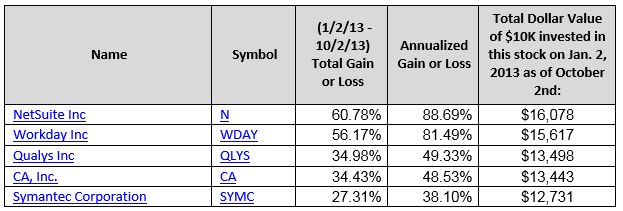
Twelve of the nineteen companies in the index delivered a positive return in the first three quarters of this year.  NetSuite (NYSE:N) leads all companies in the index with an annualized gain as of calendar Q3 of 88.69% and has a dollar value of $16,078 on $10,000 invested on January 2nd of this year.    Workday (NYSE:WDAY) attained an annualized gain of 81.49% as of Q3, and has a dollar value of $15,617 on $10,000 invested on January 2nd.  Qualys (NASDAQ: QLYS) attained an annualized gain of 49.33% and delivered $13,498 on $10,000 invested from January 2nd to October 2nd of this year.  The following table lists the top best performing cloud computing stocks in the index.

Best Performing 

high-performing-cloud-computing-stocks

Worst Performing

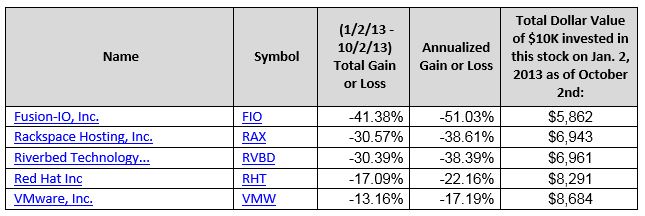
Seven of the nineteen companies in the index lost value, with Fusion-IO (NYSE:FIO) experiencing the greatest annualized loss in stock value of -51.03% and $10,000 invested on January 2nd of this year being worth $5,862 as of October 2nd.  Rackspace (NYSE:RAX) had an annualized loss of -38.61%, with $10,000 invested on January 2nd being worth $6,943 as of October 2nd.  The following table shows the five lowest-performing cloud computing stocks in the index.

low-performing-cloud-computing-stocks

The nineteen companies that comprise the Cloud Computing Stock Index attained a 19.41% return from October 3, 2012 to October 2, 2013.  In the same period Microsoft gained 13.98%, Oracle, 7.05% and SAP, 4.83%. Please click on the index to expand it for easier viewing.

CLOUD-INDEX-FOR-A-YEAR

Specifics on the Cloud Computing Stock Index

I used The Cloud Times 100 as the basis of the index, selecting nineteen companies all of which are publically traded.  The latest edition of the Cloud Computing Stock Index is shown here.  The filter applied to these companies is that 50% or more of their revenues are generated from cloud-based applications, infrastructure and services.  Please click on the index for easier viewing.

clous-computing-stock-index-October-2-20132-1024x351

Note: I do not hold equity positions or work for any of the companies mentioned in this blog post or included in the Cloud Computing Stock Index.  

451 Research Summit: Enterprises Competing With Digital Infrastructure & Cloud Computing

bellagio1Enterprises are defining their own cloud strategies, their own way, ignoring vendor hype and requiring metrics that reflect security (61%), mean-time-to-recover from outages (57%), number of data center outages (51%).

This and many insights were gained from attending the 451 Research Hosting and Cloud Transformation Summit at the Bellagio Resort & Casino in Las Vegas last week. 451 Research provided a free pass to the event but did not cover travel, hotel or meals.

What’s refreshing about 451 Group’s conferences is that each of their companies including 451 Research, Uptime Institute, and Yankee Group rely on solid methodologies to research their coverage areas and markets. This results in presentations that are packed with insight and are based on a solid foundation of interviews and research.  I had a chance to catch up with SoftLayer’s Lance CrosbySimon West and Andre Fuochi for an update on how the IBM acquisition is going, which is summarized in this post as well.  The slides shown are from Michelle Bailey, Vice President, Datacenter Initiatives and Digital Infrastructure’s excellent presentation given at the conference.

The following are the key take-aways from the summit:

  • Enterprises are defining their own cloud strategies, their own way, ignoring vendor hype and requiring metrics that reflect security (61%), mean-time-to-recover from outages (57%), number of data center outages (51%). When asked which metrics beyond Service Level Agreements (SLAs) service providers should report, respondents to the 451 Research survey provided the following insights, shown below:

  • The top three SaaS applications in two years will be for the enterprise, business support, and database platforms per 451 Research’s latest survey:

  • Infrastructure-as-a-Service (IaaS) growth is critical to off-premises hosting deployments succeeding in the next two years, as the following graphic illustrates:

  • 80%of enterprises would experience a severe impact to their operations if there was a cloud outage of just a day which make security and availability must-haves for any hosting and cloud services provider.  The following graphic breaks down the impact of service provider outage by time:
  • Worldwide Infrastructure-as-a-Service (IaaS) is projected to grow from $4.475B in 2013 to $10.23B in 2016, with Platform-as-a-Service (PaaS) growing from $2.23B in 2013 to $5.24B in 2016.  The following slide provides a breakout of forecast categories by hosting and cloud business categories:

Why Enterprises Need A Digital Infrastructure Playbook

The focal point of the summit was the launch of the digital infrastructure playbook.  Tony Bishop, Chief Strategy Officer, The 451 Group introduced the Digital Enterprise Playbook Series which you can download here. His presentation provided insights into how enterprises are struggling to align legacy IT, infrastructure including data centers, cloud, applications and system management to business goals while becoming more agile.

I had a chance to speak with Tony after his presentation and asked him why enterprises need a digital infrastructure playbook now.   “Digital transformation is breaking down the barriers to sustainable global prosperity by shifting power towards the individual,” he said. “This revolution will transform how enterprises create and deliver value. Digital enterprises will pursue and build dynamic infrastructure capabilities to innovate and differentiate customer experience, constantly empower employees and disseminate prescriptive knowledge across the enterprise.”

One of the most passionate and knowledgeable people I’ve ever met in infrastructure and IT research is Martin McCarthy, Chairman and CEO, The 451 Group.  He told me he’s seeing more pressure than ever for edge-to-core integration in the enterprise, which is forcing CIOs to be strategists over experts in cost reduction.  “Digital infrastructure will be the backbone enabling enterprise transformation in coming years. To blaze this trail, organizations need an ‘edge to core’ digital infrastructure playbook,” he said.   Presented below is a page from the Digital Enterprise Playbook Series:

The eight-striper wordmark of IBM, the letters...

IBM SoftLayer Update

  • IBM’s acquisition of SoftLayer is going excellently and many IBM divisions now are actively collaborating with the Softlayer team to migrate existing apps and develop new ones. Thank you Lance CrosbySimon West and Andre Fuochi for the update provided at the conference, it was invaluable.
  • Softlayer will be the foundation for a global cloud services infrastructure capable of delivering applications across multiple continents and thousands of users within hours, not days.  Lance Crosby explained the vision IBM has of delivering a continual stream of new applications and services over the global cloud services infrastructure network, which has the potential to turn into a high margin business quickly.
  • Softlayer is assisting with making the IBM Request for Proposal (RFP) more efficient based on their deep expertise in this critical area. Based on personal experience it can take anywhere from several weeks to up to several months for an RFP response.  SoftLayer has devised processes and systems that make RFP response times a fraction of that.
  • The majority of the top ten customers Softlayer has today are running large-scale clusters of Hadoop, with 40 Hadoop clusters being commonplace.  Lance Crosby mentioned these customers are very sophisticated in their use of Hadoop and many of them are in consumer products companies, looking to gain greater insights into customer behavior.
  • Bare metal servers running Hadoop are one of the fastest growing areas of the Softlayer business right now.  Simon West made an excellent point that running Hadoop on bare metal servers instead of through virtualized environment leads to a higher level of throughput, given Softlayer’s internal testing results.  Bare metal servers continue to accelerate in the industry and Softlayer’s executives confirmed they are seeing an acceleration of demand in this area.
  • An additional six data centers are planned for 2014, and SoftLayer has the capability to build one data center every two months of needed.  When asked what the global expansion plans are for SoftLayer since the acquisition, Lance Crosby told me London and Germany are of primary interest.  He also added that whenever the demand for a given nation reached between four and five thousand servers, Softlayer and IBM will consider building a data center in-country.

Predicting Enterprise Cloud Computing Growth

69% of enterprises who have separate budgets for cloud computing are predicting spending increases this year and into 2014.

This is one of several key take-aways from a research study published today by TheInfoPro, a service of 451 Research.  TheInfoPro Wave 5 Cloud Computing Study is based on research completed in the first six months of 2013, and relies on live interviews with IT management and primary decision-makers in midsize and large enterprises in Europe and North America. You can view details of TheInfoPro Cloud Computing Overview Program and methodology here.

Additional key take-aways from the study include the following:

  • The worldwide cloud computing market will grow at a 36% compound annual growth rate (CAGR) through 2016, reaching a market size of $19.5B by 2016.
  • 38% of enterprises surveyed break out cloud computing budgets, while 60% include cloud-related spending as part of their enterprise-wide IT budgets.  TheInfoPro asserts that cloud computing’s benefits of greater business orchestration and reduced time-to-market have led to a change in budgeting approaches.

cloud-computing-budget

  • Internal Private Cloud (35%), Cloud Provider Assessments/Strategy Planning (33%), Infrastructure-as-a-Service (IaaS) (31%) and Software-as-a-Service (30%) are the top four cloud computing-related projects enterprises are working on right now.  Cloud Provider Assessments/Strategy Planning have seen the largest increase, attributable to more enterprises looking to better support strategic plans with more agile, efficient IT organizations.

top-challenges-graphic2

deciphering-the-cloud-journey

cloud-related-pain-points