Skip to content

Posts tagged ‘IaaS Forecast’

Sizing the Data Center Services Market, 2012

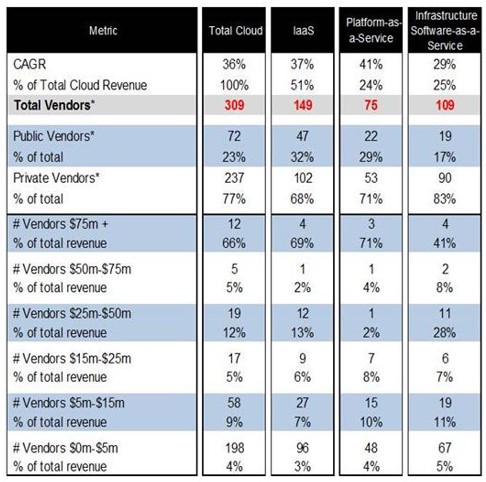
The Data Center Services (DCS) market is at a turning point today, with both Infrastructure-as-a-Service (IaaS) and Platform-as-a-Service (PaaS) strategies potentially playing a pivotal role.

Traditionally data centers generate the majority of their business from colocation, data center outsourcing, and hosting.  The current and future impact of IaaS and PaaS is small but growing rapidly in this market.  Gartner estimates the global DCS market generated $150B globally as of 2011, projected to grow to $200B in 2012.

IaaS and PaaS Will Define The Future of the DCS Market

With IaaS generating $4B in global revenues in 2011 and PaaS is generating $1.4B, together they contributed 3.6% of the total DCS revenues last year.  The future direction of the DCS market, including the nature and trajectory of IaaS and PaaS, will be determined over the next three to five years by enterprise adoption of these platforms and the increasing move of enterprise applications to the cloud.  In sizing the DCS market, it’s useful to take a look at the forecasts from Gartner of cloud application infrastructure and cloud applications as a proportion of enterprise application software.  The following tables provide this analysis.

Cloud Application Infrastructure, Cloud Systems Infrastructure as a Proportion of Core ITO and Traditional Web Hosting (Dollars in Billions)

Source: Forecast: Public Cloud Services, Worldwide and Regions, Industry Sectors, 2010-2015, 2011 Update

Cloud Applications as a Proportion of Enterprise Application Software (Dollars in Billions)

Source: Forecast: Public Cloud Services, Worldwide and Regions, Industry Sectors, 2010-2015, 2011 Update

Mapping the Data Center Services Market – A First Approach

Gartner has proposed a Data Center Services Map and Market Compass for Enterprise Data Center Services, both of which are shown below.  Taken as taxonomies for organizing the market, they are effective, resembling value chains in their structure.  The Garter Data Center Services Map is shown below:

The Gartner Data Center Services Map

Source: Data Center Services: Regional Differences in the Move Toward the Cloud, 2012

Gartner’s Market Compass for Enterprise Data Center Services takes into account size, scope and management of data center (DC) applications by the use of sharing, pricing models and elasticity (Time to Provision Change) to create a market grid.  These are considered to be the six most differentiating factors in DC performance in this model.  The foundation of the Market Compass are shown below:

Gartner’s Market Compass for Enterprise Data Center Services

Source:Data Center Outsourcing, Hosting or Cloud? Use Gartner’s Market Map and Compass to Decide

The Garter Market Compass can further be used to define which solution sets in the DCS market best align with a given business’ strategic and IT needs.  Elasticity of infrastructure utility and cloud computing are, according to the analysis, the strongest growth factors in the DCS market today.

Analyzing the Six Main Segments of the Data Center Services Market with the Gartner Market Compass

Source: Data Center Outsourcing, Hosting or Cloud? Use Gartner’s Market Map and Compass to Decide

Bottom line: As more enterprise applications migrate to the cloud, DCS providers will be forced to rapidly improve the elasticity and time provisioning options their platforms provide.  All these changes will re-order the economics of cloud computing forcing DCS providers to greater level of flexibility that many have attained in the past.

SaaS-based Analytics and Business Intelligence Market Update, August 2011

Challenging, uncertain economic times accelerate sales cycles and lead to more closed deals for business intelligence software providers.  Companies get an urgency to reduce costs and risks, relying on the insights gained from these applications.

There’s an interesting dichotomy starting to emerge in how experts and analysts define just how these markets will mature however.  Both agree that economic uncertainty are growth catalysts yet they diverge on adoption rates, roadblocks, and which analytics and BI technology will dominate in the years ahead.

This week I read Balancing Custom And Packaged Apps In Your Application Portfolio Strategy by George Lawrie, Mike Gilpin and Adam Knoll from Forrester and the latest Hype Cycle of Business Intelligence, 2011 by a collection of Gartner authors led by Andreas Bitterer.  I’ve summarized the key points of each below.

Forrester Sees SaaS Applications Overtaking Custom Application Development

Forrester sees SaaS-based applications starting to replace in-house custom application development, gathering momentum through 2013.  Gartner, with their Hype Cycle for Business Intelligence, 2011 just released this week, shows BI platforms having greater near-term benefit than SaaS-based analytics and BI.  Custom application development projects are going to face continued pressure to keep up with business requirements that SaaS applications are proving able to handle more effectively and economically than ever before.

In-house development makes more sense for specific analytics and reporting requirements,  yet will continually be eroded by SaaS-based applications that can meet most requirements at a lower cost.  Forrester has in the past said SaaS-based adoption of analytics applications in general and predictive applications specifically would be very slow due to data integration challenges.  This study points to a potential shift in their mindset, as the data shows SaaS-based analytics beginning to replace custom in-house developed applications.

Here are the key take-aways from the report:

  • Analytics processes are supported 79% of the time with custom application development.  Procure-to-pay (33%) and record-to-report (33%) are the second-most supported.  Multiple responses were allowed in the survey.
  • When asked which process areas they are automating with SaaS, analytics (33%), record-to-report (18%), order-to-cash  (15%), and purchase-to-pay (12%) were the most common responses.  There was a small sample size on the Forrester report and the most startling insight was how quickly respondent companies plan to migrate from custom application development to SaaS-based analytics and BI.
  • Nearly 50% of the respondents to the Forrester survey have between five and 19 SaaS-based applications today with 18% expecting to have 35 or more by 2013.  In addition 63% of respondents expect to deploy between five and 34 SaaS-based applications by 2013, a significant shift in just two years.
  • 36% of survey respondents say their  SaaS applications run completely standalone.  Another 36% mention they use a combination of on-premises Master Data Management (MDM) and process integration tools.  Ironically only 3% are deploying their applications on cloud-based MDM or process integration-based platforms.

Gartner’s Hype Cycle for Business Intelligence, 2011

Unlike the hype cycle for cloud computing, this hype cycle has fewer technology categories (25), a narrative firmly grounded in business process and strategy, and more practical and pragmatic insights versus just theoretical.  At 50 pages it’s  quick read and while there are many excellent points made, I have summarized the key take-aways pertaining to the highest hype points and SaaS adoption below:

  • Mobile Business Intelligence (BI) is the latest entry to the Hype Cycle for Business Intelligence based on the massive hype around analyzing locational and application data.  The hype surrounding the Apple iPad Series, Google Android and other tablet and smartphone platforms has made this one of the most hyped areas of the last year according to the analysis.
  • Consumerization, Decision Support, analysis of non-traditional data and “Big Data” are the areas of the greatest innovation today.  The hype cycle points to search, mobile, visualization and data discovery being the catalyst of Consumerization.  Predictive analytics, which is on the Slope of Enlightenment on this latest hype cycle, is critical to decision support.  The non-traditional and “Big Data” area of innovation is further supported by content, text analytics, in-memory DBMSs and columnar DBMSs.
  • SaaS-based Business Intelligence is at the apex of the Peak of Inflated Expectations yet will continue to have low adoption rates.  Gartner believes that the  lack of trust in third parties managing confidential data, and the inertia and fear many companies have in moving to a new architecture are slowing adoption.  This is in contrast to the survey Forrester released this week showing analytics being one of the most popular SaaS-based applications planned by 2013 in their base of respondents.
  • Gartner sees SaaS-based Business Intelligence of the most value to midsize and smaller organizations who lack IT staff yet have very specific, targeted information needs.  Website analytics, social media monitoring, dashboards, predictive analytics and Excel as a BI front-end all apply.  Both Forrester and Gartner agree on this point and see this type of custom development going away quickly internally.
  • There is a massive amount of hype surrounding in-memory computing, particularly from SAP at its Sapphire conferences .  Gartner believes that SAP’s vision of in-memory computing exceeds  in-memory analytics to include analytical and transactional processing.  As a result, In-Memory Database Management Systems are at the Peak of Inflated Expectations.


Source: Hype Cycle for Business Intelligence, 2011, Published 12 August 2011 | ID:G00216086 By Andreas Bitterer.  Gartner, Inc.

What Both Agree On

Forrester’s survey shows SaaS eventually replacing custom application development while Gartner’s Hype Cycle for Business Intelligence shows the practical, pragmatic technologies including dashboards, predictive analytics combined with the more complex Business Activity Monitoring (BAM), Business Intelligence Platforms, and Data-Mining Workbenches delivering the most value.  Despite these differences, both agree on the following:

  • The overall market for BI, Analytics and Performance Management continues to grow at between 8 to 12% per year depending on the forecast used.  The following forecast is from the report  Market Trends: Business Intelligence, Worldwide, 2011-2014, 7 June 2011 | ID:G00213483 by Dan Sommer and James Richardson.
Source: Market Trends: Business Intelligence, Worldwide, 2011-2014, 7 June 2011 | ID:G00213483 by Dan Sommer and James Richardson
  • 2011 continues to see large, strategic deals for analytics and BI closing more rapidly than they have in the past.
  • SaaS-based analytics and BI continues to gain a greater share of spending in midsize and smaller companies.  Both also agree that the proliferation of smaller SaaS-based analytics and Bi vendors concentrating on a specific niche have successfully displaced in-house custom development of competitive applications.  Trust in the smaller vendor, their track record, customer references and financial viability are what are winning deals for SaaS-based analytics and BI software providers today.
  • The market transition from build to buy is now in full force as budgets become available again.  This is key assumption of both analyses and means that smaller, more niche-oriented SaaS-based analytics and BI vendors stand a chance to get new reference accounts and grow, despite a challenging economy.

Predicting Cloud Computing Adoption Rates

From conservative, single digit adoption rates to hockey-stick projections of exceptional growth, analyst firms, venture capitalists and government ministries are weighing in on how they see cloud adoption progressing.

While each of the adoption rate predictions vary significantly in terms of their methodologies and results, all rely on the assumption that SaaS applications including CRM will continue to gain momentum.  The user adoption rates vary on how fast the momentum is, yet all share this assumption.  Speed, increased user adoption rates, and the ability to more closely align software to business goals are cited most often as the biggest benefits.

Where the projections vary most is whether enterprises will eventually migrate the majority of their applications to the cloud or not.  Forrester, Gartner and others see a hybrid cloud architecture emerging in the enterprise and forcing the issue of legacy systems migration by 2015.  As would be expected, vendor-driven research sees an “all or nothing” world in the near future.

Sanity Check

Wanting to see how reliable the figures were showing rapid cloud adoption in the enterprise, I did a quick sanity check.  Taking the  distribution of sales by segment for Salesforce.com and their annual revenue growth rate, then normalizing it across all segments, enterprise emerges as their strongest segment by a wide margin in 2015.  It had a 15%+ compound annual growth rate (CAGR) from 2011 – 2015 just taking their current sales by segment distribution of sales and extrapolating forward.  Data points like this and the market factors behind them is why SaaS is often used in these studies as a leading indicator of broader cloud adoption.

Adoption Rate Round-Up

  • Forrester found that SaaS will outgrow all other cloud services, achieving 37% adoption in 2011 growing to 50% by 2012.  In previous studies Forrester has shown that SaaS is a major growth catalyst of ongoing investment in IaaS and PaaS in enterprises. Source: Source:  Forrsights: The Software Market In Transformation, 2011 And Beyond Shifting Buying Preferences Lead To New Software Priorities by Holger Kisker, Ph.D. with Pascal Matzke, Stefan Ried, Ph.D., Miroslaw Lisserman  Link: http://bit.ly/ijJy70  The following table is from the report:

  • Microsoft Global SMB Cloud Adoption Study released in March, 2011 is one of the most comprehensive done this year on this topic. Of the many findings, the study predicts  39 % of SMBs expect to be paying for one or more cloud services within three years).  One of the best studies on cloud adoptions done this year Source: Study Results Document (PDF (22 pages): http://bit.ly/gN8yTx

  • North Bridge Venture Partners, GigaOM PRO and over a dozen research partners completed the study The Future of Cloud Computing 2011.  The study found 13% expressed high level of confidence in cloud computing for enterprise applications, with 40% experimenting and 10% saying they will never use cloud-based platforms as they are too risky. A presentation of the results can be found here:

Source: http://futureofcloudcomputing.drupalgardens.com/2011-future-cloud-computing-survey-results

  • Springboard Research (Forrester) completed a study of cloud computing adoption in Asia finding 31% of companies with 50 or fewer PCs will adopt cloud-based applications in 18 months, 56% with up to 500 PCs.  The key findings are available for download from the source URL below the infographic.

                                     Microsoft Asia is making this available for download here: http://bit.ly/jWjOj1

  • TechTarget published their analysis of virtualization and cloud computing adoption in the study, State of virtualization and cloud computing: 2011.  Of the many findings, a few of the most significant is how pervasive VMware ESXi 4 and later (vSphere) is throughout enterprises today.  The study also shows that 7% of those interviewed had implemented cloud computing in 2010, growing to 9% in 2011 – quite conservative compared to many of the other adoption rate analyses completed.  You can find the results here: http://searchdatacenter.techtarget.com/feature/State-of-virtualization-and-cloud-computing-2011
  • Yankee Group has found that in 2011, 41 percent of very large enterprises (more than 10,000 employees) have already deployed or are considering deployment of platform as a service (PaaS) within the next 12 months, compared to just 32 percent in 2010.  They have also found that mobility is most significant factor driving cloud adoption in the enterprise. Source: http://professional.wsj.com/article/TPCHWKNW0020110722e77q0004d.html

Roundup of Cloud Computing and Software-as-a-Service (SaaS) Forecasts, June 2011

The gap is beginning to close between the value SaaS-based applications have the potential to deliver and what customers are achieving.

While SaaS-based software vendors are making major strides in integration, reliability, system performance and usability, it is the enterprise buyer’s skepticism and high standards forcing the market to move forward.  The latest series of market forecasts and surveys reflect greater use of actual customer results and a quickening pace of progress.

Performance-Driven Cultures and SaaS Adoption

Measuring business outcomes using industry standard and company-specific metrics typifies companies getting the best results.  A lack of clarity or confusion around strategy based goals leads to low adoption and eventual abandonment of SaaS initiates.  Sales and sales operations VPs are winning the debates against home-grown or internal system development based on speed of deployment, usability and integrated analytics of SaaS applications.  Based on the surveys and research completed this year, the best SaaS implementations are designed on a firm foundation of measurable results including quantifying risk.

Performance-driven cultures have a higher success rate with SaaS pilots, are more thorough in defining their own infrastructure (IaaS) and platforms (PaaS), and also know what success looks like from a metrics-driven standpoint.   The graphic, Performance-Driven Culture: The Metrics Continuum, shown to the left, was originally published in Gartner’s Predicts 2011: Enterprise Architecture Shifting Focus to Business Value Outcomes Report, November, 11, 2010 Philip Allega, et.al supports this point.  Please click on the graphic to expand it for easier reading.

Hype is Prolonging the Peak of Inflated Expectations

The bottom line is all really matters is measurable, repeatable performance when enterprises evaluate their SaaS strategies.  Many marketing, sales, sales operations and service VPs must defend their choice of SaaS over legacy system upgrades or internal system development.  Resistance to change and complacency in IT is slowly killing many companies who must step up and keep pace with their customers to survive. People are betting their jobs on this technology.  Many in marketing, sales and service want to know how to improve and measure business strategy performance.  That’s one of the main inflexion points in SaaS marketing today.

 The reality for enterprise users is that nothing gets purchased, no matter how wonderful the claims, unless there are strong metrics that link them back to business performance.  That’s what is deflating hype in this market faster than any other factor.  You can download the Gartner Hype Cycle for Cloud Computing 2010 from the link (no opt-in).  Please click on the graphic to download the Gartner Hype Cycle for Cloud Computing 2010.

Here are short summaries of the latest cloud computing and SaaS forecasts published recently:

  • Gartner is forecasting enterprise-based spending for Software-as-a-Service (SaaS) applications  will grow at a 16.3% compound annual growth rate through 2015. SaaS will grow at nearly double the pace of licensed enterprise applications during the forecast period.  Licensed applications will grow at a n 8.5% CAGR during the same period. The following  table, Total Software Revenue Forecast for SaaS Delivery Within the Enterprise Application Software Markets, 2007-2015 (Millions of U.S. Dollars) compares enterprise software spending by application category for the forecast period. Source: http://my.gartner.com/portal/server.pt?open=512&objID=260&mode=2&PageID=3460702&id=1728009&ref=

     Total Software Revenue Forecast for SaaS Delivery Within the Enterprise Application Software Markets, 2007-2015  (Millions of U.S. Dollars) 


  • The Asia-Pacific (APAC) Software as a Service (SaaS) market is expected to grow from $390M in 2008 to $4.3B in 2015, at an estimated CAGR of 41.0% from 2008 to 2015. The appeal and reach of software as a service (SaaS) continue to grow rapidly among enterprises in Asia Pacific. Australia & New Zealand (ANZ) is the largest regional SaaS market in Asia Pacific. SAAS is gaining momentum in ANZ because of the markets resemblance to the North American market with better broadband penetration, availability of applications getting delivered in SaaS mode and overall greater adoption of IT in general. Source: http://professional.wsj.com/article/TPMTPW000020110214e72e002k2.html
  • Cloud middleware systems markets at $1.5B in 2010 are forecast to reach $4.3B, worldwide by 2017.  Cloud computing middleware represents the base for development of all cloud computing infrastructure as it supports systems integration and systems self-provisioning.  Market leaders are predicted to be Akamai, IBM, Google, Microsoft, and Oracle. Source: http://wintergreenresearch.com/
  • Infonetics Research forecasts the overall managed security services market, including CPE, SaaS, and cloud services, to reach just under $17B by 2015.  SaaS and cloud-based security services are expected to make up close to half of the overall managed security services market opportunity by 2015 Worldwide SaaS revenue is forecast to grow dramatically over the next few years, with a compound annual growth rate (CAGR) of 23% from 2010 to 2015.  Source: WSJ Journal 
  • Cloud service adoption is up 61% from 2010 and 45% of multinational corporations (MNCs) already use cloud sourcing for at least some elements of key IT services.  Cable & Wireless and Ovum partnered to create this white paper, full of excellent insights and research data: http://www.cw.com/assets/content/pdfs/resource/ovum-cloud-wp.pdf
  • 60 percent of companies worldwide said cloud computing is a top IT priority for the next year, the sentiment is even higher in the C-suite with three in four (75 percent) C-level executives reporting cloud computing as top of mind.  According to an Avanade Research and Insights’ Global Survey: Has Cloud Computing Matured? Third Annual Report, June 2011, there is also significant purchasing of cloud services without the IT department’s knowledge, with nearly 20% of all purchases never reviewed with the CIO. Source: Avanade Research Report  
  • By 2014, cloud computing services will grow to a $45B industry a year (IDC) and SaaS to grow at 21% CAGR to touch $17.6B.  Microsoft recently published the following presentation, Grow Your Business with Cloud – Are You Ready?  You can download a copy of the presentation by clicking on the presentation to the right.
  • The global cloud computing market is expected to grow from $37.8B in 2010 to $121.1 B in 2015 at a  CAGR of 26.2% from 2010 to 2015 according to Yankee Group. SaaS is the largest segment of the cloud computing services market, accounting  as it did for 73% of the market’s revenues in 2010. The IaaS and PaaS markets are still at a nascent stage and  currently hold a small share of the Cloud computing services market. However, these are expected to witness  moderate growth due to their flexibility and cost effectiveness.Source: CSS Corp. Analysis.
  • Project and Portfolio Management (PPM) software emerged in 2009 as a fast-growing market for SaaS, with a compound annual growth rate (CAGR) of more than 40% projected for the next five years according to Gartner. PPM software consumption environments are changing radically, with hosted and SaaS options — as a result, most traditional on-premises vendors are forced to provide SaaS alternatives to counter new entrants and SaaS-only PPM vendors.  Source:  Competitive Landscape: SaaS Project and Portfolio Management Software, Worldwide, 2011 published 6 April 2011.

Sizing the Public Cloud Computing Market

Forecasting the global public cloud market is growing from $25.5B in 2011 to $159.3B in 2020 in the report Sizing the Cloud, Understanding And Quantifying the Future of Cloud Computing  (April, 2011), Forrester Research has taken on the ambitious task of forecasting each subsegment of their cloud taxonomy.   Forrester defines the public cloud as IT resources that are delivered as services via the public Internet in a standardized, self-service and pay-per-use way.   The aggregate results of their forecasts are shown in the attached graphic.

The forecast range is from 2008 to 2020 and I’ve included several of the highlights from the study below:

  • Forrester breaks out Business Process-as-a-Service (BPaaS) in their public cloud taxonomy, not aggregating this area of cloud computing into IaaS or PaaS.  This is unique as other research firms have not broken out this component in their cloud market taxonomies, choosing to include Business Process Management (BPM) as part of either infrastructure-as-a-service (IaaS) or platform-as-a-service (PaaS) subsegments.  Forrester is predicting this category will grow from $800M in 2012 to $10.02B in 2020.
  • SaaS is quickly becoming a catalyst of PaaS and IaaS growth, growing from $33B in 2012 to $132.5B in 2020, representing 26% of the total packaged software market by 2016.  Forrester is predicting that SaaS will also be the primary innovative force in public cloud adoption, creating applications that can be tailored at the user level.  Forrester is bullish on public cloud growth overall, and their optimistic outlook can be attributed to the assumption of cloud-based applications being configurable at the user level, with little to no enterprise-wide customization required.
  • PaaS is forecasted to grow from $2.08B in 2012 to $11.91B in 2020.  Forrester is defining PaaS as a complete preintegrated platform used for the development and operations of general purpose business applications.  The research firm sees the primary growth catalyst of PaaS being corporate application development beginning this year.  By the end of the forecast period, 2020, up to 15% of all corporate application development will be on this platform according to the report findings.
  • IaaS will experience rapid commoditization during the forecast period, declining after 2014.  Forrester reports that this is the second-largest public cloud subsegment today globally, valued at $2.9B, projected to grow to $5.85B by 2015.  After that point in the forecast, Forester predicts consolidation and commoditization in the market, leading to a forecast of $4.7B in 2020.
Follow

Get every new post delivered to your Inbox.

Join 100 other followers