Skip to content

Posts tagged ‘enterprise software’

Citrix Sees Strong Cloud Sales Growth, Snaps Up Reuven Cohen As Chief Cloud Advocate

saas-200x300Citrix (NASDAQ: CTXS) continues to successfully launch and manage products in the areas of cloud, desktop, mobile and networking, reporting net revenue of $730M for their latest quarter (Q2, 2013), up 19% from Q2, 2012.  Product license revenue is up 21% from Q2, 2012 to $227M for the latest quarter as well.  In the interest of full disclosure, I have never held a position in Citrix stock and do not today, and they have never been a client.

The following table is from their 2Q13 Financial Results presentation:

Managing Multiple Businesses And Making It Look Easy

Citrix continues to be a fascinating company to watch as it successfully competes across a broad range of businesses.  Cloud management, mobility and desktop management platforms, online collaboration, networking and security, and server virtualization are all revenue-generating businesses in the company today.

And while the majority of acquisitions in enterprise software struggle to deliver revenue or even fail, Citrix has been able to bolster is collaboration, enterprise mobility and telecom and networking businesses with solid additions.  Acquiring Zenprise in December, 2012 to bolster its mobile device management (MDM) strategy has led to increased sales, as has the acquisition of Podio in April of last year to augment its Online Services Division (OSD).  In June of last year Citrix also acquired ByteMobile, which gives the company entry into the telecom/carrier market.

At Citrix Synergy 2013 held May 22 – 24 of this year in Anaheim, California the company hosted the Citrix Financial Analyst Track.  You can download the presentation from this track here.  This presentation shows how challenging it can be to manage a business with multiple revenue streams across a broad base of technologies.  The following slide taken from the Citrix Financial Analyst Track illustrates just how quickly Citrix is growing and how mobile & desktop, SaaS and networking & cloud are contributing to their growth.

The addressable market opportunity for Citrix given the breadth of their product strategies is reflected in this slide, also from the Citrix Financial Analyst track:

Why Citrix Snapped Up Reuven Cohen

With so much growth potential in their cloud-based businesses, Citrix needed a seasoned veteran from the cloud computing industry who had both developed and managed new cloud platforms, products and services to the stack level.

They chose Reuven Cohen as their first-ever Chief Cloud Advocate based on his entrepreneurial expertise in Infrastructure-as-a-Service (IaaS) including being the founder and CEO of Enomaly which was sold to Virtustream in 2012. He is also actively involved in the National Institute of Standards Technology (NIST) cloud definition, and is a GSA Cloud IaaS BPA awardee, presented Great Britain’s G-Cloud initiative to the Parliament, and is an active delegate in the Sino-EU America Cooperation Workgroup.

He is responsible for leading Citrix’s cloud advocacy efforts with a specific focus on increasing the volume, reach and influence of Citrix’s extensive portfolio of cloud solutions used by more than 260,000 customers and 100 million end users across the globe.  He’ll also be responsible for increasing the adoption of several Open Source initiatives at Citrix as well.   Here are a few of the current Citrix open source projects now underway:

Apache CloudStack, an open source software designed to deploy and manage large networks of virtual machines, as a highly available, highly scalable Infrastructure as a Service (IaaS) cloud computing platform.

OpenDaylight, a community-led, open, industry-supported framework, for accelerating adoption, fostering new innovation, reducing risk and creating a more transparent approach to Software-Defined Networking.

The Xen Project, the home for various virtualization technologies powering the world’s largest clouds in production and is the foundation of many commercial products.

XenServer, an open source project and community managed by Citrix. The project develops open source software for securely running multiple operating systems and applications on a single device, enabling hardware consolidation and automation to reduce costs and simplify IT management of servers and applications.

Congratulations to Reuven on being named Chief Cloud Advocate at Citrix, I am sure he’ll accomplish much in his new role.

Best- And Worst-Performing Cloud Computing Stocks In The First Half Of 2013

Cloud computing stocks continue to show wide variation in performance throughout the first half of this year.

Ten of the twenty companies in the Cloud Computing Stock Index delivered returns to shareholders with NetSuite leading with a 37.30% share gain, delivering $13,730 on $10,000 invested on January 2, 2013.

To more fully define the stock performance of these companies, I’ve added Earnings Per Share (EPS), Price/Earnings Ratio, Year-To-Date (YTD) Total Gains or Loss, Annualized Gain or Loss, and Total Dollar Value of $10,000 invested on January 2, 2013.  You can download the latest version of the Cloud Computing Stock Index here.  The filter applied to these companies is that 50% or more of their revenues are generated from cloud-based applications, infrastructure and services.  Additional details of the index are provided at the end of this post.


Best Performing

Name

Symbol

(1/2/13 – 7/5/13)Total Gain or Loss

Annualized Gain or Loss

Total Dollar Value of $10K invested in this stock on Jan. 2, 2013 as of July 5th:

NetSuite Inc

N

37.30%

87.55%

$13,730.00

Keynote Systems, Inc.

KEYN

36.18%

84.53%

$13,618.00

CA, Inc.

CA

26.67%

59.83%

$12,667.00

Workday Inc

WDAY

23.81%

52.77%

$12,381.00

Cisco Systems, Inc.

CSCO

22.60%

49.82%

$12,260.00

Symantec Corporation

SYMC

18.84%

40.84%

$11,884.00

Amazon.com, Inc.

AMZN

11.10%

23.23%

$11,110.00


Worst Performing

Name

Symbol

(1/2/13 – 7/5/13)Total Gain or Loss

Annualized Gain or Loss

Total Dollar Value of $10K invested in this stock on Jan. 2, 2013 as of July 5th:

Rackspace Hosting, Inc.

RAX

-46.78%

-71.39%

$5,322.00

Fusion-IO, Inc.

FIO

-41.21%

-65.13%

$5,879.00

F5 Networks, Inc.

FFIV

-31.57%

-52.88%

$6,843.00

VMware, Inc.

VMW

-29.94%

-50.63%

$7,006.00

Riverbed Technology…

RVBD

-24.91%

-43.34%

$7,509.00

Red Hat, Inc.

RHT

-11.47%

-21.46%

$8,853.00

Key Take-Aways:

  • NetSuite leads the index with a 37.3% gain in their stock price, and $10K invested in their stock on January 2nd of this year would be worth $13,730 as of July 5thCloud-based Enterprise Resource Planning (ERP) systems acceptance is accelerating, evidenced by the success NetSuite is having with their two-tier ERP strategy and recent announcement they are moving into manufacturing.  Their recent alliance with Oracle also shows upside potential.   A cloud-based ERP provider leading the index is good news for Acumatica and Plex Systems especially, the leader in cloud-based ERP systems for manufacturing and one of the most enthusiastic customer bases in enterprise software.  Both of these companies are privately held or they would have been included in the index.
  • The 20 companies that comprise the Cloud Computing Stock Index attained a 29.6% return from July 10, 2012 to July 5, 2013.  The Dow Jones Industrial Average (DJIA) gained 18.83%;  Microsoft, 14.02%; Oracle, 7.17%; and SAP, 27.51%.  The following chart compares the performance of each. Please click on the index to expand it for easier viewing.

  • Widespread adoption of Amazon Web Services, success using the Kindle series of tablets as customer acquisition tools for digital content, market leadership of the online retail landscape, and successful pilots of the AmazonFresh online grocery business in Los Angeles and Seattle are all fueling Amazon’s stock performance this year.

Specifics on the Cloud Computing Stock Index

I used The Cloud Times 100 as the basis of the index, and included the 20 following companies, all of which are publically traded.  The latest edition of the Cloud Computing Stock Index is shown here.  Please click on the index to expand it for easier viewing.

 Note: I do not hold equity positions or work for any of the companies mentioned in this blog post or included in the Cloud Computing Stock Index.  

21 Most Admired Companies Making IT A Competitive Advantage

time-and-IT-competitive-advantage1-300x215All enterprises, regardless of what they produce or the services they deliver, are really information businesses.

The accuracy, speed and precision of IT systems means the difference between winning or losing customers, keeping supply chains profitable, and solidly translating new concepts into revenue-producing products and services.  The world’s best-run services businesses have customer-driven IT as part of their DNA; it is very much who these companies are internally.

In the recently published Garter report CEO and Senior Executive Survey 2013: 21 Top Companies Admired for Competitive IT  completed between October and December, 2012, which was part of the 2013 CEO and Senior Business Executive Survey, C-level respondents were asked to name the companies they most admired in terms of their ability to apply IT-related business capabilities for competitive advantage.   Respondents were also asked to limit their responses only to their own and related industries.

391 respondents participated in the survey with 147 being CEOs, 149, CFOs; 49, COOs; and 46 being board members including Chairman of the board and president.  Geographic distribution included 152 respondents from North America; 124 from Europe; 78 from Asia/Pacific; 20 from Brazil; 12 from South Africa; and 5 from the Middle East with minimum company size being $250M in annual sales or above.

The following is the list of the world’s most admired companies using IT for competitive advantage.

Most Admired Companies Making IT A Competitive Advantage

Accenture
Amazon
Apple
Cleveland Clinic
General Electric
Goldman Sachs
Google
Hospital Corporation of America
IBM
Intermountain Healthcare
JP Morgan Chase
Kaiser Permanente
Mayo Clinic
Microsoft
Nestle
Proctor & Gamble
Progressive Insurance
Schlumberger
Target
Toyota
Wells Fargo

Key Take-Aways

  • Customer-driven IT is the single most admired trait of all 21 companies in the list.  Associated with this attribute is the proven ability of these enterprises to manage complex e-commerce systems & platforms, support multichannel management, in addition to continually show the ability to innovate quickly.
  • Enterprises need to consider how the business successes their investments in  IT are enabling can be used for branding and recruitment.   Providing benchmark performance data and stories of how IT helped create entirely new markets and solve customer problems needs to be used for recruiting.  Many of the 21 companies mentioned are doing this, using success stories as a catalyst for driving recruitment efforts for analytics, cloud computing and systems integration experts.
  • Dont underestimate the disruptive power of cloud computing and mobility to completely re-order enterprise systems quickly.  Gartner mentions that there are enterprises whose IT organizations would have made the list had they not slowed down.  While not directly stated, Gartner warns IT departments to not become complacent over time.  From personal experience working in IT departments however, it is clear that complacency is a leading career hazard.  It’s imperative for CIOs to keep challenging their organizations to stay intensely focused on new developments, seeking out how they can be used to strengthen business strategies.
  • Four of the top five factors that most impressed respondents about the admired companies are customer-related.  Customer-facing IT (15%); followed by an integrated/standardized/unified IT organization and process framework (13%); exceptional use of CRM (11%); customer-centered innovation (9%);  and product design & offerings (9%) are the most mentioned attributes of the highest-performing companies. Multiple responses were allowed to this area of the survey.  The following graphic provides an analysis of which factors most impressed the C-level executives who were respondents to the survey.

What Impressed Business Leaders Most

Plex Systems’ CEO Jason Blessing on the Future of ERP and Software-as-a-Service (SaaS)

Jason Blessing med HS
Last week Plex Systems, a leading provider of SaaS-based Enterprise Resource Planning (ERP) systems announced enterprise software veteran Jason Blessing has joined their company as CEO.   He is responsible for the strategic direction and growth of the company, and has a proven track record in many facets of enterprise software, from new application development to professional services.  His extensive experience includes previous executive positions at Oracle, Taleo, PeopleSoft and Price Waterhouse.  You can find his LinkedIn profile here.

Plex Systems’ success delivering ERP entirely on the SaaS platform to manufacturers have many industry analysts, experts and pundits saying their unique business model is prescient of the future of enterprise software.  Originally designed for an automotive parts manufacturer, Plex Online is being adopted by aerospace and defense, food and beverage, high tech and electronics, industrial machinery, and precision metal manufacturers.  You can find an overview of Plex Systems here.

I recently had a chance to speak with Jason and get his views on the future of ERP, SaaS in manufacturing and the enterprise, and what he sees as the greatest challenges and opportunities for Plex Systems.

Here’s a transcript of my interview with Jason Blessing, the new CEO of Plex Systems:

What are the three biggest challenges you see to Plex Systems’ growth over the long-term and how will you and the management team address them?

Our greatest challenge is awareness of who Plex Systems is and the value we are delivering to our manufacturing customers today. We’re already putting together programs that will highlight the very meaningful customer base we have and what they are able to accomplish using Plex Online.  Second, we’re going to continue making significant product investments.  Our owners are growth-minded and we’re looking to create a beachheads in additional areas to compliment our heritage in auto manufacturing.  Third, we’re going to expand our sales and marketing investments to provide better coverage domestically and in Europe and Asia. We’re also on a mission to lead the resurgence of manufacturing in America by giving small and mid-sized companies the systems they need to be formidable global competitors. 

SaaS-based applications have proved themselves in the enterprise.  How and why are manufacturers adopting SaaS-based ERP systems today?  How is this going to change in the future?

Credit has to go to Taleo and Salesforce for proving SaaS can succeed at the departmental level in the enterprise.  We’re finding that the combination of financials and Manufacturing Execution Systems (MES) delivered in the cloud is very well-suited for small and medium manufacturers.  These manufacturers often don’t have a large Information Technologies (IT) staff and want to offload these systems so they can stay focused on their core business.  In this sense we free up these smaller manufacturers to get back to work running their businesses without having to hassle with large, complex and costly ERP deployments. 

Will SaaS-based ERP systems cannibalize monolithic ERP systems or coexist and compliment them?  Or are you seeing a mix of both cannibalization and coexistence?  For Plex Systems, what’s the best direction?

We do see customer that adopt parts of our solution, quality for example, to test the cloud model before going wall to wall Plex.   Another approach we see is customers who have global operations bring foreign factories online quicker than they had in the past as a result of SaaS.  The end result will be the cannibalization of monolithic ERP systems by those that are SaaS-based.

One of the implicit factors in this area of cannibalization is the typical release cadence of a SaaS provider.  Most large cloud providers have, on average, 3 releases a year.  Here at Plex Systems we’re on a continuous release cadence.  When a customer asks for a feature enhancement or entirely new set of functions, we strive to be very responsive with our release cycles and deliver what is needed.  

Plex Systems has done well in several key manufacturing industries including automotive, A&D, electronics, food and beverage, and medical devices.  Do you see Plex Systems moving into additional industries, and if so, which ones?  Pharmaceutical and biotech for example.

We’re going to be fairly disciplined in our approach within the verticals we’re already selling into.  We’re seeing increasing interest in moving core shop floor applications to the cloud for example, and we’re going to expand out our coverage in our core vertical markets as a result.      

With the majority of sales in the United States, does Plex Systems have plans for Europe and Asia?  What’s your perspective of those markets for SaaS-based ERP system sales? 

We’re growing at an approximately compound annual growth rate of 30%+ per year, the majority of that growth coming from North America today.  We’re also seeing strong interest from EMEA, South America and Asia.  What’s driving our foreign market demand is the need manufacturers have for quickly getting production centers up and running on financials, MES and Supply Chain Management Systems (SCM).  We also run our own data centers and have hot standby and back facilities supporting our worldwide customer base.

Two-tier ERP delivers significant business value and is growing in adoption. How will Plex Systems capitalize on this trend and what are the implications for the application development priorities?

Were delivering two-tier ERP implementations today and one of the largest heavy equipment manufacturers in the world uses Plex Online to run their shop floor operations at several manufacturing centers.  Their main ERP system is an SAP R/3 instance, and we integrate to that and help this manufacturer be more efficient at the individual plant and shop floor level.   

Plex_ColorLast year Plex Systems announced IntelliPlex, SmartPlex, in addition to several other significant new services and partnerships.  Of these, IntelliPlex has the potential to deliver analytics and business intelligence to manufacturers who may have never had these metrics available before.  How do you see analytics in manufacturing improving this year, and how will this augment Plex Online’s analytics strategy going forward?

Much of our success as a provider of SaaS-based ERP systems is due to the breadth of applications that span from the shop floor to the top floor. We’re seeing analytics resonate really well with the people who write us the checks, the top floor executives and their teams responsible for the getting the highest performance from manufacturing operations.  We’re going to augment our analytics this year, supporting mobile devices.  We’ve also been doing data mining of production data across the worldwide Plex Systems customer base and see the potential to create an index of manufacturing performance. We’re going to look at how this data will be able to help our customers predict economic conditions in their specific manufacturing industries. 

There are a myriad of studies out on the impact of mobile technologies on manufacturing.  Last year, Plex Systems introduced SmartPlex Mobile, which gives ERP users access to data on iOS and Android devices.  Can you discuss the challenges of mobile adoption in manufacturing and how Plex Systems will address them?

Often mobile technologies installed and used on the factory floor are proprietary to the systems and workflows for that specific factory.  They are fine-tuned to the specific workflows on the factory floor, and the proprietary nature of their electronics only work with the systems they are designed for and Plex Online supports many of these devices.  Material handling, RFID and other logistics projects are based on these kinds of technologies.

We’ve also found that senior management teams want to get as close to real-time data as possible on each phase of manufacturing operations.  SmartPlex Mobile is designed to give senior management teams visibility into operations on Android and iOS devices, and continues to gain interest from existing and new customers alike.

Many manufacturers are dealing with “brain drain” or the retiring and churn of their long-time manufacturing, process control, and quality management professionals.  How do you see Plex Systems helping these manufacturers to retain that tacit knowledge in their organizations over their long-term?

We talk quite often about this with our prospects, customers and internally in our development meetings.  Prospects are especially interested in how to solve this problem as tribal knowledge is often the most difficult to capture and re-use.  It’s common to find manufacturers with a myriad of Microsoft Access databases, legacy systems and data locked on spreadsheets. Our architecture is based on a Master Data Management (MDM) model with gives manufacturers a single source or version of the truth.  Using our experience implementing these systems in small and medium-sized manufacturers, we’ve found methods and techniques for managing corporate-wide data effectively.

Visualization in manufacturing including the extensive use of 2D and 3D CAD drawings is also accelerating.   What are your thoughts on the future of visualization in manufacturing, and more specifically, which key process areas do you see Plex Systems addressing with its visualization strategy?

This area is critically important for the shop floor as it can drive higher levels of production quality quickly. We’re going to continue to invest in this area, and our Actify partnership gives us a strong foundation to build on in this area.  The partnership with Actify allows us to embed engineering drawings directly in Plex, allowing shop floor workers to look up specifications on the fly to ensure high levels of quality.  The drawings are highly valuable because they are contextualized in Plex (e.g., tied to the product in question) and don’t require any expensive CAD equipment or training to view.

Plex Systems has also built a strong foundation of partners including system integrators and resellers.  Do you anticipate Plex Systems will increasingly rely on resellers or stay with primarily a direct sales strategy?  

It’s very important to high fidelity relationships with customers when you’re selling SaaS-based enterprise software so the direct model is important to us.   That said, partners are also very important to us because of the value they can bring to customers and the added reach they can provide us.  So, we’ve been successful in creating a partner program, which has a rigorous certification process that ensures those we partner with have strong domain expertise to serve our shared customers.  Partners can quickly become a force multiplier for us, and we’re working towards that goal by keeping direct sales in balance.   

Disclaimer: This interview was done independent of Plex Systems. I have not and have never been a paid consultant of the company.  I approached them to do this interview based on insights gained from WordPress analytics showing readers’ interest in ERP, SaaS and enterprise software.

Cloud Computing and Enterprise Software Forecast Update, 2012

The latest round of cloud computing and enterprise software forecasts reflect the growing influence of analytics, legacy systems integration, mobility and security on IT buyer’s decisions.

Bain & Company and Gartner have moved beyond aggregate forecasts, and are beginning to forecast by cloud and SaaS adoption stage.  SAP is using the Bain adoption model in their vertical market presentations today.

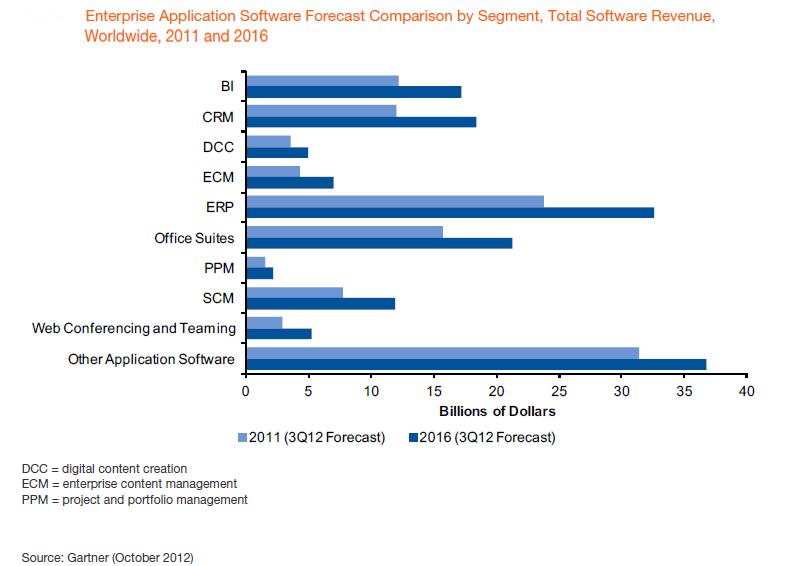
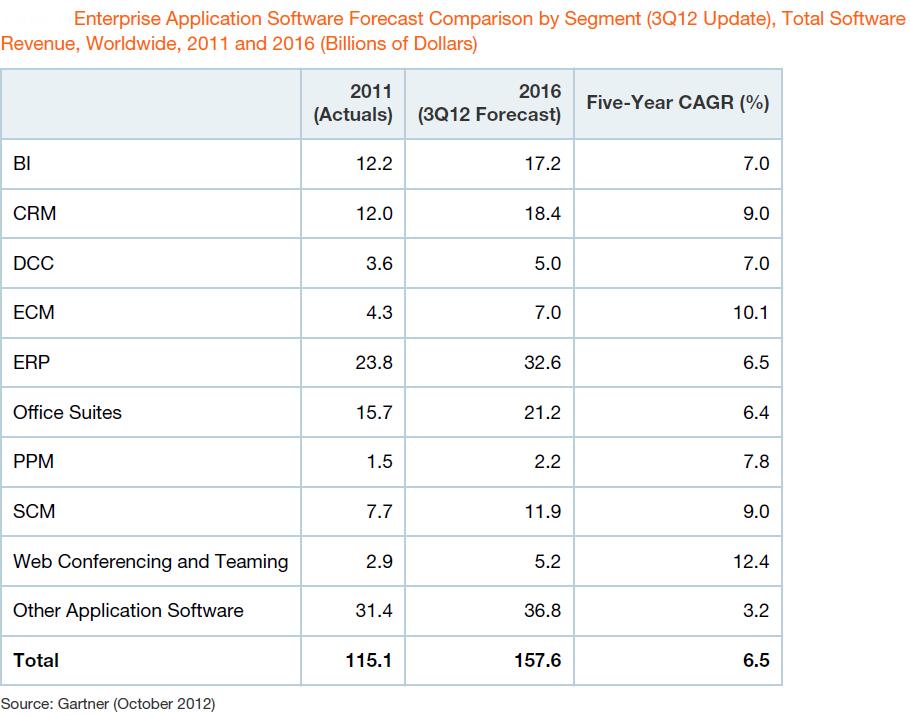
Despite the predictions of the demise of enterprise software, forecasts and sales cycles I’ve been involved with indicate market growth.  Mobility and cloud computing are the catalysts of rejuvenation in many enterprise application areas, and are accelerating sales cycles.  Presented in this roundup are market sizes, forecasts and compound annual growth rates (CAGRS) for ten enterprise software segments.

Key take-aways from the latest cloud computing and enterprise software forecasts are provided below:

  • Public and private cloud computing will be strong catalysts of server growth through 2015.  IDC reports that $5.2B in worldwide server revenue was generated in 2011 or 885,000 units sold.  IDC is forecasting a $9.4B global market by 2015, resulting in 1.8 million servers sold. Source:  IDC Worldwide Enterprise Server Cloud Computing 2011–2015 http://www.idc.com/getdoc.jsp?containerId=228916 
  • 11% of companies are transformational, early adopters of cloud computing, attaining 44% adoption (as defined by % of MIPS) in 2010, growing to 49% in 2013.  This same segment will reduce their reliance on traditional, on-premise software from 34% to 30% in the same period according to Bain & Company’s cloud computing survey results shown below.  SAP is using this adopter-based model in their vertical market presentations, an example of which is shown here.

  • The global Platform-as-a-Service (PaaS) market is growing from $900M in 2011 to $2.9B in 2016, achieving a 26.6% CAGR.  At this projected rate, PaaS will generate an average of $360M a year in revenue between 2011 and 2016.  Gartner projects that the largest segments will be Application Platform Services (aPaaS) which generated 35% of total PaaS spending in 2011, followed by cloud application lifecycle services (12.5).    Source: Market Trends: Platform as a Service, Worldwide, 2012-2016, 2H12 Update Published: 5 October 2012 ID:G00239236.

  • The three most popular net-new SaaS solutions deployed are CRM (49%), Enterprise Content Management (ECM) (37%) and Digital Content Creation (35%).  The three most-replaced on-premise applications are Supply Chain Management (SCM) (35%), Web Conferencing, teaming platforms and social software suites (34%) and Project & Portfolio Management (PPM (33%). The following graphic shows the full distribution of responses. Source: User Survey Analysis: Using Cloud Services for Mission-Critical Applications Published: 28 September 2012

Using Search Analytics To See Into Gartner’s $232B Big Data Forecast

By combining search analytics and the latest Gartner forecast on big data published last week, it’s possible to get a glimpse into this areas’ highest growth industry sectors.  Big data is consistently a leading search term on Gartner.com, which is the basis of the twelve months of data used for the analysis.

In addition, data from Gartner’s latest report, Big Data Drives Rapid Changes in Infrastructure and $232 Billion in IT Spending Through 2016 by Mark A. Beyer, John-David Lovelock, Dan Sommer, and Merv Adrian is also used.  These authors have done a great job of explaining how big data is rapidly emerging as a market force, not just a single market unto itself.  This distinction pervades their analysis and the following table showing Total IT Spending Driven by Big Data reflects the composite market approach.  Use cases from enterprise software spending, storage management, IT services, social media and search forecasts are the basis of the Enterprise Software Spending for Specified Sub-Markets Forecast.  Social Media Analytics are the basis of the Social Media Revenue Worldwide forecast.

Additional Take-Aways

  • Enterprise software spending for specified sub-markets will attain a 16.65% compound annual growth rate (CAGR) in revenue from 2011 to 2016.
  • Attaining a 96.77% CAGR from 2011 through 2016, Social Media Revenue Is one of the primary use case catalysts of this latest forecast.
  • Big Data IT Services Spending will attain a 10.20% CAGR from 2011 to 2016.
  • $29B will be spent on big data throughout 2012 by IT departments.  Of this figure, $5.5B will be for software sales and the balance for IT services.
  • Gartner is projecting a 45% per year average growth rate for social media, social network analysis and content analysis from 2011 to 2016.
  • Gartner projects a 20 times ratio of IT Services to Software in the short term, dropping as this market matures and more expertise is available.
  • Organizations are already replacing early implementations of big data solutions – and Gartner is projecting this will continue through 2020.
  • By 2016 spending on Application Infrastructure and Middleware becomes one of the most dominant for big data in Enterprise Software-Specified Sub Markets.

  • $232B is projected to be sold in total across all categories in the forecast from 2011 to 2016. From $24.4B in 2011 to $43.7B in 2016, this presents a 12.42% CAGR in total market growth.

Search Analytics and Big Data

Big data is continually one of the top terms search on Gartner.com, and over the last twelve months, this trend has accelerated.  The following time series graph shows the weekly number of inquiries Gartner clients have made, with the red line being the logarithmic trend.

Banking (25%), Services (15%) and Manufacturing (15%) are the three most active industries in making inquiries about big data to Gartner over the last twelve months.  The majority of these are large organizations (63%) located in North America (59%) and Europe (19%).

What unifies all of these industries from a big data standpoint is how critical the stability of their customer relationships are to their business models.  Banks have become famous for bad service and according to the American Customer Satisfaction Index (ACSI) have shown anemic growth in customer satisfaction in the latest period measured, 2010 to 2011.  The potential for using big data to becoming more attuned to customer expectations and deliver more effective customer experiences in this and all services industries shows great upside.

Bottom line: Companies struggling with flat or dropping rankings on the ACSI need to consider big data strategies based on structured and unstructured customer data.  In adopting this strategy the potential exists to drastically improve customer satisfaction, loyalty, and ultimately profits.