Skip to content

Posts tagged ‘Enterprise Resource Planning’

2013 ERP Prediction: The Customer Takes Control

From the obvious to the outrageous, enterprise software predictions often span a wide spectrum at the beginning of every year.

In enterprise software in general and ERP specifically, there are many safe harbors to dock predictions in, from broad industry consolidation to Oracle buying more companies.  Or the inexorable advances of cloud computing and SaaS platforms in ERP today, which is often cited in enterprise software predictions.

Too often predictions gravitate too much towards theoretical economics, overly-simplified industry dynamics and technologies, leaving out the most critical element: customers as people, not just transactions.  So instead of repeating what many other industry analysts, observers and pundits have said, I am predicting only the customer side of ERP advances in the next twelve months.

The following are my predictions for ERP systems and enterprise computing in 2013:

  • The accelerating, chaotic pace of change driven by customers will force the majority of Fortune 500 companies to reconsider and refine their ERP and enterprise computing strategies.  Social, mobile and cloud computing are combining to provide customers with more acuity and articulation of what their preferences, needs and wants are.  The majority of ERP systems installed today aren’t designed for managing the growing variation and pace of change in customer requirements and needs.  In the next twelve months this trend will force the majority of Fortune 500 companies to re-evaluate their current ERP systems when it becomes clear their existing enterprise systems are getting in the way of attracting new customers and holding onto existing ones.
  • Highest-performing CIOs will rejuvenate monolithic, dated ERP systems and make them agile and customer-focused, while at the same time excelling at change management.  There are CIOs who can handle these challenging tasks, and the future belongs to those who can fluidly move between them quickly.  In twelve months, a group of CIOs will emerge that are doing this, delivering significant gains to gross margins and profitability in their companies as a result.  They’re the emerging class of rock stars in IT and enterprise computing.
  • Quality ratings of ERP systems by internal customers will become commonplace, including 360-degree feedback on ERP performance.  This is overdue in many companies and it takes a courageous CIO and senior management staff to value feedback on how their ERP systems are performing.  In the most courageous companies, within twelve months the results of these internal surveys will be posted on bulletin boards in IT and throughout IT services departments.  For some companies this will be first time IT staff members have a clear sense of just what internal customers need, how they are being served, and what needs to be done to improve business performance.
  • ERP systems built on a strong foundation of personas, or clear definition of customers and their roles, will overtake those built just on features alone.  This is already happening and it will accelerate as featured-based ERP systems prove too difficult to be modified to reflect the fast-changing nature of personas and roles in organizations.  The quickest way to determine if a given ERP system launching in the next twelve months will succeed or not is asking what personas it is based on and why.
  • Customers push speed and responsiveness from a “nice to have” to a “must have” as advances in mobility platforms and integration make real-time possible.  If there is one unifying need across the personas of customers an ERP system serves, it is the need to improve responsiveness and speed. The same holds true within enterprises today as well. It would be fascinating to look at the data latency differences between market leaders versus laggards in the airline industry for example.  Customers will push accuracy, speed and precision of response up on the enterprise computing agenda of many companies this year. Speed is the new feature.
  • What were once considered ERP-based operations bottlenecks will be shown  to be lack of customer insight.  Take for example the very rapid product lifecycles in retailing.  At first glance slower sales are attributed to not having the right mix of products in stores, which is a classic supply chain problem.  Yet customer-driven ERP systems will tell retailers a different story, showing how product selection, even suppliers, are no longer pertinent to their customers’ preferences and needs.  More customer-centric ERP systems will help retailers overcome costly and difficult to recover from bottlenecks in their operations.

 Bottom line: Enterprises clinging to monolithic, inflexible ERP systems need to re-evaluate how their enterprise computing strategies are serving their customers before their competitors do.

How Cloud Computing And ERP Mobility Are Reordering Gartner’s Hype Cycle for ERP

A good friend of mine recently became CIO of a financial services firm and was given his first major project last month: make the complete accounting, financial, and loan provider data and applications available 24/7 on any iPad or Android-based tablet from any office, at any time.

The majority of loan provider applications are cloud-based and his company is running NetSuite.  His corporate office is in Asia and cloud-based applications made it possible for the company to launch and operate in California within months.   He’s been given six months to transform this mobile vision into reality.

Another CIO of a major A&D manufacturer I recently visited wants vendors to challenge him more to get greater value from his investments in legacy data and ERP systems. Using ERP to run batch reports alone has nearly caused project schedules to slip, so the focus internally is on real-time system integration of project management and accounting systems.  He’s also been given the task of revamping accounting and financial systems by October, 2012, and they just started late last year.

Gartner’s Hype Cycle for ERP 

Considering these two extremes in the context of the Gartner Hype Cycle for ERP (shown below) and the recent report SaaS and Cloud ERP Trends, Observations, and Performance 2011  (free for download until January 9, 2012) published by Aberdeen last month several take-aways emerge.

  • CIOs are under increasing pressure in 2012 to enhance, modify even replace existing ERP systems while standardizing technology across the enterprise at the same time.  The most risk-averse way around this is to add applications to single instance ERP backbone systems, with analytics and Business Intelligence (BI) being the among the most in demand.
  • Cloud-based ERP in the Enterprise and Small & Medium Businesses (SMB) are accelerating along the Hype Cycle faster than Gartner indicates.  Enterprises are using Cloud-based ERP systems as part of their two-tier ERP system strategies due to the Total Cost of Ownership (TCO) and time-to-deploy advantages, and the flexibility of tailoring everything from user interfaces to workflows to their specific requirements.  Highly specialized Cloud-based ERP suites including those from Plex Systems are gaining traction due to their expertise in specific industries and the compliance-related challenges inherent within them. In SMBs, the cost and time-to-deploy are two major drivers with concerns over security being the biggest impediment to growth.  Gartner reports that they are seeing Cloud-based ERP adoption fastest in companies with fewer than 200 users overall.
  • Cloud-based ERP systems most often considered in industries that have high variable costs, rapid transaction cycles and tend towards higher Return on Invested Capital (ROIC).  Based on the research SaaS and Cloud ERP Trends, Observations, and Performance 2011 the industries who are the most willing to consider Cloud-based ERP versus on-premise are Financial Services (22% SaaS versus 44% on-premise); Healthcare (42% SaaS versus 58% on-premise); and Professional Services (56% SaaS versus 58% on-premise).
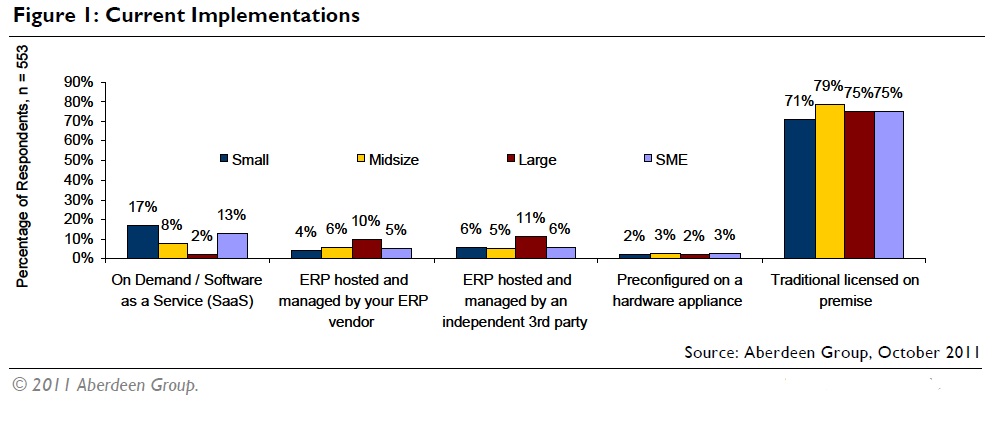
  • Large companies (over $500M in annual revenue) using Cloud-based ERP systems are opting for hosted deployments managed by their ERP vendor (10%) or an independent 3rd party (11%), with just 2% relying on a SaaS platform. Aberdeen defined small organizations as those with annual sales under $50M, midsize organizations having annual sales of $50M – $500M. The following is from SaaS and Cloud ERP Trends, Observations, and Performance 2011:
  • ERP mobility will be a dominant force from the shop floor to each sales call where quotes, orders and contracts deliver real-time order and pricing updates.  How a given manufacturer chooses to sell is even more important than what they sell in many industries. Equipping manufacturing, quality assurance, production scheduling, procurement and sales to have immediate data on what’s going on with orders, customers and suppliers is critical.  For the sales and service teams, real-time data is the fuel they run on.  There’s a chronic time shortage in many, many companies right now, and bringing greater ERP mobility from the shop floor to the sales call will increasingly be seen as a means to lessen the time crunch.  2012 is the year where mobility gets real across the enterprise with solid performance numbers being generated as a result.  For companies with large sales forces and service organizations, integrating to key ERP systems to gain real-time data will quickly lead to increased sales and higher gross margins on service and warranty repairs.
  • Gartner predicts that by 2015 enterprises who are successfully using extreme information management strategies (Big Data) will outperform competitors in their industry sectors by 20% in every available financial metric.  The following is the Priority Matrix for ERP, 2011 showing what Gartner believes to be transformational technologies and strategies in ERP.

SaaS-based ERP Systems are Business Process Stress Tests in Progress

Bottom line: Signing up for an Amazon AWS account is faster than creating a profile on Expedia. As a result, there are dozens of SaaS start-ups in the analytics, CRM, social CRM, ERP, supply chain management and many other areas of enterprise software. The ones that are going to make it already have a very clear vision of which complex, challenging, impossible business processes their customers face that they can standardize on, drive down cost per user per month down, and build a real business on.

Read more