Skip to content

Posts from the ‘AI Security’ Category

$3.6 Billion in Crunchbase funding, $96 Billion in M&A, and 10 Agentic AI security startups Reshaping 2026

Palo Alto Networks spent $29 billion acquiring three companies. ServiceNow spent $11.6 billion on three more. Alphabet paid $32 billion for Wiz. The startups building agentic AI defenses raised $3.6 billion. Total MCP security funding for 17,000+ deployed servers: $40 million. Then RSAC 2026 happened.

Read more

Gartner’s $244.2B security forecast shows enterprises spend 17x more on AI tools than securing AI itself

Analyst on a video call beside monitors showing Gartner's $244.2 billion 2026 security spending forecast and a 17x comparison

Update: Gartner’s 2Q26 forecast, revised July 21, 2026, puts 2026 information security spending at $248.2 billion. Read the current analysis.

Inside the $244.2 billion security market: agentic AI adoption outpaces defenses 8 to 1, cloud security grows at 28.8%, and enterprises spend 17x more on AI tools than on securing the AI itself

Gartner forecasts worldwide AI spending will reach $2.52 trillion in 2026, a 44% increase year-over-year. Worldwide IT spending will hit $6.15 trillion. Within that massive build-out, information security spending accelerates to $244.2 billion, up 13.3%.

The headline looks healthy. Look closer, and it isn’t. I’ve been tracking Gartner’s information security forecast through multiple quarterly updates, and the trajectory keeps steepening. But the spending acceleration is masking a deeper problem: enterprises are deploying AI agents into production far faster than they are securing them.

  1. The 40% / 6% gap

Gartner predicts 40% of enterprise applications will include task-specific AI agents by the end of 2026. Up from less than 5% in January. These are not chatbots. Gartner’s examples include autonomous cybersecurity response agents that scan network traffic, analyze system logs, and initiate responses without human intervention.

Only roughly 6% of organizations report having an advanced AI security strategy in place, according to vendor-sourced research from BigID’s 2025 AI Risk and Readiness study. Even adjusting for methodology differences between vendor and analyst research, the gap is stark. Agents are entering production at roughly 7-8x the rate organizations are building governance around them.

Gartner’s 4Q25 AI spending forecast created a dedicated agentic AI market segment for the first time. The spending lines are dramatic. Agentic AI overtakes chatbot and assistant spending by 2027. By 2029, agentic AI will reach $752.7 billion at a 119% compound annual growth rate. Chatbot spending peaks at $264.7 billion, then declines. That crossover point is where the security model breaks, because chatbots operate within human-supervised sessions. Agents don’t.

Gartner named agentic AI oversight the number-one cybersecurity trend for 2026 in its February report (my breakdown of all six trends here). A separate Gartner poll of 147 CIOs found 24% had already deployed AI agents and 50% were actively experimenting. Guardian agents, AI systems designed to monitor and govern other AI agents, are projected to capture 10-15% of the agentic AI market by 2030.

Forrester’s 2026 cybersecurity predictions go further: an agentic AI deployment will cause a publicly disclosed data breach this year, leading to employee dismissals. Senior analyst Paddy Harrington frames it as a cascade of failures, not a single point of error. That prediction landed in October 2025. Nothing since has made it less likely.

  1. $244.2 billion, and where it goes

Gartner’s 4Q25 information security forecast projects global spending reaching $244.2 billion in 2026, up 13.3% year-over-year. That is acceleration, not continuation. Gartner’s forecast trajectory has been steepening for multiple quarters. It follows a year where many CISOs focused on consolidating tools rather than buying new ones.

The allocation matters more than the total (please click on the graphic to expand for easier reading):

Gartner 4Q25 Information Security forecast table of subsegment sizing to 2029, led by cloud security posture management at a 31.3% CAGR

Cloud security at 28.8% growth is the fastest subsegment by a wide margin. CSPM alone carries a 31.3% CAGR. These represent organizations reacting to attack surfaces that expanded when workloads moved to the cloud faster than security controls followed.

Managed security services at 11.1% tells a workforce story the spending headline misses. The ISC2 documented a global cybersecurity workforce gap of 4.8 million professionals in October 2024. That gap grew 19% year-over-year while the active workforce flatlined at 5.5 million. A quarter of organizations reported cybersecurity layoffs. So they’re buying SOC capacity from managed providers instead. The spending growth in managed services is a staffing problem wearing a procurement mask.

The 17:1 spending asymmetry

Gartner’s 4Q25 AI spending forecast splits the AI cybersecurity market into two sub-segments for the first time. AI-amplified security, using AI to defend the enterprise, reached $49 billion in 2025. Securing AI itself, protecting the models, training data, inference pipelines, agent workflows, and decision outputs, stood at $2.8 billion. That is 5.5% of the AI cybersecurity market.

Enterprises are investing 17 times more in AI-powered security tools than in securing the AI on which those tools run. Gartner projects over 75% of enterprises will use AI-amplified cybersecurity products by 2028, up from less than 25% in 2025. The tools are getting funded. What the tools actually depend on to function is not.

  1. Quantum crosses the 5% budget threshold

Forrester predicts quantum security spending will exceed 5% of overall IT security budgets in 2026. Five percent sounds modest until you consider what it represents: the shift from research line items to actual procurement.

That means consulting engagements for quantum migration planning. Cryptographic discovery tools to figure out which systems need replacing first. Post-quantum algorithm testing across live production environments. Gartner calls post-quantum cryptography a force that demands organizations identify, manage, and replace traditional encryption methods now. Not eventually. Gartner’s 3Q26 forecast carries that logic into hardware, and my analysis of the $247.5 billion security forecast shows post-quantum firewall refreshes as the only hardware upgrade Gartner expects through 2030. The encryption market is growing at 2.0x according to the 4Q25 forecast, and the planning horizon is 2030. Starting migration in 2028 means compounding rip-and-replace costs every quarter of delay.

Forrester also predicts the EU will establish its own known exploited vulnerability database in 2026. Regulatory fragmentation adds cost. For enterprises operating across jurisdictions, quantum migration planning cannot be separated from compliance architecture.

  1. 57% of employees are already using shadow AI

A smaller Gartner survey of 175 employees conducted between May and November 2025 found that 57% use personal GenAI accounts for work. A third admitted to uploading sensitive information to tools their organizations have not sanctioned.

I keep coming back to this stat because it reframes the entire agentic AI security conversation. The firewalls most enterprises rely on were built for human-to-application communication. Protocols like MCP now enable agent-to-agent interaction at a scale and speed those tools were never designed to see. Machine identities outnumber human employees by more than 80 to 1 in most enterprises, according to CyberArk. Traditional IAM was not built for nonhuman actors operating autonomously.

Gartner’s cybersecurity trends report identifies IAM adaptation for AI agents as a top-six trend for 2026, specifically calling out identity registration, credential automation, and policy-driven authorization for machine actors. Failure to address these issues will lead to greater access-related cybersecurity incidents as autonomous agents become more prevalent.

The investment context: AI in the trough, security in the gap

Gartner places AI in the Trough of Disillusionment throughout 2026. AI will most often be sold by incumbent software providers rather than bought as part of new moonshot projects. ROI predictability has to improve before enterprises scale their deployments.

Forrester’s 2026 predictions reinforce this: enterprises will defer 25% of planned AI spending into 2027 as financial rigor slows production deployments and kills proofs of concept. Fewer than one-third of decision-makers can tie AI value to their organization’s financial growth.

Yet Gartner’s IT spending forecast shows server spending accelerating at 36.9% year-over-year and data center spending surging 31.7% past $650 billion. GenAI model spending grows at 80.8%. The infrastructure build-out is not slowing even as enterprise application adoption pauses.

Infrastructure spending runs hot. Application-layer AI spending cools. Security spending accelerates into the gap between adoption speed and governance readiness. The $244.2 billion flowing into information security is the cost of operating in an environment where AI agents are proliferating faster than the controls designed to govern them.

What these numbers add up to

For two decades, enterprise security assumed a human on the other end of every session, every credential request, every decision. That assumption is collapsing. The autonomous agent accessing your production database at 3 AM doesn’t authenticate the way your SOC analyst does, doesn’t respect the same governance boundaries, and operates at speeds no human reviewer can match.

What makes this moment different from previous security inflection points is the speed asymmetry. When cloud migration created new attack surfaces, enterprises had years to adapt. The shift from on-prem to cloud took a decade. The shift from human-operated to agent-operated environments is measured in quarters. Gartner didn’t even have a dedicated agentic AI spending segment until this forecast cycle. By the next one, the crossover will have already happened.

The practical question for 2026 is not whether to invest in AI security. That decision has been made by the spending trajectory. It is whether to govern AI agents proactively, before the first publicly disclosed agentic breach forces a reactive scramble, or to wait and pay the premium that every late mover in cybersecurity history has paid. Forrester has already predicted which outcome is more likely this year. The 17:1 ratio suggests most enterprises are betting on the wrong side of that question.

Sources

Gartner Forecast: Information Security, Worldwide, 2023–2029, 4Q25 (December 18, 2025)

Gartner Forecast Analysis: Information Security, Worldwide, 2026 (February 5, 2026)

Gartner Forecast: AI Spending, Worldwide, 2024–2029, 4Q25 (December 2025)

Gartner, Top Trends in Cybersecurity for 2026 (February 5, 2026)

Gartner, Worldwide AI Spending Will Total $2.52 Trillion in 2026 (January 15, 2026)

Gartner, Worldwide IT Spending to Grow 10.8% in 2026 (March 2026)

Gartner, 40% of Enterprise Apps Will Feature AI Agents by 2026 (August 26, 2025)

Gartner, Guardian Agents Will Capture 10-15% of Agentic AI Market by 2030 (June 11, 2025)

Forrester Predictions 2026: Cybersecurity and Risk (October 28, 2025)

Forrester, Global Tech Spend Will Grow 7.8% in 2026 (February 2, 2026)

Forrester, 2026 Technology & Security Predictions (October 28, 2025)

ISC2, 2024 Cybersecurity Workforce Study (October 2024)

CyberArk, Machine Identities Report (April 2025)

BigID, AI Risk & Readiness in the Enterprise (2025)

Roundup of agentic AI forecasts and market estimates, 2026

Roundup of agentic AI forecasts and market estimates, 2026

Agentic AI spending is projected to reach $201.9 billion in 2026 (Gartner), overtaking chatbot spending by 2027.  Four independent firms size the standalone market at $7–8 billion with 40%+ CAGRs. But adoption lags the money: only 23% of organizations have scaled agent deployments (McKinsey), and 40% of projects face cancellation by 2027 (Gartner).

Fortune Business Insights projects $7.29 billion in 2025, reaching $139.19 billion by 2034 at 40.5% CAGR. Precedence Research sizes it at $7.55 billion in 2025, growing to $199.05 billion by 2034 at 43.84% CAGR. MarketsandMarkets puts the figure at $7.06 billion in 2025, reaching $93.20 billion by 2032 at 44.6% CAGR. Deloitte’s TMT Predictions 2025 estimates $8.5 billion in 2026, growing to $35 to $45 billion by 2030.

Every major forecast agrees on direction. None agrees on scale. The standalone agentic AI market lands between $7 billion and $8.5 billion. Gartner’s broader view, counting agentic capabilities embedded across enterprise software, reaches $201.9 billion in 2026. That 25x gap is not a contradiction. It is a measurement problem, and the takeaways below reflect both realities. The following are the key takeaways from agentic AI forecasts published in 2026 so far:

Two later comparisons extend this roundup: AI infrastructure spending forecasts compared (October 2026), which tracks the 2030 build-out numbers, and AI revenue gap forecasts compared, which follows the returns on that spending.

Key takeaways

Worldwide AI spending will reach $2.52 trillion in 2026, growing 44% year-over-year. That number jumped roughly $500 billion from the September forecast, which had pegged the market just above $2 trillion. Infrastructure takes $1.37 trillion, 54% of total spend. AI software follows at $452.5 billion, up 60%. AI services add $588.6 billion. AI-optimized servers alone account for $421.6 billion, growing to 49%. Gartner expects spending to grow by another 30% in 2027 and surpass $3 trillion. I have tracked these forecasts through multiple iterations. The revisions keep going in one direction. Source: Gartner press release, January 15, 2026

Table 1: Gartner worldwide AI spending by market, 2025 to 2027, in millions of dollars, rising from $1,757,152M to $3,336,690M, January 2026


Gartner projects $4.71 trillion in global AI spending by 2029. The fastest growth isn’t in infrastructure. Synthetic data generation leads all categories at 178% CAGR, followed by the broader AI Data market at 155%. Agentic AI compounds at 119%, expanding from $15 billion to $753 billion by 2029. AI Infrastructure, the largest category by dollars, grows at just 29%. The money is following the bottlenecks. Source:  Gartner 4Q25: $4.71T AI Market Proves Agentic AI and Data Readiness Are the Only Race That Matters, Software Strategies Blog, January 22, 2026 Link: https://softwarestrategiesblog.com/2026/01/22/gartner-4q25-agentic-ai-data-readiness-4-71t-market/

Bar chart of Gartner AI spending categories by 2024 to 2029 growth rate, led by synthetic data generation at 178.29% CAGR, AI data at 155.35% and agentic AI at 118.73%


The AI cybersecurity market is predicted to hit $51.3 billion in 2026, nearly doubling from $25.9 billion in 2025. But the category masks a structural imbalance. AI-amplified security, where AI defends the enterprise, captures 94.5% of spending at $48.5 billion. Securing AI, where the enterprise defends its own AI systems, gets $2.8 billion. Enterprises are investing 17x more in using AI as a security tool than in protecting the AI itself. Both sub-segments grow at similar CAGRs (74% vs. 72%), which means the dollar gap widens every year. By 2029, AI-amplified security reaches $160.4 billion, while securing AI hits just $11.6 billion. One is a tool. The other is the thing that needs protecting. Source: Gartner Forecasts Agentic AI Will Overtake Chatbot Spending by 2027, Software Strategies Blog, February 16, 2026 Link: https://softwarestrategiesblog.com/2026/02/16/gartner-forecasts-agentic-ai-overtakes-chatbot-spending-2027/

Table: Gartner AI cybersecurity spending 2024 to 2029, securing AI growing from $777M to $11,571M and AI-amplified security from $10,039M to $160,437M, 74% combined CAGR


AI Data sits alone in the upper-right quadrant of Gartner’s spending map, compounding at 155% CAGR with 277% growth in 2026. AI Cybersecurity and AI Models cluster above 67% CAGR. AI Infrastructure anchors the chart as the largest bubble, but grows at just 29%. Global AI spending reaches $1.8 trillion in 2025 and $4.7 trillion by 2029. The acceleration is not in compute. It is in data readiness, security architecture, and agentic capabilities. By 2028, software with agentic capabilities crosses 50% of total application software spend, up from 2% in 2024. Non-agentic software spending starts declining in 2027. Source:Data Readiness and Security Are Driving AI’s $4.7 Trillion Run, Software Strategies Blog, December 22, 2025 Link: https://softwarestrategiesblog.com/2025/12/22/data-readiness-security-driving-ai-4-7-trillion/

Gartner bubble chart of worldwide AI spending by market plotting 2026 growth against 2024 to 2029 CAGR, with AI data the fastest-growing segment and AI infrastructure the largest

Gartner’s AI spending forecast reaches $2.53 trillion in 2026 and $4.71 trillion by 2029. Eight markets. One pattern. AI Infrastructure dominates absolute dollars at $1.37 trillion in 2026 but grows at just 29% CAGR. AI Data, the smallest segment at $3.1 billion, compounds at 155%. AI Cybersecurity nearly doubles to $51.3 billion. AI Software hits $452.5 billion, growing 60% year-over-year as agentic capabilities reshape the category. The growth rates tell you where the bottlenecks are breaking. Source: Data Readiness and Security Are Driving AI’s $4.7 Trillion Run, Software Strategies Blog, December 22, 2025 Link: https://softwarestrategiesblog.com/2025/12/22/data-readiness-security-driving-ai-4-7-trillion/

Table: Gartner AI spending forecast by market, 2024 to 2029, in billions of dollars, total rising from $1,143.5B to $4,709.2B at 32.7% CAGR, 4Q25 update December 2025

Nearly nine in ten organizations now use AI in at least one business function, up from 78% a year ago, but nearly two-thirds have not begun scaling it across the enterprise. Only 6% qualify as high performers where AI contributes more than 5% to EBIT. Sixty-two percent of organizations are at least experimenting with AI agents, yet in no individual business function are more than 10% scaling them. High performers are three times more likely than peers to fundamentally redesign workflows and three times more likely to have senior leaders demonstrating ownership of AI initiatives. More than one-third of high performers commit over 20% of their digital budgets to AI, and about three-quarters have reached the scaling phase, versus one-third of other organizations. Source: McKinsey / QuantumBlack, The state of AI in 2025: Agents, innovation, and transformation, November 2025

McKinsey chart: share of organizations using AI in at least one business function rose from 20% in 2017 to 88% in 2025, with generative AI use at 79%; 7% report fully scaled AI

Valued at $638.23 billion in 2024, the global AI market is projected to reach $3,680.47 billion by 2034, expanding to a CAGR of 19.20%. North America holds 31.80% market share. The software segment dominates at 51.40%, while machine learning leads by technology at 36.70%. Healthcare is expected to record the highest CAGR of 36.50% across end-use segments. Among regions, Asia-Pacific is expected to grow at 19.8% CAGR from 2025 to 2034, with AI projected to add up to $3 trillion to the region’s GDP by 2030, driven by national AI strategies in China, India, and Japan. Source: Precedence Research, AI Market Size, Growth & Trends, September 2025

Precedence Research bar chart: artificial intelligence market size growing from $638.23B in 2024 to $3,680.47B in 2034

Nearly $7 trillion. That’s the capital outlay data centers will require by 2030 to keep pace with demand for compute power. Of that, $5.2 trillion goes toward AI-ready facilities and $1.5 trillion toward traditional IT workloads. Global demand for data center capacity could almost triple by 2030, with about 70% of new demand coming from AI workloads. Three investment scenarios range from $3.7 trillion (constrained demand) to $7.9 trillion (accelerated demand, adding 205 incremental GW). The 60% majority of investment—$3.1 trillion—flows to technology developers and designers producing chips and computing hardware. Source: McKinsey, The cost of compute: A $7 trillion race to scale data centers, April 2025

McKinsey chart of estimated global data center capacity demand in gigawatts, continued momentum scenario, rising from 82 GW in 2025 to 219 GW in 2030, a 3.5x increase driven by AI workloads

Inference already consumed half of all AI compute in 2025. That number will grow to two-thirds in 2026 and reach 75% of all AI compute needs by 2030. Global data center capacity is projected to nearly double from 103 gigawatts to 200 GW by 2030, yet U.S. data centers already face a capacity shortfall exceeding 11 GW, with the cumulative gap expected to exceed 40 GW by 2028. North American data center capacity alone will increase eightfold, from 5.6 GW in 2024 to 44 GW by 2030. Operators are increasingly deploying edge facilities closer to end users to reduce latency as inference-dominated workloads drive a fundamental redesign of data center architectures. Source: Avid Solutions, 13 Data Center Growth Projections, January 2026

Grand View Research bar chart: AI inference market growing from $113.5B in 2025 to $253.7B in 2030


Generative AI could add the equivalent of $2.6 trillion to $4.4 trillion annually to the global economy, increasing the projected impact of all AI by 15 to 40%. About 75% of the value falls across four areas: customer operations, marketing and sales, software engineering, and R&D. Half of today’s work activities could be automated between 2030 and 2060, with a midpoint in 2045—roughly a decade earlier than previously estimated. When embedding effects in existing software are included, the total economic benefit rises to $6.1 trillion to $7.9 trillion annually. Source: McKinsey, The economic potential of generative AI, June 2023

McKinsey chart of AI's potential impact on the global economy in trillions of dollars, with generative AI adding $2.6T to $4.4T on top of $11.0T to $17.7T from advanced analytics and machine learning

The global AI market hit $294.16 billion in 2025 and is projected to grow to $2,480.05 billion by 2034, at a CAGR of 26.60%. The Banking, financial services and insurance (BFSI) segment holds 18.90% market share, while healthcare is expected to record the highest CAGR of 36.50%. In the U.S. alone, the AI market was estimated at $146.09 billion in 2024 and is predicted to reach $851.46 billion by 2034. The number of AI companies funded globally in 2024 totaled 2,049, with U.S.-funded companies accounting for 1,143, signaling strong investor confidence in the sector’s expansion potential. Source: Fortune Business Insights, AI Market Size, Growth & Trends by 2034

Fortune Business Insights infographic: artificial intelligence market valued at $294.16B in 2025 and $375.93B in 2026, projected at $2,480.05B by 2034 at a 26.60% CAGR

Big Tech’s AI capex hit $405 billion in 2025, up from a $250 billion estimate at the start of the year. Sell-side analysts have underestimated AI spending every quarter for two years running. A decade ago, Big Tech’s trailing-twelve-month capex was $24 billion—15x less than today. AI data center costs are projected at $3 trillion to $8 trillion, with gigawatt capacity expected to grow 3.5x by 2030. Source: IO Fund, Big Tech’s $405B Bet, November 2025

I/O Fund bar chart of Big Tech capex revisions, January 2025 versus September 2025: Microsoft $89.9B to $117.5B, Meta $52.3B to $71.0B, Alphabet $62.6B to $92.0B, Amazon $96.4B to $125.0B

The global AI market was valued at $371.71 billion in 2025 and is projected to reach $2,407.02 billion by 2032, growing at a CAGR of 30.6%. Hyperscalers accounted for 53% of chip purchases in 2023, spurring 156% market growth from 2023 to 2024. While demand from hyperscalers is expected to moderate, growth of 41% is still forecast from 2025 to 2026. Enterprises are moving from cloud reliance to in-house AI infrastructure investments, particularly for cost-effective inference solutions, as edge AI gains traction through AI-enabled PCs and mobile devices. Source: Markets and Markets, AI Market Report 2025-2032

MarketsandMarkets snapshot: artificial intelligence market size $371.71B in 2025 growing to $2,407.02B by 2032 at 30.6% CAGR, Asia Pacific the fastest-growing region

At $602 billion projected for 2026, hyperscaler capex has entered uncharted territory. Amazon, Microsoft, Google, and Meta will each exceed $100 billion individually, pushing capital intensity to 45-57% of revenue. Total hyperscaler capex from 2025-2027 is projected at $1.15 trillion, more than double the $477 billion spent from 2022-2024. Morgan Stanley and JP Morgan suggest the technology sector may need to issue $1.5 trillion in new debt over the next few years to finance AI infrastructure construction. The sheer scale of debt issuance mirrors patterns seen during the fiber-optic buildout of the late 1990s. Source: Multiple sources compiled by Introl, January 2026

Table of 2025 capex and 2026 projections for Amazon ($125B), Microsoft (about $95B), Google (about $75B), Meta ($66B to $72B) and Oracle (about $15B), most of it for AI infrastructure

The number of software companies using consumption-based pricing more than doubled between 2015 and 2024, as AI introduces new variable costs that make traditional perpetual licenses obsolete. SaaS remains dominant, but the next wave is outcome-aligned pricing that scales with actual AI usage. Software businesses that successfully adopt consumption-based pricing aligned with usage and outcomes may be better positioned to capture AI-driven value and differentiate themselves in a rapidly evolving market where the cost of each AI inference adds a new variable to the P&L. Source: McKinsey, AI adjusts the software bill, January 27, 2026

McKinsey chart: enterprise software pricing model by type, 2016 to 2028, showing consumption-based pricing taking share from perpetual and on-premises subscription licenses

Data center capacity needs for AI and non-AI workloads could almost triple by 2030, with AI capacity increasing 3.5 times and making up roughly 70% of the total. Under a continued-momentum scenario, total capacity demand rises from 82 GW in 2025 to 219 GW by 2030, with incremental AI capacity ranging from 13 GW in 2025 to 31 GW in 2030, totaling 124 GW of new AI capacity. Non-AI workloads grow from 38 GW to 64 GW over the same period. Average power densities in AI-ready data centers have more than doubled in just two years and are expected to rise nearly four times by 2027. Source: McKinsey, Data center demands (Week in Charts), May 2025

McKinsey chart of estimated global data center capacity demand in gigawatts, 2025 to 2030, split between AI and non-AI workloads, with AI workloads reaching 156 GW by 2030

U.S. data-center spending exceeded half a trillion dollars in 2025. The U.S. and China drove a massive expansion in AI-related computing capacity through 2024, with the U.S. pulling further ahead in the first half of 2025. AI-related trade accounted for nearly half of all merchandise trade growth in that period, despite representing only 15% of total trade volume. The infrastructure boom is reshaping international commerce, with surging demand for servers, graphics cards, and related components essential to AI training and inference now a dominant force in global supply chains. Source: Federal Reserve Board, FEDS Notes: The Global Trade Effects of the AI Infrastructure Boom, February 2026

Federal Reserve charts of existing AI supercomputer capacity through H1 2025 and planned capacity through 2030 in quintillion calculations per second for the U.S., China, EU and rest of world, Epoch AI data

The generative AI market is expanding from $71.36 billion in 2025 to $890.59 billion by 2032, at a CAGR of 43.4%. North America accounted for 43.05% of global revenue in 2025. Text remains the dominant data modality due to its foundational role in enterprise workflows, while the services segment is gaining traction for scalability and cost-effectiveness. Foundation model delivery platforms verticalized adoption across industries, and the rapid scaling of AI-native infrastructure are the three key forces driving the market as of 2025. The 43.4% CAGR makes this one of the fastest-expanding technology subsegments in history. Source: MarketsandMarkets, Generative AI Market Report, Global Forecast to 2032

MarketsandMarkets snapshot: generative AI market size $71.36B in 2025 growing to $890.59B by 2032 at 43.4% CAGR, Asia Pacific the fastest-growing region

The generative AI market reached $37.89 billion in 2025 and is projected to hit $1.2 trillion by 2035, a 37% compound annual growth rate. Transformer architectures account for more than 42% of technology revenue, driven by text-to-image and text-to-video applications. Software captures over 65% of total revenue. North America holds 41% of the market. Asia-Pacific is the fastest-growing region at a 27.6% CAGR through 2035. Financial services is expected to lead sector growth at 36.4%, fueled by fraud detection, risk management, and regulatory compliance demands. Source: Precedence Research, Generative AI Market Size, January 2026

Precedence Research bar chart: generative AI market size growing from $37.89B in 2025 to $1,206.24B in 2035

GPUs captured 89% of AI processor revenue in 2025, but FPGA and ASIC alternatives are growing at a 17% CAGR through 2031. Hardware accounted for 68% of all AI infrastructure spending last year. North America held 40% of the market, backed by $52.7 billion in CHIPS Act grants and hyperscalers operating roughly 60% of global AI compute capacity. Liquid cooling reached 18% of AI server racks as power densities crossed 100 kilowatts per rack, the threshold where air cooling fails. Asia-Pacific is projected to grow fastest at 16.4% CAGR through 2031, driven by China’s $50 billion semiconductor fund and $15 billion in hyperscaler commitments across India. Source: Mordor Intelligence, AI Infrastructure Market Size, Trends & Growth Drivers 2031

Mordor Intelligence snapshot: AI infrastructure market growing from $101.17B in 2026 to $202.48B in 2031 at 14.89% CAGR, with AMD, Intel, Nvidia, Microsoft Azure and AWS as major players

Nearly one in four Americans has already made a purchase through AI. Morgan Stanley Research estimates agentic shoppers will drive $190 billion to $385 billion in U.S. e-commerce spending by 2030, capturing 10% to 20% of market share. Grocery and consumer packaged goods lead adoption, with 49% of AI-assisted buyers transacting in those categories. AI shopping agent users are projected to reach 126 million by 2030, up from near zero today, while traditional e-commerce users decline from 264 million to 149 million over the same period. Source: Morgan Stanley Research, Agentic Commerce Market Impact Outlook, December 2025 Link: https://www.morganstanley.com/insights/articles/agentic-commerce-market-impact-outlook

Morgan Stanley Research charts of agentic share of e-commerce spend, 2026 to 2030: base case reaches 10% agentic by 2030, bull case reaches 20%

Gartner forecasts agentic AI will overtake chatbot spending by 2027


Agentic AI spending grows 141% in 2026 to $201.9 billion. By 2027, it will overtake chatbot and assistant spending for the first time. Then chatbot spending starts declining. I’ve tracked Gartner’s AI forecasts through multiple iterations. This crossover changes where security risk concentrates for every security professional reading this.

The crossover is in the segment-level data tables of Gartner’s Forecast: AI Spending, Worldwide, 2024–2029, 4Q25. The headline number is well known: $2.53 trillion in 2026, $4.7 trillion by 2029 at 33% CAGR. The segment breakdowns are not. Eight markets. Nineteen sub-segments. The sub-segment data tells a different story than the top line.

This is Gartner’s first dedicated AI spending forecast, and I’ve been waiting for it. Gartner states that comparisons to previous AI estimates are not meaningful because the scope widened, adding AI cybersecurity, agentic AI as a separate segment from chatbots, AI data technology, and expanded infrastructure coverage. Gartner writes, “This is the first iteration of the forecast on AI spending that Gartner has published. Gartner has significantly expanded and modified its AI forecast coverage. Spending comparisons to previous iterations are therefore not meaningful as the scope has widened. This includes both coverage of new markets and broadened definitions of the types of AI spending that are reflected in some market segments.”

Forrester’s Predictions 2026: Cybersecurity and Risk arrives at the same warning from a different angle: an agentic AI deployment will cause a publicly disclosed breach in 2026, leading to employee dismissals. Two firms. Same conclusion. The spending data explains why.

Line chart of total worldwide AI spending rising from $1.14 trillion in 2024 to $4.71 trillion in 2029, a 33% CAGR, per Gartner

CAPTION: Total worldwide AI spending, 2024–2029. $1.14T to $4.71T. 33% CAGR. Growth decelerates from 54% (2025) to 16% (2029) as the base expands. Source: Gartner Forecast: AI Spending, 4Q25 (December 2025).

The full market breakdown

AI infrastructure dominates at $1.37 trillion, 54% of the total. AI software follows at $452.5 billion, growing 60% year-over-year. AI services add $588.6 billion. AI cybersecurity and AI data are the outliers: growing at 74% and 155% CAGR, respectively, rates that dwarf everything else in the forecast.Table of Gartner AI spending by market from 2024 to 2029, totaling $4,709.2 billion in 2029, with AI data growing fastest at a 155% CAGR

Source: Gartner Forecast: AI Spending, Worldwide, 2024–2029, 4Q25 (December 19, 2025). All figures in U.S. dollars. CAGR = 2024–2029. Gartner press release: https://www.gartner.com/en/newsroom/press-releases/2026-1-15-gartner-says-worldwide-ai-spending-will-total-2-point-5-trillion-dollars-in-2026

Infrastructure takes 54% of every AI dollar

AI-optimized servers alone account for $421.6 billion in 2026, growing to $699.7 billion by 2029. AI processing semiconductors add $289.4 billion. AI-optimized IaaS hits $38.3 billion at 71% CAGR, the fastest-growing infrastructure sub-segment. AI network fabric, a new category in this forecast, reaches $28.7 billion.

Infrastructure’s share drops from 54% to 48% by 2029 as software and services scale faster. The capital-intensive build-out phase is not over.

The agentic crossover nobody is planning for

Gartner now splits AI software into chatbots/assistants and agentic AI. The spending lines cross in 2027.

Line chart showing Gartner forecasts agentic AI spending at $371 billion overtaking chatbots and assistants at $265 billion in 2027

CAPTION: Agentic AI spending overtakes chatbot/assistant spending by 2027. Chatbots peak at $264.7B then decline. Agentic AI grows at 119% CAGR to $752.7B by 2029. Source: Gartner Forecast: AI Spending, 4Q25 (December 2025). AI Software segment, Table 1-2.

Table of Gartner AI software spending on chatbots and assistants versus agentic AI from 2024 to 2029, with agentic AI reaching a 76.7% share by 2029

Source: Gartner Forecast: AI Spending, 4Q25 (December 2025). CAGR = 2024–2029.

Chatbots talk to people. Agents act on behalf of people. They access databases, execute transactions, chain multi-step workflows without human approval at each step. The attack surface has moved well beyond conversation windows. Agents are autonomous decision engines with production access.

Gartner’s Top Trends in Cybersecurity for 2026 lists agentic AI oversight as the number-one trend. Forrester’s Predictions 2026: Cybersecurity and Risk goes further: an agentic AI deployment will cause a public breach this year, and employees will lose their jobs for it. Forrester senior analyst Paddy Harrington calls it a “cascade of failures,” not a single point of error. Two analyst firms. Different methodologies. Same conclusion. Security strategies built for chatbot-era risk have a shelf life measured in quarters, not years.

AI cybersecurity is two markets, not one

Gartner created a dedicated AI cybersecurity market for the first time in this forecast. It nearly doubles in 2026. But the category name hides a structural split that matters more than the growth rate.

Table of Gartner AI cybersecurity spending split into securing AI and AI-amplified security, totaling $172 billion in 2029

Source: Gartner Forecast: AI Spending, 4Q25 (December 2025). CAGR = 2024–2029.

Two sub-segments. Two very different problems.

AI-amplified security ($48.5 billion, 94.5% of the market) is what most enterprises mean when they say “AI cybersecurity.” This is AI working for your security team. Machine learning models that analyze network traffic patterns and flag anomalies faster than a human analyst can. Natural language processing that reads threat intelligence feeds and correlates indicators of compromise across millions of data points in seconds. Automated triage systems that prioritize which of the 11,000 daily alerts actually need a human response. AI-powered endpoint detection that identifies malware variants that signature-based tools miss. Behavioral analytics that learn what normal looks like for each user and flag deviations. Security orchestration platforms that automate incident response playbooks, reducing mean time to containment from hours to minutes.

This is the category where enterprises are spending aggressively. And for good reason. The math on analyst workloads demands it. Security operations centers are drowning in alerts, facing a persistent talent shortage, and defending attack surfaces that expand every quarter. AI-amplified tools address all three.

Securing AI ($2.8 billion, 5.5% of the market) is the other problem. AI-amplified security puts AI to work defending the enterprise. Securing AI reverses the relationship entirely — defending the AI itself. Protecting the models, the training data, the inference pipelines, the agent workflows, and the decision outputs that enterprises are deploying at $2.53 trillion in 2026. Prompt injection defenses. Model access controls. Training data poisoning detection. Output validation. Agent permission boundaries. Audit trails for autonomous decisions.

The distinction matters because they protect different things. AI-amplified security protects your enterprise using AI. Securing AI protects the AI itself. One is a tool. The other is the thing that needs protecting. Enterprises are investing 17 times more in the tool than in protecting the thing the tool runs on.

Shadow AI is not just employees using ChatGPT

Gartner names the mechanism driving AI software growth: vendor push. Software providers are integrating GenAI and agentic AI into existing product lines. AI software grows from $143 billion in 2024 to $981 billion by 2029 at 47% CAGR.

For CISOs, vendor push changes the equation. AI capabilities are being added to tools already in production. Often without explicit procurement decisions. The AI features embedded in your existing ERP, CRM, and developer platforms may already exceed what your security team has inventoried. Shadow AI is vendors activating AI inside products you already own.

The smallest market with the biggest growth rate

AI data technology: $134 million in 2024. $3.1 billion in 2026. $14.6 billion by 2029. The 155% CAGR is the highest in the forecast. The 277% year-over-year growth in 2026 is the steepest single-year jump of any segment.

Synthetic data generation is the standout sub-segment, going from $41 million to $6.8 billion by 2029. Gartner is direct: enterprises need AI-ready data with proper labeling, quality checks, and compliance. For organizations running AI projects on ungoverned data, the readiness gap compounds every quarter.

Bar chart ranking Gartner AI spending markets by 2024 to 2029 CAGR, led by AI data at 155.4% and AI cybersecurity at 73.9%

CAPTION: AI spending markets ranked by five-year CAGR. AI Data (155%) and AI Cybersecurity (74%) lead. AI Infrastructure is the largest by absolute dollars. Source: Gartner Forecast: AI Spending, 4Q25 (December 2025).

Indirect services are the governance blind spot

Indirect AI services, where AI is a supporting component in a larger project, grow from $78.4 billion in 2024 to $255.9 billion in 2026 at 50% CAGR. Direct AI services hit $332.8 billion. By 2028, indirect overtakes direct.

Indirect AI means capabilities embedded in consulting and implementation projects that procurement does not classify as AI. If you cannot see it in your AI inventory, you cannot govern it.

Servers are a bigger market than AI software

AI-optimized servers alone hit $421.6 billion in 2026, just below the entire AI software market at $452.5 billion. By 2029, servers reach $699.7 billion. Cloud providers are building capacity for AI workloads that have not materialized at scale. The infrastructure is ahead of the applications.

The enterprise agentic stack is showing up in spending data

Gartner’s DSML segment includes a dedicated agent builder platforms sub-segment at $5.0 billion in 2026, reaching $13.7 billion by 2029. AI observability and governance adds $1.3 billion, growing to $4.0 billion. The xOps sub-segment (MLOps, DataOps, ModelOps) is the largest at $15.0 billion.

Together, these form the tooling layer for building, monitoring, and governing agents in production. The enterprise agentic stack is materializing in the spending data. Most organizations have not formalized it in their architecture.

The numbers that belong in your next board deck

If you take one thing from this forecast into a budget meeting, take this table. I built it from the raw spreadsheet data. Six years of AI deployment spending next to AI security spending. The bottom row is the one that gets the questions.

Table comparing total AI spending with AI cybersecurity and securing AI spending as a share of AI from 2024 to 2029

Source: Gartner Forecast: AI Spending, 4Q25 (December 2025). All percentages derived from Gartner’s published data tables (Tables 1-1 and 1-2).

The ratio improves over time. Securing AI goes from 0.07% in 2024 to 0.25% by 2029. But watch the absolute numbers. In 2029, enterprises will spend $4.71 trillion deploying AI and $11.6 billion securing it. The percentage gets better. The dollar gap gets wider. Every year, the market grows its way into a larger exposure.

Where I think this lands

Three things worth tracking from the segment data:

The agentic crossover. Agentic AI overtakes chatbot spending in 2027. The enterprise risk profile shifts from conversational data leakage to autonomous decision-making at scale. CISOs who build agentic governance frameworks in 2026 position themselves before the inflection. The spending curve says the window is narrowing.

The securing-AI gap. $2.8 billion to protect AI systems in a year when $2.53 trillion deploys them. Enterprises are enthusiastic about using AI for defense. The investment in defending AI itself has not caught up.

Data readiness is the bottleneck. The 277% growth in AI data spending confirms that AI without governed data delivers diminished returns. Data classification investments directly enable or constrain AI ROI.

If your security budget is growing at 12% and AI deployment inside your enterprise is growing at 44%, the gap compounds every quarter. You cannot close it by holding steady. The organizations getting this right treat AI security as a proportion of AI deployment, not a fixed line item.

—

Sources

Gartner, Forecast: AI Spending, Worldwide, 2024–2029, 4Q25, December 19, 2025, ID G00843179.

Gartner press release (January 15, 2026): https://www.gartner.com/en/newsroom/press-releases/2026-1-15-gartner-says-worldwide-ai-spending-will-total-2-point-5-trillion-dollars-in-2026

Gartner, Top Trends in Cybersecurity for 2026 (February 5, 2026): https://www.gartner.com/en/newsroom/press-releases/2026-02-05-gartner-identifies-the-top-cybersecurity-trends-for-2026

Gartner, IT Spending Forecast 1Q26 (February 3, 2026): https://www.gartner.com/en/newsroom/press-releases/2026-02-03-gartner-forecasts-worldwide-it-spending-to-grow-10-point-8-percent-in-2026-totaling-6-point-15-trillion-dollars

Forrester, Predictions 2026: Cybersecurity and Risk (October 2025): https://www.forrester.com/blogs/predictions-2026-cybersecurity-and-risk/

All dollar figures in U.S. dollars. Growth rates and CAGR derived from Gartner’s published data tables (Tables 1-1 and 1-2).

Top 6 cybersecurity trends from Gartner’s 2026 Security Forecast

Over 57% of employees are using personal GenAI accounts for work. A third of them admit to uploading sensitive data into tools their security teams haven’t approved. Meanwhile, agentic AI is proliferating through no-code platforms and vibe coding, creating attack surfaces most CISOs can’t see, let alone govern. And quantum computing? No longer a 10-year planning horizon. It’s a 2030 action deadline.

Gartner’s Top Trends in Cybersecurity for 2026 report, released February 5, 2026, identifies six forces reshaping how CISOs must operate. These cut across governance, AI adoption, identity, workforce, and cryptographic strategy simultaneously. None of them is incremental.

The trends report lands alongside Gartner’s updated Forecast: Information Security, Worldwide, 2023–2029, 4Q25 (G00843183, December 18, 2025) and the Forecast Analysis: Information Security, Worldwide, 2026 (G00838442, February 5, 2026), which together project global information security spending reaching $244.2 billion in 2026, up 13.3% in current U.S. dollars. I’ve tracked this forecast through multiple quarterly updates. The trajectory keeps steepening. The six trends below explain where that money is going and why.

“Cybersecurity leaders are navigating uncharted territory this year as these forces converge, testing the limits of their teams in an environment defined by constant change,” said Alex Michaels, Director Analyst at Gartner. “This demands new approaches to cyber risk management, resilience, and resource allocation.”

The spending backdrop: $244 billion and accelerating

Before getting into the six trends, context matters. Gartner’s 4Q25 forecast shows the three major security segments all growing at double-digit constant currency rates in 2026:

Table of Gartner 2026 security spending by segment, with security software at $123.5 billion or 50.6% of the total

Source: Gartner Forecast: Information Security, Worldwide, 2023–2029, 4Q25 Update (G00843183). Constant currency rates.

Cloud security remains the fastest-growing subsegment at 28.8% growth in 2026. Nothing else comes close. The combined cloud security market (cloud security posture management, cloud access security brokers, and cloud workload protection platforms) is projected to reach $32.4 billion by 2029, with a 25% CAGR in constant currency. I’ve been watching this subsegment accelerate for three quarters straight. CSPM alone is growing at a 31.30% CAGR.


Stacked area chart of Gartner cloud security spending across CSPM, CASB and CWPP growing from $7.9 billion in 2023 to $32.4 billion in 2029

Cloud security spending reaches $32.4 billion by 2029. CSPM leads at 31.30% CAGR. Source: Gartner 4Q25 Forecast. (Please click on the image to expand for easier reading)

Trend 1: Agentic AI demands cybersecurity oversight

This is the trend that touches everything else on this list. Employees and developers are deploying AI agents through no-code/low-code platforms and “vibe coding” at a pace that outstrips security governance. Unmanaged AI agent proliferation. Unsecured code. Compliance violations that most security teams don’t even have visibility into yet. That’s the picture Gartner is painting.

Gartner’s recommendation is blunt: cybersecurity leaders must identify both sanctioned and unsanctioned AI agents operating within their environments, enforce access controls and data guardrails, and develop incident response playbooks specific to agent-driven threats.

“While AI agents and automation tools are becoming increasingly accessible and practical for organizations to adopt, strategic cybersecurity planning for these technologies is essential,” said Michaels. Cybersecurity leaders must work cross-functionally to manage agentic AI adoption, identifying sanctioned and unsanctioned AI agents, enforcing data access controls, and developing incident response playbooks.

The spending data backs this up. Gartner’s 4Q25 forecast projects the AI-amplified security market reaching $160 billion by 2029, up from $49 billion in 2025. Gartner is clear that this isn’t additive spending. It represents the portion of existing security products that now embed AI capabilities. But the expectation tells the story: over 75% of enterprises will use AI-amplified cybersecurity products by 2028, up from less than 25% in 2025. Vendors that don’t embed AI will lose shelf space. (For more on AI security platforms, see Gartner’s Top Strategic Technology Trends for 2026, which predicts that over 50% of enterprises will use AI security platforms to protect their AI investments by 2028.)

Trend 2: Global regulatory volatility drives cyber resilience efforts

Regulators are getting personal. Boards and executives now face direct liability for compliance failures. Not just organizational fines, but individual accountability. The penalties for inaction have moved from theoretical to career-ending. Across multiple jurisdictions simultaneously.

Gartner advises cybersecurity leaders to formalize collaboration across legal, business, and procurement teams to establish clear accountability for cyber risk. Align control frameworks to recognized standards. Address data sovereignty concerns before they become enforcement actions. The organizations doing this well are treating regulatory preparedness as a core security function, not an annual compliance checkbox.

This is where the spending data gets interesting. Gartner’s forecast shows security consulting services growing from $24.2 billion (2024) to $36.6 billion (2029), adding $12.4 billion in five years. Security professional services follow a similar trajectory: $27.3 billion to $40.8 billion, adding $13.5 billion. Organizations are buying outside expertise because they can’t build regulatory competence fast enough in-house. I’ve been covering these numbers for three quarters, and the services growth is the part of the forecast that keeps surprising me.

Bar chart comparing Gartner information security spending by subsegment in 2024 and 2029, led by infrastructure protection at $58.5 billion

Infrastructure protection adds $26.4 billion between 2024 and 2029, the largest absolute growth of any subsegment. Source: Gartner 4Q25 Forecast. (Please click on the image to expand for easier reading)

Trend 3: Post-quantum computing moves into action plans

Gartner predicts advances in quantum computing will render the asymmetric cryptography that organizations rely on unsafe by 2030. Four years. That’s the window to adopt post-quantum cryptography alternatives before “harvest now, decrypt later” attacks start cashing in on data that adversaries are collecting today. In Gartner’s 3Q26 forecast that readiness work reaches budgets as post-quantum firewall refreshes, the only hardware upgrade Gartner expects through 2030.

Organizations need to identify their cryptographic deployments, assess data sensitivity and lifespan, and prioritize cryptographic agility. That last phrase keeps coming up in my conversations with CISOs. The ability to swap encryption methods without re-architecting entire systems. Swapping an algorithm is one thing. Doing it across a production environment without downtime is an entirely different problem.

“Post-quantum cryptography is reshaping cybersecurity strategies by prompting organizations to identify, manage, and replace traditional encryption methods, while prioritizing cryptographic agility,” said Michaels. “By investing in these capabilities and prioritizing migration now, assets will be secured when quantum threats become a reality.“

The encryption market in Gartner’s 4Q25 forecast grows from $1.04 billion in 2023 to $2.04 billion by 2029 at an 11.95% CAGR. A 2.0x increase. For what has historically been one of the slower-growing security subsegments, that’s a significant acceleration. Quantum urgency is changing the math.

Trend 4: Identity and access management adapts to AI agents

AI agents are breaking traditional IAM models. Plain and simple. Identity registration and governance, credential automation, and policy-driven authorization weren’t designed for autonomous machine actors that can initiate actions, access data, and interact with systems without human intervention. The scale problem compounds fast: when every employee can deploy dozens of AI agents, the identity surface area explodes.

Gartner recommends a targeted, risk-based approach. Invest where gaps and risks are greatest. Leverage automation where possible. The practical starting point is understanding which AI agents carry the most privilege and the least oversight. Those are your highest-risk identities right now, and most organizations haven’t inventoried them.

The identity market is already significant. Gartner’s 4Q25 forecast shows identity access management growing from $18.7 billion (2024) to $29.0 billion (2029), adding $10.3 billion in five years. That’s before the full scale of agentic AI identity requirements hits the market. IAM vendors that solve machine-actor identity at scale will capture a disproportionate share of that $10.3 billion growth.

Trend 5: AI-driven SOC solutions destabilize operational norms

AI-enabled security operations centers are enhancing alert triage and investigation workflows. The technology works. But deploying AI into a SOC doesn’t automatically reduce headcount needs. It changes the skill mix. Analysts who excelled at manual triage need different capabilities to oversee AI-driven workflows. Organizations are discovering this the hard way. That’s an organizational transformation challenge, and throwing more technology at it doesn’t help.

“To realize the full potential of AI in security operations, cybersecurity leaders must prioritize people as much as technology,” said Michaels. “Strengthening workforce capabilities, implementing human-in-the-loop frameworks into AI-supported processes and aligning adoption with clear strategic objectives will be critical to maintaining resilience as SOCs evolve.”

The talent dimension makes this harder than it already sounds. ISC2’s 2024 Cybersecurity Workforce Study, published in October 2024, documented a global workforce gap of 4.8 million professionals, a 19% year-over-year increase. The active workforce flatlined at 5.5 million (up just 0.1%). The numbers are brutal: 25% of organizations reported cybersecurity layoffs in 2024. 37% faced budget cuts. 90% report skills shortages. 58% believe the shortage puts their organization at significant risk. On the spending side, managed security services are growing at 11.1% in 2026, the fastest rate in the services segment. Organizations can’t hire fast enough, so they’re buying managed SOC capacity instead.

Trend 6: GenAI breaks traditional cybersecurity awareness tactics

Existing security awareness programs are failing. Full stop. A Gartner survey of 175 employees conducted between May and November 2025 found that 57% use personal GenAI accounts for work purposes, while 33% admit to uploading sensitive information to tools their organizations haven’t sanctioned. Those numbers should alarm every CISO reading this. A third of your workforce is actively feeding proprietary data into tools you can’t audit.

Gartner recommends shifting from general awareness training to adaptive behavioral programs that include AI-specific tasks. Generic compliance videos won’t cut it here. The organizations getting this right are making approved GenAI tools easy to access and unsanctioned tools hard to justify. Trying to ban GenAI outright just drives usage underground and costs you talent.

Strengthening governance, embedding secure practices, and establishing clear policies for authorized GenAI use will reduce exposure to privacy breaches and intellectual property loss. The governance gap on GenAI usage is, in my view, the most underestimated risk on this entire list. Every other trend has a spending line item attached to it. This one requires behavioral change, which is harder to buy.

Total market trajectory: $173.5 billion to $323.5 billion

Gartner’s year-by-year spending trajectory shows the acceleration curve these six trends are riding:

Table of Gartner total information security spending from $173.5 billion in 2023 to $323.5 billion in 2029 with yearly growth

Source: Gartner Forecast: Information Security, Worldwide, 2023–2029, 4Q25 Update (G00843183, December 18, 2025). Current U.S. dollars.


Bar chart ranking 15 security categories by Gartner 2023 to 2029 CAGR, led by cloud security posture management at 31.30%

CSPM and CASB lead all security categories with 31% and 26% CAGR through 2029. Source: Gartner 4Q25 Forecast. (Please click on the image to expand for easier reading)

What this means for CISOs

Three of the six trends (agentic AI oversight, IAM for machine actors, and GenAI awareness) are fundamentally about the same problem: autonomous AI systems operating inside enterprise environments without adequate governance. The other three (regulatory volatility, post-quantum readiness, and AI-driven SOCs) are the structural forces those governance failures will collide with. That convergence is the signal about where 2026 budgets need to go.

The organizations that will navigate this environment successfully are doing three things simultaneously:

Mapping their AI agent footprint now. If you don’t know how many AI agents are operating across your environment, sanctioned and unsanctioned, you can’t govern what you can’t see. Gartner’s 75% AI-amplified product adoption projection by 2028 means this window for establishing control is narrow.

Building cryptographic agility into their architecture. The 2030 quantum deadline means migration planning starts in 2026, not 2028. The encryption market’s 2.0x growth reflects early movers. Late movers face rip-and-replace costs that compound every quarter they wait.

Investing in people alongside AI tooling. AI-enabled SOCs work when human operators have the skills to oversee them. The ISC2 data is unambiguous: a 4.8 million professional gap growing at 19% year-over-year. Managed security services growth at 11.1% tells you where CISOs are finding capacity.

Gartner’s numbers aren’t projections anymore. They’re procurement trends already hitting finance systems. The $244.2 billion flowing into information security this year will fund agentic AI governance, quantum migration, and SOC transformation, whether your organization participates or not.

Bottom line: CISOs planning for 2027 are watching their competitors buy the tools they’ll be scrambling for in 18 months. The data says move now.

AI Security market 2025 funding data, top startups, and the ServiceNow factor

AI security startups raised $8.5 billion across 175 companies in Series A, B and C rounds between January 2024 and December 2025, based on my analysis of Crunchbase data.

ServiceNow dropped $11.6 billion on AI and security acquisitions in 2025 alone. Armis for $7.75 billion. Moveworks for $2.85 billion. Veza for roughly $1 billion. In 2025, just one company, ServiceNow, spent more on acquiring AI and security startups than 175 startups raised in two years. Meanwhile, the entire AI security startup ecosystem raised $8.5 billion across 175 companies over 24 months. That single data point should reshape how security leaders think about vendor consolidation and how AI builders think about their exit paths.

I analyzed Crunchbase data covering every AI security startup that raised Series A, B, or C funding between January 2024 and December 2025. The patterns are striking.

Stacked bar chart: ServiceNow's $11.6B in 2025 security acquisitions (Armis $7.75B, Moveworks $2.85B, Veza $1.00B) versus $8.5B raised by 175 AI security startups across 2024 and 2025, Crunchbase data

The acceleration is real

Q1 2024: $274 million across 8 deals. Q4 2025: $2.17 billion across 28 deals. That’s 8x growth in quarterly funding over two years.

The full-year numbers tell the story more clearly. 2024 saw $2.16 billion in total funding. 2025 hit $6.34 billion, nearly tripling. Average deal sizes jumped from $34 million to $54 million. This isn’t a gentle upward trend. The market is restructuring in real time.

Bar chart of AI security startup funding by quarter, Q1 2024 to Q4 2025, rising from $274M to $2,168M, 175 companies and $8.5B total in Series A, B and C rounds, Crunchbase data

Where the money flows

Network and Zero Trust infrastructure captured $1.9 billion across 44 companies. Tailscale‘s $161 million Series C reflects what enterprises already know. VPN architectures are dying. Identity-based access is replacing them.

Threat Detection and SOC automation drew $1.2 billion across 28 companies. 7AI‘s $130 million Series A stands out as one of the largest A funding rounds in this category. The bet: AI agents can handle the full security operations lifecycle at a scale human analysts cannot match.

Identity and Access Management pulled $990 million. But here’s what matters: that money went to just 6 companies. Saviynt‘s $700 million Series B dominates the category. When one company captures 71% of a category’s funding at Series B, investors see platform consolidation ahead. ServiceNow’s Veza acquisition, three weeks later, validated that thesis.

Bar chart of AI security funding by category 2024 to 2025: network and zero trust $1,926M across 44 companies, threat detection $1,166M, identity and access $990M across 6 companies, AI/LLM security $414M, Crunchbase data

Insights into deal sizes

Median tells a different story from average deal sizes. Series A median: $20 million. Series A average: $28 million. The gap widens at later stages. Series C median: $85 million. Series C average: $119 million.

Translation: mega-deals skew the data significantly. Eighteen companies raised $100 million or more. Those 18 deals represent 10% of companies but 40% of total funding. For every Saviynt raising $700 million, dozens of startups are raising $15-25 million Series A rounds.

Bar chart of AI security deal size by funding stage, 2024 to 2025: median versus average of $20M vs $28M for Series A, $40M vs $56M for Series B and $85M vs $119M for Series C, Crunchbase data

Bar chart of AI security funding concentration 2024 to 2025: 18 deals of $100M or more make up 10% of deals but 40% of funding ($3.4B), Crunchbase data

The AI/LLM security gap

Only 13 companies focus specifically on securing AI systems, LLMs, and agentic applications. Total funding: $414 million. That’s less than 5% of the $8.5 billion total. For context: ServiceNow paid more for Veza alone than the entire AI/LLM security category raised in two years.

The players building in this space:

• Noma Security ($100M, Series B). Unified AI and agent security platform.

• Credo AI ($21M, Series B). AI governance and compliance automation.

• Lakera ($20M, Series A). Real-time GenAI security against LLM vulnerabilities.

• Prompt Security ($18M, Series A). Enterprise generative AI adoption platform.

• GetReal Security ($17.5M, Series A). Deepfake and AI-generated impersonation defense.

• Jericho Security ($15M, Series A). Training against generative AI-powered attacks.

Enterprises are deploying AI systems at unprecedented rates. Shadow AI breaches cost $4.63 million per incident. That’s $670,000 more than standard breaches, according to IBM’s 2025 Cost of a Data Breach Report. Model Context Protocol vulnerabilities. Prompt injection attacks. Data exfiltration through AI assistants. The attack surface expands while protection lags.

Either these 13 companies scale rapidly, established players acquire their way into the space, or CISOs face a protection gap without commercial solutions.

How spending breaks out geographically

The U.S. captured $6.1 billion across 119 companies. That’s 71% of total funding. Israel remains the second hub: 15 companies, $738 million. Germany, the UK, and Canada trail with single-digit percentages.

Within the U.S., California dominates: $2.7 billion across 62 companies. That’s more than all non-U.S. markets combined ($2.4 billion). Texas ($865M), New York ($667M), and Colorado ($295M) round out the top states.

Bar charts of AI security funding by country and U.S. state, 2024 to 2025: the United States captures $6,066M of the total, Israel $738M, and California leads states with $2,683M, Crunchbase data

The concentration creates vendor risk. Regulatory fragmentation between the U.S. and EU markets. Geopolitical tensions affecting Israeli companies. Single-region dependency in security infrastructure. These are fundamental considerations for enterprise security architects.

ServiceNow’s acquisitions signal large-scale consolidation

ServiceNow’s 2025 acquisition spree warrants its own analysis. Armis brings cyber-physical security and OT/IoT visibility. Moveworks adds agentic AI capabilities. Veza delivers identity security for the AI era. The company calls it an “AI control tower.” A unified security stack that sees, decides, and acts across the entire technology footprint.

The driver: ServiceNow’s Security and Risk business crossed $1 billion in annual contract value in Q3 2025. They expect Armis alone to triple their market opportunity. When a platform vendor invests $11.6 billion in its own AI and security workflows, point solutions become acquisition targets or competitors.

What this means for 2026

For security leaders: Map your vendor portfolio against both funding momentum and M&A activity. Startups with strong backing will survive consolidation. Others won’t. Audit your AI deployment pipeline against available protections. The gap between AI adoption and AI security is widening. Accelerate zero-trust adoption while solutions mature.

For AI builders: Security isn’t a feature to add later. The $414 million flowing into AI/LLM security represents smart money recognizing that unprotected AI systems are enterprise liabilities. Build with guardrails or build vulnerabilities.

Analysis based on Crunchbase data covering 175 AI security startups that raised Series A, B, or C funding between January 2024 and December 2025. ServiceNow acquisition data from the company’s press releases dated December 2025.

2021 Roundup Of AI And Machine Learning Market Forecasts Show Strong Growth

2021 Roundup Of AI And Machine Learning Market Forecasts Show Strong Growth

Demand for TensorFlow expertise is one of the leading indicators of machine learning and AI adoption globally. Kaggle’s State of Data Science and Machine Learning 2020 Survey found that TensorFlow is the second most used machine learning framework today, with 50.5% of respondents currently using it.

TensorFlow expertise continues to be one of the most marketable machine learning and AI skills in 2021, making it a reliable leading indicator of technology adoption. In 2020, there were on average 4,134 LinkedIn open positions that required TensorFlow expertise soaring to 8,414 open LinkedIn positions this year in the U.S. alone. Globally, demand for TensorFlow expertise has doubled from 12,172 open positions in 2020 to 26,958 available jobs on LinkedIn today.  

Demand for machine learning expertise, as reflected in LinkedIn open positions, also shows strong growth. Increasing from 44,864 available jobs in 2020 to 78,372 in 2021 in the U.S. alone, organizations continue to staff up to support new initiatives quickly. Globally, LinkedIn’s open positions requiring machine-learning expertise grew from 98,371 in 2020 to 191,749 in 2021.

Market forecasts and projections also reflect strong growth for AI and machine learning spending globally for the long term. The following are key takeaways from the machine learning market forecasts from the last year include the following:

  • Forrester says the AI market will be defined and grow within four software segments, with AI maker platforms growing the fastest, reaching $13 billion by 2025, helping drive the market to $37 billion by 2025. Forrester is defining the four AI software segments as follows: AI maker platforms for general-purpose AI algorithms and data sets; AI facilitator platforms for specific AI functions like computer vision; AI-centric applications and middleware tools built around AI for specialized tasks like medical diagnosis; and AI-infused applications and middleware tools that differentiate through advanced use of AI in an existing app or tool category.  New AI-centric apps built on AI functions such as medical diagnosis and risk detection solutions will be the second-largest market, valued at nearly $10 billion by 2025. Source: Sizing The AI Software Market: Not As Big As Investors Expect But Still $37 Billion By 2025, December 10, 2020.
2021 Roundup Of AI And Machine Learning Market Forecasts Show Strong Growth
  • IDC predicts worldwide revenues for the artificial intelligence (AI) market, including software, hardware, and services, will grow from $327.5 billion in 2021 to $554.3 billion in 2024, attaining a five-year compound annual growth rate (CAGR) of 17.5%. IDC further predicts that the AI Software Platforms market will be the strongest, with a five-year CAGR of 32.7%. The slowest will be AI System Infrastructure Software, with a five-year CAGR of 13.7% while accounting for roughly 36% of AI software revenues. IDC found that among the three technology categories, software represented 88% of the total AI market revenues in 2020. It’s the slowest growing category with a five-year CAGR of 17.3%. AI Applications took the largest share of revenue within the AI software category at 50% in 2020. Source: IDC Forecasts Improved Growth for Global AI Market in 2021, February 23, 2021
2021 Roundup Of AI And Machine Learning Market Forecasts Show Strong Growth
  • AI projects continued to accelerate in 2020 in the healthcare, bioscience, manufacturing, financial services, and supply chain sectors despite economic & social uncertainty. Two dominant themes emerge from the combination of 30 diverse AI technologies in this year’s Hype Cycle. The first theme is the democratization or broader adoption of AI across organizations. The greater the democratization of AI, the greater the importance of developers and DevOps to create enterprise-grade applications. The second theme is the industrialization of AI platforms. Reusability, scalability, safety, and responsible use of AI and AI governance are the catalysts contributing to the second theme.  The Gartner Hype Cycle for Artificial Intelligence, 2020, is shown below: Source: Software Strategies Blog, What’s New In Gartner’s Hype Cycle For AI, 2020, October 20, 2020.
2021 Roundup Of AI And Machine Learning Market Forecasts Show Strong Growth
  • Capgemini finds that Life Sciences, Retail, Consumer Products, and Automotive industries lead in the percentage of successfully deployed AI use cases today. Life Sciences leads all interviewed industries to AI maturity, with 27% of companies saying they have deployed use cases in production and at scale. Retail is also above the industry average of 13% of companies that have deployed AI in production at scale, with 21% of companies in the industry has adopted AI successfully.  17% of companies in the Consumer Products and Automotive industries now have AI in production, running at scale. Source: Capgemini, Making AI Work For You, (The AI-powered enterprise: Unlocking the potential of AI at scale) 2021
2021 Roundup Of AI And Machine Learning Market Forecasts Show Strong Growth
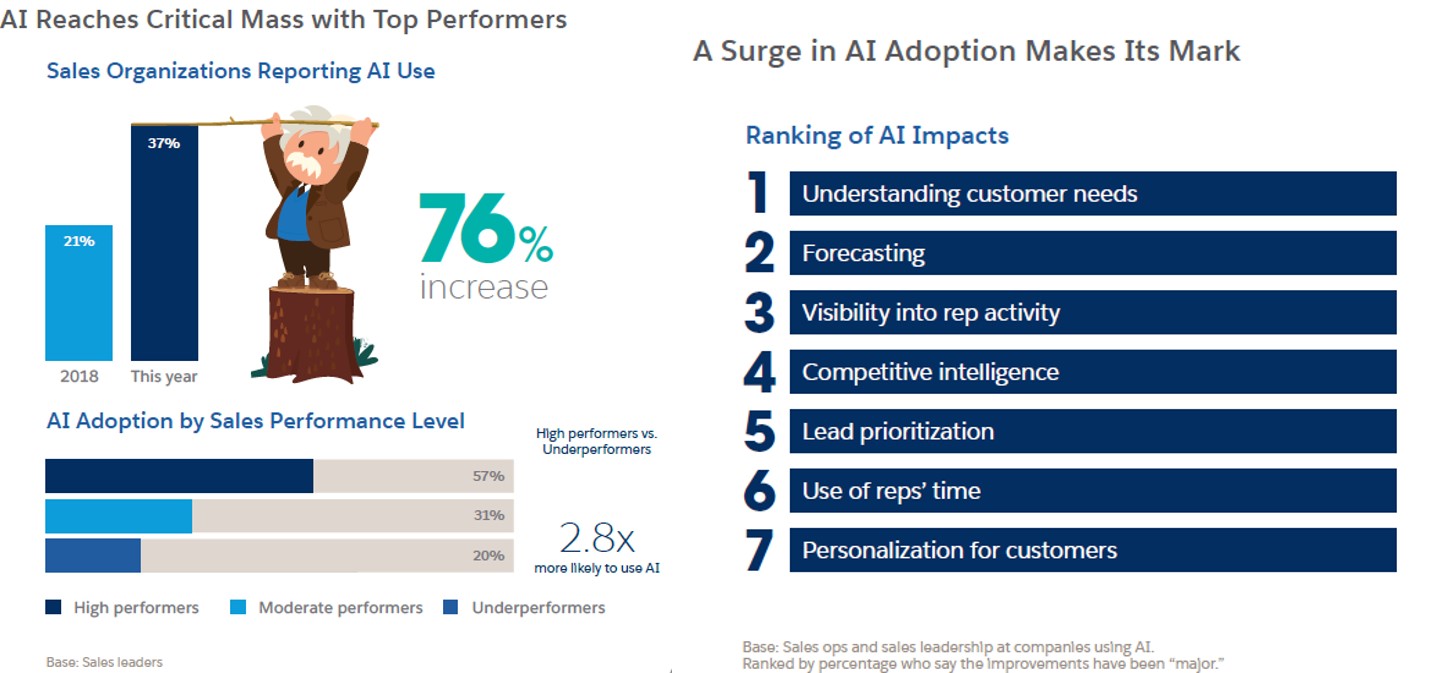
  • Between 2018 and 2020, there’s been a 76% increase in sales professionals using AI-based apps and tools. Salesforce’s latest State of Sales survey found that 57% of high-performance sales organizations use AI today. High-performing sales organizations are 2.8x more likely to use AI than their peers. High-performing sales organizations rely on AI to gain new insights into customer needs, improve forecast accuracy, gain more significant visibility of rep activity, improve competitive analysis, and more. Source: Salesforce Research, 4th Edition, State of Sales, June 2020
2021 Roundup Of AI And Machine Learning Market Forecasts Show Strong Growth
  • While 24% of companies are currently using AI for recruitment, that number is expected to grow, with 56% reporting they plan to adopt AI next year. In addition, Sage’s recent survey of 500 senior HR and people leaders finds adoption of AI as an enabling technology for talent management increasing. AI is proving effective for evaluating job candidates for potential, improving virtual recruiting events, and reducing biased language in job descriptions. It’s also proving effective in helping to improve career planning and mobility. Josh Bersin, a noted HR industry analyst, educator, and technologist, recently published an interesting report on this area titled The Rise of the Talent Intelligence Platform. Leaders in the field of Talent Intelligence Platforms include Eightfold.ai. Grounded in Equal Opportunity Algorithms, the Eightfold® Talent Intelligence Platform uses deep-learning AI to help each person understand their career potential, and each enterprise understands the potential of their workforce.Sources: VentureBeat, 8 ways AI is transforming talent management in 2021, March 25, 2021, and Eightfold.ai.
2021 Roundup Of AI And Machine Learning Market Forecasts Show Strong Growth
  • 84% of marketers are using AI-based apps and platforms today, up from 28% in 2018. Salesforce Research’s latest State of Marketing survey finds that high-performing marketers use an average of seven different applications or use cases. The familiarity high-performing marketers have with AI is a primary factor in 52% of them predicting they will increase their use of AI-based apps in the future. Source: Salesforce Research, 6th Edition, State of Marketing, June 2020
2021 Roundup Of AI And Machine Learning Market Forecasts Show Strong Growth
  • Marketing and Sales lead revenue increases due to AI adoption, yet lag behind other departments on cost savings.  40% of the organizations McKinsey interviewed see between a 6 and 10% increase in revenue from adopting AI in their marketing and sales departments. Adopting Ai to reduce costs delivers the best manufacturing and supply chain management results based on the McKinsey survey results. Revenue increases and cost reductions based on AI adoption are shown in the graphic below. Source: McKinsey & Company, The state of AI in 2020, November 17, 2020
2021 Roundup Of AI And Machine Learning Market Forecasts Show Strong Growth
  • AI sees the most significant adoption by marketers working in $500M to $1B companies, with conversational AI for customer service as the most dominant. Businesses with between $500M to $1B lead all other revenue categories in the number and depth of AI adoption cases. Just over 52% of small businesses with sales of $25M or less use AI for predictive analytics for customer insights. It’s interesting to note that small companies are the leaders in AI spending, at 38.1%, to improve marketing ROI by optimizing marketing content and timing. Source: The CMO Survey: Highlights and Insights Report, February 2019. Duke University, Deloitte, and American Marketing Association. (71 pp., PDF, free, no opt-in).
2021 Roundup Of AI And Machine Learning Market Forecasts Show Strong Growth
  • Three out of four companies are fast-tracking automation initiatives, including AI.  Bain & Company found that executives would like to use AI to reduce costs and acquire new customers, but they’re uncertain about the ROI and cannot find the talent or solutions they need. Bain research conducted in 2019 found that 90% of tech executives view AI and machine learning as priorities that they should be incorporating into their product lines and businesses. But nearly as many (87%) also said they were not satisfied with their Company’s current approach to AI. Source: Bain & Company, Will the Pandemic Accelerate Adoption of Artificial Intelligence? May 26, 2020
2021 Roundup Of AI And Machine Learning Market Forecasts Show Strong Growth
  • Gartner’s Magic Quadrant for Data Science and Machine Learning Platforms predicts a continued glut of exciting innovations and visionary roadmaps from competing vendors. Competitors in the Data Science and Machine Learning (DSML) market focus on innovation and rapid product innovation over pure execution. Gartner said key areas of differentiation include UI, augmented DSML (AutoML), MLOps, performance and scalability, hybrid and multicloud support, XAI, and cutting-edge use cases and techniques (such as deep learning, large-scale IoT, and reinforcement learning). Please see my recent article on VentureBeat, Gartner’s 2021 Magic Quadrant cites ‘glut of innovation’ in data science and ML, March 14, 2021.
2021 Roundup Of AI And Machine Learning Market Forecasts Show Strong Growth
  • 76% of enterprises are prioritizing AI & machine Learning In 2021 IT Budgets. Algorithmia’s survey finds that six in ten (64%) organizations say AI and ML initiatives’ priorities have increased relative to other IT priorities in the last twelve months. Algorithmia’s survey from last summer found that enterprises began doubling down on AI & ML spending last year. The pandemic created a new sense of urgency regarding getting AI and ML projects completed, a key point made by CIOs across the financial services and tech sectors last year during interviews for comparable research studies. Source: Algorithmia’s Third Annual Survey, 2021 Enterprise Trends in Machine Learning.
2021 Roundup Of AI And Machine Learning Market Forecasts Show Strong Growth

Sources of Market Data on Machine Learning:

The Top 20 Machine Learning Startups To Watch In 2021

.
  • There are a record number of 9,977 machine learning startups and companies in Crunchbase today, an 8.2% increase over the 9,216 startups listed in 2020 and a 14.6% increase over the 8,705 listed in 2019.
  • Artificial Intelligence (A.I.) and machine learning (ML)-related companies received a record $27.6 billion in funding in 2020, according to Crunchbase. 
  • Of those A.I. and machine learning startups receiving funding since January 1, 2020, 62% are seed rounds, 31% early-stage venture rounds and 6.7% late-stage venture capital-funded rounds.
  • A.I. and machine learning startups’ median funding round was $4.4 million and the average was $29.8 million in 2020, according to Crunchbase.

Throughout 2020, venture capital firms continued expanding into new global markets, with London, New York, Tel Aviv, Toronto, Boston, Seattle and Singapore startups receiving increased funding. Out of the 79 most popular A.I. & ML startup locations, 15 are in the San Francisco Bay Area, making that region home to 19% of startups who received funding in the last year. Israel’s Tel Aviv region has 37 startups who received venture funding over the last year, including those launched in Herzliya, a region of the city known for its robust startup and entrepreneurial culture.  

The following graphic compares the top 10 most popular locations for A.I. & ML startups globally based on Crunchbase data as of today:


Top 20 Machine Learning Startups To Watch In 2021

Augury – Augury combines real-time monitoring data from production machinery with AI and machine learning algorithms to determine machine health, asset performance management (APM) and predictive maintenance (PdM) to provide manufacturing companies with new insights into their operations. The digital machine health technology that the company offers can listen to the machine, analyze the data and catch any malfunctions before they arise. This enables customers to adjust their maintenance and manufacturing processes based on actual machine conditions. The platform is in use with HVAC, industrial factories and commercial facilities.

Alation – Alation is credited with pioneering the data catalog market and is well-respected in the financial services community for its use of A.I. to interpret and present data for analysis. Alation has also set a quick pace to evolving its platform to include data search & discovery, data governance, data stewardship, analytics and digital transformation. With its Behavioral Analysis Engine, inbuilt collaboration capabilities and open interfaces, Alation combines machine learning with human insight to successfully tackle data and metadata management challenges. More than 200 enterprises are using Alation’s platform today, including AbbVie, American Family Insurance, Cisco, Exelon, Finnair, Munich Re, New Balance, Pfizer, Scandinavian Airlines and U.S. Foods. Headquartered in Silicon Valley, Alation is backed by leading venture capitalists including Costanoa, Data Collective, Icon, Sapphire and Salesforce Ventures.

Algorithmia – Algorithmia’s expertise is in machine learning operations (MLOps) and helping customers deliver ML models to production with enterprise-grade security and governance. Algorithmia automates ML deployment, provides tooling flexibility, enables collaboration between operations and development and leverages existing SDLC and CI/CD practices. Over 110,000 engineers and data scientists have used Algorithmia’s platform to date, including the United Nations, government intelligence agencies and Fortune 500 companies.

Avora – Avora is noteworthy for its augmented analytics platform, making in-depth data analysis intuitively as easy as performing web searches. The company’s unique technology hides complexity, empowering non-technical users to run and share their reports easily. By eliminating the limitations of existing analytics, reducing data preparation and discovery time by 50-80% and accelerating time to insight, Avora uses ML to streamline business decision-making. Headquartered in London with offices in New York and Romania, Avora helps accelerate decision making and productivity for customers across various industries and markets, including Retail, Financial Services, Advertising, Supply Chain and Media and Entertainment.

Boast.ai – Focused on helping companies in the U.S. and Canada recover their R&D costs from respective federal governments, Boast.ai enables engineers and accountants to gain tax credits using AI-based tools. Some of the tax programs Boast.ai works with include US R&D Tax Credits, Scientific Research and Experimental Development (SR&ED) and Interactive Digital Media Tax Credits (IDMTC). The startup has offices in San Francisco, Vancouver and Calgary.

ClosedLoop.ai – An Austin, Texas-based startup, ClosedLoop.ai has created one of the healthcare industry’s first data science platforms that streamline patient experiences while improving healthcare providers’ profitability.  Their machine learning automation platform and a catalog of pre-built predictive and prescriptive models can be customized and extended based on a healthcare provider’s unique population or client base needs. Examples of their technology applications include predicting admissions/readmissions, predicting total utilization & total risk, reducing out-of-network utilization, avoiding appointment no-shows, predicting chronic disease onset or progression and improving clinical documentation and reimbursement. The Harvard Business School, through its Kraft Precision Medicine Accelerator, recently named ClosedLoop.ai as one of the fastest accelerating companies in its Real World Data Analytics Landscapes report.

Databand – A Tel Aviv-based startup that provides a software platform for agile machine learning development, Databand was founded in 2018 by Evgeny Shulman, Joshua Benamram and Victor Shafran. Data engineering teams are responsible for managing a wide suite of powerful tools but lack the utilities they need to ensure their ops are running properly. Databand fills this gap with a solution that enables teams to gain a global view of their data flows, make sure pipelines complete successfully and monitor resource consumption and costs. Databand fits natively in the modern data stack, plugging seamlessly into tools like Apache Airflow, Spark, Kubernetes and various ML offerings from the major cloud providers.

DataVisor – DataVisor’s approach to using AI for increasing fraud detection accuracy on a platform level is noteworthy. Using proprietary unsupervised machine learning algorithms, DataVisor enables organizations to detect and act on fast-evolving fraud patterns and prevent future attacks before they happen. Combining advanced analytics and an intelligence network of more than 4.2B global user accounts, DataVisor protects against financial and reputational damage across various industries, including financial services, marketplaces, e-commerce and social platforms. They’re one of the more fascinating cybersecurity startups using AI today.

Exceed.ai – What makes Exceed.ai noteworthy is how their AI-powered sales assistant platform automatically communicates the lead’s context and enables sales and marketing teams to scale their lead engagement and qualification efforts accordingly. Exceed.ai follows up with every lead and qualifies them quickly through two-way, automated conversations with prospects using natural language over chat and email. Sales reps are freed from performing error-prone and repetitive tasks, allowing them to focus on revenue-generating activities such as phone calls and demos with potential customers.

Indico – Indico is a Boston-based startup specializing in solving the formidable challenge of how dependent businesses are on unstructured content yet lack the frameworks, systems and tools to manage it effectively. Indico provides an enterprise-ready A.I. platform that organizes unstructured content while streamlining and automating back-office tasks. Indico is noteworthy given its track record of helping organizations automate manual, labor-intensive, document-based workflows.  Its breakthrough in solving these challenges is an approach known as transfer learning, which allows users to train machine learning models with orders of magnitude fewer data than required by traditional rule-based techniques. Indico enables enterprises to deploy A.I. to unstructured content challenges more effectively while eliminating many common barriers to A.I. & ML adoption.

LeadGenius – LeadGenius is noteworthy for its use of AI to provide personalized and actionable B2B lead information that helps its clients attain their global revenue growth goals. LeadGenius’s worldwide team of researchers uses proprietary technologies, including AI and ML-based techniques, to deliver customized lead generation, lead enrichment and data hygiene services in the format, methods and frequency defined by the customer. Their mission is to enable B2B sales and marketing organizations to connect with their prospects via unique and personalized data sets.

Netra – Netra is a Boston-based startup that began as part of MIT CSAIL research and has multiple issued and pending patents on its technology today. Netra is noteworthy for how advanced its video imagery scanning and text metadata interpretation are, ensuring safety and contextual awareness. Netra’s patented A.I. technology analyzes videos in real-time for contextual references to unsafe content, including deepfakes and potential cybersecurity threats. 

Particle –  Particle is an end-to-end IoT platform that combines software including A.I., hardware and connectivity to provide a wide range of organizations, from startups to enterprises, with the framework they need to launch IoT systems and networks successfully.  Particle customers include Jacuzzi, Continental Tires, Watsco, Shifted Energy, Anderson EV, Opti and others. Particle is venture-backed and has offices in San Francisco, Shenzhen, Las Vegas, Minneapolis and Boston. Particle’s developer community includes over 200,000 developers and engineers in more than 170 countries today.

RideVision – RideVision was founded in 2018 by motorcycle enthusiasts Uri Lavi and Lior Cohen. The company is revolutionizing the motorcycle-safety industry by harnessing the strength of artificial intelligence and image-recognition technology, ultimately providing riders with a much broader awareness of their surroundings, preventing collisions and enabling bikers to ride with full confidence that they are safe. RideVision’s latest round was $7 million in November of last year, bringing their total funding to $10 million in addition to a partnership with Continental AG.

Savvie – Savvie is an Oslo-based startup specializing in translating large volumes of data into concrete actions that bakery and café owners can utilize to improve their bottom line every day.  In doing so, we help food businesses make the right decisions to optimize their operations and increase profitability while reducing waste at its source. What’s noteworthy about this startup is how adept they are at fine-tuning ML algorithms to provide their clients with customized recommendations and real-time insights about their food and catering businesses.  Their ML-driven insights are especially valuable given how bakery and café owners are pivoting their business models in response to the pandemic.

SECURITI.ai – One of the most innovative startups in cybersecurity, combining AI and ML to secure sensitive data in multi-cloud and mixed platform environments, SECURITI.ai is a machine learning company to watch in 2021, especially if you are interested in cybersecurity.  Their AI-powered platform and systems enable organizations to discover potential breach risk areas across multi-cloud, SaaS and on-premise environments, protect it and automate all private systems, networks and infrastructure functions.

SkyHive – SkyHive is an artificial intelligence-based SaaS platform that aims to reskill enterprise workforces and communities. It develops and commercializes a methodology, Quantum Labor Analysis, to deliver real-time, skill-level insights into internal workforces and external labor markets, identify future and emerging skills and facilitate individual-and company-level reskilling. SkyHive is industry-agnostic and supporting enterprise and government customers globally with a mission to reduce unemployment and underemployment. Sean Hinton founded the technology company in Vancouver, British Columbia, in 2017.

Stravito – Stravito is an A.I. startup that’s combining machine learning, Natural Language Processing (NLP) and Search to help organizations find and get more value out of the many market research reports, competitive, industry, market share, financial analysis and market projection analyses they have by making them searchable. Thor Olof Philogène and Sarah Lee founded the company in 2017, who identified an opportunity to help companies be more productive, getting greater value from their market research investments. Thor Olof Philogène and Andreas Lee were co-founders of NORM, a research agency where both worked for 15 years serving multinational brands, eventually selling the company to IPSOS. While at NORM, Anders and Andreas were receiving repeated calls from global clients that had bought research from them but could not find it internally and ended up calling them asking for a copy. Today the startup has Carlsberg, Comcast, Colruyt Group, Danone, Electrolux, Pepsi Lipton and others. Stravito has offices in Stockholm (H.Q.), Malmö and Amsterdam.

Verta.ai – Verta is a startup dedicated to solving the complex problems of managing machine learning model versions and providing a platform to launch models into production. Founded by Dr. Manasi Vartak, Ph.D., a graduate of MIT, who led a team of graduate and undergraduate students at MIT CSAIL to build ModelDB, Verta is based on their work define the first open-source system for managing machine learning models. Her dissertation, Infrastructure for model management and model diagnosis, proposes ModelDB, a system to track ML-based workflows’ provenance and performance. In August of this year, Verta received a $10 million Series A round led by Intel Capital and General Catalyst, who also led its $1.7 million seed round. For additional details on Verta.ai, please see How Startup Verta Helps Enterprises Get Machine Learning Right. The Verta MLOps platform launch webinar provides a comprehensive overview of the platform and how it’s been designed to streamline machine learning models into production:

V7 – V7 allows vision-based A.I. systems to learn continuously from training data with minimal human supervision. The London-based startup emerged out of stealth in August 2018 to reveal V7 Darwin, an image labeling platform to create training data for computer vision projects with little or no human involvement necessary. V7 specializes in healthcare, life sciences, manufacturing, autonomous driving, agri-tech, sporting clients like Merck, GE Healthcare and Toyota. V7 Darwin launched at CVPR 2019 in Long Beach, CA. Within its first year, it has semi-automatically annotated over 1,000 image and video segmentation datasets. V7 Neurons is a series of pre-trained image recognition applications for industry use. The following video explains how V7 Darwin works:


5 Mistakes That Threaten Infrastructure Cybersecurity And Resilience

5 Mistakes That Threaten Infrastructure Cybersecurity And Resilience


Bottom line: With many IT budgets under scrutiny, cybersecurity teams are expected to do more with less, prioritizing spending that delivers the greatest ROI while avoiding the top five mistakes that threaten their infrastructures.

In a rush to reduce budgets and spending, cybersecurity teams and the CISOs that lead them need to avoid the mistakes that can thwart cybersecurity strategies and impede infrastructure performance. Cutting budgets too deep and too fast can turn into an epic fail from a cybersecurity standpoint. What I’ve found is that CIOs are making decisions based on budget requirements, while CISOs are looking out for the security of the company.

Based on their ongoing interviews with CIOs, Gartner is predicting an 8% decline in worldwide IT spending this year. Cybersecurity projects that don’t deliver a solid ROI are already out of IT budgets. Prioritizing and trimming projects to achieve tighter cost optimization is how CIOs and their teams are reshaping their budgets today. CIOs say the goal is to keep the business running as secure as possible, not attain perfect cybersecurity.

Despite the unsettling, rapid rise of cyber-attacks, including a 667% increase in spear-fishing email attacks related to Covid-19 since February alone, CIOs often trim IT budgets starting with cybersecurity first. The current economic downturn is making it clear that cybersecurity is more of a business strategy than an IT one, as spending gets prioritized by the best-to-worst business case.

Five Mistakes No CISO Wants To Make

One of the hardest parts of a CISO’s job is deciding which projects will continue to be funded and who will be responsible for leading them, so they deliver value. It gets challenging fast when budgets are shrinking and competitors actively recruit the most talented team members. Those factors taken together create the perfect conditions for the five mistakes that threaten the infrastructure cybersecurity and resilience of any business.

The five mistakes no CISO wants to make include the following:

1.   No accountability for the crown jewels for the company. Privileged access credentials continue to be the primary target for cyber-attackers. However, many companies just went through a challenging sprint to make sure all employees have secure remote access to enable Covid-19 work-from-home policies. Research by Centrify reveals that 41% of UK businesses aren’t treating outsourced IT and other third parties likely to have some form of privileged access as an equal security concern.

And while a password vault helps rotate credentials, it still relies on shared passwords and doesn’t provide any accountability to know who is doing what with them. That accountability can be introduced by moving to an identity-centric approach where privileged users log in as themselves and are authenticated using existing identity infrastructures (such as Microsoft Active Directory) to federate access with Centrify’s Privileged Access Service.

CISOs and their teams also continue to discount or underestimate the importance of privileged non-human identities that far outweigh human users as a cybersecurity risk in today’s business world. What’s needed is an enterprise-wide approach enabling machines to protect themselves across any network or infrastructure configuration.

2.   Cybersecurity budgets aren’t revised for current threatscapes. Even though many organizations are still in the midst of extensive digital transformation, their budgets often reflect the threatscape from years ago. This gives hackers the green light to get past antiquated legacy security systems to access and leverage modern infrastructures, such as cloud and DevOps. IT security leaders make this even more challenging by not listening to the front-line cybersecurity teams and security analysts who can see the patterns of breach attempts in data they review every day. In dysfunctional organizations, the analyst teams are ignored and cybersecurity suffers.

3. Conflicts of interest when CISOs report to CIOs and the IT budget wins.  This happens in organizations that get hacked because the cybersecurity teams aren’t getting the tools and support they need to do their jobs. With IT budgets facing the greatest scrutiny they’ve seen in a decade, CISOs need to have their budget to defend. Otherwise, too many cybersecurity projects will be cut without thinking of the business implications of each. The bottom line is CISOs need to report to the CEO and have the autonomy to plan, direct, evaluate and course-correct their strategies with their teams.

4. The mistake of thinking cloud platforms’ Identity and Access Management (IAM) tools can secure an enterprise on their own. Cloud providers offer a baseline level of IAM support that might be able to secure workloads in their clouds adequately but is insufficient to protect a multi-cloud, hybrid enterprise. IT leaders need to consider how they can better protect the complex areas of IAM and Privileged Access Management (PAM) with these significant expansions of the enterprise IT estate.

Native IAM capabilities offered by AWS, Microsoft Azure, Google Cloud and other vendors provide enough functionality to help an organization get up and running to control access in their respective homogeneous cloud environments. However, often they lack the scale to fully address the more challenging, complex areas of IAM and PAM in hybrid or multi-cloud environments. Please see the post, The Truth About Privileged Access Security On AWS and Other Public Clouds, for additional information.

5. Exposing their organizations to a greater risk of breach and privileged access credential abuse by staying with legacy password vaults too long. Given the severity, speed and scale of breach attempts, IT leaders need to re-think their vault strategy and make them more identity-centric. Just as organizations have spent the past 5 – 10 years modernizing their infrastructure, they must also consider how to modernize how they secure access to it. More modern solutions can enforce a least privilege approach based on Zero Trust principles that grant just enough, just-in-time access to reduce risk. Forward-thinking organizations will be more difficult to breach by reorienting PAM from being vault-centric to identity-centric.

Conclusion

Decisions about what stays or goes in cybersecurity budgets this year could easily make or break careers for CISOs and CIOs alike. Consider the five mistakes mentioned here and the leading cause of breaches – privileged access abuse. Prioritizing privileged access management for human and machine identities addresses the most vulnerable threat vector for any business. Taking a more modern approach that is aligned to digital transformation priorities can often allow organizations to leverage their existing solutions to reduce risk and costs at the same time.


Machine Learning Engineer Is The Best Job In The U.S. According To Indeed

  • Machine Learning Engineer job openings grew 344% between 2015 to 2018, and have an average base salary of $146,085.
  • At $158,303, Computer Vision Engineers earn among the highest salaries in tech
  • The average base salary of the 25 best jobs in the U.S. according to Indeed is $104,825, and the median base salary is $99,007.
  • Agile Coach is the highest paying job with an average base salary of $161,377.
  • 9 of the top 25 jobs in the U.S. this year are in tech fields according to Indeed.
  • Five jobs are heavily dependent on applicants’ Artificial Intelligence (AI) skills and expertise.

These and many other insights are from this Indeed’s The Best Jobs in the U.S.: 2019 study released this week. Indeed defined the best jobs as those experiencing the fastest growth measured by the increase in job postings between 2015 and 2018, in conjunction with those offering the highest pay using a baseline salary of $75,000. Indeed’s best jobs of 2019’s data set is available here in Microsoft Excel.

Key insights from Indeed’s ranking of the best jobs of 2019 include the following:

  • At $158,303, Computer Vision Engineers earn among the highest salaries in tech according to Indeed, followed Machine Learning Engineers with a base salary of $146,085. The average base pay of the nine tech-related jobs that made Indeed’s list is $122,761, above the median salary of $99,007 for the entire group of the top 25 jobs. Indeed’s top 25 jobs for 2019 are illustrated below in descending salary order with the median salary providing a benchmark across the group. Please click on the graphic to expand for easier reading.

  • Three of the top 10 fastest growing jobs as measured by percentage growth in the number of job postings are in tech. From 2015 to 2018, job postings for Machine Learning Engineers grew 344%, followed by Full-stack developers (206%) and Salesforce developers (129%). In aggregate, all nine technology-related job postings increased by 146% between 2015 and 2018. The graphic below illustrates the percentage of growth in the number of postings between 2015 and 2018. Please click on the graphic to expand for easier reading.

  • Comparing average base salary to percentage growth in job postings underscores the exceptionally high demand for Machine Learning Engineers in 2019. Technical professionals with machine learning expertise today are in an excellent position to bargain for the average base salary of at least $146,085 or more. Full-stack developers and Salesforce developers are in such high demand, technical professionals with skills on these areas combined with experience can command a higher salary than the average base salary. The following graphic compares the average base salary to percentage growth in job postings for the years 2015 – 2018. Please click on the graphic to expand for easier reading.