Skip to content

Posts from the ‘AI Market Forecasts’ Category

Capgemini report finds top 10 ways enterprises are harnessing the value of GenAI

Capgemini report finds top 10 ways enterprises are harnessing the value of GenAI


Eighty percent of enterprises have increased their investment in GenAI over the past year, with nearly one-quarter (24%) now integrating the technology into their operations, up from just 6% in the previous year.

Capgemini Research Institute’s recent report, Harnessing the value of generative AI: 2nd edition: Top use cases across sectors, highlights enterprises’ accelerating pace of GenAI adoption and growing importance across their operations and industries.

“Generative AI is not just a technological innovation; it’s a catalyst for transformative change across multiple sectors, driving productivity gains, operational efficiency, and strategic shifts in business models,” write the report’s authors. Enterprise leaders’ sentiment underscores the increasing recognition of GenAI as a critical technology for staying competitive in an increasingly turbulent economic environment.

According to the report, GenAI’s rapid adoption across IT and marketing indicates that companies are actively integrating it into their core operations to drive tangible, measurable benefits. Capgemini’s findings highlight the need for a strong data governance framework, strategic talent development, and vigilant cybersecurity to maximize GenAI’s potential as companies scale their initiatives.

How enterprises are maximizing GenAI’s value

Capgemini found ten key ways enterprises are positioning themselves to maximize GenAI’s potential. These strategies demonstrate how all companies can potentially invest in and integrate GenAI to boost growth, efficiency, and innovation across departments and industries.

Investment surge reflects growing confidence in GenAI. 89% of large businesses with annual revenues over $20 billion are leading this investment surge, highlighting GenAI’s significance for future growth. Additionally, 73% of companies with revenues between $1 billion and $5 billion have significantly increased their GenAI budgets, showing that this trend is not limited to the largest companies. This investment trend indicates that many companies believe GenAI can drive enterprise evolution and deliver substantial returns, with many expecting double-digit productivity and customer engagement growth.

GenAI maturity grows steadily across industries. GenAI implementations have continued to mature across industry sectors over the past year. Up from 6% in 2023, 18% of organizations will fully integrate GenAI into most or all functions in 2024. With 64% and 53% of companies enabling GenAI, high-tech and financial services lead. Retail grew 17%–40% and industrial manufacturing 14%–35%. With 53% and 47% of telecom and energy/utilities adopting GenAI, respectively, progress has been made.

GenAI’s integration across organizational functions is growing. In one year, GenAI IT adoption rose from 4% to 27% across organizational functions. GenAI is improving enterprise productivity and innovation through this broad integration across sales, marketing, operations, and R&D. Capgemini also found that GenAI is transforming operations and creating value across all business areas.

Productivity and customer engagement gains. Over the last year, organizations that have implemented GenAI have reported a 7.8% increase in productivity and a 6.7% increase in customer engagement. These tangible benefits demonstrate GenAI’s ability to provide real, measurable value to enterprises. Early adopters report significant improvements in key performance metrics, highlighting the strategic importance of incorporating GenAI into business operations.

Small Language Models (SLM) are gaining momentum. 24% of organizations have implemented SLMs, and 56% plan to do so within three years. These models are cheaper and less computationally intensive than larger AI models, so many companies are piloting and eventually moving them into production. SLMs excel in industry-specific applications, allowing businesses to harness AI’s potential without the infrastructure and resource demands of larger models. SLMs are becoming a good option for companies trying to compete in an AI-driven market as they seek efficient and scalable AI solutions.

GenAI is enabling enterprises to advance from chatbots to autonomous multi-agent systems. GenAI is helping 62% of organizations upgrade from chatbots to AI agents that autonomously manage complex goals. 48% of users use multi-agent systems, where AI agents operate independently in changing environments. As businesses automate and optimize complex processes with these systems, decision-making and operational efficiency improve across industries. AI has evolved from simple user interactions to complex, agentic use cases, as shown in the image.

GenAI agents are accelerating the shift to autonomous operations. GenAI agents are increasingly used in enterprise automation, with 82% of companies planning to implement them in 1–3 years. These agents are evolving from supportive tools to autonomous entities that can perform complex tasks without interaction. This shift is significant, with 71% of organizations expecting AI agents to automate workflows and 64% expecting customer service and productivity improvements. AI agents are not just efficient; they are a radical shift toward fully autonomous, AI-driven operations that will transform enterprise productivity and strategic decision-making.

GenAI is forcing major business strategy shifts. 54% of companies expect GenAI to improve their strategies, up from 39% in 2023. 40% of companies are revising their business models to stay competitive as GenAI becomes more important. As GenAI becomes more important, 74% of businesses believe they must use it to grow revenue and stay ahead of the competition.

Strengthening data foundations is crucial for GenAI’s success. More than 60% of companies realize GenAI’s potential depends on solid data foundations. Only 51% have documented data integration processes and 46% have AI data management policies. Even enterprises that have adopted GenAI still struggle to make the most of all their external data sources. Capgemini makes it clear that for GenAI initiatives to succeed, companies need scalable, secure data infrastructure.

Tighten AI controls or risk trust and compliance. Ethics in AI deployment is a priority for 57% of organizations, which recognize the need for control mechanisms that can flex and adapt as their business goals change. While 46% have clear AI governance frameworks, 73% agree that human oversight is necessary to validate AI-driven decisions. Without strong governance, bias, and accountability issues could counteract GenAI’s benefits, so organizations must act now.

Conclusion

With 80% of organizations increasing their investment and almost a quarter already including it in their operations, GenAI is fast changing how businesses run. This general acceptance emphasizes GenAI’s importance as a main engine of efficiency and creativity, providing real advantages in customer interaction and output.

Organizations are not only embracing GenAI as AI agents and Small Language Models (SLMs) acquire traction; they are also including GenAI in their basic strategies. Those who match GenAI with their business models, make investments in solid data foundations, and develop the knowledge required to maximize its possibilities will inherit the future. They will lead in the era of artificial intelligence by doing this, establishing new benchmarks for operational excellence and creativity.

BCG Shares Their Insights On What Sets GenAI’s Top Performers Apart

BCG Shares Their Insights On What Sets GenAI's Top Performers Apart

image created in DALL-E

The top 10% of enterprises have one or more GenAI applications in production at scale across their organizations. 44% of these top-performing organizations are realizing significant value from scaled predictive AI cases. 70% of top performers explicitly tailor their GenAI projects to create measurable value.

Boston Consulting Group (BCG) estimates that an organization with $20 billion in revenue can achieve gains of $500 million to $1 billion in profit using GenAI, with nearly a third of those gains coming in the first 18 months. Their recent analysis of what sets GenAI’s top performers apart, What GenAI’s Top Performers Do Differently, looks at the factors that most differentiate enterprises excelling with GenAI today.

What further differentiates these top performers from others is how they’re looking to use GenAI to redefine the functional areas of their organizations. They’re far more likely to have a solid foundation in predictive AI and four times more likely to increase their investment in AI and digital-first strategies and technologies.

Half of the enterprise leaders BCG interviewed say their organizations are testing GenAI in pilot projects today but have not achieved full-scale implementation. The remaining 40% haven’t taken any action on GenAI yet.

BCG Shares Their Insights On What Sets GenAI's Top Performers Apart

Source: Boston Consulting Group, What GenAI’s Top Performers Do Differently.

What Sets The Top 10% Apart

Two-thirds of GenAI’s top-performing enterprises aren’t digital natives like Amazon or Google but instead leaders in biopharma, energy, and insurance. BCG found that a U.S.-based energy company launched a GenAI-driven conversational platform to assist frontline technicians, increasing productivity by 7%. A biopharma company is reimagining its R&D function with GenAI and reducing drug discovery timelines by 25%.

Top GenAI performers have their greatest lead over peers across five main capabilities. These capabilities include having a clear link to business performance, modern technology infrastructure, strong data capabilities, leadership support, and a grounding in responsible AI. The steep curves shown in the graphic below suggest how these five most differentiated capabilities are essential for successful GenAI adoption at scale.

BCG Shares Their Insights On What Sets GenAI's Top Performers Apart

Source: Boston Consulting Group, What GenAI’s Top Performers Do Differently.

Key takeaways from BCG’s analysis of GenAI top performers 

Top performers excel at creating strong links between GenAI initiatives and business value. Seven in ten enterprises who are high achievers know how to build a business case for their GenAI projects and pilots. They’re focused on measuring results and quantifying value. BCG found that in a typical GenAI portfolio, 60% of the initiatives are focused on reducing costs and 40% on increasing revenue.

An all-in mindset when it comes to maintaining and growing a modern technology infrastructure. GenAI top-performing enterprises are three times more likely to already have a modular, modern IT tech stack and supporting infrastructure in place. They’re focused on being prepared to develop new, GenAI-powered services on their current and future AI models while supporting DevOps. BCG says top performers are 1.5 times more likely to focus on building the GenAI stack internally over the coming three years, underscoring their desire to make the technology a core capability for the organizations.

Are pursuing and advanced data strategy that includes unstructured data. GenAI top performers are two times more likely to have data pipelines and data management practices in place to streamline data sourcing and storage. They’re also more likely to have unstructured data expertise. BCG observes that an advanced data strategy “is a critical element of GenAI, given that models are only as strong as the data on which they’re trained.”  Organizations have found success with less mature skills in these areas, although it may take longer as they need to address infrastructure and data strategy gaps or shortcomings.

Strong leadership support for innovation, including the willingness to champion GenAI. Senior executives’ support and prioritizing an innovative culture are the most differentiating factors in defining GenAI’s high performers. Gen AI high performers who are scaling use cases are three times more likely than no-action companies to have leaders who prioritize innovation and actively support GenAI. BCG notes that these leaders often have a deep understanding of the technology’s potential impact on their industry, and they are publicly committed to ensuring that the organization capitalizes on it in new ways that generate value. “Visible support and commitment from our leadership team has been crucial, as it provided the freedom to experiment and deal with failures along the way,” said the head of data and analytics at a global media company referenced in BCG’s report.

Have responsible AI guidelines, guardrails and processes in place. Top-performing enterprises are more likely to have responsible AI frameworks, guidelines, and guardrails in place. BCG observes that a common trait top-performing enterprises have is ensuring their AI systems and workflows put humans in the loop and use only factual data. “Our research shows that leading companies are far more likely to have developed guardrails, guidelines, and policies to ensure that they follow the principles of responsible AI. In the findings, the share of scaling companies that are cautious about the potential misuse of GenAI and taking proactive measures to address these risks is 20 percentage points higher than the share of companies taking no action in this area,” write BCG’s researchers.

Gartner Predicts Solid Growth for Information Security, Reaching $287 Billion by 2027

Gartner Predicts Solid Growth for Information Security, Reaching $287 Billion by 2027

Image created in DALL-E

AI continues to become more weaponized with nation-state attackers and cybercrime gangs experimenting with LLMs and gen AI-based attack tradecraft. The age of weaponized LLMs is here.

At the same time, multi-cloud-based infrastructures more businesses rely on are coming under attack. Exfiltrating any identity data available from endpoints and then traversing a network to gain more access by collecting more credential data is often the goal.

Cyberattacks that combine AI and social engineering are just beginning  

Attackers have a version of human-in-the-middle, too, but their goal is to unleash AI’s offensive attack capabilities within social engineering campaigns. Last year’s social engineering-based attacks on MGM, Comcast, Shield Healthcare Group, and others serve as a case in point.

CrowdStrike’s 2024 Global Threat Report finds that cloud intrusions jumped 75% last year. There was a 76% increase in data theft victims named on data leak sites and a 60% increase in interactive intrusion campaigns. Worse, 75% of attacks were malware-free, making them difficult to identify and stop. There was also a 110% YoY increase in cloud-conscious cases.

PwC’s 2024 Digital Trust Insights Report finds that 97% of senior management teams have gaps in their cloud risk management plans. 47% say cloud attacks are their most urgent threat. One in three senior management teams is prioritizing cloud security as their top investment this year.

Gartner sees a more complex threatscape driving growth

Gartner’s Forecast: Information Security and Risk Management, Worldwide, 2021-2027, 4Q23 Update report predicts the information security and risk management market will grow from $185 billion in 2023 to $287 billion in 2027, attaining a compound annual growth rate of 11% in constant currency.

Nation-state attackers are picking up the pace of their stealthy AI arms race. They’re looking to score offensive first victories on an increasingly active digital battlefield. Gartner predicts that in 2027, 17% of the total cyberattacks and data leaks will involve generative AI.

Another key assumption driving Gartner’s latest forecast is that by 2025, user efficiency improvements will drive at least 35% of security vendors to offer large language model (LLM)-driven chat capabilities for users to interact with their applications and data, up from 1% in 2022.

Gartner has also factored in the surge in cloud attacks and the continued growth of hybrid workforces. One of their key assumptions driving the forecast is that “by the end of 2026, the democratization of technology, digitization, and automation of work will increase the total available market of fully remote and hybrid workers to 64% of all employees, up from 52% in 2021.”

Gartner Predicts Solid Growth for Information Security, Reaching $287 Billion by 2027

Source: Gartner, Forecast Analysis: Information Security and Risk Management, Worldwide, Published February 29, 2024

Source: Gartner, Forecast Analysis: Information Security and Risk Management, Worldwide, Published 29 February 2024

Key takeaways from Gartner’s forecast

Market subsegments predicted to see the most significant growth through 2027 include the following:

  • Gartner has high expectations for Zero Trust Network Access (ZTNA) growth, stating the worldwide market was worth $575.7 million in 2021 and predicting it will soar to $3.99 billion in 2027, attaining a 31.6% CAGR in the forecast period.
  • Identity Access Management (IAM) is predicted to grow from $4 billion in 2021 to $11.1 billion in 2027, attaining a 17.6% CAGR. Identity Governance and Administration software is predicted to grow from $2.8 billion in 2021 to $5.77 billion in 2027, attaining a 12.8% CAGR.
  • Endpoint Protection Platforms (EPP) are predicted to grow from $9.8 billion in 2021 to $26.9 billion in 2027, achieving a 17.2% CAGR.
  • Threat Intelligence software is predicted to grow from $1.1 billion in 2021 to $2.79 billion in 2027, growing at a 15.6% CAGR through the forecast period.
  • Cloud Access Security Brokers (CASB) is predicted to grow from $928M in 2021 to $4.75 billion in 2027, attaining a CAGR of 30.2%. Gartner believes that the market share of cloud-native solutions will continue to grow. They are predicting that the combined market for cloud access security brokers (CASBs) and cloud workload protection platforms (CWPPs) will reach $12.8 billion in constant currency by 2027, up from $4.6 billion in 2022. Gartner continues to also see strong demand for cloud-based detection and response solutions that include endpoint detection and response (EDR) and managed detection and response (MDR).

IT And Marketing Show Strongest Interest In Adopting Gen AI First

IT, Marketing Show Strongest Interest In Adopting Gen AI First

  • Currently, 16% of organizations have implemented generative AI in production, while 44% are piloting it for potential applications.
  • Interest in deploying generative AI for production applications saw a fivefold increase from the first to the fourth quarter of 2023.
  • Healthcare, manufacturing, and education are the three industries most actively pursuing generative AI adoption.
  • A majority of organizations, 63%, deem CRM data critical to their generative AI initiatives.

These and many other insights are from Dresner Advisory Services‘ recent Generative AI Report. The advisory firm surveyed its research community of over 8,000 organizations and vendors’ customer communities. The study is global in scope, with 50% of respondents from North America, 26% from EMEA, 19% from Asia/Pacific and 6% from Latin America. Dresner’s report stands out for its in-depth and nuanced analysis of gen AI adoption across global organizations.

News about generative AI has captivated technology leaders. Demand for gen AI-related news and insights dominates many organization leaders’ time. 29% are following gen AI news updates constantly, and 30% say they often check in and see what’s new in gen AI, 24% regularly check the news. Overall, 72% of analytics and business intelligence (BI) professionals have made gen AI news a priority. North American respondents are the most diligent with constantly checking gen AI news, reflecting the region having the highest production use of gen AI.

Key takeaways from the report include the following:

Professionals in IT and marketing report plans to be the first adopters of generative AI, with 44% of IT and 36% of marketing professionals saying adopting gen AI is a primary focus. Operations/ production, sales, and C-level executives also show significant interest in adopting gen AI early. Dresner’s report states that “finance and human resources least often indicate overall interest, exceeding a majority only when aggregating their primary, secondary, and tertiary responses.”

gen ai

63% of organizations consider CRM data as critical or very important to generative AI. Finance and accounting data is considered the next most important, followed by call center and supply chain data. Dresner’s analysis found that respondents least often expect generative AI to leverage workforce (HR) data. Organizations are wary of using HR data due to privacy concerns combined with the stringent standards and safeguards on data security and its use across regulated industries today.

gen ai

Gen AI adoption across organizations accelerated rapidly in 2023. From 1Q23 to 4Q23, production use increased nearly fivefold, experimenting increased by 70%, and planned use in 12 months increased by 157%. Dresner’s research results reflect a major shift in generative AI prioritization last year. The report’s authors contend that implementation activity and funding were primarily from autonomous, decentralized sources, not from C-level mandates or sponsors, as it occurred late in fiscal years and into annual budget cycles.

gen ai

Consumer services lead gen AI production levels at 43%. Technology, business services, and healthcare have the next three highest levels of gen AI production in use today. The education industry reports the highest experimentation rate at 67%, closely followed by healthcare at 62%, while government trails at 50%. The report notes that the government also reports the highest levels for planned use beyond 12 months and no planned use.

gen ai

40% of organizations consider it critical to achieve productivity and efficiency gains from gen AI. One in three (30%) say improving customer experience and personalization is the next most critical priority, followed by improved search quality and decision-making (26%).

gen ai

Data privacy concerns are considered critical to 46% of organizations pursuing gen AI initiatives today. Legal and regulatory compliance, the potential for unintended consequences, and ethics and bias concerns are also significant. Less than half of respondents—46% and 43%, respectively—consider costs and organizational policy important to generative AI adoption.

gen ai


Top 10 Insights From Forrester’s State of Generative AI in 2024 Report

Top 10 Insights From Forrester's State of Generative AI in 2024 Report

Created with DALL-E

Over 90% of enterprise AI decision-makers have concrete plans to adopt generative AI (gen AI) for internal and customer-facing use cases. Nearly half, 47%, say productivity gains are the primary goal. Those anticipated gains are closely followed by greater innovation (44%) and cost efficiency (41%). One in three, or 34%, expect AI to deliver greater revenue growth.

Productivity gains are happening faster than enterprises can track because Shadow AI is growing quicker than many IT and security teams anticipated. OpenAI says their enterprise adoption is soaring, with over 80% of Fortune 500 companies’ workers and departments having accounts.

Enterprise workers are achieving a 40% performance boost thanks to ChatGPT based on a recent Harvard study. A second study from MIT discovered that ChatGPT reduced skill inequalities and accelerated document creation times while enabling enterprise workers to be more efficient with their time. Seventy percent haven’t told their bosses about it.

Forrester: A Wave Of Disruption Is Coming

Forrester’s recent report, The State of Generative AI, 2024, warns enterprises not to discount the impact of generative AI on their operations and to start planning for greater experimentation, governance, and security now.

Get ready for the challenges of defining and managing bring your own AI (BYOAI) as workers are inventing and adopting gen AI tools and apps faster than IT or security can keep up. Forrester advises that enterprises need to have forward-thinking governance and security guardrails in place before launching their AI-based apps.

With nearly every enterprise app and platform integrating gen AI into its feature set, it’s up to IT, security, and senior management to have an AI plan that can adapt and flex fast to the fast-growing feature set gen AI is delivering.

Enterprise AI leaders also need to define where they stand on the controversial and complex state of model training data. Forrester says that questions regarding the quality of training data using copyright material, model and data bias, and frequent “hallucinations” by models.

“In 2024, as organizations embrace the generative AI (genAI) imperative, governance and accountability will be a critical component to ensure that AI usage is ethical and does not violate regulatory requirements,” writes Forrester in their cybersecurity predictions late last year. “This will enable organizations to safely transition from experimentation to implementation of new AI-based technologies,” the report continues.

Top 10 Insights From Forrester’s State of Generative AI

The ten most valuable insights from Forrester’s State of Generative AI report provide a comprehensive overview of the current and future landscape of generative AI. Noteworthy for its balance between opportunities and risks, the report explains the hurdles in front of enterprises looking to gain value from gen AI now and in the future.

Here are the top 10 insights from the report:

Gen AI shows strong potential to improve and scale enterprise operations. Forrester is optimistic regarding the potential of gen AI to increase productivity and deliver measurable business value. “Forrester expects that gen AI will add convenience to and remove friction from a variety of experiences, reshape jobs in ways we are only beginning to contemplate and disrupt organizations and industries,” writes Forrester’s research team in the report. The report explains that there are three broad tiers of generative AI suppliers, further supporting the market’s expansion and growth.

Top 10 Insights From Forrester's State of Generative AI in 2024 Report

Source: Forrester, The State of Generative AI, 2024 report. January 26, 2024


Large Language Models will continue to dominate the gen AI narrative. Large language models (LLMs), including Anthropic, Google, Meta, and OpenAI’s GPT series, will continue to dominate the gen AI landscape. Forrester notes that significant data and infrastructure requirements make the task of creating and maintaining an LLM difficult for companies considering competing in the market. Open-source LLMs are redefining the market, a point Forrester touches on briefly.

Gen AI is becoming part of planning cycles in enterprises: Forrester found that over 90% of global enterprise AI decision-makers have definite plans to implement generative AI. Internal use cases are dominating the planning cycles of enterprise AI leaders today.

Top 10 Insights From Forrester's State of Generative AI in 2024 Report

Source: Forrester, The State of Generative AI, 2024 report. January 26, 2024

Overcoming technical skills shortages and integration challenges stand in the way of achieving benefits. A third of enterprise AI leaders say that lack of technical skills in their organizations is the single greatest roadblock to their gaining the benefits they’re looking for from gen AI. Twenty-eight percent say they’re having difficulty integrating gen AI into their existing tech stacks and infrastructure. The potential to gain significant benefits from gen AI motivates enterprise AI leaders to look for new ways to overcome technical skills shortages and find new ways to integrate gen AI into their infrastructure.

Top 10 Insights From Forrester's State of Generative AI in 2024 Report

Source: Forrester, The State of Generative AI, 2024 report. January 26, 2024

Ethical and safe gen AI use will require new cybersecurity and governance approaches. Enterprises need to decide how they approach the most challenging and controversial aspects of LLMs, gen AI, and the future of AI at scale in their companies now rather than later. The core message of Forrester’s report is for enterprises not to procrastinate but to start making plans now for their stance on the issues of model bias, data security, regulatory compliance, and ethics of model training.

Weaponized LLMs are a fact of life for every enterprise looking to adopt these technologies today. There’s also the growing threat of intellectual property and confidential data being accidentally shared with LLMs via ChatGPT and comparable chatbots. The intensity cybersecurity providers are putting behind this problem makes it one of the fastest evolving areas in the industry today.

While not mentioned by Forrester in their report, these vendors are defining the state of the art when it comes to protecting confidential data being entered into LLMs. Cisco, Ericom Security by Cradlepoint’s Generative AI isolation, Menlo Security, Nightfall AI,  Wiz, and Zscaler have all developed and launched solutions to reduce the threat of confidential data making it into LLMs via chatbots.

The use of a virtual browser that is separate from an organization’s network environment in the Ericom Cloud distinguishes Ericom’s Generative AI Isolation. Data loss protection, sharing, and access policy controls are applied in the cloud to prevent confidential data, PII, or other sensitive information from being submitted to the LLM and potentially exposed.

“Generative AI websites provide unparalleled productivity enhancements, but organizations must be proactive in addressing the associated risks,” said Gerry Grealish, Vice President of Marketing Ericom Cybersecurity Unit of Cradlepoint. “Our Generative AI Isolation solution empowers businesses to attain the perfect balance, harnessing the potential of generative AI while safeguarding against data loss, malware threats, and legal and compliance challenges.”

Early adopters are implementing gen AI in a wide variety of use cases, ranging from operations to customer engagement and product development. Forrester notes that they’re seeing organizations use knowledge management bots to accelerate workflows, automate tasks, generate new ideas, and drive innovation across a broad base of use cases. Early adopters are also piloting gen AI for diverse use cases across operations, customer engagement, and product development. Forester emphasizes that for external use cases, they’re seeing enterprises adopt a main-in-the-middle workflow to strengthen model training with human intelligence – and avert potential errors in model response.

Top 10 Insights From Forrester's State of Generative AI in 2024 Report

Source: Forrester, The State of Generative AI, 2024 report. January 26, 2024

Internal use cases precede external use cases as enterprises look to gain expertise in controlled environments. Companies will initially focus on internal use cases for generative AI to refine their models before slowly expanding to customer-facing applications, employing heavy human-in-the-loop management. Forrester is seeing gen AI being used internally to drive employee productivity and workflow optimization gains first. The top three use cases of employee productivity, knowledge management, and software development are all focused on internal improvements.

Legal and intellectual property uncertainty will continue to surround gen AI. Forrester implies there’s going to be an increasingly complex, controversial legal landscape regarding the data models are trained on, especially when it comes to copyrighted content.

Privacy and regulatory concerns are going to continue influencing adoption. Forrester is seeing enterprises in heavily regulated industries exercising extreme caution to protect company and customer data, with some even banning tools like ChatGPT over concerns about data protection and regulatory backlash.

Enterprises need to get a sense of urgency about preparing for gen AI governance and experimentation. Having a clear vision of how they’re going to adopt gen AI is essential if enterprises are going to succeed in governing these new technologies at scale. The combination of growing and recruiting in-house skills, having a solid plan for BYOAI, and defining guardrails for internal use cases are all needed to avoid being blindsided by risks.

Five Ways AI Can Help Create New Smart Manufacturing Startups

smart manufacturing, AI, machine learning

AI and machine learning’s potential to drive greater visibility, control, and insight across shop floors while monitoring machines and processes in real-time continue to attract venture capital. $62 billion is now invested in 5,396 startups concentrating on the intersection of AI, machine learning, manufacturing, and Industry 4.0, according to Crunchbase.

PwC’s broader tech sector analysis shows a 30% year-over-year growth in funding rounds that reached $293.2 billion in 2021. Smart manufacturing startups are financed by seed rounds at 52%, followed by early-stage venture funding at 33%. The median last funding amount was $1.6 million, with the average being $9.93 million.

 Abundant AI startup opportunities in smart manufacturing and industry 4.0 

According to Gartner, “The underlying concept of Industry 4.0 is to connect embedded systems and smart production facilities to generate a digital convergence between industry, business, and internal functions and processes.” As a result, Industry 4.0 is predicted to grow from $84.59 billion in 2020 to $334.18 billion by 2028. AI and machine learning adoption in manufacturing are growing in five core fields: smart production, products and services improvements, business operations and management, supply chain, and business model decision-making. Deloitte’s survey on AI adoption in manufacturing found that 93% of companies believe AI will be a key technology to drive growth and innovation.

Machine intelligence (MI) is one of the primary catalysts driving increased venture capital investment in smart manufacturing. Startup CEOs and their customers want AI and machine learning models based on actual data, and machine intelligence is helping to make that happen. An article by McKinsey & Company provides valuable insights into market gaps for new ventures. McKinsey’s compelling data point is that those leading companies using MI achieve 3X to 4X the impact of their peers. However, 92% of leaders also have a process to track incomplete or inaccurate data – which is another market gap startups need to fill.

AI, Industry 4, smart manufacturing

McKinsey and the Massachusetts Institute of Technology (MIT) collaborated on a survey to identify machine intelligence leaders’ KPI gains relative to their peers. They found that leaders achieve efficiency, cost, revenue, service, and time-to-market advantages. Source: Toward smart production: Machine intelligence in business operations, McKinsey & Company. February 1, 2022.

Based on the uplift MI creates for new smart manufacturing startup funding and the pervasive need manufacturers have to improve visibility & control across shop floors, startups have many potential opportunities. The following are five that AI and machine learning is helping to create:

  1. AI-enabled Configure, Price, and Quote (CPQ) systems that can factor in supply chain volatility on product costs are needed. Several startups are already using AI and machine learning in CPQ workflows, and they compete with the largest enterprise software providers in the industry, including Salesforce, SAP, Microsoft, and others. However, no one has taken on the challenge of using AI to factor in how supply chain volatility changes standard and actual costs in real-time. For example, knowing the impact of pricing changes based on an allocation, how does that impact standard costs per unit on each order? Right now, an analyst needs to spend time doing that. AI and machine learning could take on that task so analysts could get to the larger, more complex, and costly supply chain problems impacting CPQ close rates and revenue.
  2. Using AI-enabled real-time data capture techniques to identify anomalies in throughput as an indicator of machine health. The aggregated data manufacturing operations produced every day holds clues regarding each machine’s health on the shop floor. Automated data capture can identify scrap rates, yield rates and track actual costs. However, none of them can analyze the slight variations in process flow product outputs to warn of possible machine or supply chain issues. Each process manufacturing machine runs at its cadence or speed, and having an AI-based sensor system track and analyze why speeds are off could save thousands of dollars in maintenance costs and keep the line running. In addition, adding insight and intelligence to the machine’s real-time data feeds frees quality engineers to concentrate on more complex problems.
  3. Industrial Internet of Things (IIoT) and edge computing data can be used for fine-tuning finite scheduling in real-time. Finite scheduling is part of the broader manufacturing systems organizations rely on to optimize shop floor schedules, machinery, and staff scheduling. It can be either manually intensive or automated to provide operators with valuable insights. A potential smart manufacturing opportunity is a finite scheduler that relies on AI and machine learning to keep schedules on track and make trade-offs to ensure resources are used efficiently. Finite schedulers also need greater accuracy in factoring in frequent changes to delivery dates. AI and machine learning could drive greater on-time delivery performance when integrated across all the shop floors a manufacturer relies on.
  4. Automated visual inspections and quality analysis to improve yield rates and reduce scrap. Using visual sensors to capture data in real-time and then analyze them for anomalies is in its nascent stages of deployment and growth. However, this is an area where captured data sets can provide machine learning algorithms with enough accuracy to identify potential quality problems on products before they leave the factory. Convolutional neural networks are an effective machine learning technique for identifying patterns and anomalies in images. They’re perfect for the use case of streamlining visual inspection and in-line quality checks in discrete, batch, and process manufacturing.
  5. Coordinated robotics (Cobots) to handle assemble-to-order product assembly. The latest cobots can be programmed to stay in sync with each other and perform pick, pack, ship, and place materials in warehouses. What’s needed are advanced cobots that can handle simple product assembly at a more competitive cost as manufacturers continue to face chronic labor shortages and often run a shift with less than half the teams they need.

Talent remains an area of need 

Manufacturers’ CEOs and COOs say that recruiting and retaining enough talent to run all the production shifts they need is the most persistent issue. In addition, those manufacturers located in remote regions of the world are turning to robotics to fulfill orders, which opens up opportunities for integrating AI and machine learning to enable cobots to complete assemble-to-order tasks. The unknown impact of how fast supply chain conditions change needs work from startups, too, especially in tracking actual cost performance. These are just a few opportunities for startups looking to apply AI and machine learnings‘ innate strengths to solve complex supply chain, manufacturing, quality management, and compliance challenges.

2021 State Of The Machine Learning Market: Enterprise Adoption Is Strong

data science, machine learning, enterprise software, AI, artificial Intelligence
  • 59% of all large enterprises are deploying data science (DS) and machine learning (ML) today.
  • Nearly 50% of all organizations have up to 25 or more ML models in use today.
  • 29% of enterprises are refreshing their data science and machine learning models every day.
  • The higher the data literacy an enterprise can achieve before launching Data Science & Machine Learning initiatives, the higher the probability of success.

These and many other insights defining the state of the data science and machine learning market in 2021 are from Dresner Advisory Services’ 2021 Data Science and Machine Learning Market Study. The 7th annual report is noteworthy for its depth of analysis and insight into how data science and machine learning adoption is growing stronger in enterprises. In addition, the study explains which factors drive adoption and determine the key success factors that matter the most when deploying data science and machine learning techniques. The methodology uses crowdsourcing techniques to recruit respondents from over 6,000 organizations and vendors’ customer communities. As a result, 52% of respondents are from North America and 34% from EMEA, with the balance from Asia-Pacific and Latin America. 

“The perceived importance of data science and machine learning correlates with organizational success with BI, with users that self-report as completely successful with BI almost twice as likely to rate data science as critical,” said Jim Ericson, vice president, and research director at Dresner Advisory. “The perceived level of data literacy also correlates directly and positively with the current or likely future use of data science and machine learning in 2021.” 

Key insights from the study include the following:

  • 59% of large enterprises are deploying data science and machine learning in production today.  Enterprises with 10K employees or more lead all others in adopting and using DS and ML techniques, most often in R&D and Business Intelligence Competency Center (BICC)-related work. Large-scale enterprises often rely on DS and ML to identify how internal processes and workflows can be streamlined and made more cost-efficient. For example, the CEO of a manufacturing company explained on a recent conference call that DS and ML pilots bring much-needed visibility and control across multiple plants and help troubleshoot inventory management and supply chain allocation problems.
machine learning
  • The importance of data science and ML to enterprises has doubled in eight years, jumping from 25% in 2014 to 70% in 2021. The Dresner study notes that a record level of enterprises sees data science and ML as critically important to their business in 2021. Furthermore, 90% of enterprises consider these technologies essential to their operations, rating them critically important or very important. Successful projects in Business Intelligence Competency Centers (BICC) and R&D helped data science and ML gain broad adoption across all organizations. Larger-scale enterprises with over 10K employees are successfully scaling data science and ML to improve visibility, control, and profitability in organizations today.
machine learning
  • Enterprises dominate the recruiting and retention of data science and machine learning talent. Large-scale enterprises with over 10K employees are the most likely to have BI experts and data scientists/statisticians on staff. In addition, large-scale enterprises lead hiring and retention in seven of the nine roles included in the survey. It’s understandable how the Business Intelligence (BI) expertise of professionals in these roles is helping remove the roadblocks to getting more business value from data science and machine learning. Enterprises are learning how to scale data science and ML models to take on problems that were too complex to solve with analytics or BI alone.    
machine learning
  • 80% of DS and ML respondents most want model lifecycle management, model performance monitoring, model version control, and model lineage and history at a minimum. Keeping track of the state of each model, including version control, is a challenge for nearly all organizations adopting ML today. Enterprises reach ML scale when they can manage ML models across their lifecycles using an automated system. The next four most popular features of model rollback, searchable model repository, collaborative, model co-creation tools, and model registration and certification are consistent with the feedback from Data Science teams on what they need most in an ML platform. 
machine learning
  • Financial Services prioritize model lifecycle management and model performance monitoring to achieve greater scale from the tens of thousands of models they’re using today. Consistent with other research that tracks ML adoption by industry, the Dresner study found that Financial Services leads all other industries in their need for the two most valuable features of ML platforms, model lifecycle management and model performance monitoring. Retail and Wholesale are reinventing their business models in real-time to become more virtual while also providing greater real-time visibility across supply chains. ML models in these two industries need automated model version control, model lineage and history, model rollback, collaborative, model co-creation tools, and model registration and certification. In addition, retailers and Wholesalers are doubling down on data science and machine learning to support new digital businesses, improve supply chain performance and increase productivity.
machine learning
  • Enterprises need support for their expanding range of regression models, text analytics functions, and ensemble learning. Over the last seven years, text analytics functions and sentiment analysis’ popularity has continually grown. Martech vendors and the marketing technologists driving the market are increasing sentiment analysis’ practicality and importance. Recommendation engines and geospatial analysis are also experiencing greater adoption due to martech changing the nature of customer- and market-driven analysis and predictive modeling. 
machine learning
  • R, TensorFlow, and PyTorch are considered the three most critical open-source statistical and machine learning frameworks in 2021. Nearly 70% of respondents consider R important to getting work done in data science and ML. The R language has established itself as an industry standard and is well-respected across DevOps, and IT teams in financial services, professional services, consulting, process, and discrete manufacturing. Tensorflow and Pytorch are considered important by the majority of organizations Dresner’s research team interviewed. They’re also among the most in-demand ML frameworks today, with new applicants having experience in all three being recruited actively today.   
machine learning
  • Data literacy predicts DS and ML program success rates. 64% of organizations say they have extremely high literacy rates, implying that DS and ML have reached mainstream adoption thanks partly to BI literacy rates in the past. Enterprises that prioritize data literacy by providing training, certification, and ongoing education increase success odds with ML. A bonus is that employees will have a chance to learn marketable skills they can use in their current and future positions. Investing in training to improve data literacy is a win/win.
machine learning
  • On-database analytics and in-memory analytics (both 91%), and multi-tenant cloud services (88%) are the three most popular technologies enterprises rely on for greater scalability. Dresner’s research team observes that the scalability of data science and machine learning often involves multiple, different requirements to address high data volumes, large numbers of users, data variety while supporting analytic throughput. Apache Spark support continues to grow in enterprises and is the fourth-most relied-on industry support for ML scalability.   
machine learning

2021 Roundup Of AI And Machine Learning Market Forecasts Show Strong Growth

2021 Roundup Of AI And Machine Learning Market Forecasts Show Strong Growth

Demand for TensorFlow expertise is one of the leading indicators of machine learning and AI adoption globally. Kaggle’s State of Data Science and Machine Learning 2020 Survey found that TensorFlow is the second most used machine learning framework today, with 50.5% of respondents currently using it.

TensorFlow expertise continues to be one of the most marketable machine learning and AI skills in 2021, making it a reliable leading indicator of technology adoption. In 2020, there were on average 4,134 LinkedIn open positions that required TensorFlow expertise soaring to 8,414 open LinkedIn positions this year in the U.S. alone. Globally, demand for TensorFlow expertise has doubled from 12,172 open positions in 2020 to 26,958 available jobs on LinkedIn today.  

Demand for machine learning expertise, as reflected in LinkedIn open positions, also shows strong growth. Increasing from 44,864 available jobs in 2020 to 78,372 in 2021 in the U.S. alone, organizations continue to staff up to support new initiatives quickly. Globally, LinkedIn’s open positions requiring machine-learning expertise grew from 98,371 in 2020 to 191,749 in 2021.

Market forecasts and projections also reflect strong growth for AI and machine learning spending globally for the long term. The following are key takeaways from the machine learning market forecasts from the last year include the following:

  • Forrester says the AI market will be defined and grow within four software segments, with AI maker platforms growing the fastest, reaching $13 billion by 2025, helping drive the market to $37 billion by 2025. Forrester is defining the four AI software segments as follows: AI maker platforms for general-purpose AI algorithms and data sets; AI facilitator platforms for specific AI functions like computer vision; AI-centric applications and middleware tools built around AI for specialized tasks like medical diagnosis; and AI-infused applications and middleware tools that differentiate through advanced use of AI in an existing app or tool category.  New AI-centric apps built on AI functions such as medical diagnosis and risk detection solutions will be the second-largest market, valued at nearly $10 billion by 2025. Source: Sizing The AI Software Market: Not As Big As Investors Expect But Still $37 Billion By 2025, December 10, 2020.
2021 Roundup Of AI And Machine Learning Market Forecasts Show Strong Growth
  • IDC predicts worldwide revenues for the artificial intelligence (AI) market, including software, hardware, and services, will grow from $327.5 billion in 2021 to $554.3 billion in 2024, attaining a five-year compound annual growth rate (CAGR) of 17.5%. IDC further predicts that the AI Software Platforms market will be the strongest, with a five-year CAGR of 32.7%. The slowest will be AI System Infrastructure Software, with a five-year CAGR of 13.7% while accounting for roughly 36% of AI software revenues. IDC found that among the three technology categories, software represented 88% of the total AI market revenues in 2020. It’s the slowest growing category with a five-year CAGR of 17.3%. AI Applications took the largest share of revenue within the AI software category at 50% in 2020. Source: IDC Forecasts Improved Growth for Global AI Market in 2021, February 23, 2021
2021 Roundup Of AI And Machine Learning Market Forecasts Show Strong Growth
  • AI projects continued to accelerate in 2020 in the healthcare, bioscience, manufacturing, financial services, and supply chain sectors despite economic & social uncertainty. Two dominant themes emerge from the combination of 30 diverse AI technologies in this year’s Hype Cycle. The first theme is the democratization or broader adoption of AI across organizations. The greater the democratization of AI, the greater the importance of developers and DevOps to create enterprise-grade applications. The second theme is the industrialization of AI platforms. Reusability, scalability, safety, and responsible use of AI and AI governance are the catalysts contributing to the second theme.  The Gartner Hype Cycle for Artificial Intelligence, 2020, is shown below: Source: Software Strategies Blog, What’s New In Gartner’s Hype Cycle For AI, 2020, October 20, 2020.
2021 Roundup Of AI And Machine Learning Market Forecasts Show Strong Growth
  • Capgemini finds that Life Sciences, Retail, Consumer Products, and Automotive industries lead in the percentage of successfully deployed AI use cases today. Life Sciences leads all interviewed industries to AI maturity, with 27% of companies saying they have deployed use cases in production and at scale. Retail is also above the industry average of 13% of companies that have deployed AI in production at scale, with 21% of companies in the industry has adopted AI successfully.  17% of companies in the Consumer Products and Automotive industries now have AI in production, running at scale. Source: Capgemini, Making AI Work For You, (The AI-powered enterprise: Unlocking the potential of AI at scale) 2021
2021 Roundup Of AI And Machine Learning Market Forecasts Show Strong Growth
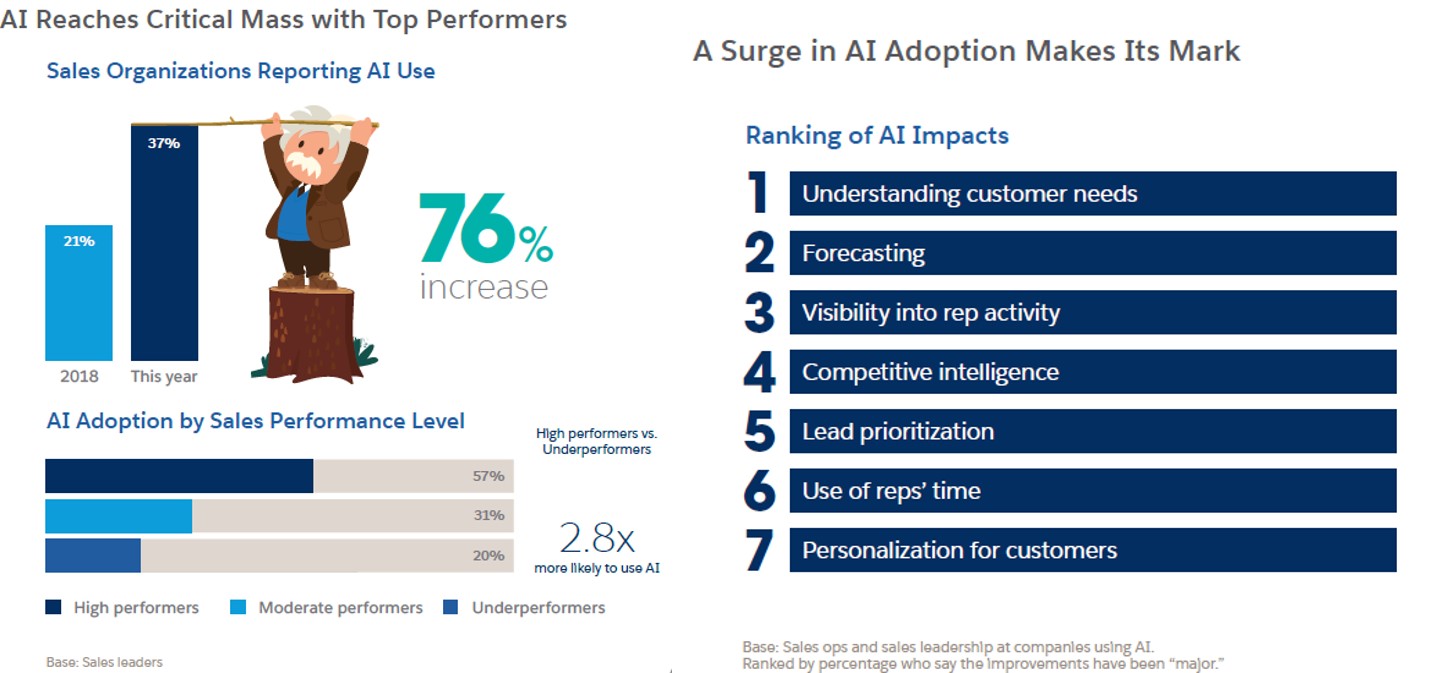
  • Between 2018 and 2020, there’s been a 76% increase in sales professionals using AI-based apps and tools. Salesforce’s latest State of Sales survey found that 57% of high-performance sales organizations use AI today. High-performing sales organizations are 2.8x more likely to use AI than their peers. High-performing sales organizations rely on AI to gain new insights into customer needs, improve forecast accuracy, gain more significant visibility of rep activity, improve competitive analysis, and more. Source: Salesforce Research, 4th Edition, State of Sales, June 2020
2021 Roundup Of AI And Machine Learning Market Forecasts Show Strong Growth
  • While 24% of companies are currently using AI for recruitment, that number is expected to grow, with 56% reporting they plan to adopt AI next year. In addition, Sage’s recent survey of 500 senior HR and people leaders finds adoption of AI as an enabling technology for talent management increasing. AI is proving effective for evaluating job candidates for potential, improving virtual recruiting events, and reducing biased language in job descriptions. It’s also proving effective in helping to improve career planning and mobility. Josh Bersin, a noted HR industry analyst, educator, and technologist, recently published an interesting report on this area titled The Rise of the Talent Intelligence Platform. Leaders in the field of Talent Intelligence Platforms include Eightfold.ai. Grounded in Equal Opportunity Algorithms, the Eightfold® Talent Intelligence Platform uses deep-learning AI to help each person understand their career potential, and each enterprise understands the potential of their workforce.Sources: VentureBeat, 8 ways AI is transforming talent management in 2021, March 25, 2021, and Eightfold.ai.
2021 Roundup Of AI And Machine Learning Market Forecasts Show Strong Growth
  • 84% of marketers are using AI-based apps and platforms today, up from 28% in 2018. Salesforce Research’s latest State of Marketing survey finds that high-performing marketers use an average of seven different applications or use cases. The familiarity high-performing marketers have with AI is a primary factor in 52% of them predicting they will increase their use of AI-based apps in the future. Source: Salesforce Research, 6th Edition, State of Marketing, June 2020
2021 Roundup Of AI And Machine Learning Market Forecasts Show Strong Growth
  • Marketing and Sales lead revenue increases due to AI adoption, yet lag behind other departments on cost savings.  40% of the organizations McKinsey interviewed see between a 6 and 10% increase in revenue from adopting AI in their marketing and sales departments. Adopting Ai to reduce costs delivers the best manufacturing and supply chain management results based on the McKinsey survey results. Revenue increases and cost reductions based on AI adoption are shown in the graphic below. Source: McKinsey & Company, The state of AI in 2020, November 17, 2020
2021 Roundup Of AI And Machine Learning Market Forecasts Show Strong Growth
  • AI sees the most significant adoption by marketers working in $500M to $1B companies, with conversational AI for customer service as the most dominant. Businesses with between $500M to $1B lead all other revenue categories in the number and depth of AI adoption cases. Just over 52% of small businesses with sales of $25M or less use AI for predictive analytics for customer insights. It’s interesting to note that small companies are the leaders in AI spending, at 38.1%, to improve marketing ROI by optimizing marketing content and timing. Source: The CMO Survey: Highlights and Insights Report, February 2019. Duke University, Deloitte, and American Marketing Association. (71 pp., PDF, free, no opt-in).
2021 Roundup Of AI And Machine Learning Market Forecasts Show Strong Growth
  • Three out of four companies are fast-tracking automation initiatives, including AI.  Bain & Company found that executives would like to use AI to reduce costs and acquire new customers, but they’re uncertain about the ROI and cannot find the talent or solutions they need. Bain research conducted in 2019 found that 90% of tech executives view AI and machine learning as priorities that they should be incorporating into their product lines and businesses. But nearly as many (87%) also said they were not satisfied with their Company’s current approach to AI. Source: Bain & Company, Will the Pandemic Accelerate Adoption of Artificial Intelligence? May 26, 2020
2021 Roundup Of AI And Machine Learning Market Forecasts Show Strong Growth
  • Gartner’s Magic Quadrant for Data Science and Machine Learning Platforms predicts a continued glut of exciting innovations and visionary roadmaps from competing vendors. Competitors in the Data Science and Machine Learning (DSML) market focus on innovation and rapid product innovation over pure execution. Gartner said key areas of differentiation include UI, augmented DSML (AutoML), MLOps, performance and scalability, hybrid and multicloud support, XAI, and cutting-edge use cases and techniques (such as deep learning, large-scale IoT, and reinforcement learning). Please see my recent article on VentureBeat, Gartner’s 2021 Magic Quadrant cites ‘glut of innovation’ in data science and ML, March 14, 2021.
2021 Roundup Of AI And Machine Learning Market Forecasts Show Strong Growth
  • 76% of enterprises are prioritizing AI & machine Learning In 2021 IT Budgets. Algorithmia’s survey finds that six in ten (64%) organizations say AI and ML initiatives’ priorities have increased relative to other IT priorities in the last twelve months. Algorithmia’s survey from last summer found that enterprises began doubling down on AI & ML spending last year. The pandemic created a new sense of urgency regarding getting AI and ML projects completed, a key point made by CIOs across the financial services and tech sectors last year during interviews for comparable research studies. Source: Algorithmia’s Third Annual Survey, 2021 Enterprise Trends in Machine Learning.
2021 Roundup Of AI And Machine Learning Market Forecasts Show Strong Growth

Sources of Market Data on Machine Learning: