Skip to content

Posts tagged ‘Software-as-a-Service’

451 Research Summit: Enterprises Competing With Digital Infrastructure & Cloud Computing

bellagio1Enterprises are defining their own cloud strategies, their own way, ignoring vendor hype and requiring metrics that reflect security (61%), mean-time-to-recover from outages (57%), number of data center outages (51%).

This and many insights were gained from attending the 451 Research Hosting and Cloud Transformation Summit at the Bellagio Resort & Casino in Las Vegas last week. 451 Research provided a free pass to the event but did not cover travel, hotel or meals.

What’s refreshing about 451 Group’s conferences is that each of their companies including 451 Research, Uptime Institute, and Yankee Group rely on solid methodologies to research their coverage areas and markets. This results in presentations that are packed with insight and are based on a solid foundation of interviews and research.  I had a chance to catch up with SoftLayer’s Lance Crosby, Simon West and Andre Fuochi for an update on how the IBM acquisition is going, which is summarized in this post as well.  The slides shown are from Michelle Bailey, Vice President, Datacenter Initiatives and Digital Infrastructure’s excellent presentation given at the conference.

The following are the key take-aways from the summit:

  • Enterprises are defining their own cloud strategies, their own way, ignoring vendor hype and requiring metrics that reflect security (61%), mean-time-to-recover from outages (57%), number of data center outages (51%). When asked which metrics beyond Service Level Agreements (SLAs) service providers should report, respondents to the 451 Research survey provided the following insights, shown below:

  • The top three SaaS applications in two years will be for the enterprise, business support, and database platforms per 451 Research’s latest survey:

  • Infrastructure-as-a-Service (IaaS) growth is critical to off-premises hosting deployments succeeding in the next two years, as the following graphic illustrates:

  • 80%of enterprises would experience a severe impact to their operations if there was a cloud outage of just a day which make security and availability must-haves for any hosting and cloud services provider.  The following graphic breaks down the impact of service provider outage by time:
  • Worldwide Infrastructure-as-a-Service (IaaS) is projected to grow from $4.475B in 2013 to $10.23B in 2016, with Platform-as-a-Service (PaaS) growing from $2.23B in 2013 to $5.24B in 2016.  The following slide provides a breakout of forecast categories by hosting and cloud business categories:

Why Enterprises Need A Digital Infrastructure Playbook

The focal point of the summit was the launch of the digital infrastructure playbook.  Tony Bishop, Chief Strategy Officer, The 451 Group introduced the Digital Enterprise Playbook Series which you can download here. His presentation provided insights into how enterprises are struggling to align legacy IT, infrastructure including data centers, cloud, applications and system management to business goals while becoming more agile.

I had a chance to speak with Tony after his presentation and asked him why enterprises need a digital infrastructure playbook now.   “Digital transformation is breaking down the barriers to sustainable global prosperity by shifting power towards the individual,” he said. “This revolution will transform how enterprises create and deliver value. Digital enterprises will pursue and build dynamic infrastructure capabilities to innovate and differentiate customer experience, constantly empower employees and disseminate prescriptive knowledge across the enterprise.”

One of the most passionate and knowledgeable people I’ve ever met in infrastructure and IT research is Martin McCarthy, Chairman and CEO, The 451 Group.  He told me he’s seeing more pressure than ever for edge-to-core integration in the enterprise, which is forcing CIOs to be strategists over experts in cost reduction.  “Digital infrastructure will be the backbone enabling enterprise transformation in coming years. To blaze this trail, organizations need an ‘edge to core’ digital infrastructure playbook,” he said.   Presented below is a page from the Digital Enterprise Playbook Series:

The eight-striper wordmark of IBM, the letters...

IBM SoftLayer Update

  • IBM’s acquisition of SoftLayer is going excellently and many IBM divisions now are actively collaborating with the Softlayer team to migrate existing apps and develop new ones. Thank you Lance Crosby, Simon West and Andre Fuochi for the update provided at the conference, it was invaluable.
  • Softlayer will be the foundation for a global cloud services infrastructure capable of delivering applications across multiple continents and thousands of users within hours, not days.  Lance Crosby explained the vision IBM has of delivering a continual stream of new applications and services over the global cloud services infrastructure network, which has the potential to turn into a high margin business quickly.
  • Softlayer is assisting with making the IBM Request for Proposal (RFP) more efficient based on their deep expertise in this critical area. Based on personal experience it can take anywhere from several weeks to up to several months for an RFP response.  SoftLayer has devised processes and systems that make RFP response times a fraction of that.
  • The majority of the top ten customers Softlayer has today are running large-scale clusters of Hadoop, with 40 Hadoop clusters being commonplace.  Lance Crosby mentioned these customers are very sophisticated in their use of Hadoop and many of them are in consumer products companies, looking to gain greater insights into customer behavior.
  • Bare metal servers running Hadoop are one of the fastest growing areas of the Softlayer business right now.  Simon West made an excellent point that running Hadoop on bare metal servers instead of through virtualized environment leads to a higher level of throughput, given Softlayer’s internal testing results.  Bare metal servers continue to accelerate in the industry and Softlayer’s executives confirmed they are seeing an acceleration of demand in this area.
  • An additional six data centers are planned for 2014, and SoftLayer has the capability to build one data center every two months of needed.  When asked what the global expansion plans are for SoftLayer since the acquisition, Lance Crosby told me London and Germany are of primary interest.  He also added that whenever the demand for a given nation reached between four and five thousand servers, Softlayer and IBM will consider building a data center in-country.

Top Ten Cloud Computing Skills Recruiters Search For

cloud-computing-jobsI recently had the opportunity to speak with Jennifer Bewley and Rachel Ceccarelli of Dice.com regarding the trends they are seeing in cloud computing recruiters’ searched-for terms on their sites.  They’re seeing exponential growth in cloud computing-related job listings today and provided an analysis of the top ten cloud computing skills recruiters are searching for.

From just 13 cloud computing-related jobs listed in May, 2008, their site has over 5,000 today.  The following graphic shows the growth in cloud computing job listings on their site over time.


The following are the top ten cloud computing skills searched for on Dice.com as of today:

  • Linux operating system
  • Chef – The open-source systems management and cloud infrastructure automation framework
  • Puppet – IT automation software that helps system administrators manage infrastructure throughout its lifecycle, from provisioning and configuration to orchestration and reporting
  • Cloud, Legacy System and IT Consulting
  • SaaS Programming – Java is the number one search term on the Dice.com site and is a common programming language cited in these searches.
  • Python
  • Perl
  • DevOps
  • Shell scripting
  • Ruby on Rails

Getting A 360-Degree View Of Potential Candidates

They also demonstrated Open Web, a unique new web application in beta right now that has the ability to aggregate all social networks, keywords, and published experience of technical professionals.  The accuracy and speed of Open Web is impressive; it’s been in beta since January and responds like a production-ready app.  Jennifer and Rachel mentioned that recruiters using Open Web today are seeing 30% response rates to their queries to in-demand technical professionals.

What’s unique about Open Web is that it provides a 360-degree view of potential candidates, including all social media they participate in, in addition to discussion boards and favorited or liked sites on Facebook. The following is what Open Web looks like today:

Bottom line:  Recruiting analytics and tools online are accelerating quickly, making it possible for companies searching for cloud computing talent to find it quicker than ever before.  For those searching for a job in the field, making every aspect of your online presence reflect cloud computing expertise can make you stand out in recruiter’s searches.

Note: Dice.com isn’t now and has never been a client. I chose to write this post to serve readers who frequently ask me to research hiring trends in cloud computing.

Lessons Learned From The 2013 Pacific Crest SaaS Survey

Pacific Crest SurveyDeveloping the ability to upsell existing customers into longer-term, higher value contracts that are multi-year in duration is one of the most critically important skill sets any SaaS business needs to attain.

These and other insights were gained from analyzing the 2013 Pacific Crest SaaS Survey, published earlier this month by David Skok.   The survey is based on responses from 155 SaaS companies, compiled by Pacific Crest Securities.   David’s blog For Entrepreneurs provides excellent content on SaaS metrics, start-up advice and a wealth on insight in the areas of sales and marketing, business models and the specifics of how to manage a SaaS business model profitability.

Key take-aways from the 2013 Pacific Crest SaaS Survey include the following:

  • Median GAAP revenue growth increased by 41% in 2012, projected to reach 47% in 2013 across all 155 SaaS companies included in the analysis.  When smaller companies whose revenue growth projections are excluded, median revenue growth for 2012 was 32%, projected to increase to 36% this year.  The following two figures illustrate distribution of revenue growth by number of companies.

  • The fastest growing SaaS companies have median contract sizes that are between $1K to $25K.  Companies’ with less than $2M in revenue were excluded from this analysis given the smaller deal sizes they generate.

  • The larger the median ACV (Annual Contract Value) the greater the reliance on field sales.  In results from previous surveys Pacific Crest found that mid-tier companies were more reliant on inside sales.  54% of respondents in the $5K to $25K ACV segment of companies this year are reliant on insider sales, up from 33% in 2012.
  • 13% of new ACV is generated from upsells across all SaaS companies, with the largest capable of expanding into other departments and divisions of existing customers.  SaaS companies with sales over $60M are generating 32% of new ACV from upsell strategies. It’s interesting to note that upsell is a more effective strategy at gaining market share versus marketing spending, and this hold true across sizes of SaaS companies.  The following graphic illustrates percentage of new ACV by size of SaaS company and an analysis showing the fastest-growth SaaS companies generate a higher proportion of new ACV from upsells compared to their peers.
  • 76% gross margins are being achieved across all respondents.  This does not change significantly when smaller companies are removed from the analysis.
  • Try-Before-You-Buy is used far more often than Freemium because it generates additional sales.  The following graphic shows the expected contribution of each to ACV in 2013:

  • Professional Services are 12% of 1rst year ACV across all customer segments.  Selling professional services into the enterprise generates 23% of first year ACV according to the study.  A graphic showing the distribution of first year ACV as a percentage of professional services by customer segment is shown below:

  • SaaS companies who primarily rely on Internet-based distribution methods are attaining the highest growth rates.  When companies with less than $2M in revenue were taken out of the analysis, those companies primarily based on inside sales grew 10% more than field sales.  The following graphic presents this analysis, excluding companies with less than $2M in revenue.

  • 37% of respondent companies rely on field sales as their primary means of distribution followed by inside sales (29%) and Internet sales (17%).  When smaller companies with sales less than $2M are excluded, field sales jumps to 50% of all respondents using this method as a primary means of distribution.  Inside sales (29%) and Internet sales (8%) are second and third.  While Internet sales is the cheapest form of distribution, it also leads to the highest churn rates (9%) recorded in the survey.

Predicting Enterprise Cloud Computing Growth

69% of enterprises who have separate budgets for cloud computing are predicting spending increases this year and into 2014.

This is one of several key take-aways from a research study published today by TheInfoPro, a service of 451 Research.  TheInfoPro Wave 5 Cloud Computing Study is based on research completed in the first six months of 2013, and relies on live interviews with IT management and primary decision-makers in midsize and large enterprises in Europe and North America. You can view details of TheInfoPro Cloud Computing Overview Program and methodology here.

Additional key take-aways from the study include the following:

  • The worldwide cloud computing market will grow at a 36% compound annual growth rate (CAGR) through 2016, reaching a market size of $19.5B by 2016.
  • 38% of enterprises surveyed break out cloud computing budgets, while 60% include cloud-related spending as part of their enterprise-wide IT budgets.  TheInfoPro asserts that cloud computing’s benefits of greater business orchestration and reduced time-to-market have led to a change in budgeting approaches.

cloud-computing-budget

  • Internal Private Cloud (35%), Cloud Provider Assessments/Strategy Planning (33%), Infrastructure-as-a-Service (IaaS) (31%) and Software-as-a-Service (30%) are the top four cloud computing-related projects enterprises are working on right now.  Cloud Provider Assessments/Strategy Planning have seen the largest increase, attributable to more enterprises looking to better support strategic plans with more agile, efficient IT organizations.

top-challenges-graphic2

deciphering-the-cloud-journey

cloud-related-pain-points

Where Cloud Computing Jobs Are Today

career-start1Gaining insights into cloud computing hiring trends is invaluable to understanding the competitive landscape and direction of new application and platform development.

It’s also invaluable for any company looking to recruit cloud computing professionals.  For qualified job seekers, staying on top of these trends can and does lead to well-timed career moves, higher salaries and greater chances for professional growth.

Real-time business intelligence of the talent marketplace is a fascinating area to track.  Wanted Analytics is a leader in this field, and their analytics applications and advanced data sets are used for competitive analysis, sourcing new hires, analyzing employment and economic trends, and lead generation.  I’ve never worked for Wanted Analytics and they’re not a client.   They were kind enough to provide a test-drive account for this analysis. The Wanted Analytics platform is based on 25,000 employment sources that together account for 950 million job posts.

Here are the key take-aways from an analysis of cloud computing job opportunities:

cloud-computing-jobs-by-job-count1
cloud-computing-jobs-by-SMA1
 
  • EMC (17%), Amazon.com (16%) and Salesforce.com (12%) and their partners are the leading cloud computing employers currently looking to fill positions.  Software, services and system integration partners that work with these three companies will often mention them in their own job ads as well.  This distribution of jobs reflects the partner network these companies have each built in addition to jobs available with each of them.

top-ten-employers-with-cloud-positions-open

  1. Top Secret Sensitive Compartmented Information (TS SCI) (863 ads);
  2. Certified Information Systems Security Professional (CISSP) (385 ads);
  3. Project Management Professional (PMP) (209 ads);
  4. Cisco Certified Network Associate (CCNA) (193 ads);
  5. Microsoft Certified Systems Engineer (MCSE) (180 ads);
  6.  Health Insurance Portability and Accountability Act (HIPAA) expertise (156 ads);
  7.  Business Process Management Programming Languages (BPM) expertise (137 ads);
  8.  EMC System Administrator (EMCSyA) (130 ads);
  9.  VMware Certified Professional (VCP) (109 ads);
  10. Cisco Certified Network Professional (CCNP) (108 ads).

Top 12 Sites For Free Cloud Computing & Enterprise Software Research

campusOne of the most common questions I get from students is where they can find free cloud computing and enterprise software research.

Few if any of my students work for companies who have subscriptions with the top analyst firms however.  A small group of students are working on a start-up on the side and want to absorb as much market data as they can.

Many of my former students are also in IT management roles, and when they become interested in a specific cloud computing or enterprise topic over time, they write me and ask if I have any data on their subject of interest.  I keep the following list updated from them too.   To serve all these students I’ve been adding to the list shown below for a number of years. None of these companies are current or past clients and I hold no equity positions in any of them.

The requests are so prevalent in global competitive strategy courses I distribute this list at the beginning of the semester with the following disclaimers.

  • Many of the cloud computing and enterprise software companies pay to have white papers written and research done.  Writing white papers and doing research for an enterprise software vendor client is a very lucrative business for many industry analyst firms.  Ethical industry analysts will often insist that a disclaimer be included in the white paper and on the website stating that they and their firms were hired to write the paper or do the research and publish the report.
  • The reports are intellectual property of the firms publishing them.  Enterprise software vendors often pay tens of thousands of dollars at a minimum for reprint rights and the right to provide them on their websites.  I advise my students to seek out the copyright and quote policies of the research firm of interest if they plan on re-using the graphics in any published materials or in their blog posts.  One for example, the Gartner Copyright and Quote Policy is shown here.
  • Pay attention to the methodologies used in each report and realize they change over time.  This is especially the case with the  Gartner Magic Quadrant and MarketScopes. Gartner has been very active this year in refining the Magic Quadrant methodology for example.

The following are the list of cloud computing and enterprise software vendor sites that offer free downloads of cloud computing and enterprise software research:

  • Amazon Web Services – Amazon has purchased re-print rights to the Gartner Magic Quadrant for Cloud Infrastructure as a Service written by Lydia Leong, Douglas Toombs, Bob Gill, Gregor Petri, Tiny Haynes published on August, 19, 2013 in addition to the latest reports from Forrester on enterprise public cloud platforms and enterprise cloud databases. Link:    https://aws.amazon.com/resources/analyst-reports/
  • BMC Software – Many free reports from Gartner, Forrester, The 451 Group and other research firms covering advanced performance analytics (APA), cloud computing, IT Service Management and long-term technology trends. Link: http://www.bmc.com/industry-analysts/reports/
  • Computer Associates – An extensive collection of cloud computing and enterprise software research organized into the following categories: cloud; data management; energy and sustainability management; IT automation; IT security; IT service management; mainframe; project and portfolio management; service assurance and virtual organizations.  CA requires opt-in on the latest research as they use this site as part of their lead generation strategy.  Link: http://www.ca.com/us/collateral/industry-analyst-reports.aspx
  • Cisco Systems –  Data Center and Virtualization; includes the latest Current Analysis, Forrester, Gartner, IDC, Lippis and Yankee Group research reports covering Big Data, blade servers, cloud computing, Hadoop, unified data centers and many other topics.  Be sure to click across the Computing, Network, Orchestration/Automation,  and Network Services tabs to find additional research:   Link: http://www.cisco.com/en/US/solutions/ns340/ns857/ns156/ns1094/analyst_reports.html
  • Hewlett-Packard – HP has invested primarily in networking-related analyst research including the latest studies and market frameworks from Forrester, Gartner, IDC and Infonetics Research.  Link: http://h17007.www1.hp.com/us/en/networking/ar/index.aspx#.Uhp-ERufg-J
  • Intel – Organized around the topic of designing a data center for the cloud, Intel is providing a series of research studies, reports, white papers and videos that provide insights into virtualization, networking, mobility and Intel-based servers running cloud architectures.  Link:  http://www.intel.com/content/www/us/en/cloud-computing/cloud-computing-analyst-reports.html
  • Microsoft – Balancing the need to support their enterprise applications today and create demand for cloud-based initiatives now and in the future, Microsoft’s series of analyst reports reflect their evolving business model.  Microsoft has licensed the latest research from Enterprise Strategy Group (ESDG), Forrester, Gartner, IDC, Ovum, Yankee Group and others listed on this site. Link: https://www.microsoft.com/en-us/news/itanalyst/
  • Oracle – The most comprehensive collection of industry analyst research online for any enterprise software vendor, Oracle has hundreds of research reports available for viewing under their reprint licenses for free, and also for download.  The reports are organized into corporate, infrastructure, systems, services, solutions, industries, enterprise applications and regions.     Link: http://www.oracle.com/us/corporate/analystreports/index.html
  • Progress Software – Extensive collection of research from Bloor, Forrester, Gartner, IDC, Tabb Group, Ovum and other research firms are available for download from this site. Link:  http://www.progress.com/en/inthenews/analyst-reports.html
  • SAS – The most extensive and well-organized online collection of analyst research on analytics and business intelligence (BI) available, SAS makes research available from fifteen analyst firms across six industries on this area of their website.  You can find the SAS Analyst Viewpoints section of their website here: http://www.sas.com/news/analysts/
  • Symantec – Provides downloadable analyst reports in the areas of risk and compliance, endpoint security and management, information and identity protection, messaging security, backup and archiving, storage and availability management, services and emerging trends.  ESG, Info-Tech Research Group, Forrester, Gartner and IDC reports are on this page for download. Link: http://www.symantec.com/about/industryanalysts/analystreports.jsp
  • Teradata – Extensive collection of industry analysis and research organized into the sections of Active Data Warehousing, Active Enterprise Intelligence, Enterprise Data Warehousing, Teradata Analytical Ecosystem and Teradata Integration Analytics.  The latest market frameworks from Gartner, Forrester, IDC and other research firms are available for download.  Link:   http://www.teradata.com/analyst-reports/

451 Research: Platform-as-a-Service (PaaS) Fastest Growing Area Of Cloud Computing

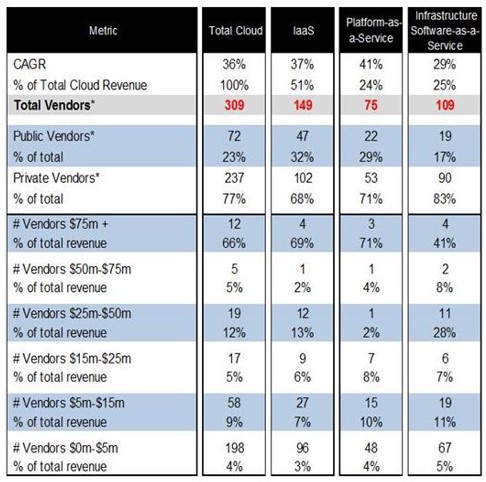
public-cloud-computing-forecast-2011-2016The majority of cloud computing revenue in 2012 was generated from vendors with sales over $75M (66%) and who are privately held (77%), with Platform-as-a-Service (PaaS) projected to attain a 41% compound annual growth rate (CAGR) through 2016.

Market Monitor, a service of 451 Research, is also predicting 36% CAGR in cloud computing, growing from $5.7B in 2012 to $20B by the end of 2016 in their Cloud-as-a-Service overview report. Other research firms including Gartner have much higher forecasts for cloud computing in general and IaaS, PaaS and SaaS specifically.

Market Monitor relies on a bottoms-up forecasting methodology that includes revenue analysis and forecasts from 309 cloud-services providers and technology vendors across 14 sectors. Their taxonomy defining Cloud as a Service is shown in the following graphic:

taxonomy cloud as a service

Here are the key take-aways from the report:

forecast breakout

distribution table

Citrix Sees Strong Cloud Sales Growth, Snaps Up Reuven Cohen As Chief Cloud Advocate

saas-200x300Citrix (NASDAQ: CTXS) continues to successfully launch and manage products in the areas of cloud, desktop, mobile and networking, reporting net revenue of $730M for their latest quarter (Q2, 2013), up 19% from Q2, 2012.  Product license revenue is up 21% from Q2, 2012 to $227M for the latest quarter as well.  In the interest of full disclosure, I have never held a position in Citrix stock and do not today, and they have never been a client.

The following table is from their 2Q13 Financial Results presentation:

Managing Multiple Businesses And Making It Look Easy

Citrix continues to be a fascinating company to watch as it successfully competes across a broad range of businesses.  Cloud management, mobility and desktop management platforms, online collaboration, networking and security, and server virtualization are all revenue-generating businesses in the company today.

And while the majority of acquisitions in enterprise software struggle to deliver revenue or even fail, Citrix has been able to bolster is collaboration, enterprise mobility and telecom and networking businesses with solid additions.  Acquiring Zenprise in December, 2012 to bolster its mobile device management (MDM) strategy has led to increased sales, as has the acquisition of Podio in April of last year to augment its Online Services Division (OSD).  In June of last year Citrix also acquired ByteMobile, which gives the company entry into the telecom/carrier market.

At Citrix Synergy 2013 held May 22 – 24 of this year in Anaheim, California the company hosted the Citrix Financial Analyst Track.  You can download the presentation from this track here.  This presentation shows how challenging it can be to manage a business with multiple revenue streams across a broad base of technologies.  The following slide taken from the Citrix Financial Analyst Track illustrates just how quickly Citrix is growing and how mobile & desktop, SaaS and networking & cloud are contributing to their growth.

The addressable market opportunity for Citrix given the breadth of their product strategies is reflected in this slide, also from the Citrix Financial Analyst track:

Why Citrix Snapped Up Reuven Cohen

With so much growth potential in their cloud-based businesses, Citrix needed a seasoned veteran from the cloud computing industry who had both developed and managed new cloud platforms, products and services to the stack level.

They chose Reuven Cohen as their first-ever Chief Cloud Advocate based on his entrepreneurial expertise in Infrastructure-as-a-Service (IaaS) including being the founder and CEO of Enomaly which was sold to Virtustream in 2012. He is also actively involved in the National Institute of Standards Technology (NIST) cloud definition, and is a GSA Cloud IaaS BPA awardee, presented Great Britain’s G-Cloud initiative to the Parliament, and is an active delegate in the Sino-EU America Cooperation Workgroup.

He is responsible for leading Citrix’s cloud advocacy efforts with a specific focus on increasing the volume, reach and influence of Citrix’s extensive portfolio of cloud solutions used by more than 260,000 customers and 100 million end users across the globe.  He’ll also be responsible for increasing the adoption of several Open Source initiatives at Citrix as well.   Here are a few of the current Citrix open source projects now underway:

Apache CloudStack, an open source software designed to deploy and manage large networks of virtual machines, as a highly available, highly scalable Infrastructure as a Service (IaaS) cloud computing platform.

OpenDaylight, a community-led, open, industry-supported framework, for accelerating adoption, fostering new innovation, reducing risk and creating a more transparent approach to Software-Defined Networking.

The Xen Project, the home for various virtualization technologies powering the world’s largest clouds in production and is the foundation of many commercial products.

XenServer, an open source project and community managed by Citrix. The project develops open source software for securely running multiple operating systems and applications on a single device, enabling hardware consolidation and automation to reduce costs and simplify IT management of servers and applications.

Congratulations to Reuven on being named Chief Cloud Advocate at Citrix, I am sure he’ll accomplish much in his new role.

Ten Ways Cloud Computing Is Revolutionizing Aerospace And Defense

Jet Above The CloudsSynchronizing new product development, supply chain, production and Maintenance, Repair & Overhaul (MRO) strategies across Aerospace and Defense (A&D) manufacturers while reducing costs continues to make cloud platforms a viable option in A&D.

With sequestration having an impact on these industries from both a budget and merger & acquisition (M&A) perspective, the economics of cloud computing are becoming even more attractive. Teri Takai, CIO of the Department of Defense (DoD) published the DoD Cloud Computing Strategy in July of last year and many of its findings are reflected in the current state of cloud adoption in A&D.  She recently published the presentation DoD CIO’s 10-Point Plan for IT Modernization, which is available for download from the department’s website.  The following is a summary of key DoD IT Modernization initiatives.

It’s ironic that two industries who are highly reliant on collaboration often have the most siloed legacy systems, processes and IT infrastructures.  As one aerospace executive told me recently, the industry sees cloud computing as solution to what many call “silos of excellence” that slow down progress.  Aerospace executives also speak of security concerns, especially in the area of globally-based defense support and logistics platforms.

Greater Collaboration, Lower Costs

Defense Information Systems Agency (DISA) Director Lt. Gen. Ronnie Hawkins Jr. was recently interviewed by Defense News, and his comments reflect what is often heard from aerospace and defense companies as well.  He says a more enterprise-wide approach to managing information systems is needed to break down functional and service-unique barriers of the past to increase collaboration.  He’s also leading the DISA in partnership with the Defense Logistics Agency (DLA) to attain a 20% cost reduction in his agency, relying in part on cloud computing to reduce costs.  Consolidating down to one e-mail system, virtualizing applications in a hosted environment, and moving capabilities to the cloud are integral to achieving the 20% cost reduction.  Ultimately he sees the DISA becoming a cloud service broker.

How A&D Requirements Are Turning Into A Catalyst for Greater Cloud Security

Lt. General Ronnie Hawkins’ comments reflect the concerns defense agencies and their supply chains have regarding cloud security.  He highlights the need for close coordination with the commercial, private sector cloud computing vendors to ensure the cloud security architecture requirements of the DISA are reflected in future product designs.  DISA requirements apparently outpace those available from commercial, private sector vendors.  This is encouraging, because it means A&D’s requirements are a catalyst of continued improvement in cloud computing security.

The American Institute of Aeronautics and Astronautics (AIAA) held Aviation 2013 in Los Angeles this week where their AAIA Framework for Aviation Cybersecurity was presented. The framework shows why security is so critical to commercial and defense-related aviation in financial terms. For the A&D industry to get the full value of cloud computing, commercial cloud computing vendors have got to invest heavily in security research & development (R&D) to keep pace with this industry’s requirements.

How Cloud Computing Is Revolutionizing Aerospace And Defense

In speaking with aerospace executives and following defense-related adoption of cloud technologies, these are the top ten ways cloud computing is revolutionizing the A&D landscape:

  • De-Siloing Quality and Compliance Management across production is leading to greater supplier audit consistency and reduced compliance reporting costs.  While visiting one defense contractor, the CIO mentioned how on-premise compliance and quality management systems had become siloed over time and of limited use except for one area of production.  He explained it would cost over $700K to get the on-premise system integrated to their enterprise-wide ERP system.  Clearly having a cloud-based quality management and compliance system would avert the $700K integration cost and reduce reporting workloads.  Today this contractor manages International Traffic in Arms Regulation (ITAR) compliance with manual workflows despite having a quality management system in place.
  • Mobile Device Management (MDM) has moved beyond dashboard support for smartphones and tablets to being integral for product design and managing production.  The two facets of mobility most affecting A&D include designed-in support for situational and battlefield awareness systems including Enhanced Position Location Reporting System (EPLRS) support and increasing reliance on mobility platforms for streamlining production data management including Computer Aided Design (CAD) design files used as part of Bill of Materials (BOM) and work instructions on the shop floor.
  • Reducing tooling costs using cloud-based platforms is accelerating.  It is common to find up to 67% of total development cost for a given commercial aerospace contract being attributable to tooling costs alone.  Cloud-based systems have been able to significantly reduce tooling time and costs by saving prior configurations and by being integral to calibrating machine tools on the production floor.
  • Higher priority being placed on virtualized applications across the DoD including data centers with cloud-ready infrastructure supporting secured applications.  The DoD is planning for a transition state that includes consolidation and virtualization of legacy applications, many of which are very costly to maintain.  The following graphic shows the planned progression the DoD anticipates in migrating their data centers to an enterprise cloud infrastructure.

  • Chief Information Officers (CIOs) realize they must become strategists and move beyond being the caretakers of legacy systems if their careers are going to survive and thrive.  Resistance to change is very strong in many A&D companies, and often the systems running production can be decades old.  CIOs and their staffs fall into a rut of being caretakers of legacy systems when what’s best for their careers is to push themselves past that role and into being strategists. CIOs confided in me that keeping legacy systems running can get pretty boring; several want a new challenge and a chance to contribute more.
  • The silent majority of cloud implementations in A&D are in highly secured vault areas and hidden from view in denied environments.  These systems are contained in secured clouds and are most often used in project management of advanced aerospace and defense engineer-to-order projects.  They also often have project-based management systems running entirely secured within a given work area.  Consortium and global-based product and program development projects are entirely managed on cloud-based systems behind multiple layers of security as well.  These are the silent majority of cloud adopters in A&D.
  • The A&D industry is losing patience with its “cylinders of excellence” as sequestration brings urgency to make collaboration pay.  Breaking down the silos that slow down collaboration, cross-project reporting and limit supply chain visibility are a high priority for many aerospace executives especially.  As one jokingly called the “cylinders of excellence” the greatest impediment to growth, others have mentioned how cloud computing applications and platforms break these down by making data locked in legacy systems available project, division and company-wide.
  • Department of Defense (DoD) requirements for cloud security are outpacing what commercial providers offer today, forcing a faster pace of innovation that benefits everyone.  Based on the comments from Lt. General Ronnie Hawkins and from the many discussions held with CIOs and CEOs of aerospace suppliers, it’s clear that many of their requirements surpass off-the-shelf cloud security platforms today.  In many cases they surpass Service Level Agreement (SLA) levels as well, requiring custom development.  This is good news for cloud computing overall as the DoD will continue to push for higher levels of security over time.   SLAs, ITAR compliance, and AS 9100 REV C. compliance are just the beginning.
  • Cloud-based consolidation of collaboration applications is the “low hanging fruit” of cost reduction in defense agencies.  As Lt. General Ronnie Hawkins said, he looks to e-mail consolidation and reliance on the cloud computing to assist with a 20% reduction in costs for DISA.  The DoD Cloud Computing strategy also mentions this as one of the key strategic objectives for the department over the long-term.
  • Automating Maintenance, Repair and Overhaul (MRO) workflows using cloud-based systems that include mobility support are leading to reduction in inventory levels while service levels increase. MRO is where the majority of A&D manufacturer make their highest gross contribution margins yet also have the greatest exposure to customer churn and attrition.  Cloud-based MRO systems are being used today to enable MRO process performance gains by reducing inventories, increasing service levels, improving the design of service strategies all leading to more integrated MRO strategies corporate-wide.

IDG Cloud Computing Survey: Security, Integration Challenge Growth

cloud computing survey 2IDG Enterprise recently published Cloud Computing: Key Trends and Future Effects Report, showing how enterprises continue to struggle with security, integration and governance while finding immediate value in collaboration and customer relationship management (CRM) applications.

IDG’s methodology is based on interviews with 1,358 respondents, stratified across CIO, Computerworld, CSO, InfoWorld, ITworld, and Network World websites, in addition to respondents contacted via email, and LinkedIn forums.  58% of respondents are from executive IT roles; 17% from Mid-level IT; 14% from IT professionals; 8% from middle-level business management and 3% non-manager roles were represented in the study.  High tech industries are the dominant industry represented with 18% of respondents, followed by financial services, government and manufacturing (each accounting for 10% of respondents).  Education (9%) and telecommunications & utilities (6%) are the other industries represented.

Key take-aways from the survey include the following:

  • Amazon (32%), Microsoft (23%) and Google (20%) are most often considered thought leaders in the field of cloud computing by respondents to the IDG survey.
  • Enabling business continuity (43%), greater flexibility to react to changing market conditions (40%), speed of deployment (39%) and improving customer support or services (38%) are the top four drivers of investment in cloud computing technology according to the survey.  The following graphic provides an analysis of each driver by level of relative importance.   This image is from Cloud Computing: Key Trends and Future Effects Report.

  • Accelerating business value by providing access to critical business data and applications (56%); serving as a catalyst of IT innovation (56%); enabling greater employee collaboration (54%); and enabling greater levels of IT agility (54%) are the top four benefits enterprises are gaining from cloud-based applications.  The following graphic provides an analysis of how cloud computing technology is impacting each of the areas shown in respondent’s enterprises. This image is from Cloud Computing: Key Trends and Future Effects Report.

  • Financial Services and high tech companies are projected to have the largest cloud computing budgets based on the survey.  Enterprises are expected to invest an average of $1.5M in cloud-based services during the 2013 – 2014 timeframe.  IDG projects that large companies will spend $2.8M relative to small and medium-sized businesses investing $486K on average.
  • Chief Financial Officers (CFOs) (35%) are the hardest to convince regarding the value of cloud computing, followed by the board of directors or equivalent (24%), the CEO (24%), and the Chief Operating Officer (COO) (16%) third. Chief Marketing Officers (CMO) are the easiest to convince, with just 6% of respondents mentioning this group of executives being a challenge to convince regarding the value of cloud computing.
  • The percentage of organizational IT budgets allocated to SaaS increased from 8% in 2012 to 13% in 2013 according to the last two IDG Enterprise Cloud Computing surveys.  Infrastructure-as-a-Service (IaaS) increased to 10% of overall IT budgets, up from 7% in 2012.  In aggregate, 44% of IT budgets are spent on cloud computing today, increasing to 51% by 2015 in the base of enterprises interviewed for the study.
  • Enterprises continue to migrate applications to the cloud that increase collaboration and enhance customer relationships first.  Collaboration and conferencing solutions (38%), e-mail and messaging (35%) and Customer Relationship Management (CRM)/Sales Force Automation (SFA) (27%) are the top three applications being migrated to the cloud in the enterprises surveyed.  The following graphic shows which applications are moving to the cloud today and the plans for migrating applications in the next 12 months, and over the next 1 to 3 years.  This image is from Cloud Computing: Key Trends and Future Effects Report.

  • 59% of enterprises are still identifying which IT operations are the best candidates for cloud hosting.  33% have identified all IT operations that they are comfortable having hosted in the cloud, given the current security of cloud infrastructure and application design.
  • The three most important factors in selecting a SaaS application provider include the ability to configure and customize the cloud application to meet specific business needs (40%), consistent cloud application performance and availability (38%) and security certification and practices of the SaaS provider (34%).
  • 61% of enterprises have at least one application that is cloud-based in their organizations today.  This increased from 57% in 2012.  24% of enterprises are planning to implement cloud applications in the next 12 months and 15% are planning to between 1 to three years from now.
  • In enterprises with less than 1,000 employees, CEOs (52%) are the most influential role in cloud purchasing, followed by the CIO (39%) and IT/networking staff (33%).  In enterprises over 1,000 employees, the CIO (60%), followed by the IT/networking management (47%) and CTO or IT network architect (45%) are the three most influential roles in the cloud purchasing process.
  • 42% of cloud-based projects are eventually brought back in-house, with security concerns (65%), technical/oversight problems (64%), and the need for standardization (on one platform) (48%) being the top three reasons why.
  • The top three challenges to implementing a successful cloud strategy in enterprise vary significantly between IT and line-of-business (LOB).  For IT, concerns regarding security (66%), integration stability and reliability (47%) and ability of cloud computing solutions to meet enterprise/industry standards (35%) challenge adoption.    The following table compares the perceptions of IT and line-of-business leaders.  This image is from Cloud Computing: Key Trends and Future Effects Report.