Skip to content

Posts tagged ‘Louis Columbus’ blog’

IDG Cloud Computing Survey: Security, Integration Challenge Growth

cloud computing survey 2IDG Enterprise recently published Cloud Computing: Key Trends and Future Effects Report, showing how enterprises continue to struggle with security, integration and governance while finding immediate value in collaboration and customer relationship management (CRM) applications.

IDG’s methodology is based on interviews with 1,358 respondents, stratified across CIO, Computerworld, CSO, InfoWorld, ITworld, and Network World websites, in addition to respondents contacted via email, and LinkedIn forums.  58% of respondents are from executive IT roles; 17% from Mid-level IT; 14% from IT professionals; 8% from middle-level business management and 3% non-manager roles were represented in the study.  High tech industries are the dominant industry represented with 18% of respondents, followed by financial services, government and manufacturing (each accounting for 10% of respondents).  Education (9%) and telecommunications & utilities (6%) are the other industries represented.

Key take-aways from the survey include the following:

  • Amazon (32%), Microsoft (23%) and Google (20%) are most often considered thought leaders in the field of cloud computing by respondents to the IDG survey.
  • Enabling business continuity (43%), greater flexibility to react to changing market conditions (40%), speed of deployment (39%) and improving customer support or services (38%) are the top four drivers of investment in cloud computing technology according to the survey.  The following graphic provides an analysis of each driver by level of relative importance.   This image is from Cloud Computing: Key Trends and Future Effects Report.

  • Accelerating business value by providing access to critical business data and applications (56%); serving as a catalyst of IT innovation (56%); enabling greater employee collaboration (54%); and enabling greater levels of IT agility (54%) are the top four benefits enterprises are gaining from cloud-based applications.  The following graphic provides an analysis of how cloud computing technology is impacting each of the areas shown in respondent’s enterprises. This image is from Cloud Computing: Key Trends and Future Effects Report.

  • Financial Services and high tech companies are projected to have the largest cloud computing budgets based on the survey.  Enterprises are expected to invest an average of $1.5M in cloud-based services during the 2013 – 2014 timeframe.  IDG projects that large companies will spend $2.8M relative to small and medium-sized businesses investing $486K on average.
  • Chief Financial Officers (CFOs) (35%) are the hardest to convince regarding the value of cloud computing, followed by the board of directors or equivalent (24%), the CEO (24%), and the Chief Operating Officer (COO) (16%) third. Chief Marketing Officers (CMO) are the easiest to convince, with just 6% of respondents mentioning this group of executives being a challenge to convince regarding the value of cloud computing.
  • The percentage of organizational IT budgets allocated to SaaS increased from 8% in 2012 to 13% in 2013 according to the last two IDG Enterprise Cloud Computing surveys.  Infrastructure-as-a-Service (IaaS) increased to 10% of overall IT budgets, up from 7% in 2012.  In aggregate, 44% of IT budgets are spent on cloud computing today, increasing to 51% by 2015 in the base of enterprises interviewed for the study.
  • Enterprises continue to migrate applications to the cloud that increase collaboration and enhance customer relationships first.  Collaboration and conferencing solutions (38%), e-mail and messaging (35%) and Customer Relationship Management (CRM)/Sales Force Automation (SFA) (27%) are the top three applications being migrated to the cloud in the enterprises surveyed.  The following graphic shows which applications are moving to the cloud today and the plans for migrating applications in the next 12 months, and over the next 1 to 3 years.  This image is from Cloud Computing: Key Trends and Future Effects Report.

  • 59% of enterprises are still identifying which IT operations are the best candidates for cloud hosting.  33% have identified all IT operations that they are comfortable having hosted in the cloud, given the current security of cloud infrastructure and application design.
  • The three most important factors in selecting a SaaS application provider include the ability to configure and customize the cloud application to meet specific business needs (40%), consistent cloud application performance and availability (38%) and security certification and practices of the SaaS provider (34%).
  • 61% of enterprises have at least one application that is cloud-based in their organizations today.  This increased from 57% in 2012.  24% of enterprises are planning to implement cloud applications in the next 12 months and 15% are planning to between 1 to three years from now.
  • In enterprises with less than 1,000 employees, CEOs (52%) are the most influential role in cloud purchasing, followed by the CIO (39%) and IT/networking staff (33%).  In enterprises over 1,000 employees, the CIO (60%), followed by the IT/networking management (47%) and CTO or IT network architect (45%) are the three most influential roles in the cloud purchasing process.
  • 42% of cloud-based projects are eventually brought back in-house, with security concerns (65%), technical/oversight problems (64%), and the need for standardization (on one platform) (48%) being the top three reasons why.
  • The top three challenges to implementing a successful cloud strategy in enterprise vary significantly between IT and line-of-business (LOB).  For IT, concerns regarding security (66%), integration stability and reliability (47%) and ability of cloud computing solutions to meet enterprise/industry standards (35%) challenge adoption.    The following table compares the perceptions of IT and line-of-business leaders.  This image is from Cloud Computing: Key Trends and Future Effects Report.

PRISM Projected To Cost U.S. Cloud Computing Industry $35B

prismU.S.-based cloud computing providers are projected to lose up to 20% of foreign market revenues or $35B over the next three years as a result of disclosures involving PRISM.

The Information Technology and Innovation Foundation (ITIF), a Washington, D.C.-based think tank published How Much Will PRISM Cost the U.S. Cloud Computing Industry? (free to download, no opt-in) on August 5th.  The report highlights how the disclosures involving PRISM quickly are turning into a catalyst that rival countries’ cloud providers are using for their competitive advantage.  PRISM has also fueled protectionism throughout European countries, with the report citing Germany’s response in detail.  Jörg-Uwe Hahn, a German Justice Minister called for a boycott of U.S. companies in response to PRISM.

Key take-aways from the report are summarized here:

  • Of the $13.5B in investments that cloud computing service providers made in 2011, $5.6B or 41.5%, came from companies outside North America.
  • Global spending on cloud computing is expected to grow by as much as 100% between 2012 and 2016, while the global IT market will grow only 3% in the same period according to the report.
  • The global enterprise public cloud computing market will be a $207B industry by 2016 according to sources cited in the report.  The following graphic illustrates how non-U.S. markets are projected to grow through 2016.

figure-1-ww-cloud-market

  • The ITIF completed two forecast scenarios as part of their methodology, the first assuming 10% reduction in foreign market share to European and Asian competitors, and no loss of current projected market share domestically.  The second forecast scenario assumes 20% reduction in foreign market share, and constant market share growth domestically.  The table below summarizes their findings.

estimated-cost-of-PRISM

Thank you Jeff Nolan and Manuel Pumarada for distributing the link to the report and for sharing your insights, much appreciated.

Coursera, edX Offer Free Online Courses As Cloud Computing Learning Options Proliferate

StanfordThe value and variety of online cloud computing programs being offered by leading colleges and universities is proliferating.

Focusing on the learning needs of IT professionals who need to apply cloud technologies to solve complex business problems, many of these programs and courses sell out before classes begin. This is because CIOs’ career paths are increasingly defined by how well they apply cloud technologies to the unique challenges and problems their businesses face. For CIOs and other members of senior management, getting a solid education on cloud computing’s business benefits is essential for managing effectively today, increasing their long-term marketability and career growth.

These programs are designed for C-level executives and senior managers to get up to speed quickly, often including guest CEOs of prominent software companies as part of the curriculum.  Stanford’s course offered this fall online and on campus has five different CEO guest speakers including Aaron Levie, CEO of Box.net for example.  These programs have an entirely different set of learning objectives versus certifications.  For an excellent analysis of cloud certifications please see David Linthicum’s recent post Are you on the right cloud computing career path?   Also excluded are vendor-sponsored certification programs as the intent of many of these is to promote a very specific view of cloud computing that aligns with their product and service strategies.

Here are key take-aways from following this area:

  •  Georgia Institute of Technology is partnering with Coursera, offering Health Informatics in the Cloud, beginning on September 16th for free.  Coursera is an education company that partners with many of the worlds’ leading colleges and universities to offer free online courses to anyone, anywhere.  They have partnered with 62 universities in 16 countries and offer over 300 courses as of today.
  • University of California, Berkeley is partnering with EdX offering Software as a Service (CS169.2X) beginning August 13th for free.  MIT and Harvard partnered to create EdX, a non-profit organization that is committed to bringing the best of higher education to students around the world.  EdX offers MOOCs (massive open online courses) in addition to interactive online courses in the subject areas of law, history, science, engineering, business, social sciences, computer science, public health, and artificial intelligence (AI).
  • Stanford University’s CS309A looks like one of the best being offered this fall, with five different CEO guest speakers including Hamish Brewer, JDA Software; Godfrey Sulliva, Splunk; Bob Beardon, Horton Works; and Aaron Levie, Box.net.  Dr. Timothy Chou, former president of Oracle OnDemand and Lecturer at Stanford University for over three decades is teaching the course.
  • The following is a comparison of the cloud computing courses and programs designed for senior management starting this fall.  Those entries in green are the free courses that take just minutes to enroll in.  Please click on the image to expand it for easier reading.

Cloud Computing

Roundup Of Small & Medium Business Cloud Computing Forecasts And Market Estimates, 2013

Small & Medium Business cloud computing What sets apart the fastest-growing small businesses is their an innate strength at turning data and information into results.

It’s becoming easy to spot a smaller business who is going to break out and grow quickly.  They often have these qualities:  they highly value knowledge, expertise and speed over seniority or cronyism; they have successfully managed a geographically distributed supply chain, production and service operations early in their history; and long before they reach $20M in sales they have learned how to balance domestic and international customer demands.  In short, they learned fast how to compete and win business globally.

Over the last several months research firms and enterprise software vendors have released studies on cloud computing adoption in small & medium businesses (SMBs).

The following are the key take-aways from these studies:

  • 61% of SMBs who responded to a recent survey are using cloud-based solutions today, with an additional 5% planning to add cloud services in the next six months.  69% of SMBs with fewer than 20 employees and 55% of SMBs with 250 to 999 employees are using cloud-based applications today. North American SMBs are more likely to use cloud-based applications co these services than EMEA (64% compared to 56%). Source: State of SMB IT 1H 2013 Semi-Annual Report On Small And Midsize Business Technology Plans & Purchase Intent (Opt-in required): http://www.spiceworks.com/marketing/state-of-smb-it/ The following is a graphic from the report:

figure 1 smb cloud adoption

  • SMB spending on cloud solutions will grow by almost 20% over the next five years, with 3 in 10 midsize firms adopting public cloud solutions.  IBM is offering a free download of the IDC report, Cloud Computing in the Midmarket: Assessing the Options in 2013 (no opt-in required): http://idcdocserv.com/995  IDC’s graphical definition of how their Primary Market and Secondary Market IT Product Taxonomy maps to the NIST Taxonomy is shown below:

figure 2 smb cloud adoption

  • Cisco predicts the U.S. SMB commercial-services market addressable by service providers will grow to more than $200B by 2015. Also included is an analysis of how fundamental differences in business segments drive IT behavior, as the following table illustrates. Source: What Do SMBs Want from Commercial-Services Providers? Insights from Cisco’s U.S. Research on SMB Services Delivery  Link:http://www.cisco.com/web/about/ac79/docs/sp/SMB-Cloud-Survey.pdf. Please click on the image to expand it for easier reading.

figure 3 smb cloud adoption

  • Hosting and cloud services provider Parallels projects that the worldwide SMB SaaS applications market was $14.5B in 2012 today and will grow to $33.8B by 2015, attaining a 32% Compound Annual Growth Rate (CAGR).  Please see the following illustration of a breakdown by region over the forecast period.  Source: Profit from the Cloud 2013 Global Parallels Global SMB Cloud Insights  Opt-in required, Link:  http://www.parallels.com/fileadmin/parallels/documents/smb-reports/2013/2013_SMB_Brochure_Global_web.pdf.  Please click on the image to expand it for easier reading.

figure 4 smb cloud adoption

figure 5 smb cloud adoption

  • SMEs overwhelmingly prefer to buy or acquire  these critical systems (43%) rather than lease or pay for use (23%) in an SAP-sponsored survey by Oxford Economics.  The study found that the tools most commonly used by SMEs are business management software (48%), mobile (46%), and analytics (44%). Cloud computing adoption is expected to jump from 35% to 47% in three years. An infographic summarizing the results is below. You can get the survey results here: http://cdn.news-sap.com/wp-content/blogs.dir/1/files/SAP-SME-analysis-presentation.pdf . Please click on the image to expand it for easier reading.

figure 1a smb cloud adoption

CIOs On Cloud Computing Adoption: Conquer Complexity And Help Us Grow

CIONTT Europe recently completed a study that found 56% of CIOs and Senior IT leaders see complexity of their own Information and Communications Technology (ICT) systems as the biggest barrier to their organization’s enterprise-wide adoption of the cloud.  The survey contends that cloud adoption continues to be tactical in nature as a result of the inordinate complexity of existing and legacy ICT platforms.

Completed in April and May of this year in the United Kingdom, the study Growing Pains In The Cloud, 300 CIOs Express Their Views About Barriers To Cloud Adoption (opt in required) was completed by Vanson Bourne and included 300 interviews of CIOs and Senior IT leaders from public and private organizations with 250+ employees.

While the study was completed in the UK, the findings are applicable to enterprises globally looking to use cloud computing to better align business and IT strategies.  59% of CIOs and IT Leaders surveyed say that enabling alignment of business and IT strategies using cloud infrastructure is their number one priority.

Key take-aways from the study include:

  • 53% said that launching new services and applications more quickly is a key request they receive from business units. In the transport and logistics sector four fifths (80%) of CIOs confirmed launching new services and applications is their most important business focus.
  • 60% of IT leaders are concerned that cloud providers don’t  appreciate how complex legacy ICT systems are, and fear migration to the cloud could fail.  A common concern of respondents is how vendors tend to oversimplify their cloud solutions despite the inordinate complexity of ICT legacy platforms and systems.
  • 46% of the IT leaders polled agree that cloud is a great enabler of ‘bring your own device’ and flexible working, through enabling remote access to data and applications.  The challenge is making cloud infrastructure work seamlessly with legacy platforms and applications.
  • 68% have had cloud-based systems in place for two years or less.  The following graphic shows the distribution of cloud adoption by industry included in the study.
  • 77% of CIOs and Senior IT leaders report cloud-based infrastructure is in use today in their enterprises.  87% of CIOs in media and retail, and 84% of CIOs from telecommunications and ICT companies have already implemented a cloud-based infrastructure as well.  The following graphic illustrates the use of cloud as part of respondent’s ICT infrastructures.
  • 28% of the CIOs surveyed stated their legacy systems were too expensive (or valuable) to abandon altogether.  The implication is that CIOs and Senior IT leaders expect cloud platforms to eventually handle the complexity of their core business systems while also meeting compliance requirements internal and external to their organizations.
  • The four industries with the highest concentration of legacy ICT systems include Financial Services (30%), Media & Retail (31%), Transport and Logistics (31%) and Public Sector (30%).  CIOs in these industries show the highest resistance to cloud adoption in the study.  6% of CIOs said they have no plans to adopt cloud computing.

Bottom line:  CIOs are looking for cloud solution providers that recognize just how uniquely complex their businesses are and can address legacy system integration challenges head-on.  With 59% saying they have responsibility for aligning business and IT strategies, greater cloud adoption at the enterprise level is inevitable.

What’s Hot In CRM 2013: Strong Interest In Mobile For Streamlining Sales And Service

Whats Hot in CRM 2013 imageGartner published the report What’s Hot in CRM Applications in 2013, by Ed Thompson on June 20, 2013.  The report covers areas of interest by clients in the four areas of marketing, sales, customer service and e-commerce.

The report states that “the 2013 What’s Hot list was compiled after examining Gartner inquiry volumes by topic. It was then supplemented by asking all Gartner CRM analysts to offer their opinions on what has been generating the most interest during all the client inquiries they have taken since the end of 2012 and in the beginning of 2013.”

Big data, cloud, social, mobile and the Internet of Things are the five catalysts that are driving inquiries in the hottest areas of interest.  Gartner’s Ed Thompson, author of the report, states that “this is where our clients’ interests lie, although not their current CRM spending.”  Technologies highlighted in red are the hottest in terms of interest, shown in the following table Highest CRM Application Priorities for 2013.

What This Says About the Future of CRM

Mobility is just one part of delivering an excellent customer experience.

  • It is surprising that Gartner clients aren’t looking to create a more unified strategy to customer experience across all channels at all times. As the report states, “The refreshing of an aging agent desktop with a new, more intelligent and unifying user interface has shot to the top of the heat charts once more.” The findings of this Gartner analysis make the highly promoted claims of usability by many CRM vendors look overly hyped.  I think usability is the fastest path to greater system adoption of any CRM system, and that has to include mobile.  It is surprising that a related technology in this area didn’t rise farther in the rankings.
  • Second, mobile sales on smartphones and tablets dominate, followed immediately by Social – Internal Collaboration and Social – Integration with Social Data. What is fascinating about this group of four top items in Sales is the indication that the behavior of how sales teams work individually and together is changing fast. Collaboration is a strong catalyst for Return on Investment (ROI) from social technologies and the sequence of these priorities in Sales underscores that.
  • Third, the vision of the mobile-enabled support representative able to be autonomous yet fully supported to solve customer problems is rapidly approaching.  Of all patterns emerging from this data, this is one shows the greatest profit potential.  Service Lifecycle Management (SLM) and the many forms of service management all have very significant profitability associated with them for manufacturers.  The quicker this area of mobility moves, the faster SLM and Maintenance, Repair and Overhaul (MRO) strategies will grow – giving manufacturers and service providers the ability to mine their installed bases for more profits.
  • Fourth, predictive analytics and big data are reordering how marketing strategies are designed, implemented and managed.  Given the increasing complexity of marketing automation systems and the strategies they support, predictive analytics and big data are starting to dominate the conversations I’ve personally had with Chief Marketing Officers (CMOs) and many demand generation professionals.  I expect the predictive analytics aspects of marketing, combined with big data, to accelerate quickly over the next year.
  • Fifth, the rapid adoption of mobile-based platforms including the Apple iPad in the Configure, Price, Quote (CPQ) continues throughout the professional services, discrete and process manufacturing companies I often visit.  One manufacturer I often work with on their CPQ strategies has the ability today to present a completed 3D model of the proposed product, embed it in a quote and e-mail it to the prospect all from an iPad.  The future of CPQ is going to be dominated by mobility and enterprise support for key order management, pricing and product configuration options.
 Gartner does not endorse any vendor, product or service depicted in its research publications, and does not advise technology users to select only those vendors with the highest ratings. Gartner research publications consist of the opinions of Gartner’s research organization and should not be construed as statements of fact. Gartner disclaims all warranties, expressed or implied, with respect to this research, including any warranties of merchantability or fitness for a particular purpose.

North Bridge Venture Partners Future Of Cloud Computing Survey: SaaS Still The Dominant Cloud Platform

6-19-2013-4-19-15-AM-300x223North Bridge Venture Partners and GigaOM Research released the results of their third annual Future Of Cloud Computing Survey today, providing a glimpse into cloud computing adoption trends, inhibitors and drivers of long-term growth.

This year’s survey included 855 respondents selected across business users, IT decision makers and cloud platform and application vendors.  North Bridge and GigaOM Research report that a third of respondents are C-level executives in their organizations.

You can view a copy of the report results here from SlideShare.

The following are key take-aways from the report:

  • Cloud adoption continued to rise in 2013, with 75%  of those surveyed reporting the use of some sort of cloud platform – up from 67% last year. That growth is consistent with forecasts from GigaOM Research, which expects the total worldwide addressable market for cloud computing to reach $158.8B by 2014, an increase of 126.5% from 2011.  The survey also shows significant growth is yet to come in SaaS adoption for business systems and IT management.

.

  • 63% of those surveyed report Software-as-a-Service (SaaS) is in use in their companies, growing 15% over 2012.  45% are using Infrastructure-as-a-Service (IaaS) today, attaining a growth of 29% from last year.  Platform-as-a-Service (PaaS) is expected to grow the fastest over the next five years, with 72% of respondents saying they expect to use PaaS in their organizations.

  • 52% of organizations are using cloud-based applications to advance business priorities, compared with 36% that use applications that advance IT initiatives.
  • CRM, marketing (including marketing automation) social business & collaboration and file sharing cloud-based applications are in use by more than 50% of all organizations in the sample.
  • North Bridge Venture Partners reports that cloud investments by venture capitalists totaled $1.6B in 2010, increasing to $2.4B in 2011.  Investments in 2012 dropped to $1.8B and through May, 2013, venture-based investments in cloud computing application and services providers totaled $281M.  Subscription fee-based business models dominate with 77% of cloud vendors relying on this strategy.
  • Gaining greater business agility (54.5%), scalability (54.3%) and cost (48%) are the three main drivers of cloud adoption today according to the survey results.  Mobility was mentioned by 25% of respondents as a major driver for adopting cloud applications and platforms, behind cost.
  • Security concerns (46%), vendor lock-in (35%), interoperability (27%), concerns over reliability (22.3%) and complexity (21%) are the top inhibitors to cloud adoption.  Regulatory compliance (30%) and privacy (26%) are he next most frequently mentioned inhibitors to cloud computing adoption according to the survey.
  • 39% expect to increase training, and 17% expect to hire outside resources as a result of increased cloud adoption.
  • Amazon (14.3%), Microsoft (10.96%) and Google (7.88%) are the three most used cloud platforms by the organizations who responded to the survey.

Gartner Predicts CRM Will Be A $36B Market By 2017

CRM in 2017The latest enterprise software forecast from Gartner shows Customer Relationship Management (CRM) increasing to a $36.5B worldwide market by 2017, a significant increase from the $20.6B forecasted in Q1 of this year.  CRM also leads all enterprise software categories in projected growth, showing a 15.1% CAGR from 2012 to 2017, also revised up from 9.7% in the Q1 forecast.

The latest round of forecasts published in the report,  Gartner Forecast: Enterprise Software Markets, Worldwide, 2012-2017, 2Q13 Update shows CRM eclipsing ERP in worldwide market size in 2017.  The following graph compares the relative growth of CRM, ERP, Business Intelligence (BI), Supply Chain Management and Web Conferencing, Collaboration/Social Software Suites.  Source: Gartner Forecast: Enterprise Software Markets, Worldwide, 2012-2017, 2Q13 Update.  Please click on the image to increase its size for easier reading.

Figure 1 Forecast

Key Take-Aways

Figure 2 Forecast

  • Worldwide enterprise software spending is projected to be $304B in 2013 in the latest forecast, up from $279B in the Q1 forecast. Gartner claims stronger demand for CRM, supply chain management and security are leading to accelerating market growth.
  • ERP spending worldwide is projected to grow from $26.03B in 2013 to $34.3B in 2017, attaining a CAGR in the forecast period 2012 – 2017 of 7%.
  • Business Intelligence (BI) worldwide is projected to grow from $14B in 2013 to $18.6B in 2017, attaining a CAGR in the forecast period 2012 – 2017 of 7.3%.
  • Supply Chain Management (SCM) worldwide is projected to grow from $9.16B in 2013 to $13.6B in 2017, attaining a CAGR in the forecast period 2012 – 2017 of 10.4%.
  • Data Integration Tools and Data Quality Tools worldwide are projected to grow from $4B in 2013 to $6B in 2017, attaining a CAGR in the forecast period 2012 – 2017 of  10.3%.

 Bottom Line:  Gartner’s latest forecasts show that enterprises are realizing the most valuable assets they have are solid, long-term customer relationships.  Trust really is the new currency, as my friend Michael Krigsman often says.

Roundup Of Mobile Apps & App Store Forecasts, 2013

mobile app developmentFaced with shorter time-to-market schedules, challenging cost constraints, and ever-increasing customer expectations, manufacturers are accelerating their use of mobility applications. They’re also using them to galvanize production, finance and selling strategies into a unified direction so customers’ expectations can better set and exceeded.

One manufacturer’s CIO summed it up well when he said they hit an inflexion point when their marketing analytics showed over 60% of dealers were looking up product and pricing data on their smartphones and tablets instead of their laptops, a 4X increase in just five months.

The following is a roundup of mobile apps and app store forecasts reflects the urgency all enterprises, including manufacturers, have to get results from their mobility strategies:

mobile application usage

  • 84% of smartphone shoppers use their phones while in a physical store and 30% use their smartphones to find information instead of asking store employees. according to a study released this month from Google.  The study, How Mobile Is Transforming the Shopping Experience in Stores, can be downloaded here. The study also found that 65% prefer mobile sites and search, and 35% prefer apps, not surprising for a study sponsored by Google.  There are several interesting findings in the report, including the finding the in-store price comparisons are the most common mobile activity across the eight categories included in the study.

In store price comparisons

market-shares1

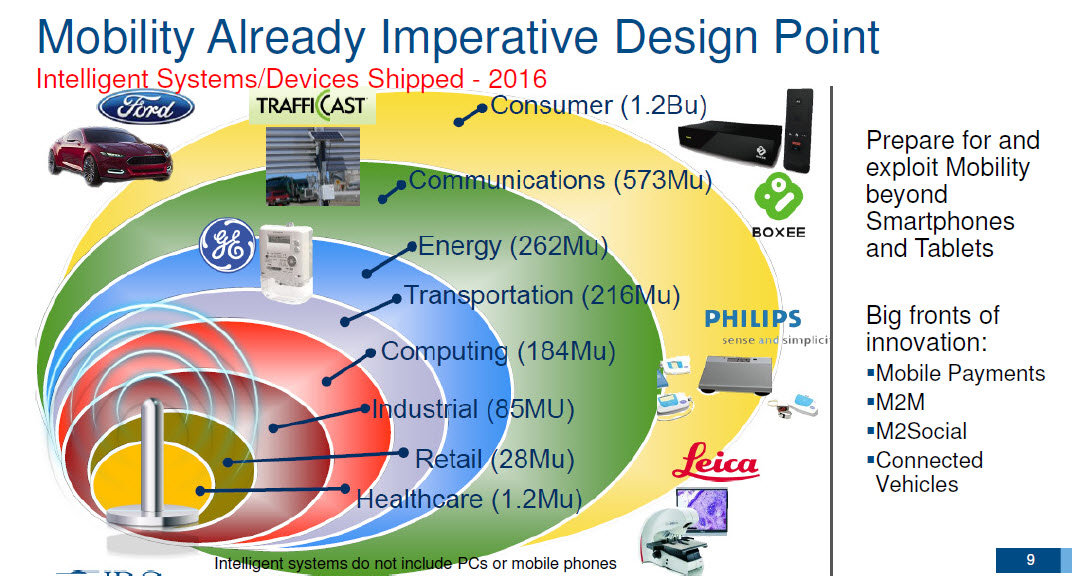
  • IDC’s prediction of how mobility will drive intelligent systems adoption, in addition to device management research on smartphone and tablet adoption is covered in the presentation, The Mobility Game Changer; Why The Workplace Will Never Be The Same. The following graphic shows IDC”s forecast of mobile-based intelligent device shipments by market and industry.

mobility analysis

Mobile App Store Forecasts

  •  90% of global mobile app store downloads in 2013 are forecast to be free, increasing to 93% in 2017.  73.2B free downloads will occur in 2013, increasing to 287.9B by 2017.  Paid-for downloads will increase from 8.1B in 2013 to 21.6B in 2017.  Source: Gartner Market Trends: Mobile App Stores, Worldwide, 2012.
  • In-app purchase will drive 41% of the store revenue in 2016. While the market is moving toward free and low-priced apps, in-app purchase will increase in both the number of downloads and in the contribution to the store revenue. As a result, we see a shift in user spending from upfront purchases to in-app purchases.   Source: Gartner Report Market Trends: Mobile App Stores, Worldwide, 2012.
  • 99% of the paid-for app store downloads cost less than $3 each. Similar to free apps, lower-priced apps will drive the majority of the downloads. We estimate that apps between $0.99 and $2.99 will account for 87.5% of the paid-for downloads in 2012, up from 86.8% in 2011. That percentage will further increase to 96% by 2016. Source: Gartner Report Market Trends: Mobile App Stores, Worldwide, 2012.
  • Global mobile app store revenue is projected to reach $24.5B in 2013, increasing to $74B in 2017.  Paid-in downloads (69%); in-app purchase (17.3%) and advertising (13.7%) are the three revenue sources in 2013.  In 2017, revenue shifts significantly to paid-for downloads contributing 45.2% of revenue, in-app purchases, 40.9% and advertising, 13.9%.  Source: Gartner Report Market Trends: Mobile App Stores, Worldwide, 2012. 

Five Ways CIOs Can Prepare For The Cloud: Lessons Learned From ServiceNow

ServiceNow2ServiceNow (NYSE:NOW) is a global leader in providing cloud-based services used by enterprises to streamline and automate their IT operations.  They’re known for their expertise in IT Service Management (ITSM), speed of development cycles, and commitment to open source including MongoDB and NoSQL.  ServiceNow also has one of the most enthusiastic, rapidly growing and loyal customer bases in enterprise software.  Matt Schvimmer, VP Product Management at ServiceNow, credits the goal of attaining 100% customer referenceability combined with intensive focus on user experience design as contributing factors to their rapid growth, in addition to continuous feedback cycles they use for capturing and acting on customer feedback.

Update from ServiceNow’s Financial Analyst Day and Knowledge13 

On May 13th they held their Financial Analyst Day at the Aria Resort & Casino in Las Vegas, the same location they hosted Knowledge13, their annual user conference held May 12th through the 16th.  You can download a set of the slides presented at the Financial Analyst Day here, and view videos and presentations from Knowledge 13 here.   ServiceNow executives are calling the next phase of their growth ERP for IT. Both in the Financial Analyst Day presentation and the presentation given by President and CEO Frank Slootman at the Pacific Crest Emerging Technology Summit on February, 13th, this concept is shown.  Below is a slide from the February 13th presentation given at the Summit.  You can download the slide deck from the Pacific Crest Emerging Technology Summit here.

ERP for IT

Five Ways CIOs Can Prepare For The Cloud

HS_Arne_Josefsberg (1)I had the opportunity to catch up with Arne Josefsberg, CTO of ServiceNow during Knowledge13.  He shared insights into how ServiceNow’s core customer base, predominantly CIOs and their IT Departments, are driving greater business value into their organizations using the Service Automation Platform.  Arne mentioned that ServiceNow sees IT Operations Management (ITOM) and Platform-as-a-Service (PaaS) as critical to their growth, in addition to enabling those without programming expertise (ServiceNow calls them Citizen Developers) with intuitive, easily used application development tools.

He also shared lessons learned and five ways CIOs can prepare for the cloud, which are listed below:

  • Adopt Cloud Architectures With An Open Mind And See Them As Business Value Accelerators.  Arne advises CIOs who are considering cloud-based initiatives to concentrate on capturing and communicating business value first, including time-to-market, cost and time savings advantages.  Getting beyond a purely cost-cutting mindset is critical for IT to become a strategic partner with business units.  He says that he’s seeing CIOs gain a greater voice in strategic planning initiatives by clearly defining the business value of cloud-based development while pursuing rapid application development.
  • Taking a leadership position in application development leads to gaining greater influence and involvement in strategic plans and initiatives.  This point galvanizes the entire ServiceNow executive team, they all speak of enabling the Citizen Developer to create new applications on their platform without writing a single line of code.  ServiceNow and their customer base have bonded on this issue of rapid application development.  And watching Fred Luddy, Chief Product Officer of ServiceNow move quickly through application development and deployment scenarios during his keynote showed how deeply engrained this value is in the company’s DNA.
  • CIOs need to realize that their resource and human resource management needs in five years will shift to business transformation away from IT alone.  There is a shortage of IT analysts and professionals who are adept at being business strategists, capable of leading transformational application development.  IT analysts and experts need to be trusted partners with business units, continually moving IT-related barriers out of the way while streamlining new application development.  Arne cited how General Electric is excelling on this dimension, consolidating 17 incident management systems into a single ServiceNow application.  All that was possible because the IT teams at GE are an essential part of business unit operations.
  • CIOs need to move beyond managing IT using cost and efficiency alone and think in terms of opportunity-to-cost instead. Arne’s point is that the most respected and counted-upon CIOs he knows today are either making or have made this transition.  They have moved beyond an IT legacy mentality of managing just to cost or efficiency.  Instead, the CIOs emerging as strategists and core members of the executive team are aligning IT as a core part of their company’s ability to compete.
  • Use cloud architectures and rapid application development to make IT more strategic in scope now.  The companies winning awards at Knowledge13 for their applications showed a common thread of anticipating and acting on the strategic needs of their business quickly, often delivering completed applications ahead of schedule and under budget.

Bottom line: Making IT strategic begins by moving away from the constraints of managing to cost and efficiency metrics alone.  Cloud-based platforms and rapid application development technologies are assisting CIOs and their staffs to be more strategic, less tactical, more responsive and focused on line-of-business needs and requirements first.

Disclosure: ServiceNow paid for travel to Knowledge13.  I’ve never held equity positions in ServiceNow, and they are not a client.