Skip to content

Posts from the ‘2013 cloud computing predictions’ Category

Demystifying Cloud Vendors

cloud-computing landscapeCutting through the hype of cloud vendors starts by evaluating how ready their Cloud Services, enabling technologies and Professional Services are to serve customers today.

That’s one of the key take-aways from a recent webinar I attended titled How Cloud Computing Changes the Vendor Landscape by David Mitchell Smith, VP and Gartner Fellow last week.  The slides are available for download here (Free for download after Gartner registration if you are not a Gartner client).

What made this webinar unique and worth mentioning is the framework that was presented for evaluating vendors.  Beginning with the well-known Infrastructure-as-a-Service (IaaS), Platform-as-a-Service (PaaS) and Software-as-a-Service (SaaS) structure, Gartner added in a Business and Information Systems layer that includes brokerages, management and security.  This is the layer where Gartner says they are seeing enterprise clients most concentrate on emerging technologies.

The cloud vendor landscape is defined by Cloud Services, Professional Services for Consumption, Enabling Technologies and Professional Services for building and running applications.  Green designates a vendor area of emphasis, yellow are those areas serviced by partners and white areas are not addressed by the vendor’s strategy at all.

Using this framework, nine different companies were analyzed including Amazon, Google, HP, IBM, Microsoft, Oracle, Salesforce.com, SAP and VMWare.

  • Microsoft has the most ambitious cloud strategy of the nine companies profiled, and their cloud-first design initiative shows they have faith in Azure performing in the enterprise.  Microsoft Dynamics AX 2012 will first be released on Azure, then on-premise is a case in point. Microsoft is impatient  to move into a subscription model with its evolving cloud platform. Gartner’s analysis of Microsoft’s cloud strategy is shown in the following graphic.

Microsoft Cloud Strategy

  • Oracle is one of the most persistent cloud washers according to Gartner, often bending the definition of cloud computing to align with their strengths.  Their continual efforts to redefine the cloud are also designed to get their formidable customer base to upgrade to the latest generation of their applications.  Of the vendors compared they also have the greatest strength in enabling technologies, evidenced by their Exalogic and Exadata systems, Oracle Linux and Solaris operating systems.

Oracle cloud strategy

  • SAP’s cloud strategy looks to make the most of the large, highly profitable R/3 installed base while partnering with IaaS vendors to build out their cloud platform according to Gartner.  The point was made that of the vendors in the comparison, SAP prioritizes enabling technologies over owning the entire cloud stack as Oracle aspires to.

SAP Summary Chart

Bottom line: If you want to know  the truth about a given cloud vendor evaluate their Cloud Services, Professional Services track record and how well they transform enabling technologies into successful products.  The following graphic provides a summary of the vendors included in the webinar:

Summary Chart

Gartner Predicts Infrastructure Services Will Accelerate Cloud Computing Growth

public cloud computing forecast 2011 - 2016As public cloud computing gains greater adoption across enterprises, there’s an increased level of spending occurring on infrastructure-related services including Infrastructure-as-a-Service(IaaS).  Enterprises are prioritizing how to get cloud platforms integrated with legacy systems to make use of the years of data they have accumulated.  From legacy Enterprise Resource Planning (ERP) to Customer Relationship Management (CRM) systems, integrating legacy systems of record to cloud-based platforms will accelerate through 2016.  I’ve seen this in conversations with resellers and enterprise customers, and this trend is also reflected in Gartner’s latest report on public cloud computing adoption, Forecast Overview: Public Cloud Services, Worldwide, 2011-2016, 4Q12 Update Published: 8 February 2013.  Below are the key take-aways from the report:

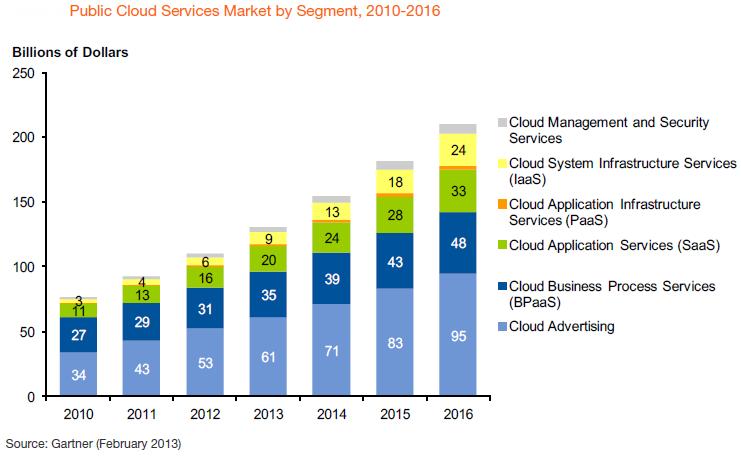
  • Global spending on public cloud services is expected to grow 18.6% in 2012 to $110.3B, achieving a CAGR of 17.7% from 2011 through 2016. The total market is expected to grow from $76.9B in 2010 to $210B in 2016. The following is an analysis of the public cloud services market size and annual growth rates:

Figure 1 Cloud Computing Growth

  • Gartner predicts that Infrastructure-as-a-Service (IaaS) will achieve a compound annual growth rate (CAGR) of 41.3% through 2016, the fastest growing area of public cloud computing the research firm tracks.  The following graphic provides insights into relative market size by each public cloud services market segment:

Figure2

  • Platform-as-a-Service (PaaS) will achieve a 27.7% CAGR through 2016, with Cloud Management and Security Services attaining 26.7% in the same forecast period.  Software-as-a-Service’s CAGR through 2016 is projected to be 19.5%.  The following graphic illustrates the differences in CAGR in the forecast period of 2011 – 2016:

Figure 3

  • Gartner is projecting the SaaS market will grow at a steady CAGR of 19.5% through 2016, having increased the forecast slightly (.4%) since its latest published report.  Global SaaS spending is projected to grow from $13.5B in 2011 to $32.8B in 2016.
  • CRM will continue to be the largest global market within SaaS, forecast to grow beyond $5B in 2012 to $9B in 2016, achieving a 16.3% CAGR through 2016.   The highest growth segments of the SaaS market continue to be office suites (49.1%), followed by digital content creation (34.0%).  The following graphic rank orders CAGRs across all public cloud services segments from the forecast period:

Figure 4

  • 59% of all new spending on cloud computing services originates from North American enterprises, a trend projected to accelerate through 2016.  Western Europe is projected to be 24% of all spending.  A graphic comparing total spending by geography and corresponding growth rates is provided below:

Figure 5

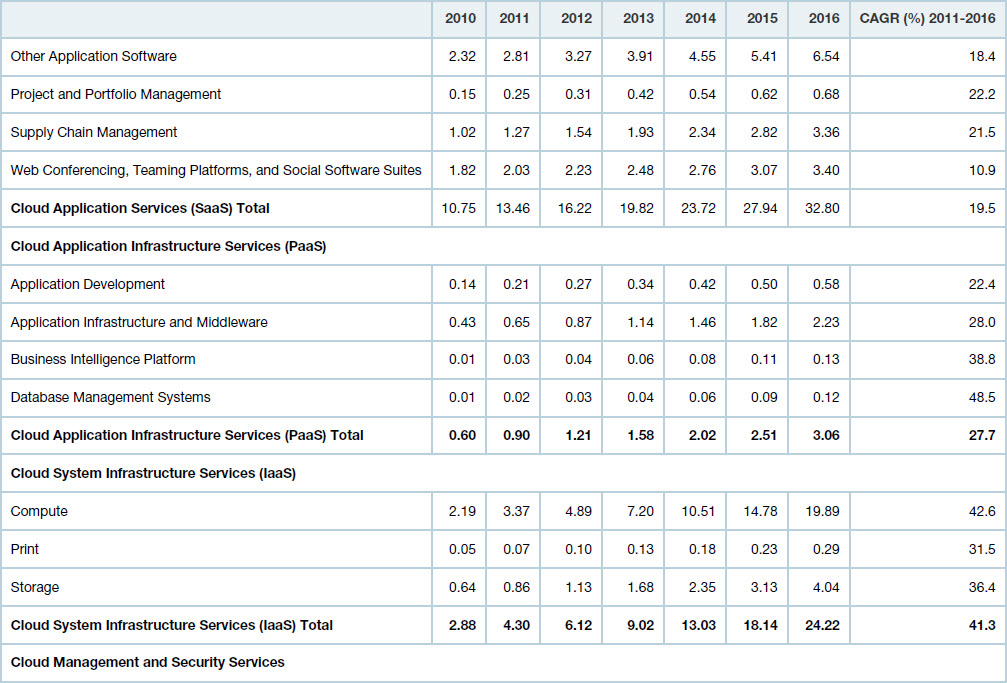
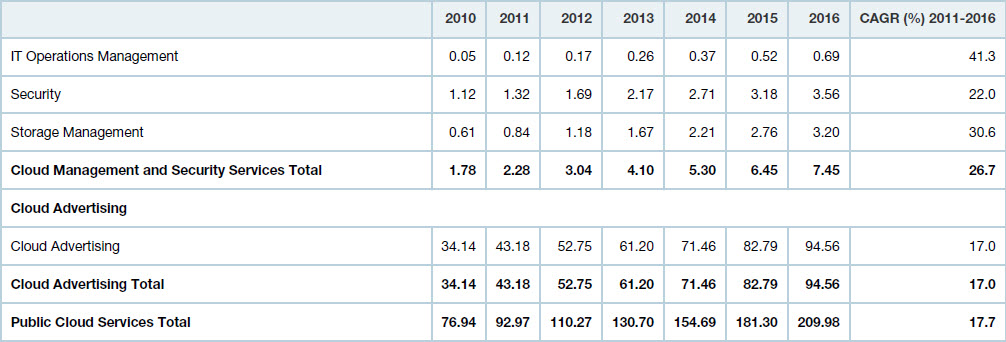
  • The following tables provide insights into each category of public cloud computing spending throughout the forecast period.  Please click on the tables to expand them for easier reading.

Table 1

Table 2

Table 3

Source:  Forecast Overview: Public Cloud Services, Worldwide, 2011-2016, 4Q12 Update Published: 8 February 2013.

Roundup of Cloud Computing & Enterprise Software Market Estimates and Forecasts, 2013

157989221When the CEO of a rust-belt manufacturer speaks of cloud computing as critical to his company’s business strategies for competing globally, it’s clear a fundamental shift is underway.

Nearly every manufacturing company I’ve spoken with in the last ninety days has a mobility roadmap and is also challenged to integrate existing ERP, pricing and fulfillment systems into next-generation selling platforms.

One of the most driven CEOs I’ve met in manufacturing implemented a cloud-based channel management, pricing, quoting and CRM system to manage direct sales and a large distributor network across several countries.  Manufacturers are bringing an entirely new level of pragmatism to cloud computing, quickly deflating its hype by pushing for results on the shop floor.

There’s also been an entirely new series of enterprise software and cloud computing forecasts and market estimates published.  I’ve summarized the key take-aways below:

  • Enterprise sales of ERP systems will grow to $32.9B in 2016, attaining a 6.7% CAGR in the forecast period of 2011 to 2016.   CRM is projected to be an $18.6B global market by 2016, attaining a CAGR of 9.1% from 2011 to 2016.   The fastest growing category of enterprise software will be Web Conferencing and Team, growing at a 12.4% CAGR through the forecast period.  The following graphic compares 2011 actual sales and the latest forecast for 2016 by enterprise software product category.  Source:  Gartner’s Forecast Analysis: Enterprise Application Software, Worldwide, 2011-2016, 4Q12 Update Published: 31 January 2013

Figure 1 enteprise spending

Figure 2

figure 3 cloud computing

 public cloud forecast

Forrester Wave

  • IDC is predicting Cloud Services and enablement spending will hit $60 billion, growing at 26% through the year and that over 80% of new apps will be distributed and deployed on cloud platforms.  Their predictions also are saying that 2.5% of legacy packaged enterprise apps will start migrating to clouds.  Source: Top 10 Predictions, IDC Predictions 2012: Competing for 2020 by Frank Gens. You can download a copy of the IDC Predictions here: http://cdn.idc.com/research/Predictions12/Main/downloads/IDCTOP10Predictions2012.pdf

How Cloud Computing Is Accelerating Context-Aware Coupons, Offers and Promotions

Retailers and marketers often face the challenge of getting coupons, offers and promotions delivered at the perfect time and in the right context to their customers.

The rapid advances in cyber foragingcontextual computing and cloud computing platforms are succeeding at revolutionizing this aspect of the retail shopping experience.  Context-aware advertising platforms and strategies can also provide precise audience and segment-based messaging directly to customers while they are in the store or retail outlet.

What makes context-aware advertising so unique and well adapted to the cloud is the real-time data integration and contextual intelligence they use for tailoring and transmitting offers to customers.  When a customer opts in to retailer’s contextually-based advertising system, they are periodically sent alerts, coupons, and offers on products of interest once they are in or near the store.  Real-time offer engines chose which alerts, coupons or offers to send, when, and in which context.  Cloud-based analytics and predictive modeling applications will be used for further fine-tuning of alerts, coupons and offers as well.  The ROI of each campaign, even to a very specific audience, will be measurable.  Companies investing in cloud-based contextual advertising systems include Apple, Google, Greystripe, Jumptap, Microsoft, Millennial Media, Velti and Yahoo.

Exploring the Framework of Me Marketing and Context-Aware Offers

A few years ago, a student in one of my MBA courses in international marketing did their dissertation on cyber foraging and contextual mobile applications’ potential use for streamlining business travel throughout Europe.  As a network engineer for Cisco at the time, he viewed the world very systemically; instead of getting frustrated with long waits he would dissect the problem and look at the challenges from a system-centric view.  The result was a great dissertation on cyber foraging and the potential use of Near Field Communications (NFC) and Radio Frequency Identification (RFID) as sensors to define contextual location and make business travel easier.  One of the greatest benefits of teaching, even part-time, is the opportunity to learn so much from students.

I’ve been following this area since, and when Gartner published Me Marketing: Get Ready for the Promise of Real-Time, Context-Aware Offers in Consumer Goods this month I immediately read it.  Gartner is defining Me Marketing as real-time, context-aware offers in grocery stores. Given the abundance of data on transactions that occur in grocery stores, Gartner is predicting this will be the most popular and fastest-growing area of context-aware offers.  The formula for Me Marketing is shown below:

The four steps of the Me Marketing formula are briefly described as follows:

Me marketing framework for contextual coupons


  • Consumer Insight and Permission – The first step of the framework and the most difficult from a change management standpoint, this requires customers to opt in to receiving alerts, coupons, offers and promotions.  The best retailers also have invested heavily in security and authentication technologies here too.
  • Delivery Mechanism and In-the-Moment Context – The real-time offer engine is used to determining which coupons, offers and promotions are best suited for a specific customer based on their shopping patterns, preferences and locations.
  • Select Best Offer – Next, the real-time offer engine next defines a very specific product or service offer based on location, previous purchase history, social media analysis, predictive and behavioral analysis, and previous learned patterns of purchasing.
  • Redemption – The purchase of the item offered.  Initial pilots have shown that less frequent yet highly relevant, targeted offers have a higher redemption rate.  It is encouraging to see that early tests of these systems show that spamming customers leads to immediate opt-outs and in some cases shopping competitors.

A Short Overview of Contextual Advertising and the Cloud

Cloud-based systems and applications are necessary for retailers to gain the full value that contextual advertising can provide.  This includes the social context, with specific focus on aggregation and analysis of Social CRM, CRM, and social media content, in addition to behavioral analytics and sentiment analysis.  It also includes the previous browsing, purchasing, returns and prices paid by product for each customer.  Cloud-based integration architectures are necessary for making contextual advertising a reality in several hundred or even thousands of retail stores at the same time.

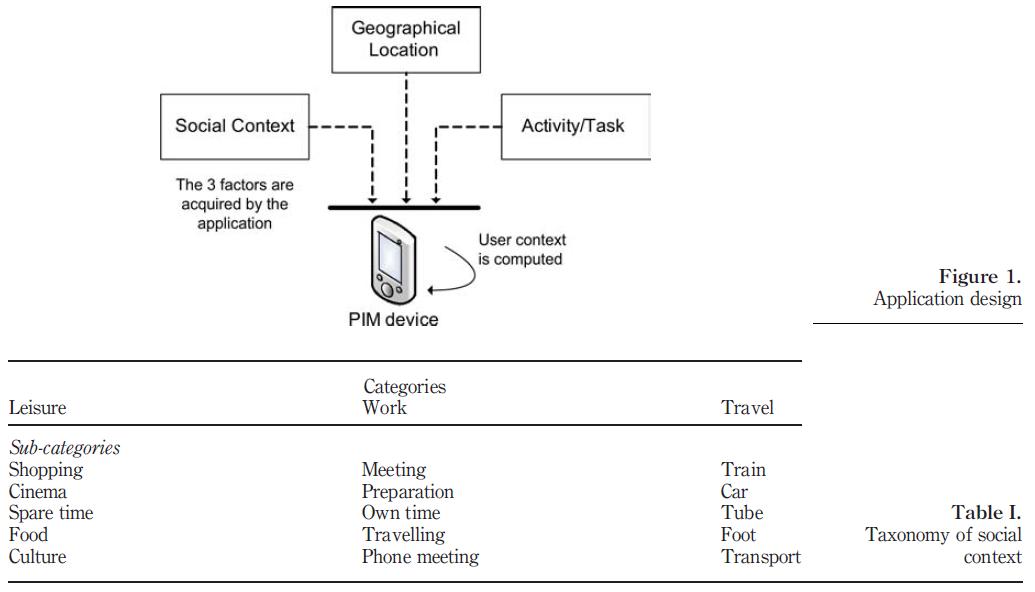
Geographical data and analysis is also essential.  RFID has often been included in cyber foraging and contextual advertising pilots, in addition to NFC.  As Global Positioning System (GPS) chip sets have dropped in price and become more accurate, companies including Google, Microsoft and Yahoo are basing their contextual advertising platforms on them.  Finally the activity or task also needs to have a contextual definition.

Combining all three of these elements gives the context of the customer in the retail store.  The figure below is from Three-Dimensional Context-Aware Tailoring of Information.  This study also took into account how personas are used by companies building cloud-based contextual advertising systems.  The taxonomies shown in the figure are used for building personas of customers.

context aware technology

There are many pilot projects and enterprise-wide system tests going on right now in the area of cloud-based contextual advertising.  One of the more interesting is an application suite created entirely on Google App Engine, Android, and Cloud Services.  The pilot is explained in the study Exploring Solutions for Mobile Companionship: A Design Research Approach to Context-Aware Management.  The following figure shows a diagram of the suite.  This pilot uses Cloud to Device Messaging (C2DM) which is part of the Android API to link the Google App Engine server and Android client.  Google will most likely add more depth of support for C2DM as it plays a critical role in contextual system development.

context aware Google Ad Platform

Benefits of a Cloud-based Contextual Advertising Platform

For the customer, cloud-based advertising systems over time will learn their preferences and eventually impact the demand planning and forecasting systems of retailers.  This translates into the customer-centric benefits of products being out of stock less.  In addition, customers will receive more relevant offers.  The entire shopping experience will be more pleasant with expectations being met more often.

For the retailer, better management of product categories and more effective gross margin growth will be possible. Having real-time analytics of each coupon, offer and promotion will also give them immediate insights into which of their selling strategies are working or not.

For the manufacturer, the opportunity to finally understand how customers respond at the store level to promotions, programs including the results of co-op funds investment and pricing strategies will be known.  The manufacturers who partner with retailers using these systems will also have the chance at attaining greater product differentiation as their coupons, offers and promotions will only go to the most relevant customers.

References:

Me Marketing: Get Ready for the Promise of Real-Time, Context-Aware Offers in Consumer Goods Published: 24 December 2012 Analyst(s): Don Scheibenreif, Dale Hagemeyer

Tor-Morten Grønli, Ghinea, G., & Bygstad, B. (2013). Exploring Solutions for Mobile Companionship: A Design Research Approach to Context-Aware Management. International Journal of Information Management, 33(1), 227. http://www.sciencedirect.com/science/article/pii/S0268401212001259

Tor-Morten Grønli, & Ghinea, G. (2010). Three-Dimensional Context-Aware Tailoring of Information. Online Information Review, 34(6), 892-906. http://www.emeraldinsight.com/journals.htm?articleid=1896452

First Steps to Creating a Cloud Computing Strategy for 2013

Cloud computing strategy 2013 will be one of the most pivotal years for cloud computing because trust in these technologies is on the line.

Expectations are high regarding these technologies’ ability to deliver business value while reducing operating costs.  Enterprises’ experiences have at times met these high expectations, yet too often are getting mixed results.  Managing cloud expectations at the C-level is quickly emerging as one of the most valuable skills in 2013. The best CIOs at this are business strategists who regularly review with their line-of-business counterparts what is and isn’t working.  These CIOs who are excelling as strategists also are creating and continually evaluating their cloud computing plans for 2013.  They are focusing on plans that capitalize the best of what cloud computing has to offer, while minimizing risks.

CIOs excelling as strategists are also using cloud computing planning to punch through the hype and make cloud technologies real from a customer, supplier and internal efficiency standpoint.  Lessons learned from these cloud computing planning efforts in enterprises are provided below:

  • Cloud computing needs to mature more to take on all enterprise applications, so plan for a hybrid IT architecture that provides both agility and security.  This is a common concern among CIOs in the manufacturing and financial services industries especially.  As much as the speed of deployment, customization and subscription-based models attract enterprises to the cloud, the difficult problems of security, legacy system integration, and licensing slow its adoption.  There is not enough trust in the cloud yet to move the entire IT infrastructure there in the majority of manufacturing companies I’ve spoken with.
  • Reorganizing IT to deliver greater business agility and support of key business initiatives will be a high priority in 2013.  The gauntlet has been thrown at the feet of many CIOs this year: become more strategic and help the business grow now.  Cloud is part of this, yet not its primary catalyst, the need to increase sales is.  IT organizations will increasingly reflect a more service-driven, not technology-based approach to delivering information and intelligence to the enterprise as a result.
  • Recruiting, training and retaining cloud architects, developers, engineers, support and service professionals will be a challenge even for the largest enterprises.  There isn’t enough talent to go around for all the projects going on and planned right now.  State Farm Insurance has 1,000 software engineers working on their mobility applications for claims processing and quoting for example.  And they are hiring more.  Certifications in cloud technologies are going to be worth at least a 30 to 50% increase in salary in specific positions. This is very good news for engineers who want to differentiate themselves and get ahead in their careers, both financially and from a management standpoint.
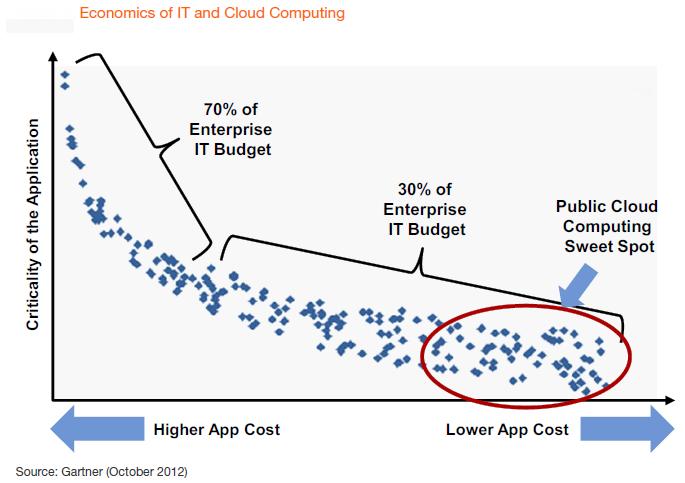
  • Measuring the contributions of operating expense (OPEX) reductions is going to become commonplace in 2013.  From the cloud computing plans I’ve seen, OPEX is being tracked with greater accuracy than in any other year and will be a strong focus in the future.  The capital expense (CAPEX) savings are clear, yet OPEX savings in many cases aren’t. Cloud computing’s greatest wins in the enterprise continue to be in non-mission critical areas of the business.  This is changing as cloud-based ERP systems gain adoption within businesses who are constrained by monolithic ERP systems from decades ago.  Plex Systems is a leader in this area and one to watch if you are interested in this area of enterprise software.  SaaS is dominating in the area of lower application costs and high user counts, which is the Public Computing Sweet Spot in the following graphic:

Figure 1 Cloud Computing Planning Guide

Source: 2013 Cloud Computing Planning Guide: Rising Expectations Published: 1 November 2012 Analysts: Drue Reeves, Kyle Hilgendorf

  • Start building a SaaS application review framework including Service Level Agreement (SLA) benchmarks to drive greater transparency by vendors.  Gartner forecasts that the SaaS-based cloud market will grow from $12.1B in 2013 to$21.3B in 2015, with the primary growth factors being ease of customization and speed of deployment. CIOs and their staffs have SaaS frameworks already in place, often with specific levels of performance defined including security and multitenancy audits.  SLAs are going to be a challenge however as many vendors are inflexible and will not negotiate them. At a minimum make sure cloud service providers and cloud management platforms (CMP) have certifications for ISO 27001 and Statements on Standards for Attestation Engagements (SSAE) No. 16, as this shows the provider is making investments in availability, security and performance levels.
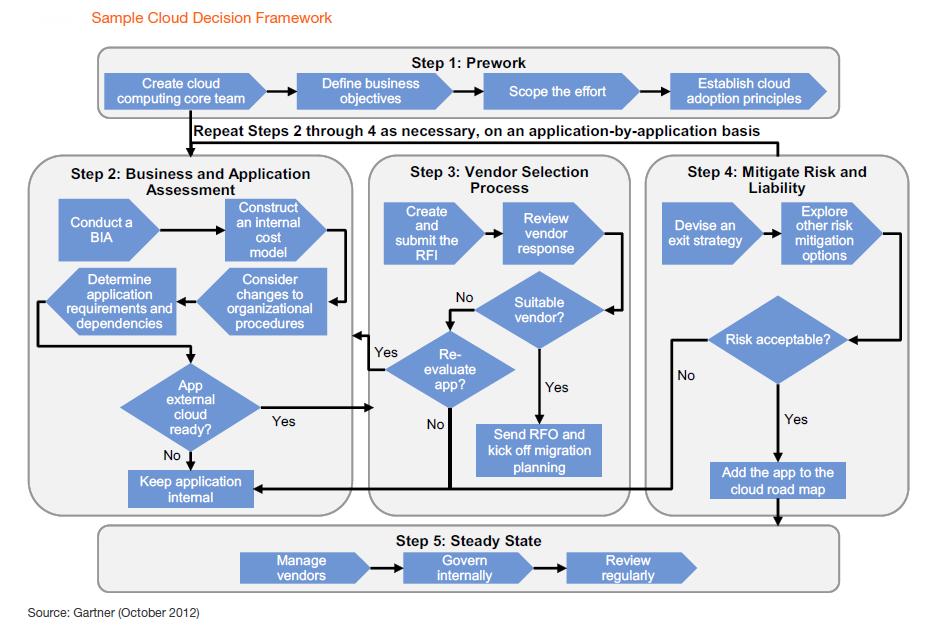
  • Create a Cloud Decision Framework to keep technology evaluations and investments aligned with business strategies.  Business and application assessments and the vendor selection process need to take into account application requirements, role of external cloud resources, and how the RFI will be structured. These process areas will vary by type of company – yet concentrating in application requirements goes a long way to reducing confusion and forcing trade-offs in the middle of a review cycle.  The following is an example of a Cloud Decision Framework:

Figure 2 Sample Cloud Decision Framework

Source: 2013 Cloud Computing Planning Guide: Rising Expectations Published: 1 November 2012 Analysts: Drue Reeves, Kyle Hilgendorf

  • Mitigating risk and liability through intensive due diligence needs to become any cloud-based companies’ core strength.  Regardless of how the HP-Autonomy litigation is resolved it is a powerful cautionary tale of the need for due diligence.  And let’s face it: there are way too many SaaS companies chasing too few dollars in the niche areas of enterprise software today.  A shakeout is on the way, the market just can’t sustain so many vendors.  To reduce risk and liability, ask to see the financial statements (especially if the vendor is private), get references and visit them, meet with engineering to determine how real the product roadmap is, and require an SLA.  Anyone selling software on SaaS will also have revenue recognition issues too, be sure to thoroughly understand how they are accounting for sales.
  • Design in security management at the cloud platform level, including auditing and access control by role in the organization.  One manufacturing company I’ve been working with has defined security at this level and has been able to quickly evaluate SaaS-based manufacturing, pricing and services systems by their security integration compatibility.  This has saved thousands of dollars in security-based customizations to meet the manufactures’ corporate standards.

Bottom line: 2013 is the make-or-break year for cloud in the enterprise, and getting started on a plan will help your organization quickly cut through the hype and see which providers can deliver value.